中国空间站 On currently on 24th to 26th December 2021 Christmas eve, CNSA –China National Space Administrationin collaboration with CCTV9 China Central Radio and Television will telecast “Our Journey” is the first panoramic documentary produced by China National Space Administration and China Central Radio and Television in 4 years to show the complete course of China’s lunar exploration project in 17 years . It is a documentary . Documentary works with international vision, international expression, and international standards are excellent works that tell Chinese stories, spread space culture, and popularize space knowledge
The documentary consists of three episodes, each of 50 minutes, which truly presents the development of China’s lunar exploration project over the past 17 years, which has been through ups and downs, and left a tortuous but full history. This imprint records not only a huge and complicated super project, but also a testimony to the rapid growth of China’s aerospace industry and the common progress of the Chinese nation. The film fully and vividly interprets the spirit of lunar exploration of “chasing dreams, exploring courageously, coordinating fortifications, and win-win cooperation” , promotes the spiritual pedigree of the Chinese Communists , and conveys the spiritual power that China’s scientific and technological development and progress rely on.
Through character interviews, important development scenarios, and the combined application of various methods such as related materials, the film outlines the continuous and staggered cooperation and support between the various development units of the major systems, and demonstrates the Chinese people’s fearlessness in scientific exploration. Pursuit, as well as the admirable courage and wisdom devoted to this journey full of risks and challenges.
“Our journey” documentary will be held December 24 – the 26th in the Central Radio and Television CCTV-9 record channel 20:00 prime time heavy launch a new media center video, CCTV and other platforms will also be broadcast simultaneously.
One year ago today 24th November 2020 Now it’s the 24th November 2021 , the Chang Zheng – Long March Five Carrier Rocket Launched away in CNSA – China National Space Administration China Wenchang spaceport launch, Change Five Lunar probe into orbit, opened up towards China – People’s Republic of China’s first celestial bodies sample return trip from Mons Rumker on the Lunar Surface.……
At 23:10 on December 3, 2020, the Chang’e-5 ascender carried a lunar sample to take off from the lunar surface. About 6 minutes later, it entered an elliptical orbit around the moon. At 2:13 on December 6, the ascender accurately reached the scheduled “handover” position 50 kilometers in front of the orbit-return assembly and about 10 kilometers above it. At 5:42, the ascender and the orbit-returning assembly completed the rendezvous and docking. At 6 o’clock, the sample packaging container was transferred from the ascender to the returner. This process of autonomous rendezvous and docking and sample transfer is like the handover process in a 100-meter relay race. It is brilliant and highly technical. Using a lunar orbital rendezvous and docking after take-off from the lunar surface, rather than a direct lunar-to-ground transfer after taking off from the lunar surface, this design is conducive to collecting and carrying more samples back to the earth, and for technical accumulation and verification for subsequent missions.
Aspect 1-chase in space
Both the ascender and the orbit-back assembly fly around the moon, but the orbital heights are different. The ascender runs on the outer track at a height of 210 kilometers, and the orbit-back assembly runs on the inner track at a height of 200 kilometers. The distance on the inner track is short, the track-back assembly runs slightly faster, and the ascender on the outer track runs slower. In order to realize the “transfer bar”, the rail-back assembly needs to raise the rail in the height direction and gradually approach the ascender in the front and rear direction. When approaching a certain distance, the orbit-back assembly will autonomously control the engine to change the direction of travel and take a shortcut to catch up with the ascender. During the entire chase process, multiple anchor points are set up, and the orbit-return assembly stops to keep the relative position unchanged, conducts a state inspection, and ensures that the measurement and control conditions meet the requirements during docking.
Picture: Lunar orbital rendezvous and docking flight phase division. (Source: Xu Yang, Ma Lin, Liu Tao, etc. Chang’e 5 Lunar Orbital Rendezvous and Docking Guidance, Navigation and Control System. Science in China: Technological Sciences, 2021, 51: 788–798)
Aspect 2-“High-precision measurement” + “Know yourself and the enemy”
During the rendezvous and docking process, it is necessary to make the orbit-return assembly and the ascender know the relative position, speed and attitude of each other. For this reason, a variety of sensors for relative measurement are configured to realize relative navigation. When the distance is 100 kilometers, the microwave radar starts to work. It not only provides the relative motion parameters of the two devices according to the traditional radar “call and answer” mode, but also upgrades to the “dialogue exchange” mode, between the orbital assembly and the ascender. Two-way transmission of remote control commands and telemetry parameters. At a distance of 20 kilometers, lidar “comes on the scene” to provide higher-precision measurement information. At about 100 meters, the optical sensor began to show its talents to achieve close distance and attitude measurement. These sensors are relayed to each other over the working distance and covered and connected, so as to ensure that there are at least two different systems of sensors available at any distance, so that the orbit-back assembly can be seen more accurately, the measurement is more precise, and the system is more reliable.
Aspect 3-precise “handover baton” from 380,000 kilometers away
The weight of the orbit-return assembly is more than 2 tons, but the mass of the ascender is only one-sixth of its mass. If the traditional collision docking is used, it is very easy to cause the ascender to be knocked into flight. For this reason, a claw-type catching and docking mechanism is specially designed. Each pair of claws is like two arms, which are quickly closed within 1 second to form a closed space, and the passive lock handle of the ascender is firmly restrained inside. Can’t escape. It has to be accurate, and the accuracy requirement after docking is better than 0.5 mm, which is like “threading a needle” in space. The use of 3 sets of claw mechanism star-shaped circumferential layout and self-centering design realizes the automatic centering of the two aircraft after docking, and realizes the lightweight design while ensuring high-precision docking.
The design of the transfer mechanism is also very clever. In order to realize the transfer of long-stroke sample containers of more than six hundred millimeters, the designers found inspiration from the inchworm. Based on the principle of movement stroke amplification + relay transfer, they proposed a relay mechanism for imitating the inchworm. The simple circular expansion and contraction movement of the parallel link can realize the continuous movement of the object. The entire transfer process is like the movement of a caterpillar, stretching and shrinking, continuously advancing.
On 2nd December 2021 In a Newest Runway December 2021, the Hong Kong Airport Authority- Hong Kong International Airport- Hong Kong International Airport City ….. introducing 香港國際機場Hong Kong International Airport. – Hong Kong International Airport City newest operational third runway in which a new re-designation of three runways …. As another major Three-runway System milestone, we have re-designated the existing North Runway (07L/25R) at #HKIA as the Centre Runway (07C/25C)!
This morning, we closed the original North Runway for the final re-designation procedures, which included updating the runway designation markings, and the mandatory 07L and 25R instruction markings on the runway and taxiways, which are now 07C and 25C respectively. We have also refreshed movement area guidance signs on the airfield, as well as relevant equipment and procedures for our air traffic control and airport operations control systems.
The Third Runway, which will be in operation in 2022, will be designated as the new North Runway (07L/25R).
The works of expanding Hong Kong International Airport into a three runway system are ongoing As the Third Runway will be commission in 2022, the North Runway needs to be re-designated as the Centre Runway as 07L/25R to 07C/25C ….. Before re-designation Manuals and documents updates, also systems testing with New Signage Preparation ….
On the 1st December 2021, on 2345 Hong Kong SAR- Beijing time Briefing before re-designation works, on 2nd December 2021 0000 Hong Kong SAR-Beijing time the North Runway Closes for the replacements moment area guidance signs with new runway markings in with inspection by relevant parties among that with updating various systems … On the Same day 2nd December 2021 0635 morning Hong Kong SAR- Beijing time… it was the final runway inspection …. The Centre runway in operation the first aircraft lands, following the first commercial flight lands at the same day at 1009 Hong Kong SAR- Beijing time, The Runway re-designation signifies a milestones in the Three runway systems project
On September 7, 2021, the Hong Kong Airport Authority held the completion ceremony of the third runway paving project, marking an important milestone in the three-runway system project of Hong Kong International Airport. The other major three-runway system facilities of the project include the expansion of the second passenger terminal, the construction of the T2 passenger corridor, the new passenger rapid transit system and the high-speed baggage handling system, etc., which are scheduled to be completed in 2024. In the future, Hong Kong International Airport will make every effort to turn a city airport into an airport city, improve airport transportation facilities, provide diversified travel services, and create a convenient and comfortable travel experience for passengers…..
In addition to the runway re-designation, other preparation work for the targeted commissioning of the Third Runway in 2022 will include exercises, drills, trials and documentation work. Thereafter the Centre Runway will be closed for reconfiguration, conducted in parallel with other works of the 3RS project, with the target of completing the construction of the 3RS in 2024 as planned.
Located in the Heart of Hong Kong central of Victoria Harbour in which locate looking at the iconic Megatroplis HongKong Island city landscape from the opposite is the Hong Kong Space Museum 香港太空館 in which located at 10 Salisbury Road, Tsim Sha Tsui, Kowloon, Hong Kong SAR, China –People’s Republic of China.. in which is one of the most international iconic buildings architecturally due to its hemispheric round dome in which is iconic known as one of Hong Kong’s local most cherish bread pastries the Pineapple Bun – Bolo Bao due to the pineapple ceramic texturing tiles of the dome structure that resembles the delicious texturing of the Pineapple Bun .. In which on In June 2014, the Hong Kong Government listed the pineapple bun as a part of Hong Kong’s intangible cultural heritage. … Despite the name, it does not traditionally contain pineapple; rather, the name refers to the look of the characteristic topping (which resembles the texture of a pineapple)……
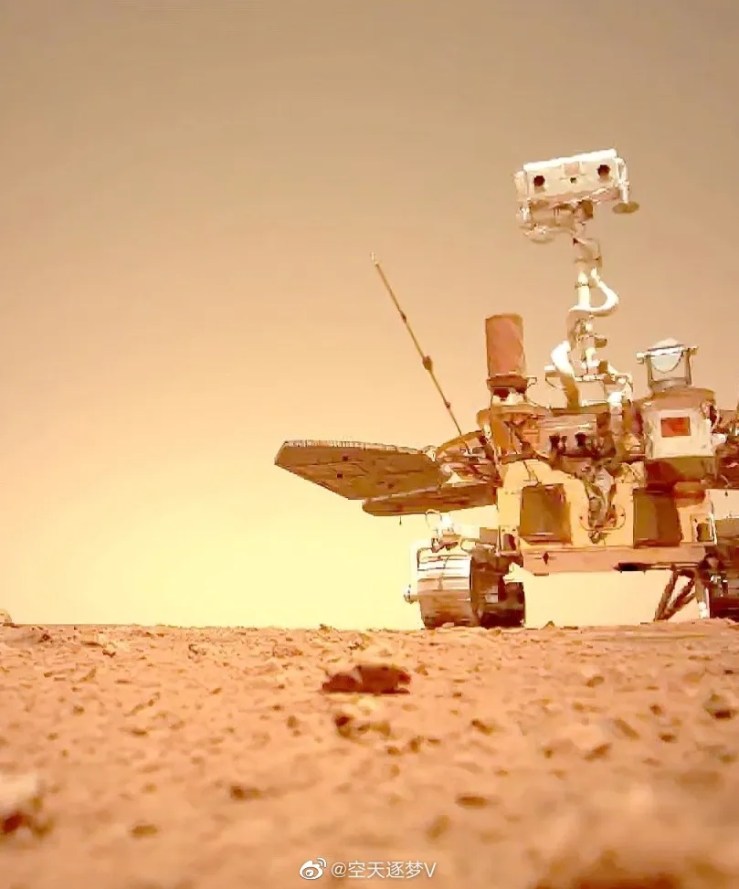
On the 20th November 2021 Saturday – 1330 to 1530 Hong Kong SAR- Beijing Time One of leading international Iconic Planetarium Space Museums 香港太空館Hong Kong Space Museum spoken in Chinese – Cantonese –Guangdong Dialect .. live streaming in one of its Auditorium in which Hong Kong SAR Space Program thorough outs it’s Universities collaborated in China- People’s Republic of China’s first most Challenging Mars Mission in which China’s CNSA –China National Space Administration skill set far out weight NASA’s Mar Missions current and past.. . In One of Hong Kong SAR Universities, Hong Kong PloyU has contributed the Camera system of Tianwen One’s one of many Camera systems also it’s Mars lander, Zhurong Mars rover, and Mars Orbiter other elementally equiment system…. Speaker: Prof. Yung Kai-leung, BBS (Chair Professor & Associate Head, Department of Industrial and Systems Engineering, The Hong Kong Polytechnic University)
The Tianwen-1, China’s first Mars mission successfully landed on it in May, achieving another extraordinary feat in the recent Chinese Aerospace Industry. This first Mars exploration mission of China is unique that employed novel technology and engineering design and encounters exceptional challenges.
The Tianwen-1, China’s first Mars mission successfully landed on it in May, achieving another extraordinary feat in the recent Chinese Aerospace Industry. This first Mars exploration mission of China is unique that employed novel technology and engineering design and encounters exceptional challenges.
The Mars Landing Surveillance Camera (Mars Camera) is developed mainly by the research team of the Hong Kong Polytechnic University. It is a sophisticated space instrument mounting on the top surface of the lander platform of Tianwen-1, which monitors the landing status, the surrounding environment of the red planet and the operation status of the Zhu Rong rover. The Mars Camera is light in weight, yet strong and durable enough to withstand the huge impact shocks of 6,200 times Earth’s gravity. Moreover, it has to operate under low Martian temperature as well as overcome extreme temperature differences it experienced during its flight. In this lecture, Professor Yung from the Hong Kong Polytechnic University will talk about the challenges of the Mars mission and delineate the contributions of the Hong Kong research team.
On 20th November 2021 Saturday its free tramways ride day for the Hong Kong Tramways 香港電車in which it’s is donated in conjunction of “China Taiping Day” in which Taiping Insurance Hong Kong held the Good life with Taiping Free Ride Day. To in celebrating celebrate the 92nd anniversary of the founding of China Taiping, Taiping Hong Kong on November 20 (Saturday) invited all Hong Kong citizens to ride the tram for free and unlimited times to share the “China Taiping Day”. Taiping Hong Kong insurance hopes to hold this free ride day event to bring more laughter and laughter to the citizens of Hong Kong and cheer the society against the epidemic.
Since taking root in Hong Kong in 1949, Taiping insurance Hong Kong has always actively contributed to the protection of Hong Kong’s social and people’s livelihood development. Since the outbreak of the new Coronavirus epidemic, Taiping insurance Hong Kong has made every effort to help enterprises resume work and production through measures such as donating funds and materials, developing exclusive products for the epidemic, opening a green claim channel, relaxing some medical product claims restrictions, introducing deferred payment measures, and reducing or exempting small and medium-sized enterprises’ rents….
Since 1904 in Already Tomorrow in Hong Kong, the FoundedHong Kong Tramways have always been the benchmark hallmark inspiration of the MTR Corporation,in which it transported countless two hundred passengers per daily, 10.4 Million per year averagely…. Within the Hong Kong Tramway route is the countless untold stories that transited ride throughout tramways system on Hong Kong Island …. The “Ding-Ding” in which iconically called for the stopping signal bell that it makes to signal a stop onto to the various stops in between from west to east side of Hong Kong Island.. in which the Hong Kong Trams have been undergoing many evolutionary changes as it progressively moved with the times in Hong Kong’s untold Tramways stories, in which is like a time machine that collect stories from memorable timeless moments in everyone lives whom travelled within with those historic furnishings also whom watched travelled away as it grew up with the evolution of changing Hong Kong SAR city region of China –People’s Republic of China..