#CNSA #ChinaNationalSpaceAdministration #国家航天局 |#BeltAndRoadinitiative #CLEP #January2022 | #VonKarmanCrater #LunarMission #Change4 #Yutu2 Lunar adventuring- the latest scientific achievements of the Chang’e-4 neutral atom detector… #AstrophysicalJournalLetters…

As of Month of January  2022, The CNSA –China National Space Administration CLEP- China Lunar Exploration Program  Belt and Road Initiative Lunar Mission……Chang’e-4 with Yutu two the Lunar rover still working exploring more than 1003.9 meters on the other side of the moon on the 103 Kilometers Diameter Von Karman Crater in which is least than two length by length fifty five Kilometers Hong Kong –Macau- Zhuhai Bridges …. Working Exploring the Crater on the other side of the Moon Chang’e Luna…. At the moment it’s resting till the next set of adventuring parameters is need..

As of the latest of the Change 4 lunar lander still constant working while Yutu 2 the lunar Rover takes a break after visiting it’ creative lunar rock art forming a Jade Rabbit snacking on lunar Carrot.  The latest scientific achievements of the Chang’e-4 neutral atom detector嫦娥四号中性原子探测仪最新科学成果……

​​As we all know, the earth has a strong global magnetic field. When the solar wind “invades” the earth, a huge protective umbrella, the magnetosphere, will form around the earth, blocking most of the solar wind. Due to the lack of this global magnetic field and dense atmosphere on the moon, the lunar surface is directly exposed to the deep space, and the solar wind and the earth’s wind can directly bombard the lunar surface, producing various effects. The current data from China’s Chang’e, Japan’s Moon Goddess, India’s Chandrayaan-1, and the US Interstellar Boundary Probe show that about 0.1-1% of the solar wind protons in the general area will be scattered by the lunar surface, and 10-20% of the solar wind protons will be scattered with the lunar surface. After the action, it is converted into energy neutral atoms, and most of the remaining will be injected into the lunar soil to produce lunar water. Although the moon does not have a global magnetic field, there are many magnetic anomaly areas scattered on the lunar surface, and the magnetic field strength on the lunar surface is about several hundred nT. It can block part of the solar wind from bombarding the lunar surface, and the reflectivity of solar wind protons increases significantly in large-scale magnetic anomalies. Detecting energy-neutral atoms can reveal the microphysical mechanisms of the interactions between the solar wind, the Earth’s wind and the lunar surface, revealing small-scale features.

Fig. 1 Chang’e-4 landed on the Von Karman crater in the South Pole-Aiken Basin on the far side of the moon. The yellow area is the magnetic anomaly, and the red arrow represents the direction of the solar wind bombarding the lunar surface on the dark side.


On January 3, 2019, Chang’e-4 landed on the Von Karman impact crater in the South Pole-Aiken Basin on the far side of the moon, and the Neutral Atom Detector (ASAN) on the Yutu-2 lunar rover was energy neutral to the lunar surface for the first time on the far side of the moon. Atoms (ENA) make observations. Based on the analysis of the ENA energy spectrum obtained by ASAN from January 11, 2019 to October 12, 2020, the study found that in most lunar days, the ENA differential flux on the morning side is higher than that on the dusk side; The analysis of the observation data of the Atom Detector and the ARTEMIS satellite during the same period found that the differential flux of ENA in different energy ranges on the morning side and the dusk side is positively correlated with the solar wind state parameters such as flux, density and dynamic pressure. This is the first time to calculate the electrostatic potential above the magnetic anomaly using the observation data of neutral atoms on the lunar surface, updating the understanding of the interaction between particles and the magnetic anomaly. The results have extensive reference value for the study of solar wind, terrestrial wind and celestial bodies without atmosphere and global magnetic field (such as asteroids or comets).
 

Fig. 2 The electric field of charge polarization caused by the motion of protons and electrons, the electric field direction is upward. 
The deceleration of solar wind protons is associated with magnetic anomalies.

       The research results were published in Astrophysical Journal Letters, an authoritative magazine in the industry. The first author of the paper is Wang Huizi, a doctoral student in the Interaction Group of the Magnetosphere and the Solar Wind at Shandong University. Zhang Jiang from the Planetary Science Research Group, and the co-authors of the paper are from Japan Aerospace Exploration Agency, Peking University, Space Center of Chinese Academy of Sciences, Institute of Earth Science of Chinese Academy of Sciences, etc.

​​众所周知,地球有着强大的全球磁场,太阳风“入侵”地球时,地球周围会形成一个巨大的保护伞——磁层,阻挡了绝大部分太阳风。而月球由于缺少这种全球磁场和浓密大气,月球表面直接暴露于深空中,太阳风、地球风可以直接轰击月表,产生各种各样的效应。目前来自中国嫦娥、日本月亮女神、印度月船一号以及美国星际边界探测器的数据表明,一般区域大约0.1-1%的太阳风质子会被月表散射,10-20%的太阳风质子与月表作用后转化成能量中性原子,剩下大部分会注入月壤产生月球水。虽然月球没有全球磁场,但在月表散落着多个磁场异常区,在月表磁场强度约几百nT,当太阳风与磁异常相互作用时,也会形成一个小保护伞——微磁层,也可以阻挡一部分太阳风轰击月表,太阳风质子的反射率在大尺度磁异常区明显增加。探测能量中性原子可以揭示太阳风、地球风与月表相互作用的微观物理机制,揭示其中的小尺度特征。

2019年1月3日,嫦娥四号着陆在月球背面南极-艾肯盆地冯•卡门撞击坑,玉兔二号月球车上的中性原子探测仪(ASAN)首次在月球背面对月表能量中性原子(ENA)开展观测。该研究在分析2019年1月11日至2020年10月12日ASAN获取的ENA能谱的基础上,发现大多数月昼中,晨侧ENA微分通量高于昏侧;结合嫦娥四号中性原子探测仪和ARTEMIS卫星同期的观测数据分析发现,晨侧和昏侧不同能量范围的ENA微分通量与太阳风状态参数如通量、密度及动压呈正相关关系。这是首次利用月表中性原子观测数据计算磁异常上方的静电势,更新了粒子与磁异常相互作用的认识。该成果对研究太阳风、地球风与无大气无全球磁场的天体(如小行星或彗星)具有广泛的参考价值。

       该研究成果发表于业内权威杂志Astrophysical Journal Letters,该论文的第一作者是山东大学磁层与太阳风相互作用课题组博士生王慧姿,通讯作者为山东大学磁层与太阳风相互作用课题组长史全岐教授和行星科学课题组张江老师,论文的合作者来自于日本宇宙航空研究开发机构、北京大学、中科院空间中心、中科院地球所等。

Materials provided by: Wang Huizi素材提供:王慧姿

#CNSA #ChinaNationalSpaceAdministration #国家航天局 |#BeltAndRoadinitiative #CLEP #January2022 | #VonKarmanCrater #LunarMission #Change4 #Yutu2 Lunar adventuring #LunaExploration 1003 Meters that #MysteriousHut appears to be Life like #JadeRabbit …

impact craters and “mystery house”

As of Month of January  2022, The CNSA –China National Space Administration CLEP- China Lunar Exploration Program  Belt and Road Initiative Lunar Mission……Chang’e-4 with Yutu two the Lunar rover still working exploring more than 1003.9 meters on the other side of the moon on the 103 Kilometers Diameter Von Karman Crater in which is least than two length by length fifty five Kilometers Hong Kong –Macau- Zhuhai Bridges …. Working Exploring the Crater on the other side of the Moon Chang’e Luna….

In which the cumulative mileage of the Yutu-2 lunar rover exceeded the 1,000-meter mark, revealing the mystery of the “mysterious cabin”] On December 27, 2021, Yutu-2 will wake up and usher in the 38th day of work, and the goal is still to continue heading north . First, the stride Meteor moved three times, 7 meters, 9 meters, and 10 meters. The larger the stride, the total mileage reached 992.3 meters. At this time, there is only about 10 meters left from the “Mystery Cabin”. The mystery of the “hut” was lifted, and the drivers immediately arranged for a panoramic camera to perform color imaging, finally revealing its true appearance!

impact craters and “mystery house”


The “Mysterious Cabin” is like a lifelike rabbit, the scattered stones in front of the “Jade Rabbit” are like a carrot, and the round stone beads behind the “Jade Rabbit” are like the products of the “Jade Rabbit” after a meal. The scene in front of us is like a rabbit about to eat, and the picture is full of fun.

“rabbit” see “rabbit”


At noon on January 6, 2022, the pilots of Yutu No. 2 started the task of the day and afternoon of this month, but everyone worked tirelessly for more than ten hours. Near midnight, the cumulative mileage of Yutu finally broke through the 1,000-meter mark, reaching 1,003.9 meters!
The upcoming January 11, 2022 will be the third anniversary of the Chang’e-4 lander and Yutu-2 completing the mutual shooting of the two vehicles and the complete success of the mission. The latest mileage record is undoubtedly the longest nice gift.

“rabbit” see “rabbit”

Over the past three years, under the precise control of flight controllers, the Chang’e-4 lander, rover, and relay star have completed one arduous task after another, constantly breaking their own records on the way to the back of the moon, and continuing to explore the mysteries of the back of the moon. .
In the next day of the month, Yutu-2 will detect the target rock at close range and perceive the large impact crater behind it. We expect Yutu-2 to make more scientific discoveries.

Images and visuals are from CNSA- China National Space Administration also from there respectives…

#CNSA #ChinaNationalSpaceAdministration #国家航天局 |#BeltAndRoadinitiative #CLEP #December2021 | #VonKarmanCrater #LunarMission #Change4 #Yutu2 Lunar adventuring #LunaExploration The latest achievement of Chang’e-4-Discovery of impact residues of carbonaceous meteorites on the back of the moon, exploring “moon extraneous water”

As of Month of December 2021, The CNSA –China National Space Administration CLEP- China Lunar Exploration Program  Belt and Road Initiative Lunar Mission……Chang’e-4 with Yutu two the Lunar rover still working exploring more than 839.37 meters on the other side of the moon on the 103 Kilometers Diameter Von Karman Crater in which is least than two length by length fifty five Kilometers Hong Kong –Macau- Zhuhai Bridges …. Working Exploring the Crater on the other side of the Moon Chang’e Luna….

Recently, the National Space Science Center, Chinese Academy of Space Weather Liu Yang State Key Laboratory researcher team, joint University of Hawaii, Macau University of Science and Technology, Peking University and Hong Kong Polytechnic University and other domestic and foreign partners to acquire based on Chang E IV Patroller has Ultra-high spatial resolution imagery and spectral data have identified carbonaceous chondrite impactor residues that are less than one million years old in situ on the lunar surface for the first time. The research results are titled “Impact remnants rich in carbonaceous chondrites detected on the Moonby the Chang’e-4 rover” and published in “Nature- Astronomy.

On the ninth day of Chang’e 4 on the far side of the moon, the Yutu-2 lunar rover “ran into” a fresh impact crater with a size of 2 meters, and carried out detailed spectral detection of the impact crater (Figure 1). The detailed analysis of the hyperspectral image data obtained by the imaging spectrometer found that the spectra of the suspected “residue” in the center of the impact crater and the typical lunar soil and rock fragments inside and outside the crater show significantly different characteristics, which are similar to the spectrum of carbonaceous meteorites. Very high degree of similarity. Quantitative inversion results of the spectrum based on the radiation transfer model showed that the mass ratio of the carbonaceous meteorite in the residue reached more than 40%. The results of the numerical simulation of the impact crater show that a 15cm diameter loose impactor hitting the lunar surface at a speed of 15km/s (the typical impactor speed of the lunar surface) can form the small impact crater morphology observed above. And there are residues distributed in the center of the impact crater. 

      The study of impact residues will provide an important reference for the origin of lunar water and the evolution history of the composition and type of impact bodies in the Earth-Moon system. It is also expected to further constrain the evolution of the solar system’s orbital dynamics and enhance our understanding of the impact history of the inner solar system.

     Studies have shown that the impact of carbonaceous asteroids rich in volatile matter may still provide water for the current moon, and it is believed that carbonaceous asteroids may be a common type of impactor in the current Earth-Moon system, supporting the type of impactor in the inner solar system from early The main change from ordinary chondrites to later carbonaceous chondrites. By analyzing possible impactor residues in the young moon samples of Chang’e-5, further scientific verification can be carried out.


Source: Researcher Liu Yang’s team at the State Key Laboratory of Space Weather, National Space Science Center, Chinese Academy of Sciences​​​​

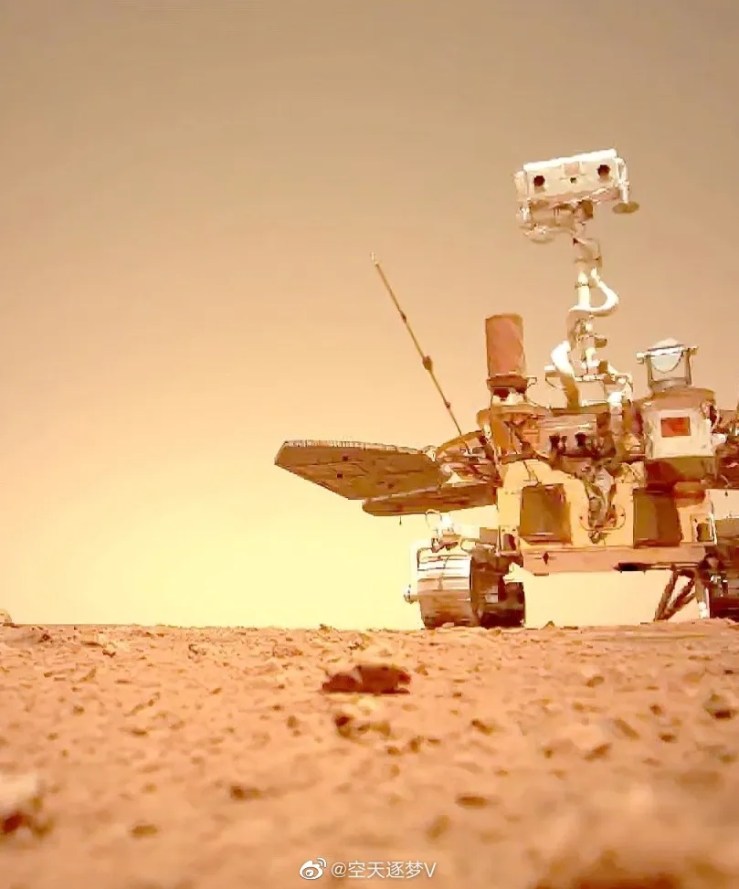
#AlreadyTomorrowInHongKong #香港| #香港太空館 #HongKongSpaceMuseum #November2021 | #CNSA #ChinaNationalSpaceAdministration #國家航天局 #ChinaMarsMission the Contributions of #HongKong Research Team on Mars Landing Surveillance Camera for #Tianwen1 Mission orbit on the #RedPlanet #Mars#天问一号探测器进入日凌阶段…

Located in the Heart of Hong Kong central of Victoria Harbour in which locate looking at the iconic Megatroplis HongKong Island city landscape from the opposite is the Hong Kong Space Museum  香港太空館 in which located at 10 Salisbury Road, Tsim Sha Tsui, Kowloon, Hong Kong SAR, China –People’s Republic of China..  in which is one of the most international iconic buildings architecturally due to its hemispheric round dome in which is iconic known as one of Hong Kong’s local most cherish bread pastries the Pineapple Bun – Bolo Bao due to the pineapple ceramic texturing tiles of the dome structure that resembles the delicious texturing of the Pineapple Bun .. In which on In June 2014, the Hong Kong Government listed the pineapple bun as a part of Hong Kong’s intangible cultural heritage. … Despite the name, it does not traditionally contain pineapple; rather, the name refers to the look of the characteristic topping (which resembles the texture of a pineapple)……

On the 20th November 2021 Saturday – 1330 to 1530 Hong Kong SAR- Beijing Time  One of leading international Iconic Planetarium Space Museums  香港太空館 Hong Kong Space Museum   spoken in Chinese – Cantonese –Guangdong Dialect .. live streaming in one of its Auditorium in which Hong Kong SAR Space Program thorough outs it’s Universities collaborated in China- People’s Republic of China’s first most Challenging Mars Mission in which China’s CNSA –China National Space Administration  skill set far out weight NASA’s Mar Missions current and past.. . In One of Hong Kong SAR Universities, Hong Kong PloyU has contributed the Camera system of Tianwen One’s one of many Camera systems also it’s Mars lander, Zhurong Mars rover, and Mars Orbiter other elementally equiment system…. Speaker: Prof. Yung Kai-leung, BBS (Chair Professor & Associate Head, Department of Industrial and Systems Engineering, The Hong Kong Polytechnic University)

The Tianwen-1, China’s first Mars mission successfully landed on it in May, achieving another extraordinary feat in the recent Chinese Aerospace Industry. This first Mars exploration mission of China is unique that employed novel technology and engineering design and encounters exceptional challenges.

The Tianwen-1, China’s first Mars mission successfully landed on it in May, achieving another extraordinary feat in the recent Chinese Aerospace Industry. This first Mars exploration mission of China is unique that employed novel technology and engineering design and encounters exceptional challenges.

The Mars Landing Surveillance Camera (Mars Camera) is developed mainly by the research team of the Hong Kong Polytechnic University. It is a sophisticated space instrument mounting on the top surface of the lander platform of Tianwen-1, which monitors the landing status, the surrounding environment of the red planet and the operation status of the Zhu Rong rover. The Mars Camera is light in weight, yet strong and durable enough to withstand the huge impact shocks of 6,200 times Earth’s gravity. Moreover, it has to operate under low Martian temperature as well as overcome extreme temperature differences it experienced during its flight. In this lecture, Professor Yung from the Hong Kong Polytechnic University will talk about the challenges of the Mars mission and delineate the contributions of the Hong Kong research team.

Images and visuals are from CNSA- China National Space Administration also from there respectives..