#CNSA #ChinaNationalSpaceAdministration #国家航天局 |#WenchangSpacecraftLaunchCenter #文昌航天發射場 #BRI #June2024 | #嫦娥六号#Change6 South Pole-Aitken successfully landed Basin #LunarSampleReturnMission #DarksideOfTheMoon …

At 17:27 on May 3rd Friday 2024  Beijing time CNSA –China National Space Administration, the Chang’e-6 probe was successfully launched by the Long March 5 Yao-8 carrier rocket from the Wenchang Space Launch Site in Hainan Province,  China, People’s Republic of China., and accurately entered the Earth-moon transfer orbit. The launch mission was a complete success. The Chang’e-6 probe has embarked on the world’s first return journey for sampling from the far side of the moon. The pre-selected landing and sampling area is the South Pole-Aitken Basin on the far side of the moon.

[Chang’e-6 successfully landed in the South Pole-Aitken Basin on the far side of the moon] According to the National Space Administration, at 06:23:15:861

Beijing time today, the Chang’e-6 lander and ascender combination, supported by the Queqiao-2 relay satellite, successfully landed in the pre-selected landing area of ​​the South Pole-Aitken Basin on the far side of the moon. At 6:09 on June 2, the Chang’e-6 lander and ascender combination began to implement power descent, and the 7500 Newton variable thrust main engine was turned on. During this period, the combination made rapid attitude adjustments and gradually approached the lunar surface. After that, obstacles were automatically detected through the visual autonomous obstacle avoidance system, and a visible light camera was used to select a rough safe point based on the brightness of the lunar surface. It hovered 100 meters above the safe point, and laser three-dimensional scanning was used to take precise photos to detect obstacles on the lunar surface. Finally, the landing point was selected and a slow vertical descent began. When it was about to reach the lunar surface, the engine was shut down, and the buffer system was used to ensure that the combination reached the lunar surface in a free fall manner, and finally landed smoothly in the South Pole-Aitken Basin on the far side of the moon.

According to the China Academy of Space Technology, Chang’e-6 is one of the most complex spacecraft systems developed by China so far. The propulsion subsystem developed by the Sixth Academy provides it with the orbiter propulsion subsystem, lander propulsion subsystem and ascender propulsion subsystem. They are composed of 3 orbit control engines, 74 attitude control engines and more than 200 supporting single units such as tanks, gas cylinders, valves, circuit boxes, pressure sensors, etc. Among them, 1 7500N variable thrust engine is used for a smooth soft landing on the moon, and 2 3000N engines are used for the probe’s near-moon braking “in-orbit braking” and lunar takeoff. With their help, the Chang’e-6 probe can complete a series of “difficult actions” in space on its own .

The payload carried by the Chang’e-6 lander will work as planned and carry out scientific exploration missions. The international payloads of the Chang’e-6 mission, the European Space Agency’s lunar surface negative ion analyzer and the French lunar radon detector, are about to start working, and the Italian laser corner reflector has been deployed.

Since the Chang’e-6 probe was launched into orbit on May 3, 2024, it has successively experienced the processes of earth-moon transfer, near-moon braking, circumlunar flight, landing and descent. The Chang’e-6 probe consists of an orbiter, a returner, a lander and an ascender. On May 30, the lander and ascender combination and the orbiter and returner combination were separated in orbit. After the lander and ascender combination lands successfully, the lander will conduct status checks and settings such as the deployment of solar panels and directional antennas under ground control via the Queqiao-2 relay satellite, and then officially begin sampling work on the far side of the moon, which will last about two days. The lunar soil samples and lunar surface rocks will be collected by drilling with a drill and by using a robotic arm to achieve multi-point and diversified automatic sampling. At the same time, scientific explorations such as on-site investigation and analysis of the landing area on the far side of the moon and analysis of the lunar soil structure will be carried out to deepen the research on the origin and evolution history of the moon.

Images and visuals are from their Respectives CMS China Manned SpaceCNSA-China National Space Administration

#CNSA #ChinaNationalSpaceAdministration #国家航天局 |#WenchangSpacecraftLaunchCenter #文昌航天發射場 #BRI #May2024 | #ChangZheng5  #LongMarch5 Yao 8 launch successfully for #嫦娥六号#Change6 #LunarLander #LunarProbe South Pole-Aitken Basin  #LunarSampleReturnMission #DarksideOfTheMoon …. #ASummary

At 17:27 on May 3rd Friday 2024  Beijing time CNSA –China National Space Administration, the Chang’e-6 probe was successfully launched by the Long March 5 Yao-8 carrier rocket from the Wenchang Space Launch Site in Hainan Province,  China, People’s Republic of China., and accurately entered the Earth-moon transfer orbit. The launch mission was a complete success. The Chang’e-6 probe has embarked on the world’s first return journey for sampling from the far side of the moon. The pre-selected landing and sampling area is the South Pole-Aitken Basin on the far side of the moon.

About 37 minutes after the Long March 5 Yao-8 carrier rocket flew, the rocket separated, sending the Chang’e-6 probe directly into the predetermined Earth-moon transfer orbit with a perigee altitude of 200 kilometers and an apogee altitude of about 380,000 kilometers. The Chang’e-6 probe consists of an orbiter, returner, lander, and ascender. Subsequently, with the support of ground measurement and control and the Queqiao-2 relay satellite, the Chang’e-6 probe will undergo processes such as earth-moon transfer, near-moon braking, orbiting the moon, landing and descent, and soft landing on the lunar surface, and finally reach a pre-selected area on the far side of the moon. Collect lunar surface rock and soil samples, and conduct scientific exploration at the same time. After completing the sampling and packaging, the ascender will take off from the lunar surface, then carry out lunar orbit rendezvous and docking and transfer the samples to the returner; the returner will undergo processes such as moon-to-earth transfer, approaching the second cosmic speed and re-entering the earth, and finally carry precious Lunar samples returned to Earth.

According to reports, the entire process from launch to sample return of the Chang’e-6 mission takes about 53 days. The mission cycle is long, there are many engineering innovations, high risks and difficulties, and each stage is interlocked. Compared with the Chang’e-5 mission that achieved sample return from the front side of the moon in 2020, the Chang’e-6 mission needs to implement the first sample return from the far side of the moon with the support of the Queqiao-2 relay star, breaking through the lunar retrograde orbit design and control, and intelligent and rapid lunar backside Key technologies such as sampling and lunar take-off and ascent. At the same time, the Chang’e-6 mission will carry out scientific explorations such as on-site investigation and analysis of the landing area on the back of the moon, laboratory analysis and research of lunar samples, and deepen the study of the formation and evolution history of the moon.

In addition, the Chang’e-6 mission has carried out pragmatic international cooperation. In April 2019, the National Space Administration released the “Announcement on International Payload Cooperation Opportunities for the Chang’e-6 Mission”. Through the collection and selection of proposals for two batches of international payload carrying projects, the ESA lunar surface negative ion analyzer, There are four international carrying projects including the French Lunar Radon Detector, the Italian Laser Corner Reflector, and the Pakistani CubeSat. Among them, the ESA Lunar Surface Negative Ion Analyzer will detect negative ions on the lunar surface and study the interaction mechanism between plasma and the lunar surface; the French Lunar Radon Detector aims to conduct in-situ detection of radon isotopes on the lunar surface and study volatilization The transmission and diffusion mechanism of objects in the lunar environment; the Italian laser corner reflector plans to use the positioning on the back of the moon to carry out joint ranging and positioning research with other lunar exploration missions; the Pakistani CubeSat will carry out an on-orbit imaging mission to verify the NanoSatelllites moon Orbit detection technology.

On May 3, the CNSA- China National Space Administration held a Chang’e-6 international payload seminar in Haikou. About 50 international friends from 12 national space agencies, embassies in China, including Pakistan, France, and Italy, as well as international organizations such as the United Nations and ESA, gathered in Hainan to discuss cooperation and witness the launch of the Chang’e-6 mission.

The Long March 5 launch vehicle is my country’s first new-generation high-thrust launch vehicle with a core diameter of 5 meters. It has a total length of about 57 meters, a take-off weight of about 870 tons, a take-off thrust of more than 1,000 tons, and a low-Earth orbit carrying capacity of up to 25 tons. The geosynchronous orbit has a carrying capacity of up to 14 tons and completed its first flight in 2016. Due to the constant changes in the relative position of the Earth and the Moon, in order to ensure that the rocket is launched on time, the model team applied the “narrow window multi-orbit” launch technology and designed a total of 10 lunar orbits for the rocket within a 50-minute window for two consecutive days. Improve implementation launch probability and reliability. At the same time, the development team continued to optimize the launch site process, reducing the time it took to launch Chang’e-5 from nearly 60 days to 43 days. This is the 519th launch of the Long March series of launch vehicles.

The lunar exploration project is organized and implemented under the leadership of the National Space Administration. For this Chang’e-6 mission, the overall project was undertaken by the Lunar Exploration and Space Engineering Center of the National Space Administration; the detector and launch vehicle were developed by the Space Technology Research Institute and Launch Vehicle Technology Research Institute of China Aerospace Science and Technology Corporation respectively; the launch The measurement, control and recovery work is jointly completed by China Wenchang Space Launch Site, Beijing Aerospace Flight Control Center, Xi’an Satellite Measurement and Control Center, Yuanwang Survey Ship, Jiuquan Satellite Launch Center and other units; the ground application system is mainly undertaken by the Chinese Academy of Sciences.

Images and visuals are from their Respectives CMS China Manned SpaceCNSA-China National Space Administration

#CNSA #ChinaNationalSpaceAdministration #国家航天局 |#WenchangSpacecraftLaunchCenter #文昌航天發射場 #BRI #April2024 | #ChangZheng5  #LongMarch5 Yao 8 launch readiness for #嫦娥六号#Change6 #LunarLander #LunarProbe South Pole-Aitken Basin  #LunarSampleReturnMission #DarksideOfTheMoon …. #ASummary

On the 15 March 2024 Hour Hong- Kong SAR – Beijing time CNSA –China National Space Administration   ….. the “Chang Zheng -Long March 5” Yao-8 carrier rocket which will carry out the Chang’e-6 mission of the fourth phase of the lunar exploration project, safely arrived at the Wenchang Space Launch Site in China. Subsequently, the rocket will be assembled and tested at the launch site together with the Chang’e-6 probe that arrived in advance. Currently, all participating systems in the launch site area are preparing for the Chang’e-6 mission as planned…..

“Chang Zheng -Long March 5” Yao-8 carrier rocket which will carry out the fourth phase of the lunar exploration project嫦娥六号was safely transported to the Wenchang Space Launch Site in China. Subsequently, the rocket will be assembled and tested at the launch site together with the Chang’e-6 probe that arrived in advance. Currently, all participating systems in the launch site area….

【Complete vertical transfer! Choose the right moment to launch! 】

On April 27th 2024, after the Chang’e-6 probe and the Long March-5 Yao-8 carrier rocket completed relevant work in the technical area at the Wenchang Space Launch Site in China, the vehicle-rocket assembly was transported vertically to the launch area. It is planned to select an opportunity for launch in early May.


After the Chang’e-6 probe and the Long March-5 Yao-8 carrier rocket arrived at the launch site in January and March respectively, they successively completed various preparations such as final assembly and testing. On April 27, the movable launch platform carrying the Long March 5 Yao-8 carrier rocket slowly and safely transferred the rocket assembly from the vertical test factory to the launch area. Subsequent functional inspections, joint tests, propellant filling and other work will be carried out as planned

Mission planning

嫦娥六号 Chang’e-6 plans to conduct systematic and long-term research on samples from the far side of the moon, analyze the structure, physical properties, and material composition of the lunar soil, and strive to obtain updated lunar scientific data [42].

The first scientific goal of Chang’e-6 is to carry out mapping detection and geological background survey of the landing site area, obtain on-site analysis data related to lunar samples , and establish a relationship between on-site detection data and laboratory analysis data. Mainly includes: topography detection of the landing area : description and structural characteristics around the sampling point ; description, size and distribution of impact craters , etc. Material composition detection: material composition characteristics at sampling points; physical characteristics and structure of lunar soil ; temperature gradient detection in the shallow layers of the lunar crust , etc. The second scientific goal is to conduct systematic and long-term laboratory research on the lunar samples returned to high altitudes, to analyze the physical characteristics and structural structure of lunar soil and lunar rocks , mineral and chemical composition, trace elements and isotope composition, and lunar rock formation and evolution. Through the isotope age determination of the process, the interaction between cosmic radiation and solar wind ions and the moon, the space weathering process and environmental evolution process, etc., we will conduct in-depth research on the formation and evolution history of the moon.

The second scientific goal is to conduct systematic and long-term laboratory research on the lunar samples returned to the ground , and analyze the physical properties and structural structure of the lunar soil and lunar rocks, mineral and chemical composition, trace elements and isotope composition , and the formation and evolution of lunar rocks. Isotopes of the process, the interaction between cosmic radiation and solar wind ions and the moon, space weathering processes and environmental evolution processes, etc., to deepen the study of the formation and evolution history of the moon.

To achieve lunar sample return, many technological breakthroughs are needed, such as sample collection technology, lunar surface ascent and takeoff technology, lunar orbit rendezvous and docking technology, etc. Because it is a high-speed return, breakthroughs in re-entry technology are also needed. In terms of sampling, it is not only necessary to collect lunar soil from the lunar surface , but also to drill holes to remove materials of different depths from the lunar soil layer 2 meters below and bring them back to the earth. Therefore, Chang’e 6 will also carry a drilling rig …


Images and visuals are from their Respectives CMS China Manned SpaceCNSA-China National Space Administration

CNSA #ChinaNationalSpaceAdministration #國家航天局 |#BeltAndRoadinitiative #June2022 | #火星 # 天問 #天问一号#TianwenOne #MarsMission #Tianwen1 probe  #祝融号 #ZhuRong #Tianwen1 completes the established scientific exploration mission…

Tianwen-1 completes the established scientific exploration mission

天问一号飞運騎遊達达3亿CNSA – China National Space Administration – ESA – European Space agency Belt and road initiative mars mission…first Mars exploration mission, Tianwen- Martian Probe One ​​​As of June 29, 2022, the Tianwen-1 mission orbiter has been flying normally for 706 days, and has acquired medium-resolution image data covering the entire world of Mars. All scientific payloads have achieved global exploration of Mars. Both the Tianwen-1 mission orbiter and the Mars rover have completed the established scientific exploration missions.

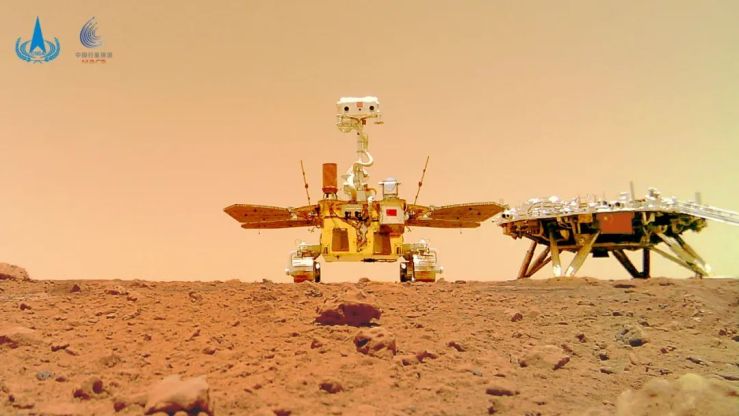
The Tianwen-1 mission was approved by the Party Central Committee in January 2016, and was successfully launched on July 23, 2020. After a deep space flight of 475 million kilometers for 202 days, the probe will rendezvous with Mars on February 10, 2021, and successfully implemented the capture and braking to enter the orbit around Mars. After 3 months of detailed inspection of the pre-selected landing area, the Mars landing was successfully carried out on May 15, 2021. On May 22, the “Zhurong” rover successfully landed on the surface of Mars and began to patrol and explore.

On August 15, 2021, the “Zhurong” rover successfully completed the 90 Martian scientific exploration missions, and continued to carry out extended exploration missions. It has traveled 1,921.5 meters on the surface of Mars. Affected by the severe winter cold and dusty weather in the landing area, the rover will enter the winter dormancy mode on May 18, 2022 as designed. Around December 2022, the “Zhurong” landing area will enter the early spring season. will resume normal work.

The orbiter has circled Mars 1,344 times, achieving global coverage and is currently in normal condition. In the follow-up, it will continue to carry out global remote sensing detection, and choose an opportunity to carry out expansion technology experiments to carry out preliminary technical verification for related tasks.

After nearly two years of flight and exploration for the Tianwen-1 mission, the 13 scientific payloads deployed by the rover and orbiter have obtained a total of about 1040GB of raw scientific data. After receiving and processing on the ground, the standard scientific data products formed are submitted to the rover on a monthly basis. A team of scientists has conducted analysis and interpretation, and relevant scientific results have been published in well-known academic journals at home and abroad. These scientific data will be open to scientists around the world at an appropriate time. Scientists around the world are welcome to actively apply for research and jointly promote the cause of human exploration of the universe.

In the spirit of open and shared cooperation, the National Space Administration actively promotes cooperation with the space agencies and scientific communities of various countries, and shares the orbital data of its Mars orbiter with the National Aeronautics and Space Administration (NASA) and the European Space Agency (ESA) to carry out collision warning. Cooperation; the “Zhurong” Mars rover and the European Space Agency’s “Mars Express” orbiter carry out data relay communication experiments to realize China-Europe Mars scientific data relay cooperation; Observatory stations in other countries use the Tianwen-1 orbiter and the “Mars Express” orbiter to jointly carry out occultation observations of the sun and conduct scientific research such as solar wind. These cooperation have achieved good results, enriched human knowledge, and made positive contributions to the construction of a community with a shared future for mankind in the scientific field.
 

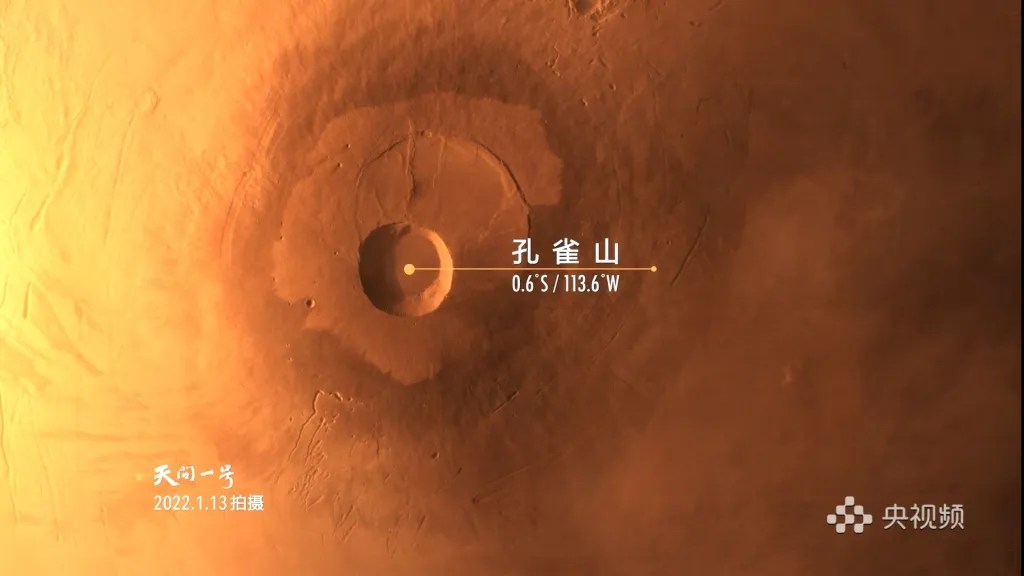
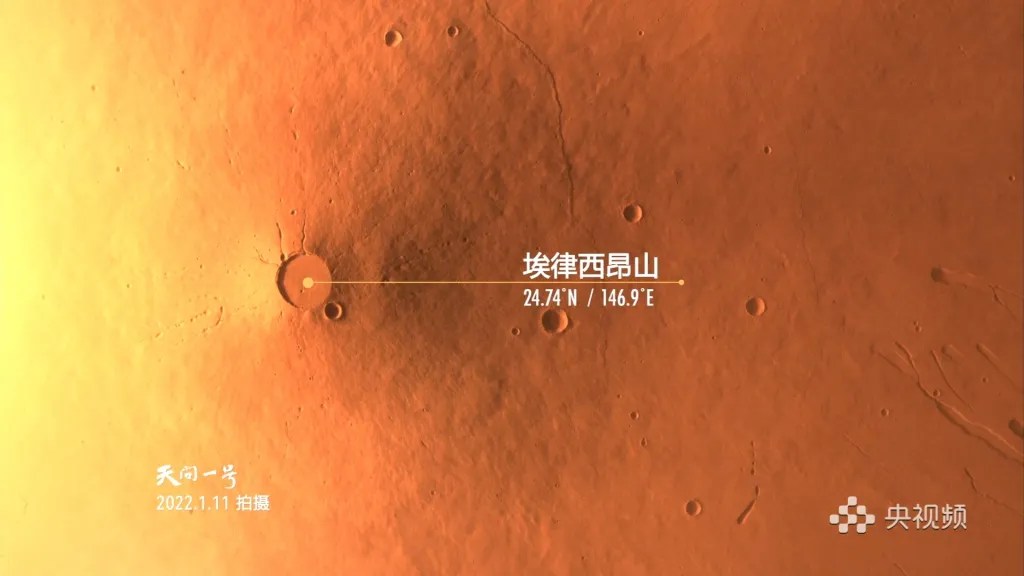
Below is a recent image of Mars taken by Tianwen-1. 

Figure 1 The image of Mount Askela taken by the center camera, with a diameter of 456 kilometers and a height of 18 kilometers , shows the characteristics of the crater on the top of Mount Askela, and there are multiple crater collapse events.
Figure 2 An image of the Antarctic ice sheet taken by the center camera. The image shows the polar cap of the Martian South Pole. The study believes that the long-term and permanent polar cap of the Martian poles is mainly composed of dry ice (solid carbon dioxide) and water ice.

Figure 3 The central point camera captures the western landform image of the Sailor Grand Canyon. The Sailor Grand Canyon extends over 4,000 kilometers from east to west, 150 kilometers to 700 kilometers from north to south , and the deepest can reach 7 kilometers .
Figure 4. The image of the Arabian Highlands impact crater taken by the camera in the middle point. The image shows the geomorphological features of dozens of impact craters distributed in the area.

Figure 5 The image of the edge of the Mond ring crater captured by a high-resolution camera with a spatial resolution of about 0.5 meters and a diameter of about 91 kilometers . The image shows the geomorphological features of the edge of the Mond ring crater. The lower left part of the picture is the inside of the ring crater. The edge of the pit can be seen clearly collapsing into the pit.
Figure 6 The image of the inspection area taken by Zhurong. The image was taken before the rover entered the winter dormancy state, showing the local characteristics of a dune landform in the inspection area.

Images and visuals are from CNSA- China National Space Administration also from there respectives- CLEP –China Lunar Exploration Project..

#CNSA #ChinaNationalSpaceAdministration #國家航天局 |#BeltAndRoadinitiative #May2022 | #火星 # 天問 #天问一号#TianwenOne #MarsMission #Tianwen1 probe  #祝融号 #ZhuRong #Tianwen1 #CCTV #HelloMars Episode Two-  Going to Mars, there is no map and no road signs. What kind of road will #TianwenOne follow…..?

“Hello Mars…!” Episode 2 Going to Mars, there is no map and no road signs. What kind of road will Tianwen-1 follow?

On the months week of  19th May 2022   天问一号飞運騎遊達达3亿CNSA – China National Space Administration – ESA – European Space agency Belt and road initiative mars mission…first Mars exploration mission, Tianwen- Martian Probe One  sent back stunning images of the Half Earth Mass size of the Rustic Planet Mars in which show stunning Martian landscape with its iconic polar caps of either southern or northern … With its timeless Stunning Mars Photography. Tianwen-1″ returned high-resolution images of the Mars inspection area The “Zhurong” rover is preparing for winter, and the orbiter continues to carry out orbital exploration….. in which one year ago it was it’s first landing on Utopia Planitia region on the planet Mars .. in celebrating a CCTV five part Episode was produced..

《你好!火星》Hello Mars Episode Two The content of this issue: At 13:17 on July 23, 2020, the Long March 5 rocket completed its mission and sent the Tianwen-1 probe to the entrance of the ground fire transfer orbit with the result of hitting the bulls eye, and gave it more than one second per second At a flight speed of 11.2 kilometers, Tianwen-1 separated from Fat Five and flew towards the dark deep space. The total weight of the probe is 5 tons. This is the largest probe to Mars in human history. The entry cabin at the front is like a steamed bun, with the landing platform and the rover inside, and the orbiter at the back. On this long journey, it has to fly alone for nearly 7 months, with a distance of nearly 500 million kilometers.

本期内容:2020年7月23日13点17分,长征五号火箭完成了使命,以正中靶心的成绩将天问一号探测器送到地火转移轨道的入口,并赋予它超过每秒11.2公里的飞行速度,天问一号与胖五分离,向着漆黑的深空飞去。探测器总重有5吨,这是人类历史上飞往火星吨位最大的探测器,前部的进入舱如同一个馒头,里面是着陆平台和火星车,后边是环绕器,在这条漫漫征途上,它要孤独地飞行近7个月,路程近5亿公里。

Hello everyone, I would like to tell you some good news about the documentary “Hello!” about China’s first Mars exploration mission. “Mars” is finally on the air, friends who want to know more about Mars can stay in front of the TV tonight

“Hello! “Mars” is a large-scale scientific documentary jointly produced by the National Space Administration and China Central Radio and Television to commemorate the first anniversary of the Tianwen-1 Mars probe’s successful landing on Mars. It took three years to complete the filming and is divided into “Departure” and “Journey” “Surrounding”, “Landing” and “Patrol” have 5 episodes, each of which is 30 minutes long. They focus on the important stages of the Tianwen-1 mission, and describe a large number of astronomy, astrophysics, space applications, aerospace engineering and other disciplines in a simple way. Knowledge, in-depth analysis of Chinese wisdom and Chinese solutions in Mars exploration. Since May 2020, the co-production team has continued to track the key nodes of the Tianwen-1 mission, filmed many wonderful moments, and obtained a large number of first-hand precious materials. Many of the contents of the documentary were made public for the first time and were released authoritatively.


Broadcasting plan CCTV-1 CCTV integrated channel every night at 22:36, five days of continuous broadcast from May 18th to 22nd; CCTV-10 CCTV science and education channel every night at 20:10, from May 19th to 23rd five days of continuous broadcast

大家好,告诉大家一个好消息,讲述中国首次火星探测任务的纪录片《你好!火星》终于要开播啦,想更多了解火星的朋友们今晚可以守在电视机前哟《你好!火星》是为纪念天问一号火星探测器成功着陆火星一周年,由国家航天局和中央广播电视总台联合出品的大型科学纪录片,共历时3年摄制完成,分为《出发》《征途》《环绕》《着陆》《巡视》5集,每集30分钟,分别聚焦天问一号任务的重要阶段,以深入浅出的形式讲述了大量天文学、天体物理学、空间应用学、航天工程学等学科知识,深度解析了火星探索中的中国智慧、中国方案。联合摄制团队自2020年5月起,持续跟踪天问一号任务关键节点,拍摄众多精彩瞬间,获得大量一手珍贵素材,纪录片中很多内容是首次公开,并权威发布。


播出计划CCTV-1央视综合频道 每晚22:36,5月18日至22日五天连播;CCTV-10央视科教频道 每晚20:10,5月️19日至23日五天连播

Images and visuals are from CNSA- China National Space Administration also from there respectives- CLEP –China Lunar Exploration Project..