On the week of 13th December 2022 wondering what the crew of the Shenzhou 15 are doing in which finalisation of the completion of the Tiangong – China Space Station the Takionaut Crew start with a productive new week taking the Dream crew working soothingly after entering orbit? In which how is life in orbit, in which they’re the second crew besides comrades Shenzhou 14 crew living in T Shape China Space Station. Having a brief moment of watching the crew.
On the week of 23rd December 2022 before Christmas Eve Looking at the earth from the space station panorama…… The beautiful picture of the earth and the space station in the same frame….. After the three cabins are combined, the angles of seeing the earth from the space station become more and more diversity. For a long period of time in the future, the Chinese space station will always silently accompany and watch this blue planet and us living on this land. This is a great era of China’s spaceflight, and the story of our space home has just begun…
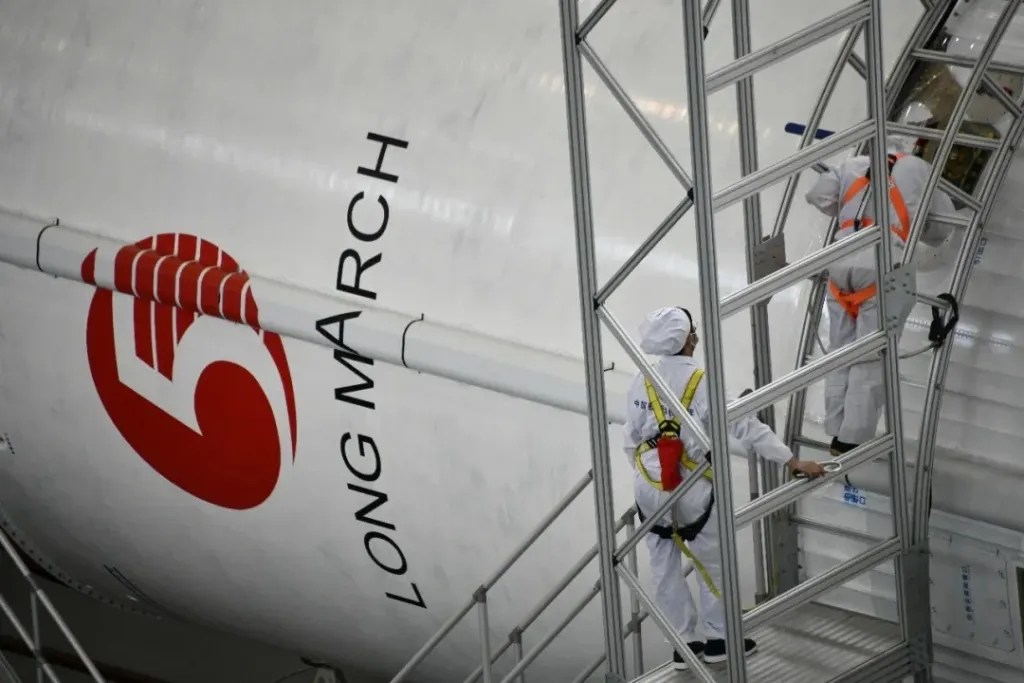
On Hainan Province –China –People’s Republic of China…. in the district area of the Wenchang – Wenchang Spacecraft launch center in which the awesome team at one of many CNSA –China National Space Administration that China National Space Administration…………… On May 29th 2022 The Chang Zheng- Long March 5B Yao three carrier rocket arrived at Wenchang Space Launch Site safely] According to the China Manned Space Engineering Office, the Long March 5B Yao 3 carrier rocket that carried out the launch mission of the Wentian experimental module has completed all the research and development finalisation certification at the Factory also Wenchang Spacecraft Center..
The Expected Countdown towards the Launch of the Chang Zheng- Long March 5 Yao 3 Carrier Rocket in which is 28 Days in between late June –early July 2022 until the Launch towards the China Space Station for the Wentian Experimental module in connecting Strengthen the mission and have the courage to innovate and make breakthroughs! Carefully prepare, organize, and implement carefully to ensure the complete success of the launch mission, and take practical actions to welcome the Party’s 20th National Congress of Victory….
Launch wise of the Chang Zheng –Long March 5 Yao 3 Carrier Rocket .
Location: China Wenchang Space Launch Site 101 Launch Station (WSLS LC101) Mission Rocket: Long March 5 Yiyao-3 Rocket (CZ-5B Y3) Mission Load: Space Station “Wentian” Experimental Module (WT) Launch Window: 2022 estimated launch time in late July, 2022: Afternoon of July 24, 2022 (to be determined)
Previously As of May 2022 both The experimental cabin is progressing smoothly, waiting for the launch The Wentian experimental cabin to be launched in July is ready for finally and the Mengtian experimental cabin is also making corresponding preparations.
After the construction of the China Space Station is completed, the two experimental cabins will be the main working places for astronauts in orbit. In both experimental cabins, space science experiments and technical experiments in the sealed cabin and outside the sealed cabin can be carried out. Both cabins are equipped with The load test cabinet inside the cabin and the load installation platform outside the cabin also provide support and guarantee measures such as information, power supply and heat dissipation, and can carry out experiments in various fields such as space science, space materials, space medicine and space exploration.
The Wentian experimental module is equipped with the same Taikonauts’ living facilities as the core module, including 3 sleeping areas, 1 sanitary area, kitchen and other facilities, which can guarantee the astronauts’ life. It can also work with the core module to support the life of 6 astronauts during the rotation of the two manned spacecraft; in addition, a small robotic arm is also configured, which can be used alone or in combination with the large robotic arm of the core module. , to jointly complete the tasks of Taikonauts leaving the cabin, caring for extravehicular facilities, and patrolling. In addition, the Wentian experimental cabin is also equipped with an astronaut exit airlock. After the space station is completed, the airlock of the Wentian experimental cabin will be As the main airlock cabin for astronauts to leave the cabin, the node cabin of the core cabin is used for other functions at this time, just as a backup; the Wentian experimental cabin also has a backup section for the core cabin to manage and control the assembly. That is to say, when the function of the core module platform fails, it can be switched to the Wentian experimental module to exercise the combined control and management functions, which can improve the reliability of the space station as a whole.
The Mengtian experimental cabin is equipped with a cargo airlock and an outboard deployment test platform. In the future, the scientific test equipment that needs to be installed outside the cabin can be transported to the space station through a cargo spacecraft, and then the load will be sent to the outside of the cabin through the cargo airlock, and the robotic arm or astronaut will install it on the platform outside the cabin. Realize the continuous update of the extravehicular test project.
On a very 24th February 2022 Thursday Morning in Hainan Province –China –People’s Republic of China….showering in the district area of the Wenchang – Wenchang Spacecraft launch center in which the awesome team at one of many CNSA –China National Space Administration that China National Space Administration………….. China’s self-developed newly advance medium-sized carrier rocket, the Long March 8, arrived in Wenchang is the Chang Zheng – Long March 8 Yao Carrier Rocket. In set on planned launching on the late February- Early March 2022 Launching schedule …
This morning, the Chang Zheng Long March 8 Carrier Rocket carried out a vertical transfer – VAB- Vertical Assemble Building at the Wenchang Spacecraft Center…… At present, the slewing launch complex platform has been closed and the transfer has ended successfully. The layers of sea fog can’t hide our enthusiasm, and we look forward to seeing the dawn in three days…!
The China Aerospace’s first Chang Zheng Long March 8 Carrier Rocket will deploy 22 satellites” micro-nano starry sky shoulders C position….. In late February 2022, the Chang Zheng Long March 8 Yao 2 Carrier Rocket will perform the “Chang Zheng Long March 8 Carrier Rocket deploying 22 satellites carpool launch mission at the Hainan Wenchang Launch Center. Satellites from 7 units including Micro-Nano Satellites were sent into a 535-kilometer sun-synchronous orbit. Both the number of launches and the launch weight set a new record for the launch of 20 satellites with one arrow set by the Chang Zheng Long March 6 Carrier Rocket in 2015. This mission is also the wonderful debut of ” Chang Zheng -Long March 8″ as China’s second-type “shared rocket” to perform a domestic commercial carpool launch mission.
The total weight of the satellites launched by the Chang Zheng -Long March 8 Yao-2 Carrier rocket this time is about 1.7 tons. Among them, the five satellites independently developed and manufactured by Micronano Star have a total weight of more than 800kg, which is close to half of the total weight of the 22 satellites launched this time. The absolute master of launch missions is. Among them, “Taijing 3 01” is a 0.5m resolution visible light remote sensing satellite, the weight of the whole satellite is close to 240kg; “Taijing 4 01” is the first domestic X-band commercial microwave remote sensing satellite (SAR satellite), The resolution is better than 1m, and the weight of the satellite is close to 350kg. These two satellites firmly occupy the center position of the satellite launched by Long March 8 this time.
The 5 satellites launched by Micro-Nano Star this time, except for Wenchang-1 01 and 02 satellites, have the same technical status, all other satellites (Taijing 3 01, Taijing 4 01, Xidian 1) No.) technology status is different, four technology status, parallel development, parallel production, one rocket launch, this is a huge challenge for any satellite company’s research and development capabilities, and the micro-nano star is for each satellite. Elaborately designed the research and development process, constantly breaking through technical difficulties, the research and development team was awake at night, gave up the opportunity to reunite with their families during the Spring Festival, and went 3,000 kilometers to the Hainan launch site, demonstrating the leading satellite development capabilities and tough work style in the domestic commercial aerospace field. .
中国空间站 On currently on 24th to 26th December 2021 Christmas eve, CNSA –China National Space Administrationin collaboration with CCTV9 China Central Radio and Television will telecast “Our Journey” is the first panoramic documentary produced by China National Space Administration and China Central Radio and Television in 4 years to show the complete course of China’s lunar exploration project in 17 years . It is a documentary . Documentary works with international vision, international expression, and international standards are excellent works that tell Chinese stories, spread space culture, and popularize space knowledge
The documentary consists of three episodes, each of 50 minutes, which truly presents the development of China’s lunar exploration project over the past 17 years, which has been through ups and downs, and left a tortuous but full history. This imprint records not only a huge and complicated super project, but also a testimony to the rapid growth of China’s aerospace industry and the common progress of the Chinese nation. The film fully and vividly interprets the spirit of lunar exploration of “chasing dreams, exploring courageously, coordinating fortifications, and win-win cooperation” , promotes the spiritual pedigree of the Chinese Communists , and conveys the spiritual power that China’s scientific and technological development and progress rely on.
Through character interviews, important development scenarios, and the combined application of various methods such as related materials, the film outlines the continuous and staggered cooperation and support between the various development units of the major systems, and demonstrates the Chinese people’s fearlessness in scientific exploration. Pursuit, as well as the admirable courage and wisdom devoted to this journey full of risks and challenges.
“Our journey” documentary will be held December 24 – the 26th in the Central Radio and Television CCTV-9 record channel 20:00 prime time heavy launch a new media center video, CCTV and other platforms will also be broadcast simultaneously.
One year ago today 24th November 2020 Now it’s the 24th November 2021 , the Chang Zheng – Long March Five Carrier Rocket Launched away in CNSA – China National Space Administration China Wenchang spaceport launch, Change Five Lunar probe into orbit, opened up towards China – People’s Republic of China’s first celestial bodies sample return trip from Mons Rumker on the Lunar Surface.……
At 23:10 on December 3, 2020, the Chang’e-5 ascender carried a lunar sample to take off from the lunar surface. About 6 minutes later, it entered an elliptical orbit around the moon. At 2:13 on December 6, the ascender accurately reached the scheduled “handover” position 50 kilometers in front of the orbit-return assembly and about 10 kilometers above it. At 5:42, the ascender and the orbit-returning assembly completed the rendezvous and docking. At 6 o’clock, the sample packaging container was transferred from the ascender to the returner. This process of autonomous rendezvous and docking and sample transfer is like the handover process in a 100-meter relay race. It is brilliant and highly technical. Using a lunar orbital rendezvous and docking after take-off from the lunar surface, rather than a direct lunar-to-ground transfer after taking off from the lunar surface, this design is conducive to collecting and carrying more samples back to the earth, and for technical accumulation and verification for subsequent missions.
Aspect 1-chase in space
Both the ascender and the orbit-back assembly fly around the moon, but the orbital heights are different. The ascender runs on the outer track at a height of 210 kilometers, and the orbit-back assembly runs on the inner track at a height of 200 kilometers. The distance on the inner track is short, the track-back assembly runs slightly faster, and the ascender on the outer track runs slower. In order to realize the “transfer bar”, the rail-back assembly needs to raise the rail in the height direction and gradually approach the ascender in the front and rear direction. When approaching a certain distance, the orbit-back assembly will autonomously control the engine to change the direction of travel and take a shortcut to catch up with the ascender. During the entire chase process, multiple anchor points are set up, and the orbit-return assembly stops to keep the relative position unchanged, conducts a state inspection, and ensures that the measurement and control conditions meet the requirements during docking.
Picture: Lunar orbital rendezvous and docking flight phase division. (Source: Xu Yang, Ma Lin, Liu Tao, etc. Chang’e 5 Lunar Orbital Rendezvous and Docking Guidance, Navigation and Control System. Science in China: Technological Sciences, 2021, 51: 788–798)
Aspect 2-“High-precision measurement” + “Know yourself and the enemy”
During the rendezvous and docking process, it is necessary to make the orbit-return assembly and the ascender know the relative position, speed and attitude of each other. For this reason, a variety of sensors for relative measurement are configured to realize relative navigation. When the distance is 100 kilometers, the microwave radar starts to work. It not only provides the relative motion parameters of the two devices according to the traditional radar “call and answer” mode, but also upgrades to the “dialogue exchange” mode, between the orbital assembly and the ascender. Two-way transmission of remote control commands and telemetry parameters. At a distance of 20 kilometers, lidar “comes on the scene” to provide higher-precision measurement information. At about 100 meters, the optical sensor began to show its talents to achieve close distance and attitude measurement. These sensors are relayed to each other over the working distance and covered and connected, so as to ensure that there are at least two different systems of sensors available at any distance, so that the orbit-back assembly can be seen more accurately, the measurement is more precise, and the system is more reliable.
Aspect 3-precise “handover baton” from 380,000 kilometers away
The weight of the orbit-return assembly is more than 2 tons, but the mass of the ascender is only one-sixth of its mass. If the traditional collision docking is used, it is very easy to cause the ascender to be knocked into flight. For this reason, a claw-type catching and docking mechanism is specially designed. Each pair of claws is like two arms, which are quickly closed within 1 second to form a closed space, and the passive lock handle of the ascender is firmly restrained inside. Can’t escape. It has to be accurate, and the accuracy requirement after docking is better than 0.5 mm, which is like “threading a needle” in space. The use of 3 sets of claw mechanism star-shaped circumferential layout and self-centering design realizes the automatic centering of the two aircraft after docking, and realizes the lightweight design while ensuring high-precision docking.
The design of the transfer mechanism is also very clever. In order to realize the transfer of long-stroke sample containers of more than six hundred millimeters, the designers found inspiration from the inchworm. Based on the principle of movement stroke amplification + relay transfer, they proposed a relay mechanism for imitating the inchworm. The simple circular expansion and contraction movement of the parallel link can realize the continuous movement of the object. The entire transfer process is like the movement of a caterpillar, stretching and shrinking, continuously advancing.