#CNSA #ChinaNationalSpaceAdministration #国家航天局 |#BRI #April2024| #酒泉卫星发射中心 #JiuquanSatelliteLaunchCenter – #ChangZheng2F #LongMarch2F Y18   #CarrierRocket readiness for the #神舟十八号#Shenzhou18 crew towards #Tiangong #ChinaSpaceStation. #ASummary #SpaceDayofChina 2024

On the day of  April 17th Wednesday 2024   Hours Hong- Kong SAR – Beijing time CNSA –China National Space Administration , China, People’s Republic of China, the Shenzhou 18 Chang Zheng-Long March 2F, Y18  has been rollout from it’s Vertical Assembly Building The eight-launch vehicle assembly has been transferred to the launch area. At present, the facilities and equipment at the launch site are in good condition, and various pre-launch functional inspections, joint tests and other work will be carried out as planned. The launch is planned to be carried out in the near future.

On April 17, 2024, the combination of the Shenzhou 18 manned spacecraft and the Chang Zheng- Long March 2F Yao 18 carrier Rocket launch vehicle, with a total weight of more than 40 tons and a total height of nearly 60 meters, arrived at the launch area and is scheduled to be launched in the near future. Shenzhou 18 is targeted for launch at 20:59 on April 25, 2024 from Jiuquan Satellite Launch Center, Inner Mongolia, China, and People’s Republic of China.

On April 23, 2024, the Shenzhou 18 mission completed the region-wide joint training, and the launch site was prepared to deal with windy and sandy weather….

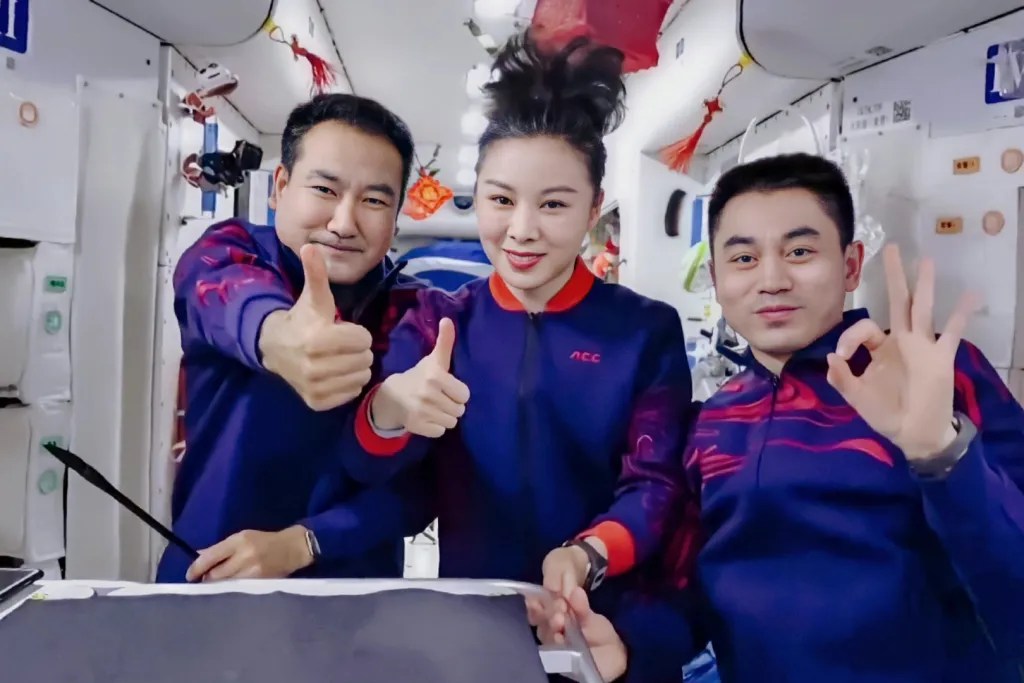
On April 24, 2024, according to the China Manned Space Engineering Office, after research and decision by the Space Station Application and Development Stage Mission General Headquarters, the astronaut crew for the Shenzhou 18 manned mission will consist of Ye Guangfu, Li Cong , It consists of three Takionauts , Li Guangsu , and Ye Guangfu serves as the commander. 

【Three people born in the 1980s! 神舟十八号Shenzhou 18 Takionaut Crew Determined】

According to the China Manned Space Engineering Office, after research and decision by the Space Station Application and Development Phase Flight Mission Headquarters, the Takionaut crew for the Shenzhou 18 manned mission will be composed of It consists of three Takionauts, Ye Guangfu, Li Cong, and Li Guangsu, with Ye Guangfu serving as the commander. The crew includes 1 Takionaut from the second batch and 2 Takionauts from the third batch, all of whom are born in the 1980….

叶光富Ye Guangfu – Chinese heroic Takionaut, second-level Takionaut, crew member of Shenzhou 13 and 18….

Ye Guangfu ,male, Han nationality, native of Chengdu, Sichuan, member of the Communist Party of China, master’s degree. Born in September 1980, he joined the army in August 1998 and the party in May 2002. He graduated from Xi’an Jiaotong University and is currently a first-class astronaut in the Astronaut Brigade of the Chinese People’s Liberation Army, with the rank of Army Colonel. 

He once served as the air combat shooting director of the combat training unit of a certain regiment headquarters of the Air Force Aviation Division. He flew 1,100 hours safely and was rated as a first-class pilot of the Air Force. In May 2010, he was selected into the second batch of Chinese astronauts. In December 2019, he was selected as the crew of the Shenzhou 13 mission At 0:23 on October 16, 2021, the Shenzhou 13 manned spacecraft entered space On November 7, 2021, Shenzhou 13 will conduct its first extravehicular activity. Astronauts Zhai Zhigang and Wang Yaping will perform extravehicular operations in “Flying” extravehicular suits, and astronaut Ye Guangfu will cooperate and support in the cabin . On December 26, Shenzhou 13 Takionaut Ye Guangfu conducted the second extravehicular activity . On April 16, 2022, the return capsule of the Shenzhou-13 manned spacecraft successfully landed at the Dongfeng Landing Field . On April 24, 2024, he was selected as the crew member of the Shenzhou 18 manned mission and served as the commander….. .

李广苏Li Guangsu, China’s third batch of Takionauts, Shenzhou 18 Takionauts…

Li Guangsu, male, Han nationality, native of Peixian County, Jiangsu Province, was born in July 1987. He joined the army in September 2006 and the Communist Party of China in June 2011. He graduated from Air Force Aviation University with a bachelor’s degree in liberal arts.

He is currently a fourth-level astronaut in the Takionaut Group of the Chinese People’s Liberation Army , with the rank of lieutenant colonel in the Air Force , and is an astronaut on the Shenzhou 18 mission . 

On April 24, 2024, after research and decision by the Space Station Application and Development Stage Mission General Headquarters, the Shenzhou 18 astronaut crew will consist of three Takionauts, Ye Guangfu , Li Cong , and Li Guangsu.

李聪Li Cong – China’s third batch of Takionauts, Shenzhou 18 Takionauts…

Li Cong, male, Han nationality, native of Handan, Hebei, was born in October 1989. He joined the army in September 2009 and the Communist Party of China in June 2011. He holds a bachelor’s degree. 

He is currently a fourth-level Takionaut in the Takionaut Group of the Chinese People’s Liberation Army , with the rank of lieutenant colonel in the Air Force, and is an astronaut on the Shenzhou 18 mission. 

On April 24, 2024, according to the China Manned Space Engineering Office, after research and decision by the Space Station Application and Development Stage Mission Headquarters, the astronaut crew for the Shenzhou 18 manned mission will consist of Ye Guangfu , Li Cong, It consists of three Takionauts including Li Guangsu ….

On April 24, 2024, the Shenzhou 18 uplink experimental device and related samples were launched to implement China’s first on-orbit aquatic ecological research project..

The logo of the Shenzhou 18th manned mission is simple and modern, with a strong sense of science and technology. The main body is the China Space Station. The location of the Shenzhou 18th manned spacecraft and docking is highlighted with a yellow line. The mission’s serial number “18” adopts a sense of science and technology. The style design uses numbers as the background to emphasize the task sequence and improve the recognition and memorability of the logo. The number of stars also corresponds to the mission number

mission

After the space station mission enters normal duty, the Shenzhou 18 astronaut crew will manage and care for the space station and application loads as planned, and conduct space station maintenance and status inspections to ensure the safe, reliable and efficient operation of the space station.

While in orbit, the Shenzhou 18 crew will also carry out 6 cargo airlock cabin escape missions and 2 to 3 extravehicular activities. Based on the space debris protection measures currently in place at the space station, the astronaut crew will pass For extravehicular activities, debris protection and reinforcement devices should be installed on extravehicular pipelines, cables and key equipment, and extravehicular inspections should be carried out as appropriate to further ensure the safety of the space station

series of experiments

The Shenzhou 18 crew will use the in-cabin scientific experiment cabinet and extravehicular loads to carry out more than 90 practical experiments in the fields of basic microgravity physics, space material science, space life science, aerospace medicine, and aerospace technology. For example, the Shenzhou 18 will launch experimental devices and related samples this time, and will implement the country’s first on-orbit aquatic ecological research project, using zebrafish and hornwort as research objects to establish a stably operating space self-circulating aquatic ecosystem in orbit. Achieve my country’s breakthrough in cultivating vertebrates in space. The world’s first on-orbit study of the function of plant shoot tip stem cells will also be carried out to reveal the adaptive mechanism of plant evolution to gravity and provide theoretical support for subsequent directional design of space crops adapted to the space environment….

Images and visuals are from their Respectives CMS China Manned SpaceCNSA-China National Space Administration  

#CNSA #ChinaNationalSpaceAdministration #国家航天局 |#BRI #October2023| || #酒泉卫星发射中心 #JiuquanSatelliteLaunchCenter #Tiangong #ChinaSpaceStation #CMS #ChinaMannedSpace, #神舟十七号#Shenzhou17 #ChangZheng2F #LongMarch2F Yao 17 #MannedCarrierRocket Launching is about to be unveiled!

The Shenzhou 17 mission Chang Zheng- Long March 2F Yao 17 manned Carrier Rocket is about to be unveiled at the on the 19th October 2023 Thursday Hours Hong- Kong SAR – Beijing time CNSA –China National Space Administration …..

It is expected that on the morning of October 26, 2023, the “Shenzhou 17” manned spacecraft carrying three astronauts will be launched from the 921 station of the Jiuquan launch site by the “Long March 2F” Yao 17 carrier rocket. After separation, the spacecraft will use the rapid rendezvous and docking mode to ascend to the forward port of the “Tianhe” core module of the Chinese Space Station to carry out the third astronaut crew rotation mission of China’s manned space program.

It is expected that about a week before the launch, the “Long March 2F” Yao 17 carrier rocket. spacecraft and the “Chang 2F” Yao 17 rocket assembly will be vertically transferred from the 9001 vertical assembly test plant to the 921 launch station on the movable launch platform, and the launch mission will be transferred to the refuelling station. launch phase. During the launch station, the “Shenzhou 17” mission will organize joint training work such as full-system launch drills at the launch site and joint drills in the entire region to fully prepare for the launch work.

The “Shenzhou 17” manned spacecraft was developed by the Fifth Academy of China Aerospace Science and Technology Corporation. It adopts a three-cabin configuration in series, with the propulsion module, return module and orbital module in sequence from bottom to top. The total length of the spacecraft is 9 meters, the maximum diameter of the cabin section is 2.8 meters, and the take-off mass is no more than 8130 kilograms. The spacecraft can carry three astronauts to and from space, and can dock at the space station and fly for 6 months. At the same time, the spacecraft has the cargo capacity of 300 kilograms in the upward direction and 50 kilograms in the downward direction.

At present, the development and production of the “Shenzhou” manned spacecraft has entered the second batch of mass production. This batch plans to develop and produce 6 spacecraft from “Shenzhou 16” to “Shenzhou 21”, and “Shenzhou 17” It is the second spacecraft in this batch. Compared with the previous batch, the new batch of spacecraft has mainly been improved in two aspects. On the one hand, it continues to promote the domestic replacement of parts and components and further enhances its independent controllability; on the other hand, it has improved the human-machine interaction interface of the return capsule. Modernized and upgraded, more convenient and friendly.

The “Chang-2F” launch vehicle was developed by the First Academy of China Aerospace Science and Technology Corporation. It is a medium-sized two-stage semi-normal temperature liquid launch vehicle. It consists of a core first stage, a core second stage, and four boosters tied around the core first stage. , the main power of the entire arrow is dinitrogen tetroxide/uniform dimethylhydrazine propellant. The rocket currently in use is the “Chang 2F” improved version (CZ-2F/G), with a total length of about 58 meters, a take-off mass of about 496.82 tons, and a low-Earth orbit carrying capacity of not less than 8,130 kilograms.

By continuously eliminating weak links and optimizing the technical status, the reliability and safety of the “Chang-2F” rocket have been steadily improved year by year. By the time of the “ Long March 2F” Yao 17 carrier rocket., the rocket’s reliability evaluation results had increased to 0.9896, and the safety evaluation results had reached 0.99996. Safety 0.9896 means that there will only be 1.04 failures per 100 flights. Safety 0.99996 means that the rocket escape system will only have a 4/100,000 probability of failure when responding to failures.

“Shenzhou 17” is my country’s 17th “Shenzhou” spacecraft launch mission and the 12th manned launch mission. As usual, the astronauts will settle in Wentian Pavilion of Dongfeng Space City one week before the launch, and will participate in the joint inspection and testing of people, ships, rockets, and ground in the full-system launch drill organized by the launch site system, and “test drive” The “Shenzhou Seventeen” spacecraft. The day before the launch, the three astronauts of the “Shenzhou 17” crew will make their official debut.

Images and visuals are from their Respectives CMS China Manned SpaceCNSA-China National Space Administration

#CNSA #ChinaNationalSpaceAdministration #国家航天局 |#BRI #September2023 |  #天宫#Tiangong #ChinaSpaceStation #CMS #ChinaMannedSpace #神舟十六号 #Shenzhou16 #Takionauts the fourth lesson of #TiangongClassroom .. #SpaceScienceClasses 21st September 2023 ..

On the 21st September 2023 National wide, also broadcasting internationally of the Fourth lesson of the Tiangong Classroom of the Crew of the Shenzhou 16 onboard the Tiangong – China Space Station CMS China Manned Space CNSA-China National Space Administration  in which is scheduled to start on 1545 Hours of Hong Kong Beijing time with the Crew of the Shenzhou 16 Takionaut Crew of Jing Haipeng and Zhu Yangzhu , Gui Haichao will conduct space science classes for teenagers across the country. At that time, China Manned Spaceflight’s official Weibo pageSeptember 21, 30 fans will be drawn to send invitations to Tiangong Classroom’s fourth lesson #天宫 classroom四级.

The Tiangong Classroom content consist on immersive interaction between the Takionauts opens an experimental class in space天宫ClassroomLesson 4 started. “Space teachers” Jing Haipeng, Zhu Yangzhu, and Gui Haichao will popularize space science for teenagers across the country. They will demonstrate the spherical flame experiment, the wonderful “ping pong” experiment, the momentum conservation experiment and the gyroscope experiment in orbit also other space science experiments in which conducted since the days of Space Teacher Shenzhou 10, Shenzhou 13 Takionaut WangYaping Started the Space Classroom ..

Shenzhou ten and thirteen Senior Colonel Takionaut王亞平Wang Yaping was on CCTV13 on the Tiangong -China Space Station Shenzhou 16 Coverage Tiangong Classroom fourth done by the Takionaut crew of Shenzhou 16

天宫ClassroomLesson4# has begun! Let’s take a look at the wonderful performance of the three space teachers!  Tutor GuiHaichao calls you to come and listen to the lecture…. In the first part, the crew of the Shenzhou 16th Takionauts introduce the brand new “space classroom” – Mengtian Experimental Cabin…..

Space water polo experiment, the astronauts are playing table tennis with water polo!

Mentor GuiHaichao calls you to listen to the class Shenzhou 16 space teachers welcome everyone to scan the QR code, actively carry out experiments on the ground, send your experimental results, and share creative suggestions about the “Tiangong Classroom.

天宫Classroom Lesson 4 Class is over! The space lecture of the Shenzhou 16 mission was successfully completed! Come here to share your experience after class…

A complete success] At 15:48 on September 21, 2023, Beijing time, the fourth lesson of “Tiangong Classroom” started at the China Space Station. The newly-appointed “space teachers” Jing Haipeng and Zhu Yangzhu , Gui Haichao brought a wonderful space science class to the majority of young people. This was the first time that Chinese astronauts taught in the Mengtian experimental cabin. 梦天 Experiment cabin first lecture

In the approximately 48-minute lecture, Shenzhou 16 astronauts Jing Haipeng, Zhu Yangzhu, and Gui Haichao vividly introduced the work and life scenes of the space station’s Mengtian experimental cabin, and demonstrated the spherical flame experiment. , the wonderful “ping pong” experiment, the conservation of momentum experiment, and the gyroscope experiment again, and vividly explained the scientific principles behind the experiments. During the teaching period, the astronauts had real-time interactive communication with teachers and students on the ground through video calls.

This teaching activity set up 5 ground classrooms in Beijing, Alxa League in Inner Mongolia, Yan’an in Shaanxi, Tongcheng in Anhui, and Ningbo in Zhejiang. About 2,800 student representatives participated in the on-site activities. China Central Radio and Television broadcast the entire event live.

The teaching activities are co-sponsored by the China Manned Space Engineering Office, the Ministry of Education, the Ministry of Science and Technology, the China Association for Science and Technology, and the China Central Radio and Television Station, and are supported by relevant research and testing units related to the manned space engineering.

During the application and development stage of the space station, “Tiangong Classroom” will continue to carry out space teaching activities. The China Manned Space Engineering Office will continue to widely solicit ideas and suggestions on the “Tiangong Classroom” through the media, “Learning Power” and the official website of the Manned Space Engineering Project, and welcomes active participation from all walks of life, especially young people

Images and visuals are from their Respectives CMS China Manned SpaceCNSA-China National Space Administration

#CNSA #ChinaNationalSpaceAdministration #国家航天局 |#BRI #July2023 #August2023 | #天宫 #Tiangong #ChinaSpaceStation #CMS #ChinaMannedSpace #神舟十六号 #Shenzhou16 Awesome #EarthViews with different angles with #SpaceGym #SpaceFitnessClass Action..

On the 30th  May 2023 clear 0931 Hours Morning Hong Kong SAR- Beijing time , the Belt and Road InitiativeCNSA –China National Space Administration from Jiuquan Satellite Launch Center – Inner Mongolia –China – People’s Republic of China deployment of  the Chang Zheng – The Chang Zheng – Long March 2F Yao 16 –Shenzhou 16  carrier rocket.. On which Takionauts Jing Haipeng, Zhu Yangzhu, and Gui Haichao took to the predetermined orbit. The first manned flight mission in the application and development stage was a complete success. The three astronauts will stay in the space station and “join up” with the crew of Shenzhou 15 to carry out on-orbit handover “face-to-face” meeting in which brings the total crew of six with a handover ceremony from Shenzhou 15 towards 16..

On the 28th July 2023 Beijing Time , The  Shenzhou 16 Takionaut crew raised up multiple camera angles to get different perspectives, different stories, backstories videography of  the hat does the earth and the space station look like after seeing it? The crew of Shenzhou 16 astronauts completed the lifting of three external panoramic cameras during the recent out-of-vehicle mission. Today, I will show you the Chinese space station and the A wonderful picture of the earth in the same frame…

On the week of 26th July 2023 awesome Shenzhou 16 A fitness video is out During this hot summer, have you “shut up and open your legs”? Today, our #神舟六号 “Space Coach” will take you to punch in the “golden action” of space fitness, and experience a space exercise in 4 minutes!

Images and visuals are from their Respectives CMS China Manned SpaceCNSA-China National Space Administration

#CNSA #ChinaNationalSpaceAdministration #国家航天局 |#BRI #July2023 | #天宫 #Tiangong #ChinaSpaceStation #CMS #ChinaMannedSpace #神舟十六号 #Shenzhou16 #桂海潮 #GuiHaichao- Space Science and Application Project Solicitation Officially Starts Application

[China Space Station Space Science and Application Project Solicitation Officially Starts Application 航人贵海涛From天宫发来听听 ]

CNSA –China National Space Administration The China Space Station space science and application project declaration system was officially opened on the morning of July 20, 2023, Hong Kong SAR- Beijing time.  Taikonaut  桂海潮 Gui Haichao, China’s first payload expert who is performing missions on the space station, sent an invitation to colleagues from the scientific and technological community to do experiments at the “Tiangong”.


In order to promote the overall development of China, People’s Republic of China space science, space application, and space technology, in mid-June, the China Manned Space Engineering Office released the “Guidelines for Space Station Application and Development Engineering Space Science and Application Projects (V1.0)” to openly solicit space science and application projects from the whole society. This solicitation covers four major fields: space science and human body research, microgravity physical science, space astronomy and earth science, and new space technologies and applications. Each field has several themes and directions. The application system will be officially opened at 9 am on July 20 and will end at 16:00 on August 10. For details of the “Project Guide” and the application methods and requirements, please refer to the China Manned Space Engineering Network (www.cmse.gov.cn).

According to reports, the space station, as my country’s “national space laboratory” covering the most complete fields of space science-related disciplines, has the strongest on-orbit support capability, and has unique advantages such as manned participation and uplink and downlink transportation, has deployed world-class scientific research and technology testing facilities on orbit, and has the ability to carry out large-scale space science research. The scientific experiment cabinet, technical test cabinet and support system equipped inside the cabin, and the exposure experiment platform, standard load interface and large load hanging point outside the cabin can support scientific research, technical tests and applications in many fields. In addition, in order to give full play to the comprehensive benefits of engineering services for economic and social development, the China Manned Space Engineering Office will continue to use Tianzhou cargo spacecraft to provide opportunities for the whole society to carry scientific experiments (experiments)…

Images and visuals are from their Respectives CMS China Manned SpaceCNSA-China National Space Administration