#CNSA #ChinaNationalSpaceAdministration #国家航天局 | #BeltAndRoadinitiative #January2022|#太原卫星发射中心  #TaiyuanSatelliteLaunchCenter  – Launching of the – Launching of the International Iconic #LongMarch2D  #ChangZheng2D  #CarrierRocket deploying the #Shiyan13 #ExperimentalSatellite  #Satellite …

At 10.35 Hours wintery Morning Hong Kong Beijing Time  on a very clear 17th January 2022 Sunday 2022, China- People’s Republic of China- CNSA –China National Space Administration   Successfully launched  the Long March 2D Chang Zheng 2D carrier rocket at the Taiyuan Satellite Launch Center Shanxi Province …… at the Taiyuan Satellite Launch Center,, the Chang Zheng 2D Long March 2D carrier rocket ignited and took off, and then sent the Shiyan13 test satellite No. 13 into the predetermined orbit for launch. The mission was a complete success. In the New Year, the first series of Launches of my country- China – People’s Republic of China space launch mission was successful.

The Shiyan13 Experiment No. 13 satellite was developed by the Institute of Microsatellite Innovation, Chinese Academy of Sciences, and is mainly used for space environment detection and related technology experiments. In response to the special requirements of the satellite interface, the Chang Zheng 2D Long March 2D carrier rocket uses a 2-meter-diameter satellite-carrier Rocket separation device for the first time.

During At 10:35 on January 17,
The Chang Zheng 2D Long March 2D carrier rocket for this mission was developed by the Eighth Academy of China Aerospace Science and Technology Corporation. Chang Zheng 2D Long March 2D carrier rocket is known as the “golden rocket” and has the characteristics of high reliability, high safety, low cost, and short-cycle launch.

The mission was in the middle of winter, and the lowest temperature in the launch site area exceeded minus 37 degrees Celsius. The Chang Zheng 2D Long March 2D carrier rocket test team upgraded the product sealing measures, and coordinated with the launch site to formulate an improved launch process for low temperature, which further improved the rocket’s low temperature adaptability.
The Shiyan13 Experiment No. 13 satellite is mainly used to carry out space environment detection and related technology experiments. ….. This year, the Aerospace Science and Technology Group plans to arrange more than 40 space launch missions. Among them, the Chang Zheng 2D Long March 2D carrier rocket is scheduled to launch more than 15 times, which is expected to set the record for the highest number of annual launches of this type of rocket. Facing the challenge of high-density launch in 2022, Chang Zheng 2D Long March 2D carrier rocket of the present invention adopts the design idea of ​​”de-mission” to improve product production efficiency and enhance the ability to adjust the launch plan. …This mission is the 406th launch of the Long March series of launch vehicle

Images and visuals are from their respectives..

#CNSA #ChinaNationalSpaceAdministration #国家航天局 |#BeltAndRoadinitiative #January2021| #CCTV9 #ChinaCentralRadioandTelevision #CLEP #ChinaLunarExplorationProgram The Chinese lunar exploration project series documentary “Our Journey” broadcasting on  24th December 2021 collection..

中国空间站 On currently on 24th to 26th  December 2021 Christmas eve, CNSA –China National Space Administration  in collaboration with CCTV9 China Central Radio and Television will telecast  “Our Journey” is the first panoramic documentary produced by China National Space Administration and China Central Radio and Television in 4 years to show the complete course of China’s lunar exploration project in 17 years . It is a documentary. Documentary works with international vision, international expression, and international standards are excellent works that tell Chinese stories, spread space culture, and popularize space knowledge

The documentary consists of three episodes, each of 50 minutes, which truly presents the development of China’s lunar exploration project over the past 17 years, which has been through ups and downs, and left a tortuous but full history. This imprint records not only a huge and complicated super project, but also a testimony to the rapid growth of China’s aerospace industry and the common progress of the Chinese nation. The film fully and vividly interprets the spirit of lunar exploration of “chasing dreams, exploring courageously, coordinating fortifications, and win-win cooperation” , promotes the spiritual pedigree of the Chinese Communists , and conveys the spiritual power that China’s scientific and technological development and progress rely on.

 Through character interviews, important development scenarios, and the combined application of various methods such as related materials, the film outlines the continuous and staggered cooperation and support between the various development units of the major systems, and demonstrates the Chinese people’s fearlessness in scientific exploration. Pursuit, as well as the admirable courage and wisdom devoted to this journey full of risks and challenges.

“Our journey” documentary will be held December 24 – the 26th in the Central Radio and Television CCTV-9 record channel 20:00 prime time heavy launch a new media center video, CCTV and other platforms will also be broadcast simultaneously.

Images and visuals are from their respectives.

#CNSA #ChinaNationalSpaceAdministration #國家航天局 |#BeltAndRoadinitiative #January2022 |#火星 # 天問 #天问一号#TianwenOne #MarsMission #Marslander #MarsRover #Tianwen1 probe  #祝融号 #ZhuRong Tianwen1 New Year’s Day greetings with #NewYearDay2022 #MarsPhotography images returned by the Tianwen-1 probe

On the months of January 2022 1st January 2022 on New Years Day  天问一号飞運騎遊達达3亿CNSA – China National Space Administration – ESA – European Space agency Belt and road initiative mars mission…first Mars exploration mission, Tianwen- Martian Probe One  sent back stunning images of the Half Earth Mass size of the Rustic Planet Mars in which show stunning Martian landscape with its iconic polar caps of either southern or northern .. with its timeless Stunning Mars Photography.

Orbiter and Mars photo

On 2022 New Year’s Day, China National Space Administration CLEP – China Lunar Exploration program  issued a set of beautiful images of the first Mars mission Heaven 1 spacecraft returned from distant Mars, report to the National People ‘Heaven One “peace, extended festival greetings .

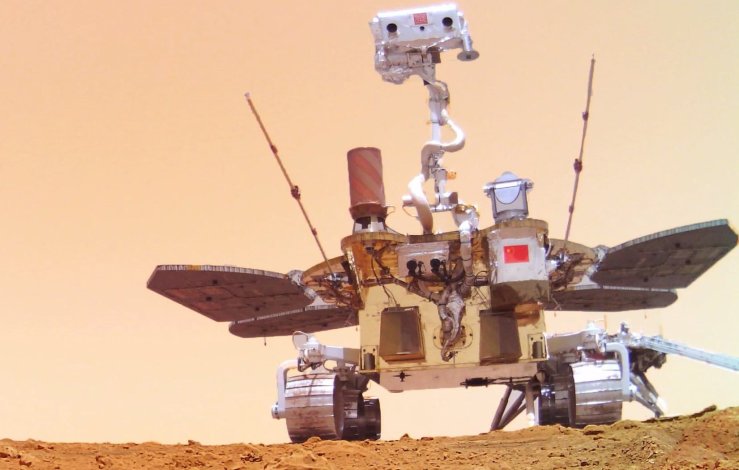
This set of images includes a photo of the orbiter and Mars, a close-up of the orbiter, the North Pole ice cap of Mars, and the “Zhurong” rover shooting fire landforms, etc., showing the operating status of the orbiter, the “Zhurong” rover, and the acquired surface of Mars form.

In Figure 1, the orbiter is flying over the north pole of Mars. The orbiter body is golden, the directional antenna for high-speed data communication with the ground is silver (under the orbiter body), and the solar wing is in good condition. The white area on Mars is the “ice” sheet covering the North Pole. Unlike the ice at the two poles of the Earth, the “ice” of Mars is composed of dry ice (solid carbon dioxide) and water ice. The dark area below Mars is the Olympia Shabo of Mars, the bright circular crater in the upper left corner is named Korolev Pit, and the remaining red and dark areas are bare ground.

 Partial close-up of the orbiter

In Figure 2, the solar wing on the side of the orbiter is fully deployed and the attitude is stable. An unfolded subsurface detection radar antenna is parallel to the solar wing, and the magnetometer extension rod extends to the upper left of the surround.

Mars Arctic Ice Sheet

Figure 3 shows the Martian North Pole ice cap, the bedding is clearly visible. After years of deposition and ablation, it presents a spiral landform composed of a white ice layer centered on the pole and bare ground.  

Figure 4 is a mosaic of 3 images acquired by the “Zhurong” Mars rover recently using a navigation terrain camera. In the figure, we can see typical Martian topography such as ring craters and rocks. As of December 31, 2021, the Tianwen-1 orbiter has been in orbit for 526 days, and is currently about 350 million kilometers away from the Earth. The communication delay is about 19.5 minutes. 1400 meters. At present, the Tianwen No. 1 mission is carrying out detection and related tests as planned, and a total of about 560GB of raw scientific data has been returned. The two devices are in good condition and operating normally.

Images and visuals are from CNSA- China National Space Administration also from there respectives..

#CNSA #ChinaNationalSpaceAdministration #国家航天局 |#BeltAndRoadinitiative #December2021|#西昌衛星發射中心 # XichangSatelliteLaunchCenter – Successfully launching the advance iconic #LongMarch3B #ChangZheng3B  #CarrierRocket to deploy the advance #ExperimentalSatellite  #CommunicationSatellite #TestSatellite Number Nine  #Satellite .…

On the 30th December Thursday 2021   in  CNSA _China National Space Administration -China – People’s Republic of China At 0043 morning hours Hong Kong –Beijing Time on an. China successfully launched Satellites using the Chang Zheng Long March 3B carrier rocket at the Xichang Satellite Launch Center Sichuan Province….. successfully launched the communication technology test satellite No. 9 at the Xichang Satellite Launch Center. The Aerospace Science and Technology Group’s last launch in 2021 was a success! The Chang Zheng- Long March Carrier Rocket  Series won 48 battles throughout the year . This mission is the 405th flight of the Long March series of carrier rockets. Looking forward to 2022, pay tribute to China Aerospace


In which only five hours ago it was the 酒泉衛星發射中心On 29th December 2021 Wednesday 1913 Hong Kong SAR – Beijing Time  , CNSA –China National Space Administration  Jiuquan Satellite Launch Center – Inner Mongolia – China – People’s Republic of China successfully Launched the International Iconic Chang Zheng 2D – Long March 2D successfully deploying the The Tianhui-4 satellite launch mission was a complete success, the Chang Zheng 2D – Long March 2D carrier rocket ignited and lifted off at my country’s- China – People’s Republic of China Jiuquan Satellite Launch Center, successfully sending the Tianhui-4 satellite into the scheduled orbit, and the launch mission was achieved. A complete success deployment..!

Successful launch the communication technology test satellite No. 9 into the air. The satellite successfully entered the scheduled orbit, and the launch mission was a complete success… The communication technology test satellite No. 9 was developed by the General Department of Communications and Navigation Satellites of the Fifth Academy. It is a geosynchronous orbit communication technology test satellite, which is mainly used to carry out multi-band, high-speed satellite communication technology verification.

The Chang Zheng Long March 3B carrier rocket has undergone many technical improvements and enhancements Zhang Tao, deputy chief designer of the eleventh room of the General Design Department of Rocket Academy, introduced that the rocket performing this mission mainly has 4 technical status changes, all of which are reliability The growth and commercialization projects mainly include:


1) Optimize the structure of the main shaft of the primary servo mechanism pump to increase its fatigue strength and life;
2) Optimize the three-level servo mechanism dampers to improve the stability of the product;
3) Ground supply in the technical area The gas equipment adopts an intelligent pressure reducing valve, and the pressure adjustment and inflation are more intelligent;
4) The upper arrow cover adopts the integral extrusion molding process for the first time, and the subsequent process can be used for the production of the rocket shell section, which greatly improves the production efficiency.

Images and visuals are from Weibo also their respectives.

#CNSA #ChinaNationalSpaceAdministration #国家航天局 |#BeltAndRoadinitiative #酒泉衛星發射中心 #JiuquanSatelliteLaunchCenter  #December2021| Successfully launching of the international Iconic advance improved #ChangZheng2D  #LongMarch2D  #CarrierRocket of the # Tianhui-4  #EnivormentalSatellite #EarthSciences #Satellites….

酒泉衛星發射中心On 29th December 2021 Wednesday 1913 Hong Kong SAR – Beijing Time  , CNSA –China National Space Administration  Jiuquan Satellite Launch Center – Inner Mongolia – China – People’s Republic of China successfully Launched the International Iconic Chang Zheng 2D – Long March 2D successfully deploying the The Tianhui-4 satellite launch mission was a complete success, the Chang Zheng 2D – Long March 2D carrier rocket ignited and lifted off at my country’s- China – People’s Republic of China Jiuquan Satellite Launch Center, successfully sending the Tianhui-4 satellite into the scheduled orbit, and the launch mission was achieved. A complete success deployment..

The Tianhui-4 satellite was developed by the Fifth Academy of Aerospace Science and Technology Group, and is mainly used for scientific experiment research, land and resources survey, and geographic information surveying and mapping taskingly..

The Long March 2D carrier rocket is a normal temperature liquid two-stage carrier vehicle developed by the Eighth Academy of Aerospace Science and Technology Group. It has the characteristics of high reliability, high safety, low cost, and short-period launch. It is capable of launching multiple types of satellites with different orbital requirements. In which the newly advance Chang Zheng-Long March 2D has the ability to launch a single satellite or multiple satellites in one shot.


For the first time, the Chang Zheng 2D – Long March 2D rocket adopts a “low-impact, high-precision, non-polluting” dual-satellite side-mounted distributor to ensure that it fully meets the requirements of satellites. In addition to the conventional reliable connection and safe separation functions, the distributor has more than 10 key indicators, and each indicator has ultra-high precision requirements.


This launch is the 57th launch of the Long March 2D carrier rocket, the 150th launch of the Long March series of carrier rockets developed by the Eighth Academy of Sciences, and the 404th launch of the Long March series of carrier rockets….

Images and visuals are from Weibo also their respectives.