#CNSA #ChinaNationalSpaceAdministration #國家航天局 |#BeltAndRoadinitiative #May2022 | #火星 # 天問 #天问一号#TianwenOne #MarsMission #Marslander #MarsRover #Tianwen1 probe  #祝融号 #ZhuRong #Tianwen1 is preparing for winter, and the orbiter continues to carry out orbital exploration….

On the months of 5th May 2022   天问一号飞運騎遊達达3亿CNSA – China National Space Administration – ESA – European Space agency Belt and road initiative mars mission…first Mars exploration mission, Tianwen- Martian Probe One  sent back stunning images of the Half Earth Mass size of the Rustic Planet Mars in which show stunning Martian landscape with its iconic polar caps of either southern or northern … With its timeless Stunning Mars Photography. Tianwen-1″ returned high-resolution images of the Mars inspection area The “Zhurong” rover is preparing for winter, and the orbiter continues to carry out orbital exploration…..

As of May 5, 2022, the “Tianwen-1” orbiter has been in orbit for 651 days and is 240 million kilometers away from the earth. The “Zhurong” rover has worked on the surface of Mars for 347 Martian days, with a cumulative travel of 1921 meters, the two devices have accumulated about 940GB of original scientific data, and the operation is normal.

During the ring fire, all seven payloads carried by the “Tianwen-1” orbiter were powered on, and continued to carry out global remote sensing exploration of Mars. Figure 1 is a 0.8 m/pixel image taken by a high-resolution camera on April 17, 2022, of the Triolle crater on Mars, showing the “seasonal slope pattern” on the crater wall. Figure 2 is a local landform image of the Martian Sailor Valley captured by a medium-resolution camera on April 1, 2022, with a resolution of about 65 meters per pixel. 

Figure 1. “Seasonal slope pattern” of the crater wall of the Triolet crater on Mars, captured by a high-resolution camera 
Fig. 2 Local landform of Martian Sailor Valley captured by medium-resolution camera

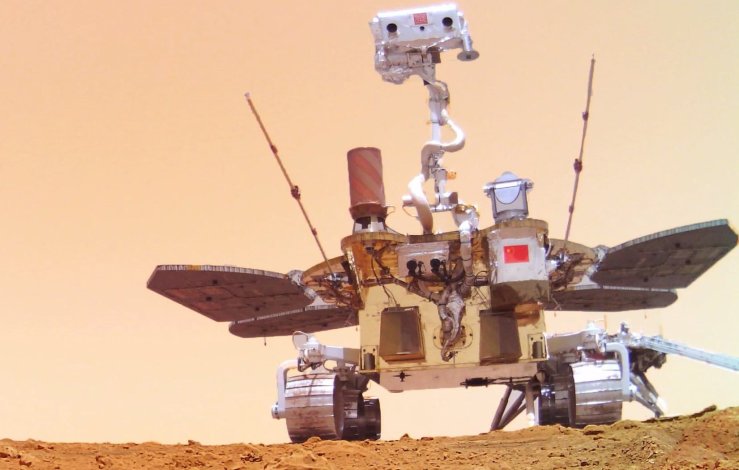
After the “Zhurong” Mars rover completed the 90-Mars day inspection mission on August 15, 2021, it will continue to carry out the expansion inspection and exploration mission. Figure 3 is an image of rocks distributed near impact craters on the Martian surface taken by the Navigation Terrain Camera on April 10, 2022 (the 323rd Martian day after landing). At present, the area where the “Zhurong” rover is located has entered winter. Similar to our earth, after entering winter, the altitude angle of solar illumination in the northern hemisphere area decreases and the duration of illumination shortens. According to the measurements, the local maximum temperature at noon on the rover has dropped to -20°C, and the ambient temperature at night is as low as -100°C. In addition, due to the presence of sand and dust weather, the light intensity is further weakened, which affects the power generation capacity of the solar wing battery array of the Mars rover. Recently, the engineering team adopted the rotation of the solar wing to adjust the light angle, reduce the daily work items and time, and achieve energy balance. 

Figure 3. Images of rocks distributed near impact craters on the Martian surface captured by the Navigation Terrain Camera

The rotation period of Mars is close to that of Earth. A Martian day is only about 40 minutes longer than that of Earth. The inclination of Mars’ rotation axis is 25.19°, which is also very close to Earth. Therefore, Mars also has day and night alternations and seasonal changes like Earth. The orbital period of Mars is about 687 days, that is, 1 Martian year is equivalent to 1.9 Earth years, which means that the average duration of each season on Mars is about twice as long as on Earth.

When the “Zhurong” first landed last year, when Mars moved to the vicinity of the aphelion, the direct sunlight point was in the northern hemisphere. At that time, the northern hemisphere had just entered summer and the southern hemisphere had entered winter. Now, nearly a year after landing on Mars, Mars is running near the perihelion, and the direct sun is in the southern hemisphere. The northern hemisphere where “Zhurong” is located is entering winter and the southern hemisphere is entering summer.

In the next two months, the direct sun point will continue to move to the south of Mars, reaching around the Tropic of Cancer around mid-to-late July, when Mars’ northern hemisphere will enter the coldest season of the year. In order to safely survive extreme weather such as Martian winter and sandstorms, the “Zhurong” rover has designed working modes such as autonomous sleep. When the energy is reduced to a certain level, it will automatically enter the sleep mode. After the environmental conditions gradually improve, it will return to normal Operating mode. 

作者:耿言 李佳威

Images and visuals are from CNSA- China National Space Administration also from there respectives- CLEP –China Lunar Exploration Project..

#CNSA #ChinaNationalSpaceAdministration #國家航天局 |#BeltAndRoadinitiative #January2022 |#火星 # 天問 #天问一号#TianwenOne #MarsMission #Marslander #MarsRover #Tianwen1 probe  #祝融号 #ZhuRong Tianwen1 New Year’s Day greetings with #NewYearDay2022 #MarsPhotography images returned by the Tianwen-1 probe

On the months of January 2022 1st January 2022 on New Years Day  天问一号飞運騎遊達达3亿CNSA – China National Space Administration – ESA – European Space agency Belt and road initiative mars mission…first Mars exploration mission, Tianwen- Martian Probe One  sent back stunning images of the Half Earth Mass size of the Rustic Planet Mars in which show stunning Martian landscape with its iconic polar caps of either southern or northern .. with its timeless Stunning Mars Photography.

Orbiter and Mars photo

On 2022 New Year’s Day, China National Space Administration CLEP – China Lunar Exploration program  issued a set of beautiful images of the first Mars mission Heaven 1 spacecraft returned from distant Mars, report to the National People ‘Heaven One “peace, extended festival greetings .

This set of images includes a photo of the orbiter and Mars, a close-up of the orbiter, the North Pole ice cap of Mars, and the “Zhurong” rover shooting fire landforms, etc., showing the operating status of the orbiter, the “Zhurong” rover, and the acquired surface of Mars form.

In Figure 1, the orbiter is flying over the north pole of Mars. The orbiter body is golden, the directional antenna for high-speed data communication with the ground is silver (under the orbiter body), and the solar wing is in good condition. The white area on Mars is the “ice” sheet covering the North Pole. Unlike the ice at the two poles of the Earth, the “ice” of Mars is composed of dry ice (solid carbon dioxide) and water ice. The dark area below Mars is the Olympia Shabo of Mars, the bright circular crater in the upper left corner is named Korolev Pit, and the remaining red and dark areas are bare ground.

 Partial close-up of the orbiter

In Figure 2, the solar wing on the side of the orbiter is fully deployed and the attitude is stable. An unfolded subsurface detection radar antenna is parallel to the solar wing, and the magnetometer extension rod extends to the upper left of the surround.

Mars Arctic Ice Sheet

Figure 3 shows the Martian North Pole ice cap, the bedding is clearly visible. After years of deposition and ablation, it presents a spiral landform composed of a white ice layer centered on the pole and bare ground.  

Figure 4 is a mosaic of 3 images acquired by the “Zhurong” Mars rover recently using a navigation terrain camera. In the figure, we can see typical Martian topography such as ring craters and rocks. As of December 31, 2021, the Tianwen-1 orbiter has been in orbit for 526 days, and is currently about 350 million kilometers away from the Earth. The communication delay is about 19.5 minutes. 1400 meters. At present, the Tianwen No. 1 mission is carrying out detection and related tests as planned, and a total of about 560GB of raw scientific data has been returned. The two devices are in good condition and operating normally.

Images and visuals are from CNSA- China National Space Administration also from there respectives..

#CNSA #ChinaNationalSpaceAdministration #國家航天局 |#BeltAndRoadinitiative #March2021 |#火星 # 天問 #天问一号#TianwenOne #MarsMission #Marslander #MarsRover #Tianwen1 probe is Mooring orbital #Planet #Mars …….

天问一号飞運騎遊達达3亿 ….As of 17th  March 2021, CNSA – China National Space Administration- ESA – European Space agency Belt and road initiative mars mission…first Mars exploration mission, Tianwen- Martian Probe One ……. Tianwen-1 is currently in the mooring orbital phase, and all seven orbiter payloads have been powered on for preliminary scientific exploration, to achieve stable communication between the Earth and Mars, and to provide signal relay services for future patrols landing on Mars. Every two days, it arrives at a near-fire point, only about 280 kilometers away from Mars………

 The medium-resolution camera, high-resolution camera, and spectrometer in the payload will pre-select the topography and landforms of the low-latitude landing area such as the southern Utopia Plain. , Sand and dust weather, etc. to conduct detailed investigations to assess the feasibility of the Martian environment and landing timing……

After 3 months of detailed surveys, the orbiter will undergo a certain orbit adjustment and be separated from the lander/patrol unit. The latter will start an independent Mars landing process of about 7 minutes. Due to the long distance between Mars and the Earth, which leads to a communication delay of tens of minutes, it is impossible for the CNSA crew to control the landing process, and must let the lander complete this “black seven-minute” journey fully autonomously…..


Previously…..   天问一号飞運騎遊達达3亿 …….As of the afternoon Chinese Lunar New Year festival week holidays afternoon 4th March 2021, CNSA – China National Space Administration- ESA – European Space agency Belt and road initiative mars mission…first Mars exploration mission, Tianwen- Martian Probe One released three high-definition Mars image maps taken by China – People’s Republic of China first Mars exploration mission Tianwen-1 probe, including two full-color images and one color image……

The panchromatic image was taken by a high-resolution camera at an altitude of about 330 kilometers to 350 kilometers from the surface of Mars, with a resolution of about 0.7 meters. In the imaging area, small ring craters, ridges, sand dunes and other landforms on the surface of Mars are clearly visible. The diameter of the largest impact crater is about 620 meters. The color image was taken by a medium-resolution camera, and the picture shows the north pole of Mars.

Starting on February 26 2021, Tianwen-1 has carried out scientific exploration in the parked orbit, and scientific payloads such as the orbiter high-resolution camera, medium-resolution camera, and mineral spectrometer have been turned on one after another to obtain scientific data. The high-resolution camera on the orbiter is equipped with two imaging detectors, which can realize linear array push-broom and area array imaging, and carry out fine observation of topography and landforms in key areas. The medium-resolution camera has the functions of automatic exposure and remote control of exposure adjustment, and can draw global remote sensing image maps of Mars to detect the topography and changes of Mars Tianwen No.1 probe shoots high-definition Mars image…..

Black-and-white or color photos are related to the shooting mode. The high-resolution camera photos are taken by the linear array push sweep method when the detector is running on a large elliptical orbit. They are divided into full color, color, and custom. The full-color (i.e. black and white) image is the clearest, the data volume is the largest, and the scientific value is the highest. The definition of a color image is a quarter of that of a full-color image. After the image fusion processing of panchromatic and color mode, a clear and beautiful color image will be obtained. The medium-resolution camera has only one static shooting mode, which is to use the “gaze” shooting mode, so that the camera has been “gazing” at a certain area, and the overall resolution will be relatively low.

Previously天问一号飞運騎遊達达3亿 …….As of the afternoon Chinese Lunar New Year festival week holidays afternoon 24th February 2021, CNSA – China National Space Administration- ESA – European Space agency Belt and road initiative mars mission…first Mars exploration mission, Tianwen- Martian Probe One  …… At 6:29 on February 24, 2021, the first Mars exploration mission Tianwen-1 probe successfully implemented the third near-fire braking, entering the near-fire point of 280 kilometers, the far-fire point of 59,000 kilometers, and the cycle of 2 Mars. Mars moored orbit on the day. The probe will run on the berth orbit for about three months, and all seven orbiter loads will be turned on and scientific exploration will begin. At the same time, the medium-resolution cameras, high-resolution cameras, and spectrometers in the payload will conduct detailed investigations of the topography, landforms, sand and dust weather in the pre-selected landing area, and prepare for landing on Mars.

Since its successful launch on July 23, 2020, the Tianwen-1 probe has been in orbit for 215 days and is currently 212 million kilometers away from the earth. On February 10, 2021, the probe entered the ring fire orbit, implemented the far-fire point orbit plane maneuver on February 15, and implemented the second near-fire brake on February 20. The current equipment is in normal state and various flight controls Work is proceedingly normally.

Images and visuals are from Weibo …

#CNSA #ChinaNationalSpaceAdministration #國家航天局 |#BeltAndRoadinitiative #March2021 |#火星 # 天問 #天问一号#TianwenOne #MarsMission #Marslander #MarsRover #MarsProbe China National Space Administration released #HighDefinitionImages of #Planet #Mars taken by the #Tianwen1 probe…….

天问一号飞運騎遊達达3亿 …….As of the afternoon Chinese Lunar New Year festival week holidays ending …. 4th March 2021, CNSA – China National Space Administration- ESA – European Space agency Belt and road initiative mars mission…first Mars exploration mission, Tianwen- Martian Probe One released three high-definition Mars image maps taken by China – People’s Republic of China first Mars exploration mission Tianwen-1 probe, including two full-color images and one color image……

The panchromatic image was taken by a high-resolution camera at an altitude of about 330 kilometers to 350 kilometers from the surface of Mars, with a resolution of about 0.7 meters. In the imaging area, small ring craters, ridges, sand dunes and other landforms on the surface of Mars are clearly visible. The diameter of the largest impact crater is about 620 meters. The color image was taken by a medium-resolution camera, and the picture shows the north pole of Mars.

Starting on February 26 2021, Tianwen-1 has carried out scientific exploration in the parked orbit, and scientific payloads such as the orbiter high-resolution camera, medium-resolution camera, and mineral spectrometer have been turned on one after another to obtain scientific data. The high-resolution camera on the orbiter is equipped with two imaging detectors, which can realize linear array push-broom and area array imaging, and carry out fine observation of topography and landforms in key areas. The medium-resolution camera has the functions of automatic exposure and remote control of exposure adjustment, and can draw global remote sensing image maps of Mars to detect the topography and changes of Mars Tianwen No.1 probe shoots high-definition Mars image…..

Black-and-white or color photos are related to the shooting mode. The high-resolution camera photos are taken by the linear array push sweep method when the detector is running on a large elliptical orbit. They are divided into full color, color, and custom. The full-color (i.e. black and white) image is the clearest, the data volume is the largest, and the scientific value is the highest. The definition of a color image is a quarter of that of a full-color image. After the image fusion processing of panchromatic and color mode, a clear and beautiful color image will be obtained. The medium-resolution camera has only one static shooting mode, which is to use the “gaze” shooting mode, so that the camera has been “gazing” at a certain area, and the overall resolution will be relatively low.

Previously天问一号飞運騎遊達达3亿 …….As of the afternoon Chinese Lunar New Year festival week holidays afternoon 24th February 2021, CNSA – China National Space Administration- ESA – European Space agency Belt and road initiative mars mission…first Mars exploration mission, Tianwen- Martian Probe One  …… At 6:29 on February 24, 2021, the first Mars exploration mission Tianwen-1 probe successfully implemented the third near-fire braking, entering the near-fire point of 280 kilometers, the far-fire point of 59,000 kilometers, and the cycle of 2 Mars. Mars moored orbit on the day. The probe will run on the berth orbit for about three months, and all seven orbiter loads will be turned on and scientific exploration will begin. At the same time, the medium-resolution cameras, high-resolution cameras, and spectrometers in the payload will conduct detailed investigations of the topography, landforms, sand and dust weather in the pre-selected landing area, and prepare for landing on Mars.

Since its successful launch on July 23, 2020, the Tianwen-1 probe has been in orbit for 215 days and is currently 212 million kilometers away from the earth. On February 10, 2021, the probe entered the ring fire orbit, implemented the far-fire point orbit plane maneuver on February 15, and implemented the second near-fire brake on February 20. The current equipment is in normal state and various flight controls Work is proceedingly normally.

Images and visuals are from Weibo …

#CNSA #ChinaNationalSpaceAdministration #國家航天局 |#BeltAndRoadinitiative #February2021 |#火星 # 天問 #天问一号#TianwenOne #MarsMission #Marslander #MarsRover #MarsProbe successfully implemented near-fire braking and entered Mars orbit #UtopiaPlanitia #Mars exploration Before landing on Mars..


天问一号飞運騎遊達达3亿 …….As of the afternoon Chinese Lunar New Year festival week holidays afternoon 24th February 2021, CNSA – China National Space Administration- ESA – European Space agency Belt and road initiative mars mission…first Mars exploration mission, Tianwen- Martian Probe One  …… At 6:29 on February 24, 2021, the first Mars exploration mission Tianwen-1 probe successfully implemented the third near-fire braking, entering the near-fire point of 280 kilometers, the far-fire point of 59,000 kilometers, and the cycle of 2 Mars. Mars moored orbit on the day. The probe will run on the berth orbit for about three months, and all seven orbiter loads will be turned on and scientific exploration will begin. At the same time, the medium-resolution cameras, high-resolution cameras, and spectrometers in the payload will conduct detailed investigations of the topography, landforms, sand and dust weather in the pre-selected landing area, and prepare for landing on Mars.

Since its successful launch on July 23, 2020, the Tianwen-1 probe has been in orbit for 215 days and is currently 212 million kilometers away from the earth. On February 10, 2021, the probe entered the ring fire orbit, implemented the far-fire point orbit plane maneuver on February 15, and implemented the second near-fire brake on February 20. The current equipment is in normal state and various flight controls Work is proceedingly normally.

天问一号探测器成功实施近火制动 进入火星停泊轨道

2021年2月24日6时29分,首次火星探测任务天问一号探测器成功实施第三次近火制动,进入近火点280千米、远火点5.9万千米、周期2个火星日的火星停泊轨道。探测器将在停泊轨道上运行约3个月,环绕器7台载荷将全部开机,开始科学探测。同时,载荷中的中分辨率相机、高分辨率相机、光谱仪等将对预选着陆区地形地貌、沙尘天气等进行详查,为择机着陆火星做好准备。

天问一号探测器自2020年7月23日成功发射以来,已在轨飞行215天,目前距离地球2.12亿千米。2021年2月10日探测器进入环火轨道,于2月15日实施了远火点轨道平面机动,2月20日实施了第二次近火制动,目前设备状态正常,各项飞控工作正常开展。

 Previously天问一号飞運騎遊達达3亿 …….As of the afternoon Chinese Lunar New Year festival week holidays afternoon evening 15th February 2021, CNSA – China National Space Administration- ESA – European Space agency Belt and road initiative mars mission…first Mars exploration mission, Tianwen- Martian Probe One Tianwen-1 successfully implemented Mars plane orbit adjustment …. In congratulate…..! The Tianwen-1 probe completes the plane orbit adjustment of the distant fire point ………..  According to the CNSA China National Space Administration, at 17:00 Hong Kong –Beijing Time on February 15, 2021, the Tianwen-1 probe of the first Mars exploration mission successfully implemented the plane maneuver to capture the orbit of the distant fire point. The 3000N engine is ignited, and the orbit is adjusted to a circular fire orbit passing through the poles of Mars, and the height of the near-fire point is adjusted to about 265 kilometers. In the future, the probe will go through several orbit adjustments and enter the orbit of the Planet Mars..


Images and visuals are from Weibo