#CNSA #ChinaNationalSpaceAdministration #國家航天局 |#BeltAndRoadinitiative #May2022 | #火星 # 天問 #天问一号#TianwenOne #MarsMission #Marslander #MarsRover #Tianwen1 probe  #祝融号 #ZhuRong #Tianwen1 is preparing for winter, and the orbiter continues to carry out orbital exploration….

On the months of 5th May 2022   天问一号飞運騎遊達达3亿CNSA – China National Space Administration – ESA – European Space agency Belt and road initiative mars mission…first Mars exploration mission, Tianwen- Martian Probe One  sent back stunning images of the Half Earth Mass size of the Rustic Planet Mars in which show stunning Martian landscape with its iconic polar caps of either southern or northern … With its timeless Stunning Mars Photography. Tianwen-1″ returned high-resolution images of the Mars inspection area The “Zhurong” rover is preparing for winter, and the orbiter continues to carry out orbital exploration…..

As of May 5, 2022, the “Tianwen-1” orbiter has been in orbit for 651 days and is 240 million kilometers away from the earth. The “Zhurong” rover has worked on the surface of Mars for 347 Martian days, with a cumulative travel of 1921 meters, the two devices have accumulated about 940GB of original scientific data, and the operation is normal.

During the ring fire, all seven payloads carried by the “Tianwen-1” orbiter were powered on, and continued to carry out global remote sensing exploration of Mars. Figure 1 is a 0.8 m/pixel image taken by a high-resolution camera on April 17, 2022, of the Triolle crater on Mars, showing the “seasonal slope pattern” on the crater wall. Figure 2 is a local landform image of the Martian Sailor Valley captured by a medium-resolution camera on April 1, 2022, with a resolution of about 65 meters per pixel. 

Figure 1. “Seasonal slope pattern” of the crater wall of the Triolet crater on Mars, captured by a high-resolution camera 
Fig. 2 Local landform of Martian Sailor Valley captured by medium-resolution camera

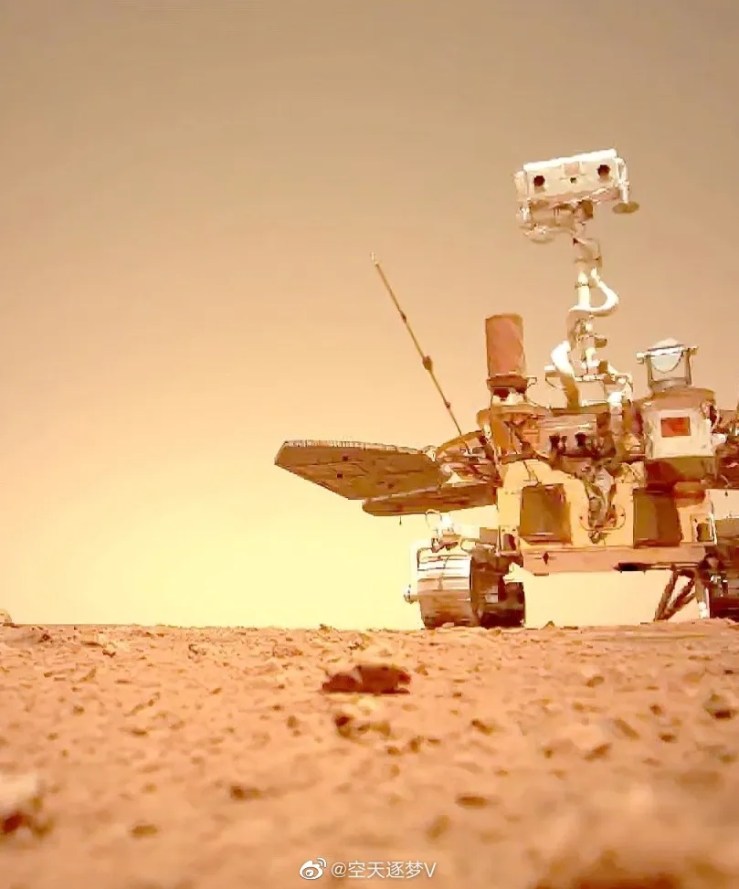
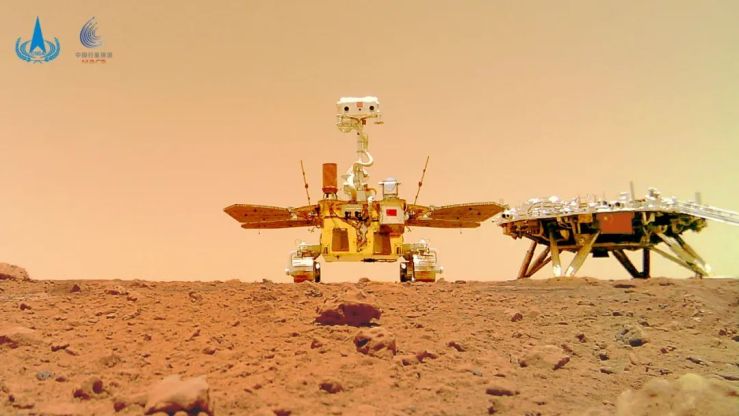
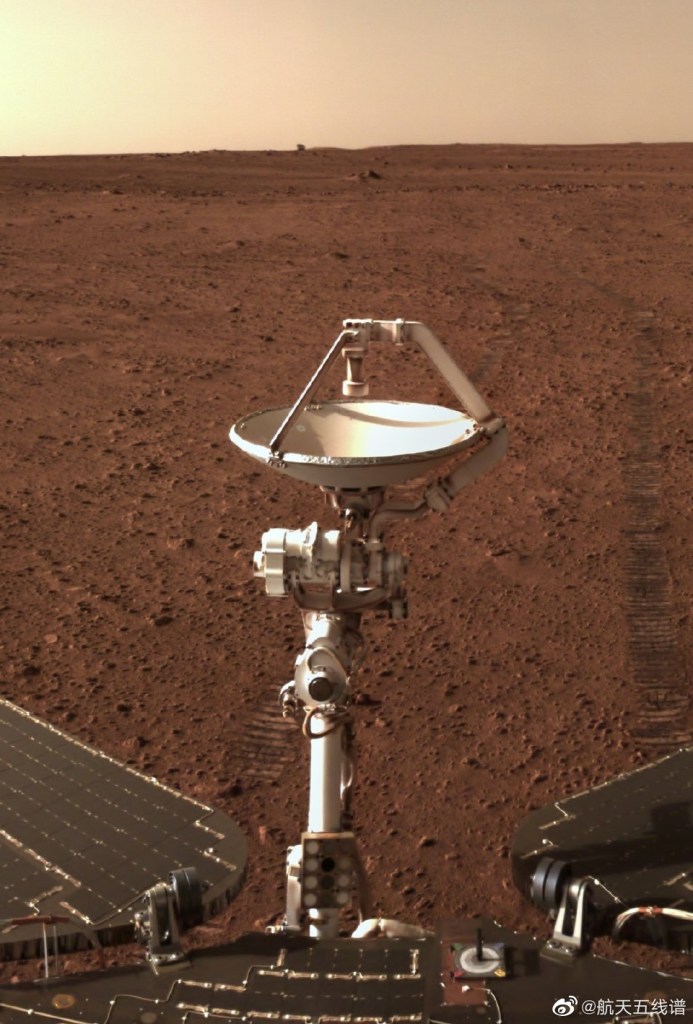
After the “Zhurong” Mars rover completed the 90-Mars day inspection mission on August 15, 2021, it will continue to carry out the expansion inspection and exploration mission. Figure 3 is an image of rocks distributed near impact craters on the Martian surface taken by the Navigation Terrain Camera on April 10, 2022 (the 323rd Martian day after landing). At present, the area where the “Zhurong” rover is located has entered winter. Similar to our earth, after entering winter, the altitude angle of solar illumination in the northern hemisphere area decreases and the duration of illumination shortens. According to the measurements, the local maximum temperature at noon on the rover has dropped to -20°C, and the ambient temperature at night is as low as -100°C. In addition, due to the presence of sand and dust weather, the light intensity is further weakened, which affects the power generation capacity of the solar wing battery array of the Mars rover. Recently, the engineering team adopted the rotation of the solar wing to adjust the light angle, reduce the daily work items and time, and achieve energy balance. 

Figure 3. Images of rocks distributed near impact craters on the Martian surface captured by the Navigation Terrain Camera

The rotation period of Mars is close to that of Earth. A Martian day is only about 40 minutes longer than that of Earth. The inclination of Mars’ rotation axis is 25.19°, which is also very close to Earth. Therefore, Mars also has day and night alternations and seasonal changes like Earth. The orbital period of Mars is about 687 days, that is, 1 Martian year is equivalent to 1.9 Earth years, which means that the average duration of each season on Mars is about twice as long as on Earth.

When the “Zhurong” first landed last year, when Mars moved to the vicinity of the aphelion, the direct sunlight point was in the northern hemisphere. At that time, the northern hemisphere had just entered summer and the southern hemisphere had entered winter. Now, nearly a year after landing on Mars, Mars is running near the perihelion, and the direct sun is in the southern hemisphere. The northern hemisphere where “Zhurong” is located is entering winter and the southern hemisphere is entering summer.

In the next two months, the direct sun point will continue to move to the south of Mars, reaching around the Tropic of Cancer around mid-to-late July, when Mars’ northern hemisphere will enter the coldest season of the year. In order to safely survive extreme weather such as Martian winter and sandstorms, the “Zhurong” rover has designed working modes such as autonomous sleep. When the energy is reduced to a certain level, it will automatically enter the sleep mode. After the environmental conditions gradually improve, it will return to normal Operating mode. 

作者:耿言 李佳威

Images and visuals are from CNSA- China National Space Administration also from there respectives- CLEP –China Lunar Exploration Project..

#CNSA #ChinaNationalSpaceAdministration #国家航天局 |#BeltAndRoadinitiative #March2022 |#TwoSessions #Beijing plans to realize the #Planet #Mars #Change7 #Change8  sampling return mission by 2030 #ASummery

On the week of 13th March 2022 in  CNSA _China National Space Administration -China – People’s Republic of China……..During the Two Sessions of which was held during in the People’s Hall during the week of 13th March 2022 China – People’s Republic of China CNSA China National Space Administration  and its Partners plans to realize the Mars sampling return mission by 2030] China Daily reported on March 6 that Wu Weiren, member of the Standing Committee of the National Committee of the Chinese People’s Political Consultative Conference and chief designer of China’s lunar exploration project, said recently that my country plans to realize the Mars sampling return mission by 2030. The difficulty of the project is much greater than that of lunar sampling and return. The first problem to be solved is to develop a launch vehicle with greater thrust. In the follow-up, China is also preparing to conduct marginal exploration of the solar system. “The sun is about 150 million kilometers from the earth, which is an astronomical unit. We plan to achieve the ‘double hundred’ goal in 2049, that is, on the 100th anniversary of the founding of New China, to complete 100 astronomical units, which is 15 billion kilometers away “Deep space exploration” China plans to realize the Mars sampling return mission by 2030

China will carry on its moon research in the future with Chang’e-6, Chang’e-7 and Chang’e-8 missions by 2030. After 2030, a new set of missions will be carried out to complete the construction of an international lunar research station by 2030….he Chang’e-6 is scheduled to bring back to Earth lunar samples with a mass of up to 2 kilograms; the Chang’e-7 will be tasked with landing on the lunar south pole and detecting local natural resources; and the Chang’e-8, working in collaboration with Chang’e-7, is going to scout how to exploit lunar resources.

According to Wu, the Chang’e-6 and Chang’e-7 are expected to be launched around 2025.

Future missions also include the development of a special craft, which can fly from the landing site to lunar craters to help scientists look for traces of water. If water is present, it could provide resources for future crewed missions on the moon, Wu noted.

After 2030, a new set of missions will be carried out to complete the construction of an international lunar research station by 2035….

“There will be multiple rovers and landers working in the future moon station and a lunar-based communication network to support these spacecraft,” Wu said. “The lunar research station can also function as a transfer outpost for the solar system and even deeper space explorations.”  

Images and visuals are from Weibo also their respectives.

#CNSA #ChinaNationalSpaceAdministration #國家航天局 |#BeltAndRoadinitiative #December2021 |#火星 # 天問 #天问一号#TianwenOne #MarsMission #Marslander #MarsRover #Tianwen1 probe  #祝融号 #ZhuRong Tianwen1 # 張榮橋 #ZhangRongqiao, chief designer of China’s first Mars exploration mission, was selected as one of the ten greatest figures of the year in Nature….

On the months of December 2021  天问一号飞運騎遊達达3亿CNSA – China National Space Administration – ESA – European Space agency Belt and road initiative mars mission…first Mars exploration mission, Tianwen- Martian Probe One …….祝融号Zhu Rong”  Zhang Rongqiao, chief designer of China’s first Mars exploration mission, was selected as one of the ten greatest figures of the year in Nature

At 0:00 on December 16th 2021 Thursday, Hong Kong SAR- Beijing time, the international authoritative scientific magazine “Nature” published the top ten figures of 2021, and Zhang Rongqiao, the chief designer of my country’s first Mars exploration mission, was selected. On May 15, 2021, China’s Mars rover “Tianwen One” successfully landed on the pre-selected landing zone on the surface of Mars. China became the second country in the world to successfully land on Mars and deploy a Mars rover. After the “Zhurong” Mars rover sent back telemetry signals, the flight control center in Beijing lit up a festive red screen, and the engineer excitedly shouted “Hello, Mars!” Zhang Rongqiao took off his glasses silently at this time, tears in his eyes.

The character of the year in “Nature” describes Zhang Rongqiao as “Mars explorer”. Mars is a space nightmare for many countries. So far, the overall success rate is only about 50%, and the success rate for landing missions is only a little over 40%. China’s first Mars exploration mission completed the three major goals of Mars orbiting, landing and patrolling. It is even more difficult and risky. Behind the steadily accomplishing the three goals is the effort to “grind a sword in ten years.” “In order to win today’s first battle, we started planning 10 years ago. We have worked hard for 6 years, held at the launch site for 110 days, and held at the Beijing Aerospace Flight Control Center for 202 days. The first victory was to orbit Mars. After that, I held on for another 93 days to this day. What is the purpose? It is for today’s final victory!” Zhang Rongqiao said excitedly at the flight control center on May 15th.

At a press conference held by the National Space Administration in Beijing on June 12, Zhang Rongqiao said, “Achieving a circumnavigation in one step means that the development is more difficult. To put it more plainly, the possibility of failure increases. For our developers, we can bear it. Zhang Rongqiao said. Fortunately, there is the correct leadership of the Party Central Committee, and there are government organizations at all levels, especially the powerful organization of the National Space Administration, including the Aerospace Science and Technology Corporation, the Chinese Academy of Sciences, and the launch site and measurement and control The competent departments have vigorously coordinated, and the fire detection research and development personnel have worked hard and overcome difficulties. “To put it more bluntly, it is the fire-detector’s vigor. We succeeded today. Looking back, the choice of this technical route is very correct.” Zhang Rongqiao said that overall it is more cost-effective, especially in terms of technology. It can achieve leapfrog development and make my country enter the world’s advanced ranks in the field of planetary exploration in a relatively short period of time. “Therefore, we said that the first Mars exploration mission was based on China’s national conditions and embarked on a path of aerospace development with Chinese characteristics.”

In the future, China will implement deep space exploration missions such as Mars sampling and return missions, near-Earth asteroid sampling and return and main belt comet orbiting missions, Jupiter system orbiting and planetary crossing missions. “Looking up at the stars and keeping your feet on the ground” are two words that Zhang Rongqiao likes very much. He said: “This is precisely what society needs for each of us, and it is a way for us to settle down in society. We need to stand on the present and look to the future.” Zhang Rongqiao Said: “Our knowledge and understanding of the universe is still very superficial. We should see that the world beyond the cradle is infinitely vast. Innovation never ends.”

The Top Ten People of the Year in Nature are records of important scientific developments and events this year, as well as some of the key figures and their colleagues. The top ten figures were selected by the editors of Nature and gathered individuals who influenced some of the most important scientific events in 2021.

(The original website link https://www.nature.com/articles/d41586-021-03621-0)

#CNSA #ChinaNationalSpaceAdministration #國家航天局 |#BeltAndRoadinitiative #October2021 |#火星 # 天問 #天问一号#TianwenOne #MarsMission #Marslander #MarsRover #Tianwen1 probe  #祝融号 #ZhuRong Tianwen No.1 probe Exploration Exiting Sun Occultation stage on the #RedPlanet #Mars#天问一号探测器进入日凌阶段…

On the  22nd  October 2021 Friday 天问一号飞運騎遊達达3亿CNSA – China National Space Administration – ESA – European Space agency Belt and road initiative mars mission…first Mars exploration mission, Tianwen- Martian Probe One …….”祝融号Zhu Rong”  previously on 30th August 2021 Mars Lander – Mars rover successfully exploring more than 1064 meters from its base lander camp.. Roamingly on the Rustic half diameter planet size Red planet Mars on Hong Kong SAR- Beijing Earth Wednesday time…  In which new mileage: “Zhu Rong” Mars Rover ….Sailing in the galaxy, strolling through the glamorous rustic environment in talking it’s adventure with Tianwen 1 Martian communications probe orbiting the Red Planet… in which “Zhurong” Mars rover completes scheduled exploration mission…
日凌结束,天问一号恢复科学探测Sun Ling ends, Tianwen No.1 resumes scientific exploration

In late September 2021, the Earth, Mars and the three sides to the sun almost in a straight line, a phenomenon known as Ling day. During this period, the communication between the Mars rover and the earth was disturbed by the sun’s electromagnetic radiation, which was unstable or even interrupted. During the transit period, the “Tianwen-1” orbiter and the “Zhurong” Mars rover entered autonomous operation mode and suspended scientific exploration work. In order to find out the actual impact of Riling, the engineering development team continued to carry out measurement and control link tracking tests, and for the first time obtained measured data on the interference of deep-space measurement and control communications under Riling, and accumulated first-hand data and engineering experience for subsequent tasks to deal with Riling.

​2021年9月下旬开始,地球、火星运行到太阳的两侧且三者近乎处于一条直线,这种现象称作日凌。在此期间,火星探测器与地球的通信受到太阳电磁辐射干扰,出现不稳定甚至中断。日凌期间,“天问一号”环绕器和“祝融号”火星车进入自主运行模式,暂停科学探测工作。为摸清日凌实际影响,工程研制团队持续开展测控链路跟踪测试,首次获取日凌状态下深空测控通信受干扰情况的实测数据,为后续任务应对日凌积累了一手数据和工程经验。

The astronomical phenomenon of occultation during the solar transit provides scientists with a rare opportunity to observe the solar transit occultation. The Shanghai Astronomical Observatory, the National Space Science Center and other units, together with the European VLBI Institute, the University of Tasmania in Australia and other institutions, used Wettzell and Yebes located in Shanghai, Kunming, Urumqi, and Europe. ), Medicina, Svetloe, Zelenchukskaya, Badary, Hobart, Keith, Russia The radio telescopes in Kath, Yarra, and Hartebeesthoek in South Africa carried out the same beam day for the “Tianwen-1” orbiter and the “Mars Express” orbiter (MEX). Ling observation. A total of about 5 terabytes of data have been obtained in this observation. At present, the parties are conducting joint research. By analyzing the influence of the electromagnetic wave signals transmitted by the two detectors back to the earth through the solar wind, the fluctuations in the interplanetary electron density caused by the intrinsic turbulence of the solar wind are studied. Scientific issues such as the relationship between solar wind micro-turbulence and macro-wind speed.

日凌期间出现掩星天文现象,为科学家提供了难得的日凌掩星观测机会。上海天文台、国家空间科学中心等单位,联合欧洲VLBI研究所、澳大利亚塔斯马尼亚大学等机构,利用分布在上海、昆明、乌鲁木齐,欧洲的韦特策尔(Wettzell)、耶韦斯(Yebes)、梅迪奇纳(Medicina),俄罗斯的斯韦特拉耶(Svetloe)、泽连楚克斯卡雅(Zelenchukskaya)、班达拉(Badary),澳大利亚的霍巴特(Hobart)、凯斯(Kath)、亚拉(Yarra)和南非的哈特比斯特胡克(Hartebeesthoek)等地的射电望远镜,对“天问一号”环绕器和“火星快车”轨道器(MEX)开展同波束日凌观测。本次观测共获取约5TB数据,目前各方正在开展联合研究,通过分析两个探测器传回地球的电磁波信号经过太阳风时受影响情况,研究太阳风内禀湍流引起的行星际电子密度涨落、太阳风微观湍流与宏观风速关系等科学问题。

A few days ago, the solar transit phenomenon has ended, and the measurement and control communication between the probe and the earth has returned to normal. Judging from the telemetry data, the “Tianwen No. 1” was in normal condition during the solar transit and passed the first solar transit safely. The orbiter will enter the remote sensing mission orbit in early November to carry out global remote sensing exploration of Mars to obtain scientific data such as Mars morphology and geological structure, surface material composition and soil type distribution, atmospheric ionosphere, and Martian space environment, while taking into account the development of the rover mission Phase of relay communication.

日前,日凌现象已经结束,探测器与地球之间的测控通信恢复正常,通过遥测数据判断,“天问一号”日凌期间状态正常,安全度过首次日凌。环绕器将于11月初进入遥感使命轨道,开展火星全球遥感探测,获取火星形貌与地质构造、表面物质成分与土壤类型分布、大气电离层、火星空间环境等科学数据,同时兼顾火星车拓展任务阶段的中继通信。

Images and visuals are from CNSA- China National Space Administration also from there respectives..

Author: Geng Yan Chen Gang

#CNSA #ChinaNationalSpaceAdministration #國家航天局 |#BeltAndRoadinitiative #May2021 |#火星 # 天問 #天问一号#TianwenOne #MarsMission #Marslander #MarsRover #Tianwen1 probe finally #祝融号 #ZhuRong Started Rover exploring #Planet #Mars #UtopiaPlanitia #MartainSurface …….

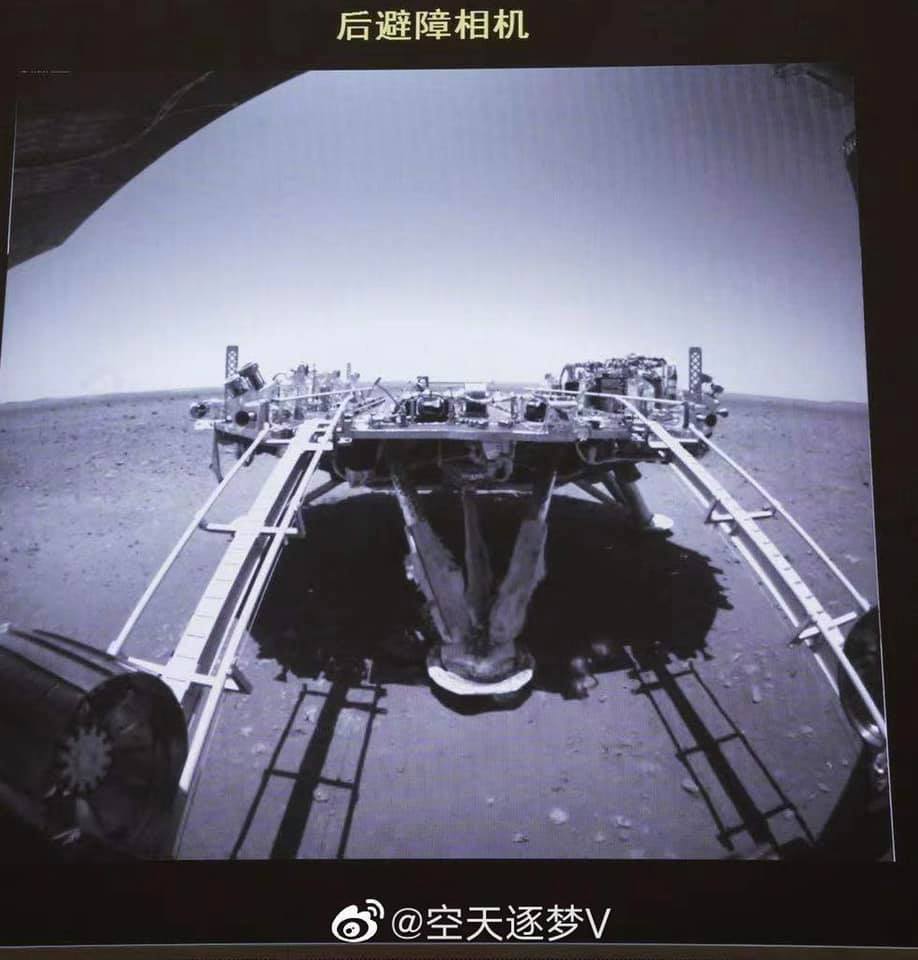
天问一号飞運騎遊達达3亿 …….As of 22nd  May 2021 CNSA – China National Space Administration– ESA – European Space agency Belt and road initiative mars mission…first Mars exploration mission, Tianwen- Martian Probe One …….”祝融号Zhu Rong” Mars Lander – Mars rover successfully sent back telemetry signals and landed on Mars with a complete success in which confirmed it’s now left the Mars Lander Platform National Space Administration that according to the telemetry data, at 10:40 on May 22, the “Zhu Rong” rover safely left the landing platform, reached the surface of Mars, and began to patrol and explore…….

The scientific goal of the Tianwen-1 mission is to study the morphology and geological structure characteristics of Mars, the characteristics of the soil on the surface of Mars and the distribution of water ice, the composition of the surface material on Mars, the ionosphere of Mars and the characteristics of the surface climate and environment, the physical field and internal structure of Mars… also any other scientifically explorations..

Since the probe was launched on July 23, 2020, during the ground-fire transfer flight and the ring-fire orbit operation, the orbiter is equipped with a medium-resolution camera, a high-resolution camera, a mineral spectrum Analyzer, a magnetometer and other 7 scientific instruments. The payload was started to detect and obtain scientific data. During the fire surface work, the rover will carry out environmental perception, fire surface movement and scientific detection in the patrol area as planned. Through the configuration of the terrain camera, multi-spectral camera, subsurface detection radar, surface composition detector and other 6 payloads, the inspection area Carry out detailed detection. At the same time, the orbiter will operate in the relay orbit to provide stable relay communication for the Mars rover patrol and detection, and take into account the development of surround detection.​​​​

At During  7:18 Hong Kong SAR – Beijing Time  on May 15th 2021 , the scientific research team confirmed according to the telemetry signal sent by the “Zhurong” Mars rover that the Tianwen 1 Landing Patrol successfully landed in the pre-selected landing zone in the southern Utopia Plain of Mars, and my country’s first Mars exploration mission landing on Mars was achieved. A complete success…..

At about 1 am, the Tianwen-1 probe was de-orbited in its parked orbit, maneuvering to Mars and entering orbit. At about 4 o’clock, the landing patrol was separated from the orbiter. After about 3 hours of flight, it entered the Martian atmosphere. After about 9 minutes of deceleration, hovering, obstacle avoidance and buffering, it successfully landed on the pre-selected landing zone. About 30 minutes after the two devices are separated; the orbiter will ascend and return to the parking orbit to provide relay communication for the landing patrol device. In the follow-up, the “Zhurong” rover will successively carry out global imaging of the landing site, self-check, leave the landing platform and carry out inspections.

images and visuals are from Weibo