#CNSA #ChinaNationalSpaceAdministration #国家航天局 |#BRI #June2024 | #嫦娥六号#Change6 South Pole-Aitken successfully Basin #LunarSampleReturnMission #DarksideOfTheMoon Chang’e 6 completes sampling and ascender takes off from the far side of the moon and enters the scheduled lunar orbit …

At 17:27 on May 3rd Friday 2024  Beijing time CNSA –China National Space Administration, the Chang’e-6 probe was successfully launched by the Long March 5 Yao-8 carrier rocket from the Wenchang Space Launch Site in Hainan Province,  China, People’s Republic of China., and accurately entered the Earth-moon transfer orbit. The launch mission was a complete success. The Chang’e-6 probe has embarked on the world’s first return journey for sampling from the far side of the moon. The pre-selected landing and sampling area is the South Pole-Aitken Basin on the far side of the moon.

[ Chang’e 6 completes sampling and ascender takes off from the far side of the moon and enters the scheduled lunar orbit]

According to the National Space Administration, at 7:38 today, the Chang’e 6 ascender carrying lunar samples took off from the far side of the moon. After the 3000N engine worked for about 6 minutes, it successfully sent the ascender into the scheduled lunar orbit.

From June 2 to 3, Chang’e 6 successfully completed intelligent and rapid sampling in the South Pole-Aitken Basin on the far side of the moon, and packaged the precious lunar far side samples in the storage device carried by the ascender in a predetermined form. During the sampling and packaging process, researchers simulated the geographical model of the sampling area and simulated sampling in the ground laboratory based on the probe data transmitted back by the Queqiao-2 relay satellite, providing important support for sampling decisions and operations in various links.

Intelligent sampling is one of the core key links of the Chang’e 6 mission. The probe withstood the high temperature test on the far side of the moon, and collected lunar samples by drilling with a drill and taking samples from the surface with a robotic arm, realizing multi-point and diversified automatic sampling.

嫦娥六号 The lander and ascender took a group photo] On June 3, 2024, the “mobile camera” carried by Chang’e 6 moved autonomously and successfully took and sent back a group photo of the lander and ascender

The Chang’e-6 lander was equipped with a landing camera, panoramic camera, lunar soil structure detector, lunar mineral spectrometer and other payloads that were powered on normally and carried out scientific exploration as planned, playing an important role in scientific exploration tasks such as lunar surface morphology and mineral composition detection and research, lunar shallow structure detection, etc. Before the probe drilled and sampled, the lunar soil structure detector analyzed and judged the underground lunar soil structure in the sampling area, providing data reference for sampling. The international payloads

carried by the Chang’e-6 lander, such as the European Space Agency’s lunar surface negative ion analyzer and the French lunar radon gas detector, worked normally and carried out corresponding scientific exploration tasks. Among them, the French lunar radon gas detector was powered on during the Earth-Moon transfer, lunar orbit phase and lunar surface working phase; the European Space Agency’s lunar surface negative ion analyzer was powered on during the lunar surface working phase. The Italian laser corner reflector installed on the top of the lander became a position control point that can be used for distance measurement on the back side of the moon.

After the surface sampling was completed, the five-star red flag carried by the Chang’e-6 lander was successfully unfolded on the back side of the moon. This is the first time that China has independently and dynamically displayed its national flag on the back side of the moon. The national flag is made of new composite materials and special technology. Due to the different landing position on the moon, the Chang’e 6 national flag display system has been adaptively improved on the basis of the Chang’e 5 mission.

Images and visuals are from their Respectives CMS China Manned SpaceCNSA-China National Space Administration

CNSA #ChinaNationalSpaceAdministration #國家航天局 |#BRI  #June2023 | #火星 # 天問 #天问一号#TianwenOne #MarsMission #Tianwen1 probe  #祝融号stunning First Mars Global Remote Sensing and Regional Patrol Exploration Mission photography #December2021 #AGallery Briefly


天问一号飞運騎遊達达3亿CNSA – China National Space Administration – ESA – European Space agency Belt and road initiative mars mission…first Mars exploration mission, Tianwen- Martian Probe One As of September 15, 2022, the Tianwen-1 orbiter has been in orbit for more than 780 days, and the rover has travelled a total of 1,921 meters, completed the established scientific exploration tasks, and obtained 1,480 GB of original scientific exploration data. The scientific research team has obtained rich scientific results through the research on the first-hand scientific data obtained independently by my country. Through a comprehensive study of typical landforms such as concave cones, barrier craters, and trenches distributed in the landing area, the important connection between the formation of the above-mentioned landforms and water activities has been revealed.

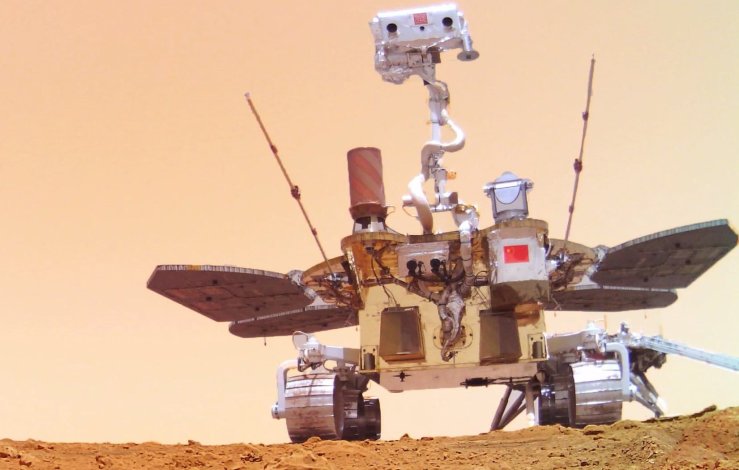
Currently as to date of the Zhurong Mars Rover is currently at sleep safe mode due to the Martian Sandstorms….. the location of Zhurong taken by the Tianwen-1 orbiter after it hibernated in Zhurong last year. The rut marks left by Zhurong after traveling 1921 meters are clearly visible….. The local dust on Mars captured by the Tianwen-1 orbiter is very layered. This photo was taken by the medium-resolution camera of the Tianwen-1 orbiter on January 6, 2022, and Zhurong went into a dormant state more than three months after this time point. 

On the week of 6th June 2023 there have been new images release of the CNSA –CLEP Mars The Lunar and Planetary Data Publishing System released a new batch of Tianwen-1 data today, including a large number of Martian surface photos taken by the obiter’s medium-resolution camera! The total number is estimated to be hundreds to thousands!  But here are some stunning incredible randomly selected a few pictures is beautiful in which has been process during the Month of December 2021 at the time when before the Martian Sandstorm!

Some of the images taken by the Zhurong rover in December 2021 come from the latest data released by the China Planetary Exploration Engineering Ground Application System

中国planet detection…. First Mars Global Remote Sensing and Regional Patrol Exploration Mission


The second batch of publicly released data is the Korolev crater (Korolev). This picture is made by mosaicing 8 orbiter medium resolution camera (MoRIC) images obtained by searching in an area with (72.77N, 164.58E) as the center and a search radius of 300 km. It was taken at detection periods 656 and 677 and 698, using OpenCV, SKImage, Lr for processing. [CAS/GRAS, CNSA/PEC; export production…..


Northeast of the Utopia Plain, west of Mie (Mie), the pirate who landed here in 1976 The impact craters in the area around the No. 2 lander are mostly named after the launch sites, measurement and control stations and other aerospace facilities in various countries in the 1970s. Among them, Xuancheng Meteor Crater (Hsūanch’eng) is named after Xuancheng City, Anhui Province. my country’s early suborbital sounding rocket launch site – Guangde Rocket Launch Site (603 Base) is located in Shijie Town, Guangde City, Xuancheng City. This is the main site for the T-7 series of sounding rockets to conduct meteorological, biological, and new technology flight tests in the 1960s. It is also the place where the brave flying pathfinding dogs “Little Leopard” and “Shanshan” set off in July 1966.


(Figure 5 shows the first flight of the T-7A rocket, and Figure 6 shows the puppy carrying out the vibration test before the flight.) 3 MoRIC images were mosaiced, taken on December 3, 2021-detection cycle 641, and processed using OpenCV, SKImage, Lr and Ps. [CAS/GRAS, CNSA/PEC; export production:

Images and visuals are from their respectives also CNSA China National Space AdministrationCLEP China Lunar Exploration Program.

CNSA #ChinaNationalSpaceAdministration #國家航天局 |#BRI  #June2023 | #火星 # 天問 #天问一号#TianwenOne #MarsMission #Tianwen1 probe  #祝融号 stunning Martian landscape new stunning Mars Orbitally  Selected photography during the year #December2021 #AGallery   ——-

 天问一号飞運騎遊達达3亿CNSA – China National Space Administration – ESA – European Space agency Belt and road initiative mars mission…first Mars exploration mission, Tianwen- Martian Probe One As of September 15, 2022, the Tianwen-1 orbiter has been in orbit for more than 780 days, and the rover has travelled a total of 1,921 meters, completed the established scientific exploration tasks, and obtained 1,480 GB of original scientific exploration data. The scientific research team has obtained rich scientific results through the research on the first-hand scientific data obtained independently by my country. Through a comprehensive study of typical landforms such as concave cones, barrier craters, and trenches distributed in the landing area, the important connection between the formation of the above-mentioned landforms and water activities has been revealed.

Currently as to date of the Zhurong Mars Rover is currently at sleep safe mode due to the Martian Sandstorms….. the location of Zhurong taken by the Tianwen-1 orbiter after it hibernated in Zhurong last year. The rut marks left by Zhurong after traveling 1921 meters are clearly visible….. The local dust on Mars captured by the Tianwen-1 orbiter is very layered. This photo was taken by the medium-resolution camera of the Tianwen-1 orbiter on January 6, 2022, and Zhurong went into a dormant state more than three months after this time point. 

On the week of 6th June 2023 there have been new images release of the CNSA –CLEP Mars The Lunar and Planetary Data Publishing System released a new batch of Tianwen-1 data today, including a large number of Martian surface photos taken by the obiter’s medium-resolution camera! The total number is estimated to be hundreds to thousands!  But here are some stunning incredible randomly selected a few pictures is beautiful in which has been process during the Month of December 2021 at the time when before the Martian Sandstorm!

Some of the images taken by the Zhurong rover in December 2021 come from the latest data released by the China Planetary Exploration Engineering Ground Application System.


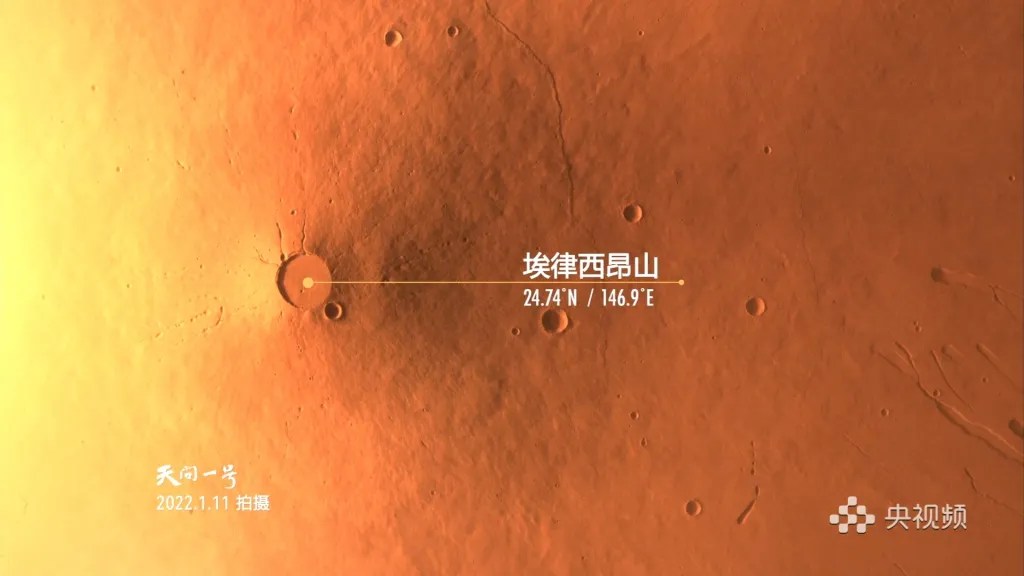
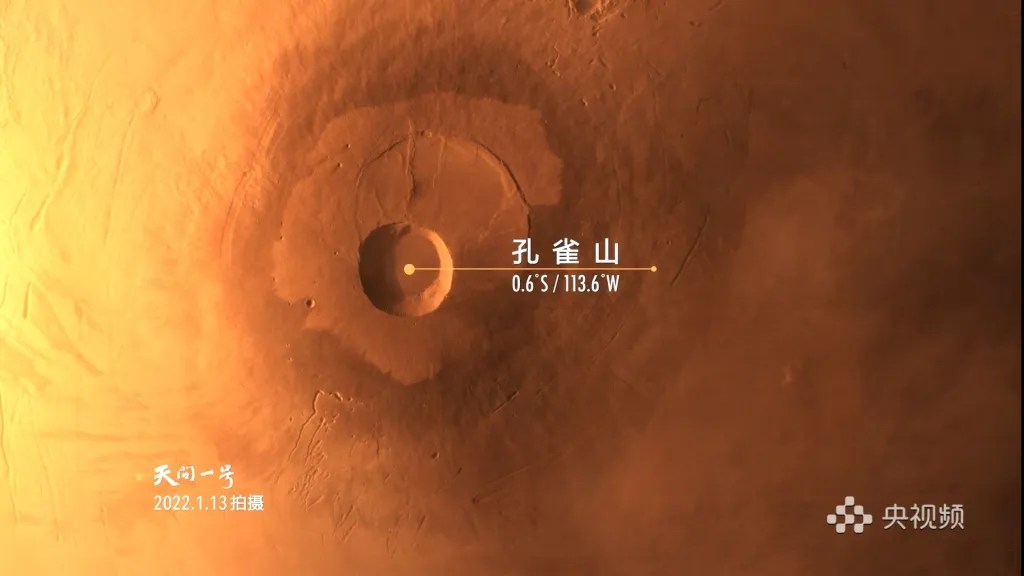
The famous Olympus Mons (Olympus Mons), a giant shield volcano on the northwest side of Mars Tharsis (Tharsis). This image is stitched together from 6 MoRIC images selected from the December 2021-detection cycle 00734 data released today, and processed using OpenCV, SKImage, and Lr. [CAS/GRAS, CNSA/PEC; export production

Selected from the December 2021 data set of the medium-resolution camera of the Tianwen-1 orbiter, source: China Planetary Exploration Engineering Ground Application System​​​​….

On August 15, 2021, the “Zhurong” rover successfully completed the 90 Martian scientific exploration missions, and continued to carry out extended exploration missions. It has traveled 1,921.5 meters on the surface of Mars. Affected by the severe winter cold and dusty weather in the landing area, the rover will enter the winter dormancy mode on May 18, 2022 as designed. Around December 2022, the “Zhurong” landing area will enter the early spring season. will resume normal work.

The orbiter has circled Mars 1,344 times, achieving global coverage and is currently in normal condition. In the follow-up, it will continue to carry out global remote sensing detection, and choose an opportunity to carry out expansion technology experiments to carry out preliminary technical verification for related tasks.

After nearly two years of flight and exploration for the Tianwen-1 mission, the 13 scientific payloads deployed by the rover and orbiter have obtained a total of about 1040GB of raw scientific data. After receiving and processing on the ground, the standard scientific data products formed are submitted to the rover on a monthly basis. A team of scientists has conducted analysis and interpretation, and relevant scientific results have been published in well-known academic journals at home and abroad. These scientific data will be open to scientists around the world at an appropriate time. Scientists around the world are welcome to actively apply for research and jointly promote the cause of human exploration of the universe.

At present, the Tianwen-1 orbiter continues to carry out scientific exploration in the orbit of the remote sensing mission, continues to accumulate first-hand scientific data, and makes China’s contribution to mankind’s in-depth understanding of Mars.
 ​​​​

Images and visuals are from CNSA China National Space AdministrationCLEP China Lunar Exploration Program.

#CNSA #ChinaNationalSpaceAdministration #国家航天局 | #BRI  #August2022 the #Xihe #SolarObservation #SolarProbe #Satellite The official release of  #羲和“#Xihe” sun exploration results set a number of international first …

At 1851 Hours Morning Hong Kong Beijing Time  on a very clear 14th October 2021 Thursday 2021, China- People’s Republic of China- CNSA –China National Space Administration   Successfully launched  the Long March-Chang Zheng 2D carrier rocket at the Taiyuan Satellite Launch Center Shanxi Province   China successfully launched Long March – Chang Zheng 2D carrier rocket at the Taiyuan Satellite Launch Center to successfully launched the Xihe Solar Probe  also other satellites into orbit…. Making this launch into this mission is the 391th flight of the International Iconic Chang Zheng- Long March series of carrier rockets…..

Successfully launching At 18:51 on October 14, 2021, Beijing time, China used the Long March 2D carrier rocket at the Taiyuan Satellite Launch Center to successfully combine solar Hα spectrum detection with dual super platform science and technology the test satellite was launched into space… . 

On 31st August 2022羲和the Team of Xihe Sun exploration results officially released…..The official release of “Xihe” sun exploration results set a number of international “firsts”…… A reporter from the Global Times learned from the National Space Administration on the 30th that on the same day, China’s first solar exploration science and technology test The results of the satellite “Xihe” were officially released. The “Xihe” Sun Exploration Achievement Conference is mainly focused on solar scientific exploration and new satellite technology, setting five international firsts.

The full name of “Xihe” is the solar Hα spectral detection and double-super-platform science and technology experiment satellite. It was launched on October 14, 2021 and operates in a sun-synchronous orbit with an average altitude of 517 kilometers. The main scientific payload is the solar Hα imaging spectrometer. . As my country’s first dedicated solar “photographer”, after preliminary on-orbit testing and debugging, “Xihe” has successfully achieved the world’s first space solar Hα band spectral scanning imaging, and the world’s first in-orbit acquisition of solar Hα and SiΙ spectral lines and the fine structure of FeI lines. According to the fine structure of these spectral lines, high-precision all-solar chromospheric and photospheric Doppler velocity fields can be inferred, and the activities occurring in the solar atmosphere can be recorded in detail, so as to study the physical process of solar activity. At present, the “Xihe” is carrying out scientific observations every day according to the established mission plan. Nearly 100 solar eruptions have been observed, and related research work is being carried out. The scientific data of “Xihe” is open to the world for sharing.


In addition to the achievements in solar scientific exploration, in terms of new satellite technology experiments, “Xihe” International has achieved the first time the master-slave collaborative non-contact “double super” (ultra-high pointing accuracy, ultra-high stability) satellite platform technology on-orbit performance Verification and engineering application; realized the in-orbit application of the world’s first solar space Hα imaging spectrometer; realized the in-orbit verification of the world’s first atomic frequency discrimination solar velocimeter. A slight vibration of the satellite load in space will make the imaging effect poor by the slightest and a thousand miles away. The “Double Super” satellite platform breaks the technical bottleneck of “unpredictable and difficult to control” micro-vibration of the traditional satellite platform, and adopts the maglev control technology to completely isolate the physical contact between the platform and the payload, ensuring that the payload imaging is not affected by the platform disturbance, allowing its Taking pictures is “more stable and more accurate”, and the attitude control level of my country’s satellite platform has been improved by 1 to 2 orders of magnitude, reaching the international advanced level. In the future, the dual-superplatform technology will be popularized and applied in a new generation of space missions such as high-resolution remote sensing, three-dimensional solar detection, and exoplanet discovery, promoting the leap-forward development of my country’s space technology.


“Imitate Xi and Yu Tianma, and aim to herd the stars in the sky.” Over the past year, the National Space Administration has organized the Aerospace Science and Technology Group, Nanjing University, Chinese Academy of Sciences and other mission-contracting units to successfully complete the on-orbit test and experiment of the “Xihe” spacecraft, and achieved major achievements in the “Xihe” sun exploration. It is a model project of cooperation between government, industry, academia, research and application. At present, the National Space Administration has organized relevant units to put forward a series of mission plans such as solar detection at the L5 point of the sun, solar polar orbit detection, and solar approach detection. Evolution contributes to the development of human scientific civilization….

Images and visuals are from Weibo also their respectives..

#CNSA #ChinaNationalSpaceAdministration #國家航天局 |#BeltAndRoadinitiative #May2022 | #火星 # 天問 #天问一号#TianwenOne #MarsMission #Tianwen1 probe  #祝融号 #ZhuRong #Tianwen1 #CCTV #HelloMars Episode Three-  What’s the Difference between Mars and Earth? What new discoveries have Tianwen-1 “Orbiting” Mars?

“Hello! Mars Episode 3 What’s the Difference between Mars and Earth? What new discoveries have Tianwen-1 “circled” Mars? Hello Mars……!

On the months week of  19th May 2022   天问一号飞運騎遊達达3亿CNSA – China National Space Administration – ESA – European Space agency Belt and road initiative mars mission…first Mars exploration mission, Tianwen- Martian Probe One  sent back stunning images of the Half Earth Mass size of the Rustic Planet Mars in which show stunning Martian landscape with its iconic polar caps of either southern or northern … With its timeless Stunning Mars Photography. Tianwen-1″ returned high-resolution images of the Mars inspection area The “Zhurong” rover is preparing for winter, and the orbiter continues to carry out orbital exploration….. in which one year ago it was it’s first landing on Utopia Planitia region on the planet Mars .. in celebrating a CCTV five part Episode was produced..

《你好!火星》Hello Mars Episode Three The content of this issue: On February 10, 2021, 202 days have passed since the launch of Tianwen-1. After a trek of 475 million kilometers, Mars is close at hand. At this time, the earth has circled the sun and has walked half a circle. Mars Falling behind, it is nearly 200 million kilometers away from the earth, and it takes 11 minutes for light to travel this distance. The main engine nozzle of the orbiter is facing forward, and it is about to ignite and brake. After a series of operation controls, Tianwen-1 has become an artificial Mars satellite.

本期内容:2021年2月10日,距离天问一号发射已经过去了202天,经过4.75亿公里的跋涉,火星近在眼前,此时地球已经绕着太阳,走过了大半圈,火星落在了后面,距离地球将近两亿公里,光线飞越这段距离也需要11分钟。环绕器主发动机喷口朝前,即将点火制动刹车,经过一系列的操作控制,天问一号成为了人造火星卫星。

Hello everyone, I would like to tell you some good news about the documentary “Hello!” about China’s first Mars exploration mission. “Mars” is finally on the air, friends who want to know more about Mars can stay in front of the TV tonight

“Hello! “Mars” is a large-scale scientific documentary jointly produced by the National Space Administration and China Central Radio and Television to commemorate the first anniversary of the Tianwen-1 Mars probe’s successful landing on Mars. It took three years to complete the filming and is divided into “Departure” and “Journey” “Surrounding”, “Landing” and “Patrol” have 5 episodes, each of which is 30 minutes long. They focus on the important stages of the Tianwen-1 mission, and describe a large number of astronomy, astrophysics, space applications, aerospace engineering and other disciplines in a simple way. Knowledge, in-depth analysis of Chinese wisdom and Chinese solutions in Mars exploration. Since May 2020, the co-production team has continued to track the key nodes of the Tianwen-1 mission, filmed many wonderful moments, and obtained a large number of first-hand precious materials. Many of the contents of the documentary were made public for the first time and were released authoritatively.


Broadcasting plan CCTV-1 CCTV integrated channel every night at 22:36, five days of continuous broadcast from May 18th to 22nd; CCTV-10 CCTV science and education channel every night at 20:10, from May 19th to 23rd five days of continuous broadcast

大家好,告诉大家一个好消息,讲述中国首次火星探测任务的纪录片《你好!火星》终于要开播啦,想更多了解火星的朋友们今晚可以守在电视机前哟《你好!火星》是为纪念天问一号火星探测器成功着陆火星一周年,由国家航天局和中央广播电视总台联合出品的大型科学纪录片,共历时3年摄制完成,分为《出发》《征途》《环绕》《着陆》《巡视》5集,每集30分钟,分别聚焦天问一号任务的重要阶段,以深入浅出的形式讲述了大量天文学、天体物理学、空间应用学、航天工程学等学科知识,深度解析了火星探索中的中国智慧、中国方案。联合摄制团队自2020年5月起,持续跟踪天问一号任务关键节点,拍摄众多精彩瞬间,获得大量一手珍贵素材,纪录片中很多内容是首次公开,并权威发布。


播出计划CCTV-1央视综合频道 每晚22:36,5月18日至22日五天连播;CCTV-10央视科教频道 每晚20:10,5月️19日至23日五天连播

Images and visuals are from CNSA- China National Space Administration also from there respectives- CLEP –China Lunar Exploration Project..