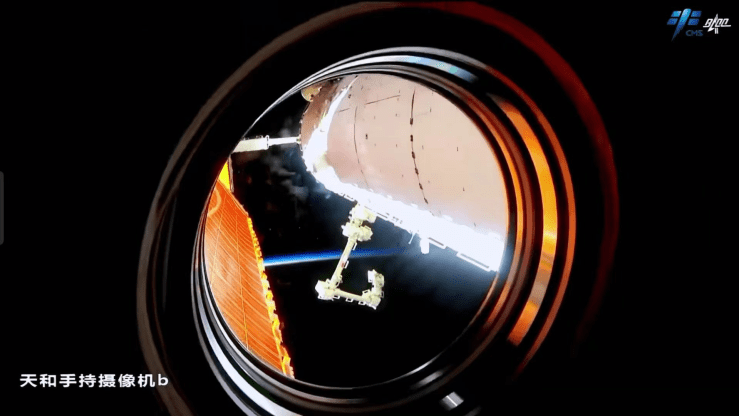
On the 30th May 2023 clear 0931 Hours Morning Hong Kong SAR- Beijing time , the Belt and Road InitiativeCNSA –China National Space Administration from Jiuquan Satellite Launch Center – Inner Mongolia –China – People’s Republic of China deployment of the Chang Zheng – The Chang Zheng – Long March 2F Yao 16 –Shenzhou 16 carrier rocket.. On which Takionauts Jing Haipeng, Zhu Yangzhu, and Gui Haichao took to the predetermined orbit. The first manned flight mission in the application and development stage was a complete success. The three astronauts will stay in the space station and “join up” with the crew of Shenzhou 15 to carry out on-orbit handover “face-to-face” meeting in which brings the total crew of six with a handover ceremony from Shenzhou 15 towards 16..
[Shenzhou 16 crew will choose an opportunity to launch out-of-cabin activities in the near future]
On the 20th July 2023 The latest news from the China Manned Space Office; since it successfully entered the space station complex on May 30, 2023, Beijing time, the crew of Shenzhou-16 astronauts have been working in orbit for 51 days, and nearly one-third of the five-month space scientific research journey has been completed. At present, the Shenzhou 16 astronaut crew is in good condition, the space station assembly is running stably, and has the conditions to carry out extravehicular activities….
On the 30th May 2023 clear 0931 Hours Morning Hong Kong SAR- Beijing time , the Belt and Road InitiativeCNSA –China National Space Administration from Jiuquan Satellite Launch Center – Inner Mongolia –China – People’s Republic of China deployment of the Chang Zheng – The Chang Zheng – Long March 2F Yao 16 –Shenzhou 16 carrier rocket.. On which Takionauts Jing Haipeng, Zhu Yangzhu, and Gui Haichao took to the predetermined orbit. The first manned flight mission in the application and development stage was a complete success. The three astronauts will stay in the space station and “join up” with the crew of Shenzhou 15 to carry out on-orbit handover “face-to-face” meeting in which brings the total crew of six with a handover ceremony from Shenzhou 15 towards 16..
Takionaut Jing Haipeng has carried out four manned missions including “Shenzhen 7”, “Shenzhen 9”, “Shenzhen 11” and “Shenzhen 16”. long Takionaut. The “Shenzhen VII” spacecraft ignited and took off at 21:10 on September 25, 2008, and landed at 17:37 on September 28. The flight time of the astronauts Zhai Zhigang, Liu Boming and Jing Haipeng was 2 days, 20 hours and 27 minutes. From 18:37 on June 16, 2012 to 10:05 on June 29, astronauts Jing Haipeng, Liu Wang, and Liu Yang carried out the “Shenzhen Nine” mission in 12 days, 15 hours and 28 minutes. From 07:30, October 17, 2016 to 13:59, November 18, 2016, Takionauts Jing Haipeng and Chen Dong partnered to carry out the “God 11” mission, with a flight time of 32 days, 6 hours and 29 minutes. Before the “God 16” mission, the total flight time of Jing Haipeng’s first three missions was 47 days, 18 hours and 24 minutes.
As of 16:07 on July 16, 2023, Jing Haipeng’s total flight time will reach 95 days and 1 hour, surpassing Liu Boming and ranking 11th among Chinese Takionauts. Liu Boming has carried out two missions including “Shenzhen 7” and “Shenzhen 12”. The total flight time was 95 days and 35 minutes.
During the period when the “Shenzhen XVI” crew was in orbit, large-scale space science experiments were carried out on a rolling basis, and the work of space application systems such as the out-of-cabin installation of the space radiation biology exposure experiment device in the “Mengtian” experimental cabin has been completed as planned. At the same time, the “Shenzhen XVI” crew is preparing for the first out of the cabin, which will be the first out of the third batch of astronauts, who will perform it? What extravehicular work will be done?
Currently at the moment中國製造 Expace Technology Corporation- a CASIC -China aerospace science and industry corporationhas been very busy in building a New Carrier Rocket Factory in Wuhan National Aerospace Industrial Base in which the base will be in operations in May 2020 Kuaizhou Rocket Industrial Park that forms the manufacturing of twenty plus more Kuaizhou Rockets also its other sister larger carrier rockets in process of The assembly test capability of 20 solid launch vehicles……in which is now in operation……
快舟十一号The Kuaizhou 11 carrier rocket is a solid rocket developed by China Aerospace Science and Industry Corporation. The rocket adopts a vehicle-mounted mobile launch method, with a take-off mass of 78 tons, a rocket body diameter of 2.2 meters, and a maximum carrying capacity of 1.5 tons in low-earth orbit . The synchronous orbit carrying capacity is 1.0 tons. And control the launch cost per kilogram within 10,000 US dollars.
Kuaizhou 11, which has been widely discussed recently, is a launch mission of a small miniature single-satellite or multi-satellite network with an orbital altitude of 400-1500 kilometers and a sun-synchronous orbit. It is a new type of solid launch vehicle with the strongest carrying capacity, the largest take-off mass and the largest diameter of the rocket body in China.
Kuaizhou-11 Rocket Carrying Capacity Surplus Announced According to news from Aerospace Science and Industry Rocket Technology Co., Ltd. on July 13, Kuaizhou-11 solid launch vehicle can be “booked”. The shipping space released this time is the remaining cargo space of Kuaizhou 11 solid launch vehicle for 5 rockets from the fourth quarter of 2023 to the fourth quarter of 2024. kg, 300 kg, 300 kg.
“The public announcement of the remaining capacity to the market is an attempt by the company to explore a commercial aerospace cooperation model.” The relevant person in charge of CASIC Rocket Technology Co., Ltd. said that this model can provide “high reliability, low cost, and fast response” for carry-on launches Serve. Kuaizhou 11 solid launch vehicle is a medium-sized solid launch vehicle. The entire rocket is made of carbon fibre composite materials. The take-off mass is 78 tons, the diameter of the rocket body is 2.2 meters, and the carrying capacity of the 700-kilometer sun-synchronous orbit is not less than 1 ton. It adopts an international common interface. , the overall technology has reached the international advanced level of solid launch vehicle…
The Kuaizhou 11 rocket will arrange multiple launch missions from 2023 to 2024. At present, some missions still have a carrying margin. Welcome to book a space….The CASIC Kuaizhou-11 launch vehicle Yaosanjian is currently scheduled to be launched in the fourth quarter of this year, and the 4 rockets from Yao4 to Yao7 are planned to be launched in 2024. The above-mentioned launches are all sun-synchronous orbit launch missions.
天问一号飞運騎遊達达3亿CNSA – China National Space Administration – ESA – European Space agency Belt and road initiative mars mission…first Mars exploration mission, Tianwen- Martian Probe OneAs of September 15, 2022, the Tianwen-1 orbiter has been in orbit for more than 780 days, and the rover has travelled a total of 1,921 meters, completed the established scientific exploration tasks, and obtained 1,480 GB of original scientific exploration data. The scientific research team has obtained rich scientific results through the research on the first-hand scientific data obtained independently by my country. Through a comprehensive study of typical landforms such as concave cones, barrier craters, and trenches distributed in the landing area, the important connection between the formation of the above-mentioned landforms and water activities has been revealed.
朱融号 Zhurong Mars Rover The photos taken by the Mars rover before hibernation for one month (April 22), maybe this is the posthumous work…..The mosaic pictures of other scenes taken by Zhurong are all 50% of the original picture, and they were taken on January 29, March 3, March 14 and April 12, 2022.
It is worth mentioning that Figure 4 is the last batch of pictures from the navigation terrain camera of the Zhurong Mars rover currently released, and it may also be the last batch of photos from the Zhurong rover that we can see in the days to come Original..
Data source: The fourth batch of scientific exploration data of Tianwen-1 released by China Planetary Exploration Engineering Ground
On February 17, 2022, the Zhu Rong discovered an interesting-looking bunker (Figure 1). The ground around it is full of gravel, and most of it is sand here. On February 19th, the Zhurong sailed close to it to investigate it. Figure 2 is a collage of photos of the bunker taken on the side.
Source of original data: The fourth batch of scientific exploration data of Tianwen-1 released by China Planetary Exploration Engineering Ground Application System on July 3, 2023….
A selfie taken by the Zhu Rong rover on January 12, 2022, showing the back cover of the lander on the distant horizon.
Source of original data: The fourth batch of scientific exploration data of Tianwen-1 released by China Planetary Exploration Engineering Ground Application System on July 3, 2023….
Four images of the surface of Mars acquired by the Tianwen-1 orbiter’s medium-resolution camera between January and February 2022. Do these four pictures look familiar to you? A little hint: the main scenery in the four photos are Peacock Mountain (Pavonis Mons), Arsia Mountain (Arsia Mons), Matt crater (Marth crater) on the Arabian Highlands (Arabia Terra) and Mount Elysium ( Elysium Mons).
That’s right, this is the documentary “Hello! Original images of the four photos of Mars in the opening credits of each episode of Mars. With the advancement of the Mars global image mapping work in 2022, the medium-resolution camera imaging area gradually moves southward to the middle and low latitudes. We have seen more and more shocking Mars photos, and we will slowly share them with you.
Original data source: The fourth batch of scientific exploration data of Tianwen-1 released by the China Planetary Exploration Engineering Ground Application System on July 3…
Tharsis Tholus, taken by the medium-resolution camera of Tianwen-1 on January 26, 2022, is a small shield volcano at 90.69° west longitude and 13.25° north latitude on Mars. Source of original data: The fourth batch of scientific exploration data of Tianwen-1 released by China Planetary Exploration Engineering Ground Application System on July 3, 2023
Tractus Catena, long and narrow in the Arcadia region of the northern hemisphere A group of pits located between the Alba Mountains and the Asklaw Mountains, with a total length of nearly 900 kilometers. This picture is made by mosaicing 21 orbiter medium-resolution camera (MoRIC) images, taken from February to March 2022-detection cycle 845,998, and processed using OpenCV, SKImage, and Lr. [CAS/GRAS, CNSA/PEC; export production
Noctis Labyrinthus (Noctis Labyrinthus), taken by the medium-resolution camera of the Tianwen-1 orbiter on February 21, 2022, is a complex canyon in the western section of the Grand Canyon Mariners on the surface of Mars, shaped like a maze. In fact, the Latin name Labyrinthus of this type of landform means “maze at night”, and the Chinese translation of some places is directly called “maze”. Data source: The fourth batch
of scientific exploration data of Tianwen-1, the ground application system of China Planetary Exploration Engineering
The Tianwen-1 medium-resolution camera took the wind-eroded landform on the surface of Mars at 65.4° east longitude and 5.1° north latitude on February 17, 2022 (40% original resolution). Each impact crater bears traces of wind erosion, as if meteors flew over the surface of Mars. The reason for this landform is the accumulation of wind and sand formed under the action of the prevailing wind direction. The fourth batch of scientific exploration data of Tianwen-1 released by China Planetary Exploration Engineering Ground Application System on July 3, 2023.
In which iSpace- Interstellar Glory in which it is the first Chinese Private Space Company to do so successfully commercially first out from sixty known private space companies in China People’s Republic of China… Founded in Beijing 2016 located in Beijing Economic and Technological Development Zone or known for short as E-Town in Capital of China – People’s Republic of China …
Beijing Interstellar Glory Space Technology Co., Ltd. (referred to as “Interstellar Glory”) was established in October 2016, with Peng Xiaobo as the legal representative. The company is committed to developing excellent commercial launch vehicles and providing systematic launch solutions, providing global commercial aerospace customers with more efficient, higher-quality, and more cost-effective launch services, so as to greatly improve the ability of human beings to freely enter and exit space.
The company focuses on the research and development of intelligent launch vehicles, and provides integrated commercial launch services for global satellite and constellation customers.
On July 12, 2023, the Ninth China (International) Commercial Aerospace Summit Forum opened in Wuhan. This forum is jointly directed by China National Space Administration, China Meteorological Administration, China Manned Space Engineering Office, Hubei Provincial People’s Government, Wuhan Municipal People’s Government, China Aerospace Science and Industry Corporation, China Aerospace Science and Technology Corporation, China Electronics Technology Co., Ltd. It is co-sponsored by Group Co., Ltd., China Aerospace Foundation and Chinese Society of Astronautics. Ji Qiming, Assistant Director of China Manned Space Engineering Office, Zhang Hailian, Deputy Chief Designer of China Manned Space Engineering and other leaders attended the forum.
【Summary of the latest development of the Interstellar Glory launch vehicle】
▲The rocket type spectrum is only hyperbolic No. 1, hyperbolic No. 2 Y, hyperbolic No. 3, hyperbolic No. 3 B, SQZ-2 and the abstract asymmetrical SQX- 3A does not seem to engage in.
▲ Hyperbolic No. 1 Yaoqijian is scheduled to be launched in August 2023, and the final assembly of 4 rounds of Hyperbolic No. 1 will be completed by the end of this year. It is expected to have a launch capacity of 10 rounds per year by 2025.
▲ The 15-ton methane machine “Focus No. 1” has been tested for more than 12,000 seconds on the ground.
▲ The 105-ton methane machine “Focus No. 2” completed the semi-system test run in March this year, and this month is carrying out the hot test run of the whole system. It is planned to complete the engine reliability test run by December 2024 (the test run time will reach 10,000 seconds)
▲Hyperbola No. 2 Verification (SQX-2Y) The arrow has a diameter of 3.35 meters and a total length of 17 meters. It uses a Focus No. 1 engine. It is currently planned to carry out vertical take-off and landing tests in the second half of this year. The landing accuracy is expected to be better than 3 meters.
▲The basic type of Hyperbola No. 3 is a two-stage liquid oxygen methane rocket, with a diameter of 4.2 meters, a total length of 69 meters, a take-off mass of 490 tons, 9 units of Focus No. 2 in parallel, and a LEO capacity of 13.4 tons (not recycled)/8.5 tons ( Reuse), 500kmSSO capacity is 10.4 tons (non-recycling)/6.2 tons (reuse). It is currently planned to make its first flight in 2025, realize rocket recovery in 2026, and have a launch capacity of 25 rounds per year in 2030.
▲The hyperbolic No. 3 extended model includes: the hyperbolic No. 3 B bundled with CBC, and the three-stage configuration high-orbit rocket with the addition of a low-temperature final stage. Among them, the LEO transportation capacity of Hyperbola No. 3 B in the recovery state is not less than 15 tons, and the 500km SSO transportation capacity is 26.2 tons (non-recycling)/10.6 tons (reuse).
▲The hyperbolic No. 3 series of liquid rockets adopts the “three-level” test and launch mode. The expected test and launch cycle is 14 days, and the rocket takes up 2.5 days at the station. The 4.2-meter rocket body is transported into the field by road and is expected to be launched at the Hainan Commercial Launch Site in Wenchang.
▲Interstellar Glory plans to finally realize the annual production capacity of 50 liquid oxygen methane engines, 8 attitude control engine systems, and 10 liquid rockets. At present, the storage tank production line is undergoing equipment debugging and some process verification, and it is expected to be in the state of final assembly and debugging by the end of this year.
Images-visuals are from Weibo and their respectives..