#CNSA #ChinaNationalSpaceAdministration #国家航天局 | #BRI #July2023 |#CASC #ChinaAerospaceScienceAndTechnologyCorporation – #长征十号 #MannedCarrierRocket #CarrierRocketFreighter  #3DPrinting #CarrierRocketEngine Testing the #ChangZheng10 #LongMarch10 engine at Thrust of 130 Tons Successfully …..

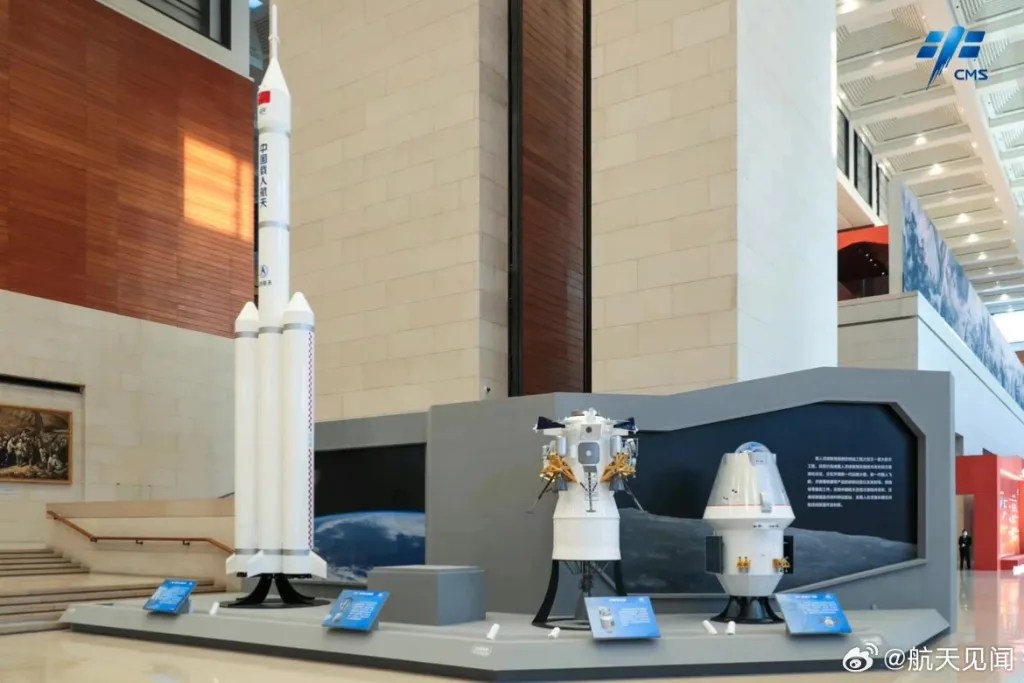
长征十号 At 22nd  23rd July  2023 Hong Kong SAR- Beijing time , China- People’s Republic of China- CNSA –China National Space Administration   Successfully Carrier Rocket  engine tested for the New Next Generation Chang Zheng – Long March 10 Manned Lunar mission landing Carrier rocket freighter The main engine of China’s manned lunar landing rocket Long March 10 completed another ignition test run yesterday, which verified all the requirements of the rocket mission for the engine, and provided strong support for the solidification of the engine’s technical status, the establishment of product technology baselines, and the improvement of reliability.


The engine used in this test run uses advanced liquid oxygen kerosene as fuel, which is improved and iterated from the high-thrust liquid oxygen kerosene engine used by the new generation of launch vehicles such as the active Long March 5, with a thrust of 130 tons. (The Sixth Academy of Aerospace Science and Technology Group)

Created with GIMP

The reporter learned from China Aerospace Science and Technology Group Co., Ltd. on July 23 that the main engine of my country’s manned moon landing rocket was tested in the Fengzhou Test Area of ​​the Sixth Academy of Aerospace Science and Technology Corporation, and achieved continuous success. This test run verified the engine flight mission profile, and provided strong support for the solidification of the engine technical state, the establishment of the product technical baseline, and the improvement of reliability.

The engine is the power source of the rocket, and its development process is very complicated. Test run is an important link in the engine development process, and there are dozens of types. In layman’s terms, engine test run is the process of igniting the engine and verifying the rationality of its design scheme and process reliability. This is an indispensable and important part of the development and delivery of a type 1 engine. It will run through all stages before and after engine development. Each stage of test run has different meanings, and the ignition time varies from a few seconds to hundreds of seconds.

It is reported that the engine used in this test run uses advanced liquid oxygen kerosene as fuel, which is improved and iterated from the high-thrust liquid oxygen kerosene engine used by the new generation of launch vehicles such as the Long March 5. The thrust reaches 130 tons. The R&D team of the Sixth Academy of Aerospace Science and Technology Group adheres to the concept of digital design, and has successively overcome key technical problems such as engine start-up and shutdown sequence, engine wide-range continuously variable thrust, and engine long life and high reliability.

In addition, the continuous success of the test run has fully verified the reliability of a number of new carrying process technologies. The engine production of this test run adopts the concept of intelligent manufacturing, and actively applies new materials, new processes, and new technologies. The inner wall of the thrust chamber of the core component adopts a new protective coating, key assemblies adopt automatic welding technology, and a large number of components adopt 3D printing technology.

During the preparation of the engine test run, the participants in the research and test conducted tests and verifications on each subsystem of the test through comprehensive means such as digital modelling, simulation calculation, and system debugging. The successful test run shows that the test area has greatly improved the multi-station parallel test run capability and test efficiency by optimizing the workflow.

Images and visuals are from their Respectives CMS China Manned SpaceCNSA-China National Space Administration  the Sixth Academy of Aerospace Science and Technology Group

#CNSA #ChinaNationalSpaceAdministration #国家航天局 | #太原卫星发射中心 #BRI #July2023|# #TaiyuanSatelliteLaunchCenter  – International Iconic #ChangZheng2D  #LongMarch2D  yao 91  #CarrierRocket in launched to deploy successfully four #Satellites # Sixiang # Yinhe #GalaxyAerospace #Lingxi .. #RemoteSensing #Telecommunications

At 1050 Hours Hong Kong SAR- Beijing Time  23rd July  2023 , China- People’s Republic of China- CNSA –China National Space Administration   Successfully launched  the New Next Generation Long March – Chang Zheng2D Yao 91 …..At 10:50 on July 23, the Chang Zheng- Long March 2D carrier rocket was ignited and blasted off at the Taiyuan Satellite Launch Center Shanxi Province.. Subsequently, the rocket successfully sent a total of four satellites, Sixiang 01~03 and Yinhe 03, into the predetermined orbit, and the launch mission was a complete success.

The four satellites launched this time are provided by the Great Wall Company, a subsidiary of China Aerospace Science and Technology Corporation, as the project contractor to provide launch services. The Chang Zheng- Long March 2D carrier rocket used for this launch mission is a room temperature liquid two-stage launch vehicle developed by the General Manager of the Eighth Academy of China Aerospace Science and Technology Corporation. It has the ability to launch single and multiple satellites with different orbital requirements, and has a carrying capacity of 1.3 tons corresponding to a 700-kilometer sun-synchronous orbit.

Sixiang 01~03 satellites are collectively referred to as Sixiang Group A multi-source remote sensing satellites. Among them, Sixiang 01 satellite is developed by Beijing Sixiang Aishu Technology Co., Ltd.; Sixiang 02~03 satellites are developed by Yinhe Aerospace (Beijing) Network Technology Co., Ltd. The three satellites are equipped with synthetic aperture radar remote sensing payload, optical remote sensing payload and infrared remote sensing payload for remote sensing observation and application.

Galaxy Aerospace Lingxi 03 satellite was developed by Galaxy Aerospace (Beijing) Network Technology Co., Ltd. The satellite is a flat-panel stacked satellite configuration, equipped with flexible solar wings and active thermal control fluid circuits, and the satellite is equipped with millimeter-wave multi-beam digital processing loads for on-orbit verification of broadband communication satellite technology. This is my country’s first satellite to use flexible solar wings, and it is also my country’s first in-orbit verification of multi-satellite stacking launch technology, which will provide technical support for the rapid deployment of my country’s giant low-orbit communication constellation.

Different from the design ideas and physical form of traditional satellites, Lingxi 03 is a flat-panel satellite without a heavy cubic shell, which looks like a car chassis. According to Hu Zhao, the commander-in-chief of Galaxy Aerospace Lingxi 03, Lingxi 03 draws on the design concept of integral casting of automobile chassis, and adopts integrated and highly integrated comprehensive electronic technology, which is easy for mass production of satellites, can shorten the cycle of satellite development, and improve the network efficiency of satellite constellations. After completing relevant technical verification, it is planned to implement multi-satellite launches with one arrow in the future.

This launch is the 479th launch of the Long March series of launch vehicles

Images and visuals are from their Respectives CMS China Manned SpaceCNSA-China National Space Administration

#CNSA #ChinaNationalSpaceAdministration #国家航天局 |#BRI #July2023 | #天宫 #Tiangong #ChinaSpaceStation #CMS #ChinaMannedSpace #神舟十六号 #Shenzhou16 #桂海潮 #GuiHaichao- Space Science and Application Project Solicitation Officially Starts Application

[China Space Station Space Science and Application Project Solicitation Officially Starts Application 航人贵海涛From天宫发来听听 ]

CNSA –China National Space Administration The China Space Station space science and application project declaration system was officially opened on the morning of July 20, 2023, Hong Kong SAR- Beijing time.  Taikonaut  桂海潮 Gui Haichao, China’s first payload expert who is performing missions on the space station, sent an invitation to colleagues from the scientific and technological community to do experiments at the “Tiangong”.


In order to promote the overall development of China, People’s Republic of China space science, space application, and space technology, in mid-June, the China Manned Space Engineering Office released the “Guidelines for Space Station Application and Development Engineering Space Science and Application Projects (V1.0)” to openly solicit space science and application projects from the whole society. This solicitation covers four major fields: space science and human body research, microgravity physical science, space astronomy and earth science, and new space technologies and applications. Each field has several themes and directions. The application system will be officially opened at 9 am on July 20 and will end at 16:00 on August 10. For details of the “Project Guide” and the application methods and requirements, please refer to the China Manned Space Engineering Network (www.cmse.gov.cn).

According to reports, the space station, as my country’s “national space laboratory” covering the most complete fields of space science-related disciplines, has the strongest on-orbit support capability, and has unique advantages such as manned participation and uplink and downlink transportation, has deployed world-class scientific research and technology testing facilities on orbit, and has the ability to carry out large-scale space science research. The scientific experiment cabinet, technical test cabinet and support system equipped inside the cabin, and the exposure experiment platform, standard load interface and large load hanging point outside the cabin can support scientific research, technical tests and applications in many fields. In addition, in order to give full play to the comprehensive benefits of engineering services for economic and social development, the China Manned Space Engineering Office will continue to use Tianzhou cargo spacecraft to provide opportunities for the whole society to carry scientific experiments (experiments)…

Images and visuals are from their Respectives CMS China Manned SpaceCNSA-China National Space Administration

#CNSA #ChinaNationalSpaceAdministration #国家航天局 |#BRI #July2023 | #天宫 #Tiangong #ChinaSpaceStation #CMS #ChinaMannedSpace #神舟十六号 #Shenzhou16 #Takionauts first time for successfully performed  #EVA #ExtravehicularActivity #Spacewalk…… #AGallery

On the 30th  May 2023 clear 0931 Hours Morning Hong Kong SAR- Beijing time , the Belt and Road InitiativeCNSA –China National Space Administration from Jiuquan Satellite Launch Center – Inner Mongolia –China – People’s Republic of China deployment of  the Chang Zheng – The Chang Zheng – Long March 2F Yao 16 –Shenzhou 16  carrier rocket.. On which Takionauts Jing Haipeng, Zhu Yangzhu, and Gui Haichao took to the predetermined orbit. The first manned flight mission in the application and development stage was a complete success. The three astronauts will stay in the space station and “join up” with the crew of Shenzhou 15 to carry out on-orbit handover “face-to-face” meeting in which brings the total crew of six with a handover ceremony from Shenzhou 15 towards 16..

At 21:40 on July 20, 2023, Shenzhou 16 Takionauts Jing Haipeng, Zhu Yangzhu, and Gui Haichao worked closely together to successfully complete all the scheduled tasks for the out-of-vehicle activities. The three astronauts interacted frequently during the whole process of leaving the cabin, and easily completed the work of raising the three panoramic cameras outside the cabin.

​[The crew of Shenzhou 16 Takionauts successfully completed all the scheduled tasks for the out-of-vehicle activities]

According to the CNSA – China National Space Administration – China Manned Space Engineering Office, at 21:40 on July 20, 2023, Hong Kong SAR Beijing time, after about 8 hours of out-of-vehicle activities, Shenzhou 16 Takionauts Jing Haipeng, Zhu Yangzhu, and Gui Haichao worked closely together, and with the support of the space station’s robotic arm, they successfully completed all the scheduled tasks for extravehicular activities. Takionauts Jing Haipeng and Zhu Yangzhu have safely returned to the space station. The experiment cabin and out-of-cabin activities were a complete success.

During the Takionauts ‘ out-of-vehicle activities, the installation and lifting of the in-orbit support for the panoramic camera B of the core module, and the unlocking and lifting of the panoramic cameras A and B of the dream capsule were completed. The whole process went smoothly and successfully. Takionauts Jing Haipeng, who has flown for four times, cooperated with the out-of-vehicle activity from the cabin of Shenzhou-7. With 15 years of perseverance, he realized the dream of “spacewalking”; astronaut Zhu Yangzhu became my country’s first out-of-vehicle activity Active Spaceflight Engineer.

According to the plan, in the future, the Takionauts crew will also carry out a large number of space science experiments (tests), and participate in the completion of multiple application load out-of-cabin installation tasks…

Shenzhou 16 Takionauts Jing Haipeng, Zhu Yangzhu, and Gui Haichao worked closely together, and with the support of the space station’s robotic arm, they successfully completed all the scheduled tasks for the out-of-vehicle activities. Astronauts Jing Haipeng and Zhu Yangzhu have safely returned to the Wentian experimental module of the space station.
During the Takionauts ‘ out-of-vehicle activities, the installation and lifting of the in-orbit support for the panoramic camera B of the core module, and the unlocking and lifting of the panoramic cameras A and B of the dream capsule were completed. The whole process went smoothly and successfully.Takionauts Jing Haipeng, who has flown four times, cooperated from the Shenzhou 7 capsule to this extravehicular activity. With 15 years of perseverance, he realized the dream of “spacewalking”.
According to the plan, in the future, the astronaut crew will also carry out a large number of space science experiments (tests), and participate in the completion of multiple application load out-of-cabin installation tasks…..

The activity area of ​​this extravehicular activity covers multiple quadrants of the third cabin of the space station. The panoramic camera of the Tianhe cabin is different from the two experimental cabins. The panoramic camera of the experimental cabin has been optimized to simplify the lifting steps and save effort; the panoramic camera of the Tianhe cabin needs more steps to complete the lifting (for details, please refer to God The four out-of-vehicle activities of Twelve and God Thirteen, the process of raising the panoramic camera is introduced).

The long path between the operating areas and many quadrants involved also means that the Takionauts need to spend more time for transfer, which may be one of the reasons why the time spent on this extravehicular activity is close to the critical value of the extravehicular suit.

Images and visuals are from their Respectives CMS China Manned SpaceCNSA-China National Space Administration

#MadeInChina #中國製造 #ExPace | #July2023| #CASIC Rocket Technology Company #Expace #Wuhan #CarrierRocketCompany #CarrierRocket #快舟一号  #Kuaizhou1A  #KX1A  YAO 21 Carrier Rocket Successfully launched #Tianmu1 #WeatherSatellite #MeteorologicalSatellite constellation…. On #InternationalMoonDay

Currently at the moment中國製造 Expace Technology Corporation- a CASIC -China aerospace science and industry corporationhas been very busy in building a New Carrier Rocket Factory in Wuhan National Aerospace Industrial Base in which the base will be in operations in May 2020   Kuaizhou Rocket Industrial Park that forms the manufacturing of twenty plus more Kuaizhou Rockets also its other sister larger carrier rockets in process of The assembly test capability of 20 solid launch vehicles……in which is now in operation……

快舟一号On a Clear blue Skies Day on Jiuquan Satellite launch Centre, Inner Mongolia, China, People’s Republic of China… 中國製造 Expace Technology Corporation.Kuaizhou-1A YAO 21 successfully launched Tianmu-1 meteorological constellation 07-10 satellites  At 11:20 Hong Kong SAR- Beijing time today, the Kuaizhou-1A solid carrier rocket was ignited and blasted off at the Jiuquan Satellite Launch Center, with “one Carrier Rocket and four satellite” The Tianmu-1 meteorological constellation 07-10 satellite were sent into the predetermined orbit by means of the method, and the launch mission was a complete success. Tianmu-1 Meteorological Constellation 07-10 is a remote sensing detection satellite developed by a system company affiliated to CASIC, which is mainly used to obtain information on global atmospheric environment elements. After completion, it can realize the three-dimensional and integrated global all-weather ocean, atmosphere, and ionosphere probing.

Images and visuals are from their respectives..