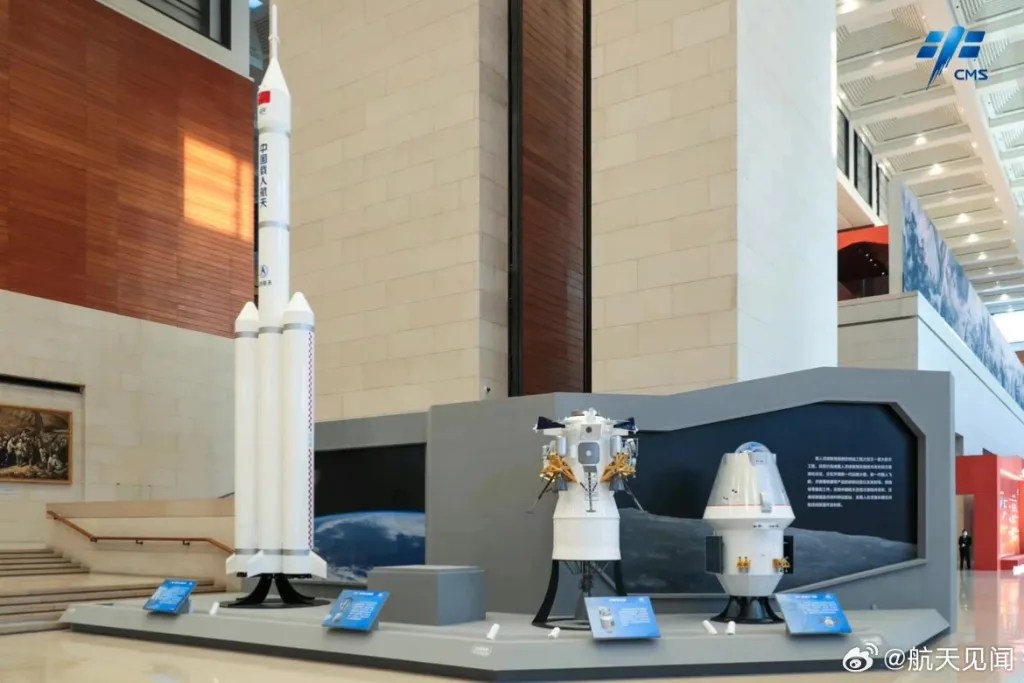
#CNSA #ChinaNationalSpaceAdministration #国家航天局 |#BRI July2024 |#长征十号#ChangZheng10 #CZ10 #LongMarch10 the Next Generation Manned #LunarCarrierRocket successfully completed the test of the  3D Printed Three #YK100K  first-stage rocket power engine system…

On the week of 23rd July  2024  CNSA _China National Space Administration -China – People’s Republic of China at a China Academy Of Launch Vehicle Technology  Engine Testing complex.. of the China Aerospace Science and Technology Corporation Sixth Academy…. China’s new generation of manned carrier rocket three-stage liquid hydrogen and liquid oxygen engine long-range high-model test was a complete success … for the长征十号 Chang Zheng- Long March

Recently, the new generation of manned carrier rocket three-stage liquid hydrogen and liquid oxygen engine completed a long-range test in a high-altitude simulated environment on China’s newly built vertical high-altitude simulation test bench, verifying the feasibility of long-range operation of China’s largest nozzle area ratio liquid hydrogen and liquid oxygen engine. The test was a complete success.

The success of this long-range high-model test indicates that China’s liquid hydrogen and liquid oxygen engine high-altitude simulation test capability has reached the level of thousands of seconds, which has greatly improved China’s liquid rocket engine high-model test capability and will strongly support the smooth implementation of China’s manned lunar exploration project. (China Aerospace Science and Technology Corporation Sixth Academy…

Long March 10 rocket is a three-and-a-half-stage rocket developed for the manned lunar exploration project. The total length of the rocket is 92.5 meters, the takeoff weight is about 2,189 tons, the takeoff thrust is about 2,678 tons, and the Earth-Moon transfer orbit carrying capacity is not less than 27 tons. In the future, it will be used to launch a new generation of manned spacecraft and lunar landers. In addition, the Long March 10 has also designed another booster-free configuration that can perform space station Takionaut and cargo transportation tasks….

Images and visuals are from their Respectives CMS China Manned SpaceCNSA-China National Space Administration

#CNSA #ChinaNationalSpaceAdministration #国家航天局 |#BRI June2024 | #长征十号#ChangZheng10 #CZ10 #LongMarch10 the Next Generation Manned #LunarCarrierRocket successfully completed the test of the Three #YK100K  first-stage rocket power engine system…

On the 14th June 2024  CNSA _China National Space Administration -China – People’s Republic of China at a China Academy Of Launch Vehicle Technology  Engine Testing complex.. On June 14, the Long March 10 series rockets used for manned lunar landing and other missions successfully completed the test of the first-stage rocket power system. During the test, the engine started normally, worked stably, shut down at a fixed time, and all parameters were tested normally. This test is the first system-level large-scale ground test of the Long March 10 series of launch vehicles. The matching of the first-stage booster delivery system and the engine, the propellant filling process, the multi-machine parallel power transmission and environmental characteristics and other technologies were fully verified.

The Long March 10 rocket is a three-and-a-half-stage rocket developed for the manned lunar exploration project. The total length of the rocket is 92.5 meters, the takeoff weight is about 2,189 tons, the takeoff thrust is about 2,678 tons, and the Earth-Moon transfer orbit carrying capacity is not less than 27 tons. In the future, it will be used to launch a new generation of manned spacecraft and lunar landers. In addition, the Long March 10 has also designed another booster-free configuration that can perform space station astronaut and cargo transportation tasks….

The engine is the power source of the rocket, and its development process is very complicated. Test run is an important link in the engine development process, and there are dozens of types. In layman’s terms, engine test run is the process of igniting the engine and verifying the rationality of its design scheme and process reliability. This is an indispensable and important part of the development and delivery of a type 1 engine. It will run through all stages before and after engine development. Each stage of test run has different meanings, and the ignition time varies from a few seconds to hundreds of seconds.

It is reported that the engine used in this test run uses advanced liquid oxygen kerosene as fuel, which is improved and iterated from the high-thrust liquid oxygen kerosene engine used by the new generation of launch vehicles such as the Long March 5. The thrust reaches 130 tons. The R&D team of the Sixth Academy of Aerospace Science and Technology Group adheres to the concept of digital design, and has successively overcome key technical problems such as engine start-up and shutdown sequence, engine wide-range continuously variable thrust, and engine long life and high reliability.

In addition, the continuous success of the test run has fully verified the reliability of a number of new carrying process technologies. The engine production of this test run adopts the concept of intelligent manufacturing, and actively applies new materials, new processes, and new technologies. The inner wall of the thrust chamber of the core component adopts a new protective coating, key assemblies adopt automatic welding technology, and a large number of components adopt 3D printing technology.

During the preparation of the engine test run, the participants in the research and test conducted tests and verifications on each subsystem of the test through comprehensive means such as digital modelling, simulation calculation, and system debugging. The successful test run shows that the test area has greatly improved the multi-station parallel test run capability and test efficiency by optimizing the workflow.

Images and visuals are from their Respectives CMS China Manned SpaceCNSA-China National Space Administration  the Sixth Academy of Aerospace Science and Technology Group

#CNSA #ChinaNationalSpaceAdministration #国家航天局 | #BRI #July2023 |#CASC #ChinaAerospaceScienceAndTechnologyCorporation – #长征十号 #MannedCarrierRocket #CarrierRocketFreighter  #3DPrinting #CarrierRocketEngine Testing the #ChangZheng10 #LongMarch10 engine at Thrust of 130 Tons Successfully …..

长征十号 At 22nd  23rd July  2023 Hong Kong SAR- Beijing time , China- People’s Republic of China- CNSA –China National Space Administration   Successfully Carrier Rocket  engine tested for the New Next Generation Chang Zheng – Long March 10 Manned Lunar mission landing Carrier rocket freighter The main engine of China’s manned lunar landing rocket Long March 10 completed another ignition test run yesterday, which verified all the requirements of the rocket mission for the engine, and provided strong support for the solidification of the engine’s technical status, the establishment of product technology baselines, and the improvement of reliability.


The engine used in this test run uses advanced liquid oxygen kerosene as fuel, which is improved and iterated from the high-thrust liquid oxygen kerosene engine used by the new generation of launch vehicles such as the active Long March 5, with a thrust of 130 tons. (The Sixth Academy of Aerospace Science and Technology Group)

Created with GIMP

The reporter learned from China Aerospace Science and Technology Group Co., Ltd. on July 23 that the main engine of my country’s manned moon landing rocket was tested in the Fengzhou Test Area of ​​the Sixth Academy of Aerospace Science and Technology Corporation, and achieved continuous success. This test run verified the engine flight mission profile, and provided strong support for the solidification of the engine technical state, the establishment of the product technical baseline, and the improvement of reliability.

The engine is the power source of the rocket, and its development process is very complicated. Test run is an important link in the engine development process, and there are dozens of types. In layman’s terms, engine test run is the process of igniting the engine and verifying the rationality of its design scheme and process reliability. This is an indispensable and important part of the development and delivery of a type 1 engine. It will run through all stages before and after engine development. Each stage of test run has different meanings, and the ignition time varies from a few seconds to hundreds of seconds.

It is reported that the engine used in this test run uses advanced liquid oxygen kerosene as fuel, which is improved and iterated from the high-thrust liquid oxygen kerosene engine used by the new generation of launch vehicles such as the Long March 5. The thrust reaches 130 tons. The R&D team of the Sixth Academy of Aerospace Science and Technology Group adheres to the concept of digital design, and has successively overcome key technical problems such as engine start-up and shutdown sequence, engine wide-range continuously variable thrust, and engine long life and high reliability.

In addition, the continuous success of the test run has fully verified the reliability of a number of new carrying process technologies. The engine production of this test run adopts the concept of intelligent manufacturing, and actively applies new materials, new processes, and new technologies. The inner wall of the thrust chamber of the core component adopts a new protective coating, key assemblies adopt automatic welding technology, and a large number of components adopt 3D printing technology.

During the preparation of the engine test run, the participants in the research and test conducted tests and verifications on each subsystem of the test through comprehensive means such as digital modelling, simulation calculation, and system debugging. The successful test run shows that the test area has greatly improved the multi-station parallel test run capability and test efficiency by optimizing the workflow.

Images and visuals are from their Respectives CMS China Manned SpaceCNSA-China National Space Administration  the Sixth Academy of Aerospace Science and Technology Group