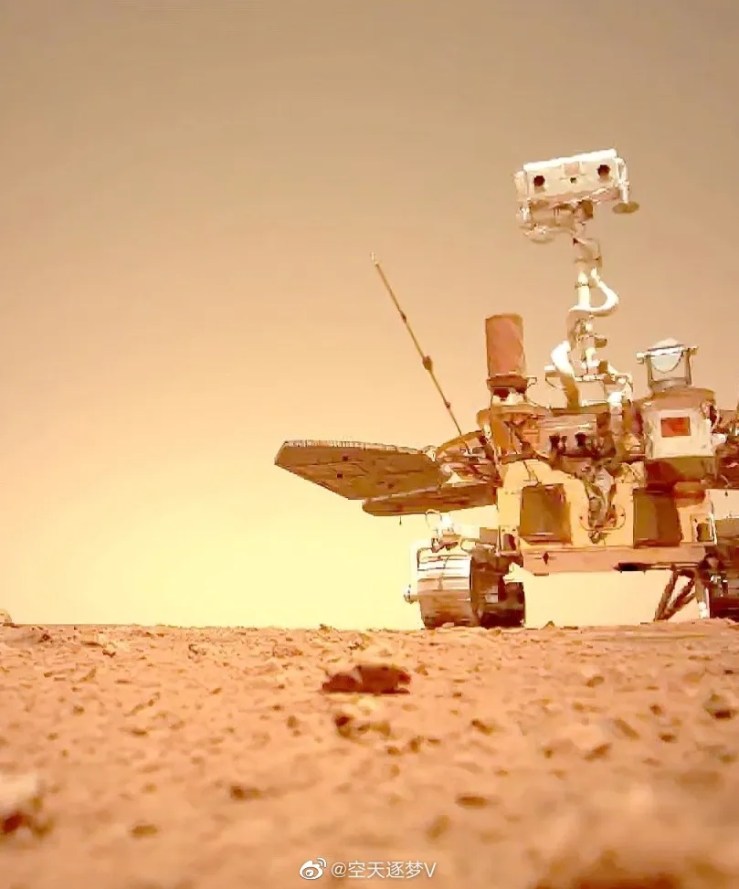
On the week of 13th March 2022 in CNSA _China National Space Administration -China – People’s Republic of China……..During the Two Sessions of which was held during in the People’s Hall during the week of 13th March 2022 China – People’s Republic of China CNSA China National Space Administration and its Partners plans to realize the Mars sampling return mission by 2030] China Daily reported on March 6 that Wu Weiren, member of the Standing Committee of the National Committee of the Chinese People’s Political Consultative Conference and chief designer of China’s lunar exploration project, said recently that my country plans to realize the Mars sampling return mission by 2030. The difficulty of the project is much greater than that of lunar sampling and return. The first problem to be solved is to develop a launch vehicle with greater thrust. In the follow-up, China is also preparing to conduct marginal exploration of the solar system. “The sun is about 150 million kilometers from the earth, which is an astronomical unit. We plan to achieve the ‘double hundred’ goal in 2049, that is, on the 100th anniversary of the founding of New China, to complete 100 astronomical units, which is 15 billion kilometers away “Deep space exploration” China plans to realize the Mars sampling return mission by 2030
China will carry on its moon research in the future with Chang’e-6, Chang’e-7 and Chang’e-8 missions by 2030. After 2030, a new set of missions will be carried out to complete the construction of an international lunar research station by 2030….he Chang’e-6 is scheduled to bring back to Earth lunar samples with a mass of up to 2 kilograms; the Chang’e-7 will be tasked with landing on the lunar south pole and detecting local natural resources; and the Chang’e-8, working in collaboration with Chang’e-7, is going to scout how to exploit lunar resources.
According to Wu, the Chang’e-6 and Chang’e-7 are expected to be launched around 2025.
Future missions also include the development of a special craft, which can fly from the landing site to lunar craters to help scientists look for traces of water. If water is present, it could provide resources for future crewed missions on the moon, Wu noted.
After 2030, a new set of missions will be carried out to complete the construction of an international lunar research station by 2035….
“There will be multiple rovers and landers working in the future moon station and a lunar-based communication network to support these spacecraft,” Wu said. “The lunar research station can also function as a transfer outpost for the solar system and even deeper space explorations.”
Images and visuals are from Weibo also their respectives.
More than One year ago on 24th November 2020, the Chang Zheng – Long March Five Carrier Rocket Launched away in CNSA – China National Space Administration China Wenchang spaceport launch, Change Five Lunar probe into orbit, opened up towards China – People’s Republic of China’s first celestial bodies sample return trip from Mons Rumker on the Lunar Surface.……
As of Month of January 2022, The CNSA –China National Space AdministrationCLEP- China Lunar Exploration Program Belt and Road Initiative Lunar Mission……Chang’e-4 with Yutu two the Lunar rover still working exploring more than 1003.9 meters on the other side of the moon on the 103 Kilometers Diameter Von Karman Crater in which is least than two length by length fifty five Kilometers Hong Kong –Macau- Zhuhai Bridges …. Working Exploring the Crater on the other side of the Moon Chang’e Luna….
On the 19th February 2022 week Hong Kong SAR – Beijing Time CNSA CLEP – China National Space Administration –China Lunar Space Program has released the 23rd batch of scientific data released by Chang’e-4 this month’s data came relatively late, but the content is very rich. More than 240 photos include more than 30 color photos. The data collection time announced this time is during the day of the 27th month (2021.02.04~2021.02.19).
is in the last month day In , experts analysed a “milestone” shaped stone, which, in fact, wasn’t the only similarly shaped stone nearby. Just south of the “milestone”, there is another similar stone, which the driving team calls a “stalagmite”, the relationship between the two is marked in Figure 1 (map from Chapter 27 of the Driving Diary). The focus of this moon and day detection is on this “stalagmite”, and the specific process is full of twists and turns. It is recommended that you read the original text of “Driving Diary”. Data source: Lunar and Planetary Data Release System
At 4:32 on February 6 2022 Hong Kong SAR- Beijing Time, Yutu-2 successfully woke up and entered the 27th lunar day, during which it spent its third Spring Festival on the moon.
Last month, we detected the “milestone” rock. Once the news came out, it attracted the attention of scientists all over the world. Dan Moriarty, a researcher at NASA, said: “This rock sample has Similar to the shape of a shark fin, it’s definitely unusual. ” He said that both the shape of the shark fin, and the apparent bulge near the edge of the rock, indicate a very young geological age and a relatively short existence at the site where it was found. Clive Neal, a famous lunar expert at the University of Notre Dame in the United States, also expressed his views on the rocks. While the “milestone” has attracted the attention of the international aerospace science community, Chinese scientists are gradually unravelling the mystery of its identity.
Strange discoveries always come in pairs. Last month, the pilots found a “stalagmite” shaped stone standing in the south direction, similar to the “milestone” shape. The two echoed each other. Everyone decided to act immediately and explore again. “Stalagmite”.
The rhythm of the whole moon, day and morning was tight and orderly. After three moves, Yutu No. 2 arrived near the “stalagmite” before noon on the moon. At this time, the shadow of the car body blocked the target, and it seemed to persuade Yutu to take a nap and explore the “stalagmite” again. , we had to wait for the Yutu to wake up from the lunch break to continue the probe.
Under the scorching sun, Jade Rabbit spent its Spring Festival, and before the fifth day of the first lunar month, it started work early in the day and afternoon. The pilots controlled Yutu-2 to turn to the intended detection heading. According to the previous ground planning path deduction, the road detected at this time is flat, and the bright surface of the “stalagmite” should be able to enter the infrared field of view. However, the obstacle-avoidance images downloaded to the ground are full of artistic “alternation of light and dark”, which is different from the “simple and straightforward” that scientists hoped to be completely illuminated by sunlight.
There are so many exciting moments in lunar exploration. It is within reach, but it seems to be so far away. However, the pilots have been very patient in the long-term detection, and proposed three detection plans for the current situation: go straight ahead, detour to the southwest side of the “stalagmite”, and detour to the southeast to wait for next month’s detection.
Here are a few photos synthesized from the original images: Figure 2: Color photos of the “Milestone” taken from a distance Figures 3 and 4: The lunar image taken by Yutu-2 to the “Stalagmite” (you find the Chang’e-4’s photo) Is the lander yet?) Figure 5: A close-up photo of the “stalagmite”
After repeated deductions and demonstrations, the last plan was not very feasible and was first excluded, and the remaining two plans entered the final PK. Drivers detour from the west side and the southeast side to verify the feasibility of the second option. Detouring from the southeast, there are many potholes along the way. After starting, Yutu No. 2 will step into the pit, which is more dangerous; while the west side seems to be flat along the way, but there is a large impact crater near the end position. Yutu No. 2 The No. 1 can only move around in a small area between the impact crater and the “stalagmite”. Not only is its range of activity severely limited, which may cause the solar wings to be blocked, but it must also return to the original path after detection, which is laborious and dangerous. After several rounds of calculation and demonstration, direct detection wins.
The pilots controlled the Yutu for the first attempt. The preliminary results show that the actual infrared field of view is about 4 cm away from the ideal field of view. The second time, everyone adjusted according to the suggestions of the scientists and tried again, but the results were still biased. The two failed attempts, and the time was approaching zero, and the station resources were almost exhausted. Facing the temptation of the mystery behind the moon, the pilots were still reluctant to give up and decided to try again. They urgently extended the measurement and control arc for an hour, adjusted the posture of the jade rabbit and probed again. With all the hard work, the images uploaded this time show that the infrared field of view finally accurately covers the narrow light of the “stalagmite” !
Those who travel a hundred miles are half and ninety. When it is unknown whether success or failure will come next time, persevering may be our only chance. This time Yutu No.2 and the pilots did it! Next time, would you like to challenge and persevere for your dreams?
Images and visuals are from CNSA- China National Space Administration also from their respectives…
As of Month of January 2022, The CNSA –China National Space AdministrationCLEP- China Lunar Exploration Program Belt and Road Initiative Lunar Mission……Chang’e-4 with Yutu two the Lunar rover still working exploring more than 1003.9 meters on the other side of the moon on the 103 Kilometers Diameter Von Karman Crater in which is least than two length by length fifty five Kilometers Hong Kong –Macau- Zhuhai Bridges …. Working Exploring the Crater on the other side of the Moon Chang’e Luna…. At the moment it’s resting till the next set of adventuring parameters is need..
As of the latest of the Change 4 lunar lander still constant working while Yutu 2 the lunar Rover takes a break after visiting it’ creative lunar rock art forming a Jade Rabbit snacking on lunar Carrot. The latest scientific achievements of the Chang’e-4 neutral atom detector嫦娥四号中性原子探测仪最新科学成果……
As we all know, the earth has a strong global magnetic field. When the solar wind “invades” the earth, a huge protective umbrella, the magnetosphere, will form around the earth, blocking most of the solar wind. Due to the lack of this global magnetic field and dense atmosphere on the moon, the lunar surface is directly exposed to the deep space, and the solar wind and the earth’s wind can directly bombard the lunar surface, producing various effects. The current data from China’s Chang’e, Japan’s Moon Goddess, India’s Chandrayaan-1, and the US Interstellar Boundary Probe show that about 0.1-1% of the solar wind protons in the general area will be scattered by the lunar surface, and 10-20% of the solar wind protons will be scattered with the lunar surface. After the action, it is converted into energy neutral atoms, and most of the remaining will be injected into the lunar soil to produce lunar water. Although the moon does not have a global magnetic field, there are many magnetic anomaly areas scattered on the lunar surface, and the magnetic field strength on the lunar surface is about several hundred nT. It can block part of the solar wind from bombarding the lunar surface, and the reflectivity of solar wind protons increases significantly in large-scale magnetic anomalies. Detecting energy-neutral atoms can reveal the microphysical mechanisms of the interactions between the solar wind, the Earth’s wind and the lunar surface, revealing small-scale features.
Fig. 1 Chang’e-4 landed on the Von Karman crater in the South Pole-Aiken Basin on the far side of the moon. The yellow area is the magnetic anomaly, and the red arrow represents the direction of the solar wind bombarding the lunar surface on the dark side.
On January 3, 2019, Chang’e-4 landed on the Von Karman impact crater in the South Pole-Aiken Basin on the far side of the moon, and the Neutral Atom Detector (ASAN) on the Yutu-2 lunar rover was energy neutral to the lunar surface for the first time on the far side of the moon. Atoms (ENA) make observations. Based on the analysis of the ENA energy spectrum obtained by ASAN from January 11, 2019 to October 12, 2020, the study found that in most lunar days, the ENA differential flux on the morning side is higher than that on the dusk side; The analysis of the observation data of the Atom Detector and the ARTEMIS satellite during the same period found that the differential flux of ENA in different energy ranges on the morning side and the dusk side is positively correlated with the solar wind state parameters such as flux, density and dynamic pressure. This is the first time to calculate the electrostatic potential above the magnetic anomaly using the observation data of neutral atoms on the lunar surface, updating the understanding of the interaction between particles and the magnetic anomaly. The results have extensive reference value for the study of solar wind, terrestrial wind and celestial bodies without atmosphere and global magnetic field (such as asteroids or comets).
Fig. 2 The electric field of charge polarization caused by the motion of protons and electrons, the electric field direction is upward. The deceleration of solar wind protons is associated with magnetic anomalies.
The research results were published in Astrophysical Journal Letters, an authoritative magazine in the industry. The first author of the paper is Wang Huizi, a doctoral student in the Interaction Group of the Magnetosphere and the Solar Wind at Shandong University. Zhang Jiang from the Planetary Science Research Group, and the co-authors of the paper are from Japan Aerospace Exploration Agency, Peking University, Space Center of Chinese Academy of Sciences, Institute of Earth Science of Chinese Academy of Sciences, etc.
As of Month of January 2022, The CNSA –China National Space AdministrationCLEP- China Lunar Exploration Program Belt and Road Initiative Lunar Mission……Chang’e-4 with Yutu two the Lunar rover still working exploring more than 1003.9 meters on the other side of the moon on the 103 Kilometers Diameter Von Karman Crater in which is least than two length by length fifty five Kilometers Hong Kong –Macau- Zhuhai Bridges …. Working Exploring the Crater on the other side of the Moon Chang’e Luna….
In which the cumulative mileage of the Yutu-2 lunar rover exceeded the 1,000-meter mark, revealing the mystery of the “mysterious cabin”] On December 27, 2021, Yutu-2 will wake up and usher in the 38th day of work, and the goal is still to continue heading north . First, the stride Meteor moved three times, 7 meters, 9 meters, and 10 meters. The larger the stride, the total mileage reached 992.3 meters. At this time, there is only about 10 meters left from the “Mystery Cabin”. The mystery of the “hut” was lifted, and the drivers immediately arranged for a panoramic camera to perform color imaging, finally revealing its true appearance!
impact craters and “mystery house”
The “Mysterious Cabin” is like a lifelike rabbit, the scattered stones in front of the “Jade Rabbit” are like a carrot, and the round stone beads behind the “Jade Rabbit” are like the products of the “Jade Rabbit” after a meal. The scene in front of us is like a rabbit about to eat, and the picture is full of fun.
“rabbit” see “rabbit”
At noon on January 6, 2022, the pilots of Yutu No. 2 started the task of the day and afternoon of this month, but everyone worked tirelessly for more than ten hours. Near midnight, the cumulative mileage of Yutu finally broke through the 1,000-meter mark, reaching 1,003.9 meters! The upcoming January 11, 2022 will be the third anniversary of the Chang’e-4 lander and Yutu-2 completing the mutual shooting of the two vehicles and the complete success of the mission. The latest mileage record is undoubtedly the longest nice gift.
“rabbit” see “rabbit”
Over the past three years, under the precise control of flight controllers, the Chang’e-4 lander, rover, and relay star have completed one arduous task after another, constantly breaking their own records on the way to the back of the moon, and continuing to explore the mysteries of the back of the moon. . In the next day of the month, Yutu-2 will detect the target rock at close range and perceive the large impact crater behind it. We expect Yutu-2 to make more scientific discoveries.
Images and visuals are from CNSA- China National Space Administration also from there respectives…