#CNSA #ChinaNationalSpaceAdministration #国家航天局 |#BeltAndRoadinitiative #June2022 | #CMS #ChinaMannedSpace #Tiangong #ChinaSpaceStation #神州三号 #Shenzhou13 Takionaut #王亞平#WangYaping blessings to graduates of #北京大学#PekingUniversity Peking University 2022 Undergraduate Commencement Ceremony……

On the 28th Tuesday June 2022 China National Space Administration CMS China Manned Space Shenzhou 13 Takionaut王亞平 Wang Yaping – Wang Yaping sends blessings to graduates of Peking University 北京大学Undergraduate Commencement Ceremony at Beijing – China – People’s Republic of China… via Live stream in front of the live audiences of lecturers and students of Peking University  in which  .. Wang Yaping sends

I wish you a brilliant star river! #王亚平‘s gift to Peking University graduates ] At Peking University’s 2022 undergraduate graduation ceremony, astronaut Wang Yaping, an alumni, made his first video appearance after returning from space, sending graduation blessings to Peking University graduates, wishing everyone a better life The bright future is as bright as the galaxy in the universe!  王亚平appeared to send graduation wishes ……Happy graduation!

The whole network debut, Wang Yaping “appeared” at Peking University Graduation Ceremony# Sending blessings to Peking University graduates At #Peking University 2022 Undergraduate Graduation Ceremony , the winner of the “Second-level Aerospace Merit Medal”, the Chinese People’s Liberation Army Aerospace Wang Yaping, a super astronaut of the crew brigade, a 2016 master graduate from the School of Journalism and Communication, and a 2018 doctoral student from the School of Psychological and Cognitive Sciences, sent graduation wishes to Peking University graduates through video. After returning from space, she made her first video appearance. What blessings did she send to the students of Peking University? 王亚平 74 days later to meet with Peking University students# 王亚平’s graduation gift to Peking University students…..

中国空间站 On currently on December 2021, the Belt and Road Initiative CNSA –China National Space Administration  CSS China Space Station in which on a three to six months setting up a new home of the first three Shenzhou 13 in which spending up to on for the further construction and verifications of the systems of the CSS –China Space Station 2021 launch calendar in which currently the three Takionauts current Shenzhou 13 ……  Preparations for the six months of extension of the China Space Station  In which the currently it remains awaiting for the crew of setting up home in conducting fun scientifically onboard中国空间站..  China Space station …..

On the 16th April 2022 Saturday in between times of 09:35-10:05 hour’s morning Hong Kong SAR Beijing Time, Shenzhou13 will be back on earth in which the crew of Shenzhou 13 Zhai Zhigang, Wang Yaping and Ye Guangfu, are on their way back to Earth after a national record six-month-long mission in orbit aboard the Chinese China Space Station to preparedness for its construction calendar stage one of the year 2022 completion ….

Images and visuals are from their respectives.

#CNSA #ChinaNationalSpaceAdministration #国家航天局 |#BeltAndRoadinitiative #酒泉衛星發射中心 #JiuquanSatelliteLaunchCenter  #June2022| Successfully launching of the international Iconic #ChangZheng4C  #LongMarch4C #CarrierRocket of the # Gaofen12 three series #EnivormentalSatellites #EarthSciences #RemoteSensing #Satellites ….

酒泉衛星發射中心On 27th June 2022 Monday 2346 late night Hong Kong SAR – Beijing Time  morning, CNSA –China National Space Administration  Jiuquan Satellite Launch Center – Inner Mongolia – China – People’s Republic of China successfully Launched the International Iconic Chang Zheng Long March 4C…. This launch is the 91st launch of the Long March 4 series of launch vehicles, the 160th launch of the Long March series of launch vehicles developed by the Eighth Academy, and the 425th launch of the Long March series of launch vehicles.

Successfully Launched the International Iconic Chang Zheng Long March 4C…. three environmental – Earth satellites the Gaofen 12 series of three Satellites into their pre-determined orbitation …. The satellite is mainly used for land census, urban planning, land rights confirmation and other fields in which the provisions of  satellite is mainly used in the fields of land census, urban planning, land rights confirmation, road network design, crop yield estimation and disaster prevention and mitigation. …


The newly improved advance Chang Zheng 4C Carrier Rocket carrier rocket used for this launch mission is a normal temperature liquid three-stage carrier rocket with excellent performance and wide application. It has the ability to launch satellites of various types and different orbits. Its sun-synchronous circular orbit has a carrying capacity of up to 3 tons (orbit height of 700 kilometers).

The Gaofen12 series Remote Sensing Earth Sciences Satellite manufacturer is CAST – China Academy of Space Technology also in collaboration with its associate agency with CHEOS- China High Resolution Earth Observation System in which is design Built on a CAST 2000 Design Heritage Earth Sciences, in which is design for Translating Gaofen is High Resolution, also known as CHEOS- China High Resolution Earth Observation System, in which provisions in the real time observational data analysis of with high resolution multi spectra equipment imaging system in analysis for assessing environmental disaster warning, emergency response also for the protection for ecological, also providing support for infrastructure construction, transportation for various purpose of the Belt And Road initiative  … one of many specifications of the Gaofen Earth Sciences satellite is The high-resolution satellite is a large-scale remote sensing satellite system for the national science and technology major special arrangement of the microwave remote sensing satellite, the ground pixel resolution is up to sub-meter …

Images and visuals are from Weibo also their respectives..

#CNSA #ChinaNationalSpaceAdministration #国家航天局 |#BeltAndRoadinitiative #CLEP #June2022 | #VonKarmanCrater #LunarMission #Change4 #Yutu2 #ChineseAcademyOfSciences Research Reveals the Constraints of the Chang’e-4 Infrared Imaging Spectroscopic Ground Validation Experiment on the Material Composition of the Lunar SPA Surface…

As of Month of April 2022, The CNSA –China National Space Administration CLEP- China Lunar Exploration Program  Belt and Road Initiative Lunar Mission……Chang’e-4 with Yutu two the Lunar rover still working exploring more than moved more than 1142.39 meters on the other side of the moon on the 103 Kilometers Diameter Von Karman Crater in which is least than two length by length fifty five Kilometers Hong Kong –Macau- Zhuhai Bridges …. Working Exploring the Crater on the other side of the Moon Chang’e Luna….

On 27th June 2022 the Chinese Academy of Sciences Research Reveals the Constraints of the Chang’e-4 Infrared Imaging Spectroscopic Ground Validation Experiment on the Material Composition of the Lunar SPA Surface

The Infrared Imaging Spectrometer (VNIS) on the Yutu No. 2 Lunar Rover has measured infrared imaging spectral data at multiple locations along the rover’s walking route. VNIS is the main method used to study the composition of lunar soil and lunar surface rocks in the landing area and to trace their origin. The research of the Institute of Geology and Earth Sciences, Chinese Academy of Sciences revealed the constraints on the composition of the lunar SPA surface by the Chang’e-4 infrared imaging spectroscopy ground verification experiment.

The Yutu-2 rover has been working on the lunar surface for more than 40 months, and the infrared imaging spectrometer (VNIS) it carried has measured infrared imaging spectral data at multiple locations along the rover’s walking route. VNIS is the main method used to study the composition of lunar soil and lunar surface rocks in the landing area and to trace their origin. However, factors such as space weathering, particle size and multiple scattering, the spectral response of the instrument, and observation conditions all affect the spectral characteristics and lead to large uncertainties in the mineral composition calculated from the lunar surface spectral data.

  In order to quantitatively evaluate the reliability of different VNIS data processing methods, Chang Rui, a doctoral student in the Key Laboratory of Earth and Planetary Physics, Institute of Geology and Geophysics, Chinese Academy of Sciences, under the guidance of his supervisor researcher Yang Wei and associate researcher Lin Honglei, selected a mineral composition with Spectroscopic ground verification experiments were performed on the Suchang-gabbro with similar lunar highland rocks (Fig. 1). The rock (CR-1) studied by the ground verification experiment has an actual mineral pattern content of 12.9% olivine, 35.0% pyroxene and 52.2% plagioclase, as measured by scanning electron microscopy. In order to more accurately calculate the spectral results of CR-1, the researchers ground and sorted the olivine, low-calcium pyroxene, high-calcium pyroxene and plagioclase from the rock samples in CR-1. -4, ASD) to measure the visible-near-infrared spectral results of each single mineral (Fig. 2a), and each single mineral has its own spectral absorption characteristics. The spectrum of CR-1 measured by the VNIS identifier showed distinct absorption features at the 971 (±1) nm and 1957 (±8) nm bands (Fig. 2b). This absorption feature is similar to the rock absorption feature detected by VNIS on the Yutu-2 rover on the third day of the month. The Hapke model of the VNIS spectrum of CR-1 calculated the mineral pattern content of the sample to be 7.5% olivine, 39.3% pyroxene and 53.2% plagioclase, which were consistent with the true results within the error range.

  According to the data processing method in this study combined with the photometric correction of the Chang’e-4 lunar surface data by Yang et al. (2020), the more accurate mineral model content of the rocks detected by the Yutu-2 rover on the third day should be 11.7 % olivine, 42.8% pyroxene and 45.5% plagioclase. The rover found another lunar surface rock on the 26th day with spectral absorption characteristics similar to those found on the 3rd day, with mineral pattern contents of 3.2% olivine, 24.6% pyroxene, and 72.2% plagioclase. The two lunar surface rocks belong to the sutraite category in the “Anorthosite-Norite-Troctolite” (ANT) system (Fig. 3) (Heiken G, 1991), which means that the Chang’e-4 landing area lunar The rock formations under the soil are mainly ANT rocks. The rocks detected by the Yutu-2 rover on the 26th day contained more plagioclase and were closer to the mineral composition of the average lunar crust.

  To sum up, the lunar surface of the Chang’e-4 landing area has su-long and plagio-like rocks, which represent the material formed by the rapid crystallization in the impact melting pool and the composition of the average lunar crust, respectively. On the one hand, an impact event excavated material from the underlying layers of lunar soil to the lunar surface. These excavated materials have the characteristics of crystalline plutonic rocks in the molten pool of the South Pole Aitken Basin (SPA). On the other hand, the initial lunar crustal material formed before the SPA big impact event can also be retained in the SPA.

  The related research results were published in Remote Sensing . The research work has been funded by the Strategic Pilot Science and Technology Project of the Chinese Academy of Sciences, the Key Deployment Project of the Chinese Academy of Sciences, the Innovation Interdisciplinary Team of the Chinese Academy of Sciences, the Civil Aerospace Pre-research Project of the National Space Administration, and the Key Deployment Project of the Institute of Geology and Geophysics of the Chinese Academy of Sciences.

Figure 1. (a) The image of the lunar surface rock detected by Chang’e-4 on the third month; (b) the spectral detection status of the lunar surface rock (the yellow circle represents the near-infrared spectral detection field); (c) the ground verification of this study The rock used in the experiment (CR-1)

Figure 2. (a) Visible-NIR spectra of single minerals in CR-1; (b) VNIS spectra of rocks and CR-1 measured on the third day of Chang’e-4

Fig. 3. Mineral composition distribution of olivine-pyroxene-plagioclase in lunar surface rocks measured by Chang’e-4 (Heiken G, 1991). The lunar sample sampling points are marked in the figure, for example: A-11 is Apollo 11, L-16 is Luna 16, (H) and (M) represent high ground and lunar soil, respectively

Images and visuals are from their Respectives source Chinese Academy of Sciences .. 52 Sanlihe Rd., Xicheng District, Beijing, China (100864)- People’s Republic of China.

#CNSA #ChinaNationalSpaceAdministration #国家航天局 |#BeltAndRoadinitiative #June2022 | #WenchangSpacecraftLaunchCenter #文昌航天發射場 | #ChinaSpaceStation #ChangZheng5B Longmarch5B Carrier Rocket实验舱#Wentian #ExperimentalCabinModule expected June- July 2022 launch ….

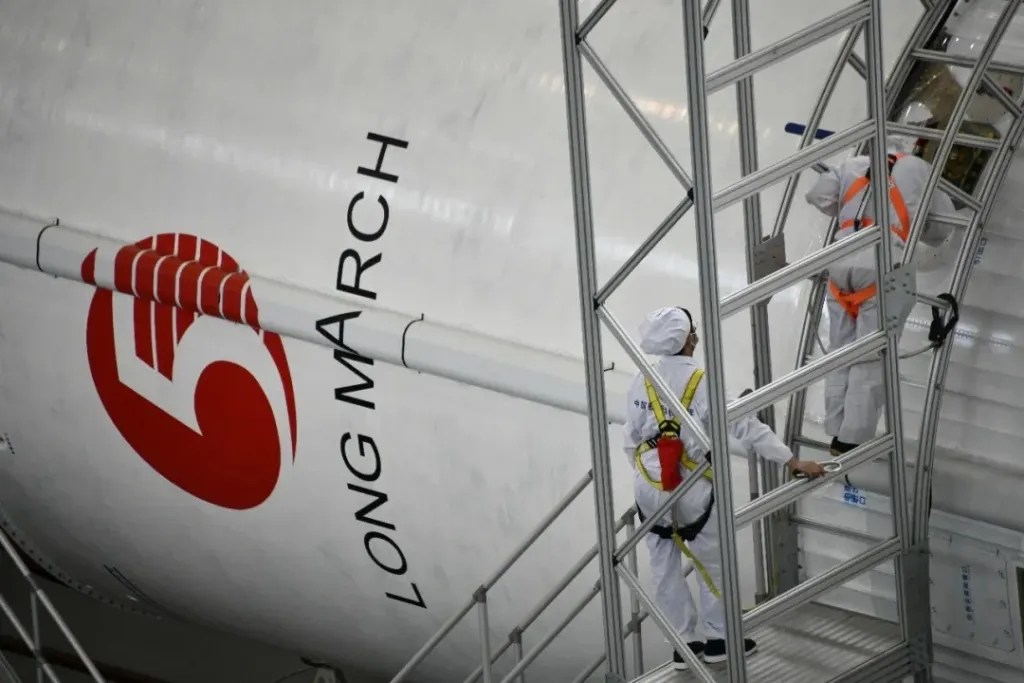
On Hainan Province –China –People’s Republic of China…. in the district area of the Wenchang – Wenchang Spacecraft launch center in which the awesome team at one of many CNSA –China National Space Administration  that China National Space Administration…………… On May 29th 2022 The Chang Zheng- Long March 5B Yao three carrier rocket arrived at Wenchang Space Launch Site safely] According to the China Manned Space Engineering Office, the Long March 5B Yao 3 carrier rocket that carried out the launch mission of the Wentian experimental module has completed all the research and development finalisation certification at the Factory also Wenchang Spacecraft Center..

The Expected Countdown towards the Launch of the Chang Zheng- Long March 5 Yao 3 Carrier Rocket in which is 28 Days in between late June –early July 2022  until the Launch towards the China Space Station for the Wentian Experimental module in connecting Strengthen the mission and have the courage to innovate and make breakthroughs! Carefully prepare, organize, and implement carefully to ensure the complete success of the launch mission, and take practical actions to welcome the Party’s 20th National Congress of Victory….

Launch wise of the Chang Zheng –Long March 5 Yao 3 Carrier Rocket .

Location: China Wenchang Space Launch Site 101 Launch Station (WSLS LC101)
Mission Rocket: Long March 5 Yiyao-3 Rocket (CZ-5B Y3)
Mission Load: Space Station “Wentian” Experimental Module (WT)
Launch Window: 2022 estimated launch time in late July,
2022: Afternoon of July 24, 2022 (to be determined)

Previously As of May 2022 both The experimental cabin is progressing smoothly, waiting for the launch The Wentian experimental cabin to be launched in July is ready for finally and the Mengtian experimental cabin is also making corresponding preparations.


After the construction of the China Space Station is completed, the two experimental cabins will be the main working places for astronauts in orbit. In both experimental cabins, space science experiments and technical experiments in the sealed cabin and outside the sealed cabin can be carried out. Both cabins are equipped with The load test cabinet inside the cabin and the load installation platform outside the cabin also provide support and guarantee measures such as information, power supply and heat dissipation, and can carry out experiments in various fields such as space science, space materials, space medicine and space exploration.

  The Wentian experimental module is equipped with the same Taikonauts’ living facilities as the core module, including 3 sleeping areas, 1 sanitary area, kitchen and other facilities, which can guarantee the astronauts’ life. It can also work with the core module to support the life of 6 astronauts during the rotation of the two manned spacecraft; in addition, a small robotic arm is also configured, which can be used alone or in combination with the large robotic arm of the core module. , to jointly complete the tasks of Taikonauts leaving the cabin, caring for extravehicular facilities, and patrolling. In addition, the Wentian experimental cabin is also equipped with an astronaut exit airlock. After the space station is completed, the airlock of the Wentian experimental cabin will be As the main airlock cabin for astronauts to leave the cabin, the node cabin of the core cabin is used for other functions at this time, just as a backup; the Wentian experimental cabin also has a backup section for the core cabin to manage and control the assembly. That is to say, when the function of the core module platform fails, it can be switched to the Wentian experimental module to exercise the combined control and management functions, which can improve the reliability of the space station as a whole.

  The Mengtian experimental cabin is equipped with a cargo airlock and an outboard deployment test platform. In the future, the scientific test equipment that needs to be installed outside the cabin can be transported to the space station through a cargo spacecraft, and then the load will be sent to the outside of the cabin through the cargo airlock, and the robotic arm or astronaut will install it on the platform outside the cabin. Realize the continuous update of the extravehicular test project.

Images and visuals are from their respectives.

#CNSA #ChinaNationalSpaceAdministration #国家航天局 |#BeltAndRoadinitiative #June2022 | #CMS #ChinaMannedSpace #Tiangong #ChinaSpaceStation #神舟十四号 #Shenzhou14 Crew do the daily’s Cleaning and exercises the typical work life balance..

中国空间站 On currently on June 5th 2022, the Belt and Road Initiative CNSA –China National Space Administration   CSS China Space Station in which on a six months setting up a new home of the third crew of Tiangong Space Station – China Space Station Shenzhou 14  in which spending up to on for the further construction and verifications of the systems of the CSS –China Space Station 2022 launch calendar in which currently the third China Space Station crew Takionauts current Shenzhou 14 ……  Preparations for the six months of extension of the China Space Station  In which the currently it remains awaiting for the crew of setting up home in conducting fun scientifically onboard中国空间站..  China Space station ….. The three Shenzhou 14 crewmates will spend around six months aboard Tianhe, the core module of the Tiangong space station. They will be aboard to receive two new modules, named Wentian and Mengtian, which are due to launch in late July and October, respectively…. crew is expected to conduct 2-3 extravehicular activities (EVA) from Wentian lab module and continue to livestream lectures from the Tiangong space station.

On the week of 25th June 2022 it’s the Shenzhou 14 Crew of Takionaut刘洋 LiuYang,  陈冬 ChenDong, 蔡旭哲 Cai Xuhe…. In which doing the typical daily chores of living on the CNSA CSS China Space Station in which神舟十四号 the crew cleaning up the Space station’s Tianhe Core module in which Takionauts main module at the moment in which cleaning afterward the Takionauts carried out onboard exercise.. Currently the Takionauts are in all in good health conditions in orbit…..

Images and visuals are from their respectives.