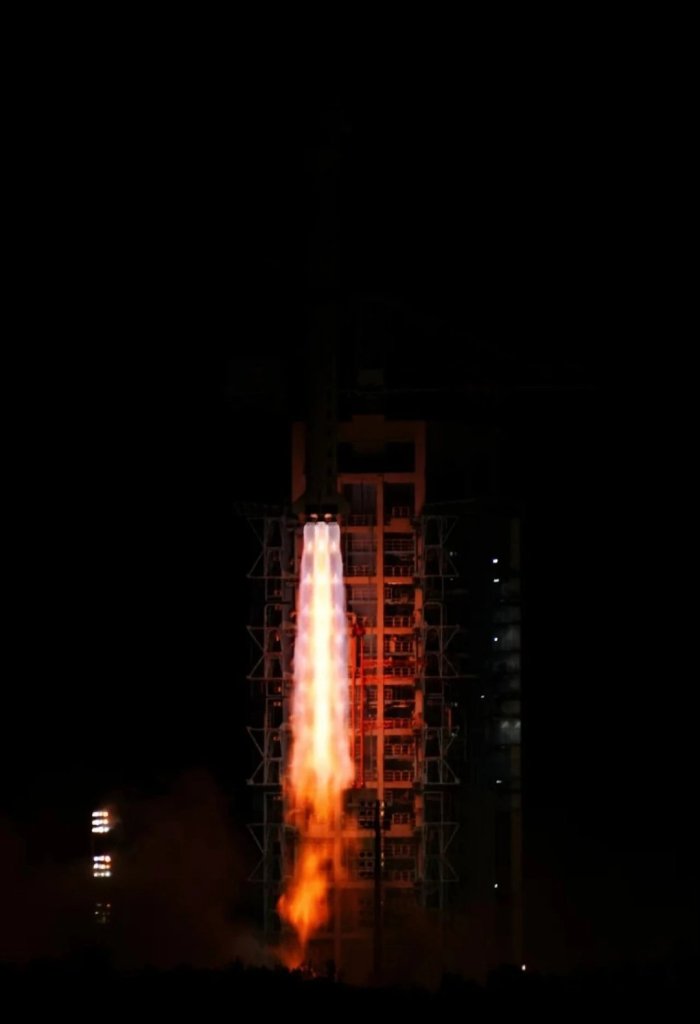
#CNSA #ChinaNationalSpaceAdministration #国家航天局 |#BRI #October2024| #酒泉卫星发射中心 #JiuquanSatelliteLaunchCenter – #ChangZheng4C #LongMarch4C Yao 59  #CarrierRocket Successfully #Gaofen 12 05 large high-resolution remote sensing satellite in northwest sky #ASummary

On the day of 0745 Hong Kong SAR- Beijing Time 16 October 2024 CNSA –China National Space Administration , China, People’s Republic of China At 0745 Hong Kong SAR- Beijing Time  , the Chang Zheng -Long March 4BYao 59  carrier rocket successfully launched China’s first reusable recoverable technology test satellite.. From The the Jiuquan Satellite Launch Center, Inner Mongolia, China, People’s Republic of China.. at the 9401 workstation of the Jiuquan Satellite Launch Center in northwest inland China, the Long March 4B Yao 59 carrier rocket carrying the Gaofen 12 05 remote sensing satellite was vertically launched into space, sending the satellite into a sun-synchronous orbit (SSO).

The satellite and carrier rocket for this mission were developed by the Eighth Academy of China Aerospace Science and Technology Corporation. The Gaofen-12 05 satellite is a large-scale high-resolution remote sensing satellite, which is mainly used in land survey, urban planning, land rights confirmation, road network design, crop yield estimation and disaster prevention and mitigation

.

The Long March 4C is a medium-sized normal-temperature liquid carrier rocket with a three-stage tandem configuration. The main power is all nitrogen tetroxide/undimethylhydrazine propellant. The Long March 4C rocket is mainly used for sun-synchronous orbit and low-Earth orbit satellite launch missions. The rocket is 48 meters high, with a diameter of 3.35 meters for the first and second stages, a diameter of 2.9 meters for the third stage, a takeoff mass of 250 tons, and a capacity of 3 tons for a circular sun-synchronous orbit (SSO) at an altitude of 700 kilometers. The Long March 4C is the first and only model among China’s normal-temperature liquid rockets equipped with a secondary start-type final stage main engine, and has the ability to launch into high orbit and deep space.

The Long March 4B successfully completed its maiden flight on April 27, 2006. So far, it has carried out 55 launches, 53 of which were successful, with a success rate of about 96%. This launch is 157 days away from the 54th launch of the Long March 4B, which will be carried out on the morning of May 12, 2024.

This launch mission is the second launch of the “Long March 4C” rocket in 2024, the 14th launch of the Jiuquan Satellite Launch Center, the 49th launch in China and the 189th orbital space launch in the world.

Images and visuals are from their Respectives CMS China Manned SpaceCNSA-China National Space Administration

#CNSA #ChinaNationalSpaceAdministration #国家航天局 |#BRI #May2024| #酒泉卫星发射中心 #JiuquanSatelliteLaunchCenter – #ChangZheng4C #LongMarch4C Y50  #CarrierRocket Successfully launched Deployed the #TestSatellite #ExperimentalSatellite Number 23 #ASummary

On the day of 12TH May 2024   Hours Hong- Kong SAR – Beijing time CNSA –China National Space Administration , China, People’s Republic of China At 0743 Hong Kong SAR- Beijing Time  , the Chang Zheng -Long March 4C Yao 50  carrier rocket carrying Experimental Satellite Number 23 .. From The the Jiuquan Satellite Launch Center, Inner Mongolia, China, People’s Republic of China..

The test satellite No. 23 was launched into space. The satellite successfully entered the predetermined orbit and the launch mission was a complete success. The satellite is mainly used for space environment detection Satellite No. 3 was put into the predetermined orbit and the launch mission was a complete success. The rockets and satellites used to carry out this mission were developed by the Eighth Academy of China Aerospace Science and Technology Corporation. This mission is the 522nd launch of the Long March series of launch vehicles.​​​

Images and visuals are from their Respectives CMS China Manned SpaceCNSA-China National Space Administration

#CNSA #ChinaNationalSpaceAdministration #国家航天局 |#BRI #September2023 || #酒泉卫星发射中心 #JiuquanSatelliteLaunchCenter #长征四号  #ChangZheng4C #LongMarch4C   successful launched deployed #Yoagan33 04  #RemoteSensing #Satellite

On the 0415 early morning 27th September 2023 Wednesday Hours Hong- Kong SAR – Beijing time CNSA –China National Space Administration , China, People’s Republic of China. Successfully launched the Yonggan 33 Remote Sensing satellite with the Chang Zheng- Long March 4C Jiuquan Satellite Launch Center, Inner Mongolia, China, People’s Republic of China, and then successfully sent the Remote Sensing No. 33 04 satellite into the predetermined orbit, and the launch mission was completed successfully.


The Remote Sensing 33-04 satellite was developed by the Eighth Academy of China Aerospace Science and Technology Corporation. It is mainly used in scientific experimental research, marine and land resource census, agricultural product production estimation, disaster prevention and reduction and other fields.


This launch is the 489th launch of the Long March series of launch vehicles.

Images and visuals are from their Respectives CMS China Manned SpaceCNSA-China National Space Administration  

#CNSA #ChinaNationalSpaceAdministration #国家航天局 |#BRI #September2023 || #酒泉卫星发射中心 #JiuquanSatelliteLaunchCenter #长征四号  #ChangZheng4C #LongMarch4C  Yao 53 successful launched deployed #Yoagan33 #RemoteSensing #Satellite

On the 0214  early morning 7th September 2023 Thursday  Hours Hong- Kong SAR – Beijing time CNSA –China National Space Administration , China, People’s Republic of China. Successfully launched the Yonggan 33 Remote Sensing satellite with the Chang Zheng- Long March 4C Jiuquan Satellite Launch Center, Inner Mongolia, China, People’s Republic of China, and then successfully sent the Remote Sensing No. 33 03 satellite into the predetermined orbit, and the launch mission was completed successfully.


The Jiuquan Satellite Launch Center to successfully launch the Yoagan 33 – 03 satellites . The satellite successfully entered the predetermined orbit, and the launch mission was a complete success. The satellite is mainly used in scientific experiments, land and resources census, agricultural production estimation, disaster prevention and mitigation and other fields….

The satellite is mainly used in scientific experiments, land and resources census, agricultural production estimation, disaster prevention and mitigation and other fields. This mission is the 486th flight of the Long March series of launch vehicles.

Images and visuals are from their Respectives CMS China Manned SpaceCNSA-China National Space Administration  

#CNSA #ChinaNationalSpaceAdministration #国家航天局 |#BRI #August2023 || #酒泉卫星发射中心 #JiuquanSatelliteLaunchCenter #长征四号  #ChangZheng4C #LongMarch4C Yao 44  successful launched deployed #WeatherSatellite #MeteorologicalSatellite # Fengyun-3C 06 #Satellite

On the 3rd August 2023 early morning Thursday 1147 Hours Hong- Kong SAR – Beijing time CNSA –China National Space Administration , China, People’s Republic of China. Successfully launched the Fengyun-3 06 satellite with the Chang Zheng- Long March 4C Yao 44 carrier rocket at the Jiuquan Satellite Launch Center- Inner Mongolia, and the satellite entered the schedule smoothly. Track, the mission was a complete success. The satellite will replace the Fengyun-3C satellite that has been in orbit for an extended period of time. The detection data will be mainly used for weather forecasting, atmospheric chemistry and climate change monitoring operations and research….. Successfully sent Fengyun 3-06 into sun-synchronous orbit, and the launch mission was a complete success.

长征四号 This is the 100th launch of the Chang Zheng- Long March 4 Carrier Rocket  series of launch vehicles

The launch weight of FY-3 F is about 2,700 kg, and its operating altitude is 830 km. As a sun-synchronous morning orbit satellite, the satellite will replace FY-3 C, which has been in orbit for nearly 10 years. While ensuring the continuity of observation data from global numerical weather prediction satellites, the new generation of Fengyun-3 morning satellites has formed a network of observations with D (afternoon satellite), E (dawn satellite), and G (precipitation satellite) to form four low-earth orbit meteorological satellites in my country. Satellite business network observation “the strongest echelon”, as of now, my country has a total of 9 Fengyun meteorological satellites in orbit.

长征四号 This is the 100th launch of the Chang Zheng- Long March 4 Carrier Rocket  series of launch vehicles. The Long March 4 series of launch vehicles has become the second type of launch vehicle in China with more than 100 launches!

The Long March 4 carrier rocket is one of the main carrier rockets in active service in my country, including three models, the Long March 4A (retired), the Long March 4B, and the Long March 4C. They were launched on September 7, 1988 and May 1999 respectively. The first flight was successful on 10th and April 27th, 2006. At present, Chang Sijia has carried out 2 launch missions, Changsi B has carried out 48 launch missions, and Changsi C has carried out 50 launch missions. This mission is the 191st launch of the Long March series of carrier rockets developed by the General Manager of the Eighth Academy, and the 481st launch of the Long March series of carrier rockets

The first flight, the hundred-flying situation. On September 7, 1988, the Long March 4 Jiayao-1 carrier rocket made its maiden flight and successfully sent my country’s first meteorological satellite, Fengyun-1, into the predetermined orbit, setting a record for a successful first flight of a large-scale carrier rocket in my country and making it my country has become the third country in the world that can independently launch sun-synchronous orbit and polar orbit satellites. According to statistics, the Long March 4 launch vehicle has carried out 4 Fengyun-1 and 7 Fengyun-3 missions, all of which have achieved complete success.

The Long March-4 carrier rocket continues to improve reliability, safety, and adaptability, and has realized that it has only undertaken the launch of polar-orbiting meteorological satellites at the beginning, and now it can perform multiple types of satellite launches such as earth observation, scientific experiments, and lunar relay communications; From one arrow and one satellite to one arrow and multiple satellites in series and parallel; from a specific time….

Images and visuals are from their Respectives CMS China Manned SpaceCNSA-China National Space Administration