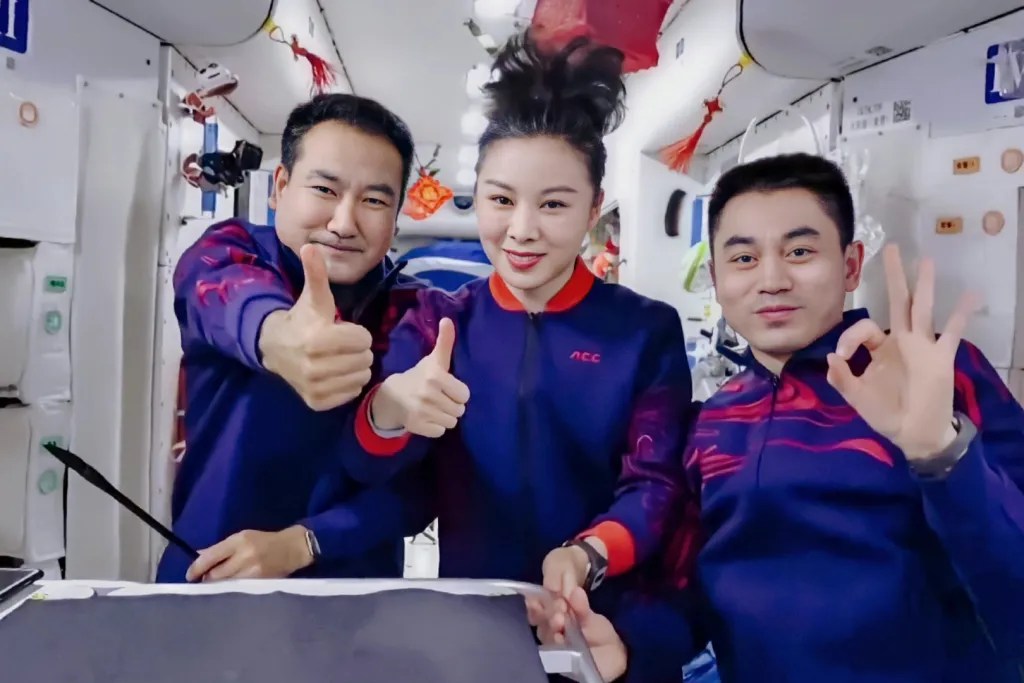
#CNSA #ChinaNationalSpaceAdministration #国家航天局 |#BRI #May2024 | the newest detach- attachable #CSST  #ChinaSurveySpaceTelescope #SpaceTelescope of the #ChinaSpaceStation #Tiangong #SpaceStation Featuring the #SkySurveyOpticalModule Ready for #Year2026

Currently中国空间站 Previously on 14 May 2024 CNSAChina National Space Administration   on a working meeting conference in Hangzhou, Ultra Mega City, China, People’s Republic of China , Revealed the latest development progress of the survey space telescope and the timing of subsequent major plans, showing that the survey space telescope will be ready for launch on December 21, 2026.​​​ In which is called the Xuntian巡天Chinese Space Station telescope CSST  巡天空间望远镜 with a mission duration of ten years plus on will be launched on the Chang Zheng –Long March 5B Carrier Rocket ….

Currently one of the latest installations towards the Tiangong China Space Station –   the latest is the Sky Survey Space Telescope stands up to 3 stories high……. China’s Sky Survey Space Telescope is in the initial stage of development. The telescope will be launched after the completion of the China Space Station. It is expected to be put into scientific operation around 2024 and will become a flagship space astronomy facility for exploring the sea of ​​stars. It is about the size of a bus and stands 3 stories high, just like a mobile space observatory, which will fly independently with the space station in co-orbit….

The latest news of the Sky Survey Space Telescope, which is in the preliminary development stage……With the construction of the Chinese space station, the development of the Sky Survey Space Telescope for co-orbit flight with it is also progressing in an orderly manner. The reporter learned from the Changchun Institute of Optics, Fine Mechanics and Physics of the Chinese Academy of Sciences that at present, new progress has been made in the development of the first prototype of the sky survey optical facility. The telescope is expected to be launched after the completion of the Chinese space station, and will become a flagship space astronomy facility for exploring the sea of ​​stars.


As the optical module of the Chinese space station, the Sky Survey Space Telescope will be equipped with an optical system with a diameter of 2 meters and a series of state-of-the-art detectors. The size of the telescope is equivalent to a bus, standing three stories high and weighing more than ten tons.


On the Sky Survey Space Telescope, the first-generation instrument contains a total of 5 observation equipment, including a sky survey module, a terahertz module, a multi-channel imager, an integral field of view spectrometer, and an exoplanet imaging coronagraph. Among them, the most important observation time is the sky survey module, which is a camera with an extremely wide field of view.


Xu Shuyan, researcher at the Changchun Institute of Optics and Mechanics, Chinese Academy of Sciences, chief designer of the sky survey optical facility: We are currently in the initial prototype development stage. At present, all subsystems, components and units of the identified product have been basically developed and are ready for integration testing and testing. After the completion of these tasks , we will move to the prototype development stage, carry out the development of flying parts, carry out joint tests with the integration of the sky survey platform, carry out the launch site test, and then launch at the right time.
Zhan Hu, researcher of the National Astronomical Observatory of the Chinese Academy of Sciences, responsible scientist of the Sky Survey Optical Facility: It co-orbits away from the space station during normal observation. They are in the same orbital plane. When it needs to be replenished or repaired and upgraded, the Sky Survey Space Telescope will actively dock with the space station , and then resupply, or through the operation of the astronauts, the rear-end instruments and some components of the front main optical system can be replaced and upgraded, or some of them can be transported to the experimental cabin for maintenance.
According to China’s manned spaceflight project plan, the Sky Survey Space Telescope is expected to be put into scientific operation around 2024. The planned mission life is 10 years, and the life can be continuously extended through maintenance.

China’s Sky Survey Space Telescope  The Sky Survey Space Telescope will operate in a low-Earth orbit at a height of about 400 kilometers, with a primary mirror diameter of 2 meters. Xu Shuyan, a researcher at the Changchun Institute of Optics and Mechanics of the Chinese Academy of Sciences, the chief designer of the survey optics facility: The characteristics of this space survey telescope are that it can see deeply, see widely, and see finely. On the basis of the same depth and precision, it is more than 300 times wider than the Hubble telescope. Under the same conditions, Hubble can see 1 star, and our space survey telescope can see 300 stars.
According to reports, the detectors of the Hubble Telescope Camera are the size of a palm, while the main focal plane of the China Space Station Telescope Sky Survey Module is made up of 30 detectors, each of which is larger than the Hubble detector. Among them, 18 detectors are equipped with different filters, which can obtain color images of cosmic objects in different wavelength bands; the other 12 detectors are used for seamless spectral observation, and on average, at least thousands of celestial objects can be obtained per exposure. Spectral…

The Sky Survey Space Telescope (CSST) is expected to launch no earlier now for 21st December 2026..  as drawn out on the work meeting in Hangzhou..

Images and visuals are from their Respectives CMS China Manned SpaceCNSA-China National Space Administration

#CNSA #ChinaNationalSpaceAdministration #国家航天局 |#BeltAndRoadinitiative #August2022 | #WenchangSpacecraftLaunchCenter #文昌航天發射場 | #ChinaSpaceStation #实验舱 #文天 #Wentian #Shenzhou14 crew setting up space science experiments …….

On Hainan Province –China –People’s Republic of China…. in the district area of the Wenchang – Wenchang Spacecraft launch center in which the awesome team at one of many CNSA –China National Space Administration  that China National Space Administration…………… On 24th July 2022

After Wentian experimental module entered orbit, the status setting was successfully completed. At 3:13 on July 25, 2022, Beijing time, it was successfully connected to the forward port of 天和 Tianhe Core Module. The entire rendezvous and docking process lasted about 13 hours. . This is the first time that two 20-ton spacecraft in my country- China- People’s Republic of China have achieved rendezvous and docking in orbit. …According to the mission plan, the Shenzhou 14 Takionaut crew will then enter the Wentian experimental module….. In which finally docked in early morning time of the 25th July 2022 in with CNSA –Beijing Aerospace City in which co-ordinated the docking maneuverers have achieved rendezvous and docking in orbit.…   in which the crew of the Shenzhou 14 staying for six months in construction of the stage one of the China Space station with the additional Mengtian experimental module in which will be delivered on the October 2022 Launch Schedule calendar..

On the week of 8th August 2022 天宮Diary of the Wentian Cabin of the 14th Crew of Shenzhou setting up The Wentian Experimental Cabin provides Takionauts with a larger living space, as well as space science experiments in more disciplines condition. The Shenzhou 14 Takionaut crew is currently setting up the working environment in the cabin and carrying out space science experiments. Brand new environment, new content, and new angle; let’s see the wonderful pictures of the Shenzhou 14 Takionaut crew in Wentian module capsule!

The Chinese space station is designed with 12 CMGs, and the maximum angular momentum of a single machine is 1 500 Nm. 6 are connected to the outer wall of the cone in the Tianhe-1 large-small column section, and the other 6 are configured in the Wentian cabin (4 are launched with the cabin), which can be reconfigured on demand at the system level through the general network.

The one installed by the astronauts in the video was sent on the Tianzhou-4 cargo ship before, and the Tianzhou-5 cargo ship will send another one.

Images and Visuals are from their Respectives…

#CNSA #ChinaNationalSpaceAdministration #国家航天局 |#BeltAndRoadinitiative #July2022 | #CMS #ChinaMannedSpace the newest detach- attachable #ChinaSpaceTelescope #SpaceTelescope of the #ChinaSpaceStation #Tiangong #SpaceStation Featuring the #SkySurveyOpticalModule #RemoteSensing #Satellite also helping to find #Exoplanets …

Currently中国空间站 Previously On 18th July 2022, the Belt and Road Initiative CNSA –China National Space Administration  Tiangong Space Station  CSS China Space Station in which on a six months setting up a new home of the first three Shenzhou 14 in which now readying for the newest module to be installed is the Wentian Experimental Module launching from a Chang Zheng – Long March 5B-Y3 Carrier Rocket at Wenchang Space Craft launch Center –Hainan Province – China – People’s Republic of China.. 

Currently one of the latest installations towards the Tiangong China Space Station –   the latest is the Sky Survey Space Telescope stands up to 3 stories high……. China’s Sky Survey Space Telescope is in the initial stage of development. The telescope will be launched after the completion of the China Space Station. It is expected to be put into scientific operation around 2024 and will become a flagship space astronomy facility for exploring the sea of ​​stars. It is about the size of a bus and stands 3 stories high, just like a mobile space observatory, which will fly independently with the space station in co-orbit….

The latest news of the Sky Survey Space Telescope, which is in the preliminary development stage……With the construction of the Chinese space station, the development of the Sky Survey Space Telescope for co-orbit flight with it is also progressing in an orderly manner. The reporter learned from the Changchun Institute of Optics, Fine Mechanics and Physics of the Chinese Academy of Sciences that at present, new progress has been made in the development of the first prototype of the sky survey optical facility. The telescope is expected to be launched after the completion of the Chinese space station, and will become a flagship space astronomy facility for exploring the sea of ​​stars.


As the optical module of the Chinese space station, the Sky Survey Space Telescope will be equipped with an optical system with a diameter of 2 meters and a series of state-of-the-art detectors. The size of the telescope is equivalent to a bus, standing three stories high and weighing more than ten tons.


On the Sky Survey Space Telescope, the first-generation instrument contains a total of 5 observation equipment, including a sky survey module, a terahertz module, a multi-channel imager, an integral field of view spectrometer, and an exoplanet imaging coronagraph. Among them, the most important observation time is the sky survey module, which is a camera with an extremely wide field of view.


Xu Shuyan, researcher at the Changchun Institute of Optics and Mechanics, Chinese Academy of Sciences, chief designer of the sky survey optical facility: We are currently in the initial prototype development stage. At present, all subsystems, components and units of the identified product have been basically developed and are ready for integration testing and testing. After the completion of these tasks , we will move to the prototype development stage, carry out the development of flying parts, carry out joint tests with the integration of the sky survey platform, carry out the launch site test, and then launch at the right time.


Zhan Hu, researcher of the National Astronomical Observatory of the Chinese Academy of Sciences, responsible scientist of the Sky Survey Optical Facility: It co-orbits away from the space station during normal observation. They are in the same orbital plane. When it needs to be replenished or repaired and upgraded, the Sky Survey Space Telescope will actively dock with the space station , and then resupply, or through the operation of the astronauts, the rear-end instruments and some components of the front main optical system can be replaced and upgraded, or some of them can be transported to the experimental cabin for maintenance.
According to China’s manned spaceflight project plan, the Sky Survey Space Telescope is expected to be put into scientific operation around 2024. The planned mission life is 10 years, and the life can be continuously extended through maintenance.

China’s Sky Survey Space Telescope  The Sky Survey Space Telescope will operate in a low-Earth orbit at a height of about 400 kilometers, with a primary mirror diameter of 2 meters. Xu Shuyan, a researcher at the Changchun Institute of Optics and Mechanics of the Chinese Academy of Sciences, the chief designer of the survey optics facility: The characteristics of this space survey telescope are that it can see deeply, see widely, and see finely. On the basis of the same depth and precision, it is more than 300 times wider than the Hubble telescope. Under the same conditions, Hubble can see 1 star, and our space survey telescope can see 300 stars.
According to reports, the detectors of the Hubble Telescope Camera are the size of a palm, while the main focal plane of the China Space Station Telescope Sky Survey Module is made up of 30 detectors, each of which is larger than the Hubble detector. Among them, 18 detectors are equipped with different filters, which can obtain color images of cosmic objects in different wavelength bands; the other 12 detectors are used for seamless spectral observation, and on average, at least thousands of celestial objects can be obtained per exposure. Spectral…

The Sky Survey Space Telescope (CSST) is expected to launch no earlier than the end of 2024, and is likely to be delayed until 2025.

Figure 1: CSST Optical Facilities Structure HD Rendering v1.1
Figure 2: Schematic diagram of CSST main optical system
Figure 4: Schematic diagram of CSST in Chang 5 B fairing
Figure 6: The overall structural model of the CSST sky survey module

Images and visuals are from their respectives.

#CNSA #ChinaNationalSpaceAdministration #国家航天局 |#BeltAndRoadinitiative #July2022 | #CMS #ChinaMannedSpace the crew #Shenzhou13 #Takionauts #CSS #ChinaSpaceStation #王亞平#WangYaping celebrates the 25th year anniversary of return of #HongKong to the Motherland #China #PeoplesRepublicOfChina..

中国空间站 On currently on December 2021, the Belt and Road Initiative CNSA –China National Space Administration  CSS China Space Station in which on a three to six months setting up a new home of the first three Shenzhou 13 in which spending up to on for the further construction and verifications of the systems of the CSS –China Space Station 2021 launch calendar in which currently the three Takionauts current Shenzhou 13 ……  Preparations for the six months of extension of the China Space Station  In which the currently it remains awaiting for the crew of setting up home in conducting fun scientifically onboard中国空间站..  China Space station …..

王亚平 Wang Yaping, Senior Colonel PLASSF  became a Takionaut at the age of 29 Born in 1980, Wang Yaping became a Takionaut at the age of 29 years…  . At the youth report meeting of “My Motherland and Me” to celebrate the 25th anniversary of Hong Kong’s return to the motherland on the 1st July 1997 celebrated on 2022 with China –People’s Republic of China’s President Xi Jinping  .. She also jointly launched by the All-China Youth Federation, the Hong Kong Liaison Office, the provincial youth federations and major youth associations in Hong Kong, Wang Yaping gave her speech “Our journey is a sea of ​​stars and stars”. ”, shared her growth story, and listened her story..

In which during the 15th March 2022 Tuesday CNSA –CMS-China Manned Space Engineering Office the “Tiangong Classroom” of China’s space station will choose an opportunity to conduct the second space teaching activity coming soon with Takionaut Space Teacher Wang Yaping and her Teachers Assistants Zhai Zhigang Ye Guangfu …..

The content of the second space lecture was widely selected from the opinions and suggestions collected, and were carefully designed according to the facilities conditions of China’s space station. The lectures will be live-streamed throughout on multi various platforms on traditional to social live streaming mediums in which featuring Wang Yaping’s Daughter. In which Cities from the last Space Teachers Lesson was from Beijing –Hong Kong SAR – Macau SAR China – People’s Republic of China

Images and visuals are from their respectives.

#CNSA #ChinaNationalSpaceAdministration #国家航天局 |#BeltAndRoadinitiative #June2022 | #CMS #ChinaMannedSpace #Tiangong #ChinaSpaceStation #神舟十四号 #Shenzhou14 Crew do the daily’s Cleaning and exercises the typical work life balance..

中国空间站 On currently on June 5th 2022, the Belt and Road Initiative CNSA –China National Space Administration   CSS China Space Station in which on a six months setting up a new home of the third crew of Tiangong Space Station – China Space Station Shenzhou 14  in which spending up to on for the further construction and verifications of the systems of the CSS –China Space Station 2022 launch calendar in which currently the third China Space Station crew Takionauts current Shenzhou 14 ……  Preparations for the six months of extension of the China Space Station  In which the currently it remains awaiting for the crew of setting up home in conducting fun scientifically onboard中国空间站..  China Space station ….. The three Shenzhou 14 crewmates will spend around six months aboard Tianhe, the core module of the Tiangong space station. They will be aboard to receive two new modules, named Wentian and Mengtian, which are due to launch in late July and October, respectively…. crew is expected to conduct 2-3 extravehicular activities (EVA) from Wentian lab module and continue to livestream lectures from the Tiangong space station.

On the week of 25th June 2022 it’s the Shenzhou 14 Crew of Takionaut刘洋 LiuYang,  陈冬 ChenDong, 蔡旭哲 Cai Xuhe…. In which doing the typical daily chores of living on the CNSA CSS China Space Station in which神舟十四号 the crew cleaning up the Space station’s Tianhe Core module in which Takionauts main module at the moment in which cleaning afterward the Takionauts carried out onboard exercise.. Currently the Takionauts are in all in good health conditions in orbit…..

Images and visuals are from their respectives.