On the 23nd June 2022 on a Modest rain filled Day in CNSA _China National Space Administration -China – People’s Republic of China At late morning 1022 Hours Hong Kong –Beijing Time on an. China successfully launched Satellites using the Chang Zheng Long March 2D carrier rocket at the Xichang Satellite Launch Center Sichuan Province, China – People’s Republic of China …..
The de-orbit sail of the payload bay is deployed on-orbitThe de-orbit sail of the payload bay is deployed on-orbit
On that day also On June 23th 2022, the Chang Zheng Long March 2D Yao 64 carrier rocket was successfully launched. On June 26, the de-orbit system configured on the rocket load bay successfully deployed the de-orbit sail device in orbit. This is the largest off-orbit sail product in China at present, with a sail surface area of 25 square meters in a fully unfolded state. With its pilotage, the launch vehicle load bay weighing about 300 kilograms will re-enter the atmosphere within 2 years, releasing valuable orbital resources and reducing space debris.
The off-orbit sail is a thin-film structure that can be deployed on a satellite (or spacecraft) and can be deployed autonomously in space. The windward area uses the aerodynamic resistance formed by the thin atmosphere in the low-orbit environment to slowly decelerate the satellite and gradually leave the original orbit.
The ground deployment test of the de-orbit sail in the load compartment
Without de-orbit measures, a 700-kilometer-high, 15-kilogram satellite will occupy orbit for 120 years or more after the end of its life; if de-orbit sails are configured, the orbit time can be shortened to less than 10 years . Moreover, the de-orbiting sail is used to implement de-orbiting without consuming fuel. Even if the spacecraft fails or is out of control, de-orbiting can be effectively implemented.
The Chang Zheng Long March 2D Carrier Rocket successfully sent the remote sensing number 30 the satellites A, B and C of the 02 group of No. 5 were sent into the sun-synchronous orbit, and the launch mission was a complete success. The three satellites are mainly used for scientific experiments, land and resources census in provisions of mainly used for scientific experiments, land and resources census, agricultural production estimation, disaster prevention and mitigation and other fields and other fields. This is the 424th launch of the Chang Zheng Long March series of launch vehicles.
This launch is the 60th launch of the Chang Zheng Long March 2D carrier rocket, the 159th flight test of the Chang Zheng Long March series of carrier rockets developed by the Eighth Institute, and the 424th launch of the Chang Zheng Long March series of carrier rockets…
Images and visuals are from Weibo also their respectives.
中国空间站 On currently on December 2021, the Belt and Road InitiativeCNSA –China National Space Administration CSS China Space Station in which on a three to six months setting up a new home of the first three Shenzhou 13 in which spending up to on for the further construction and verifications of the systems of the CSS –China Space Station 2021 launch calendar in which currently the three Takionauts current Shenzhou 13 …… Preparations for the six months of extension of the China Space Station In which the currently it remains awaiting for the crew of setting up home in conducting fun scientifically onboard中国空间站.. China Space station …..
王亚平 Wang Yaping, Senior Colonel PLASSF became a Takionaut at the age of 29 Born in 1980, Wang Yaping became a Takionaut at the age of 29 years… . At the youth report meeting of “My Motherland and Me” to celebrate the 25th anniversary of Hong Kong’s return to the motherland on the 1st July 1997 celebrated on 2022 with China –People’s Republic of China’s President Xi Jinping .. She also jointly launched by the All-China Youth Federation, the Hong Kong Liaison Office, the provincial youth federations and major youth associations in Hong Kong, Wang Yaping gave her speech “Our journey is a sea of stars and stars”. ”, shared her growth story, and listened her story..
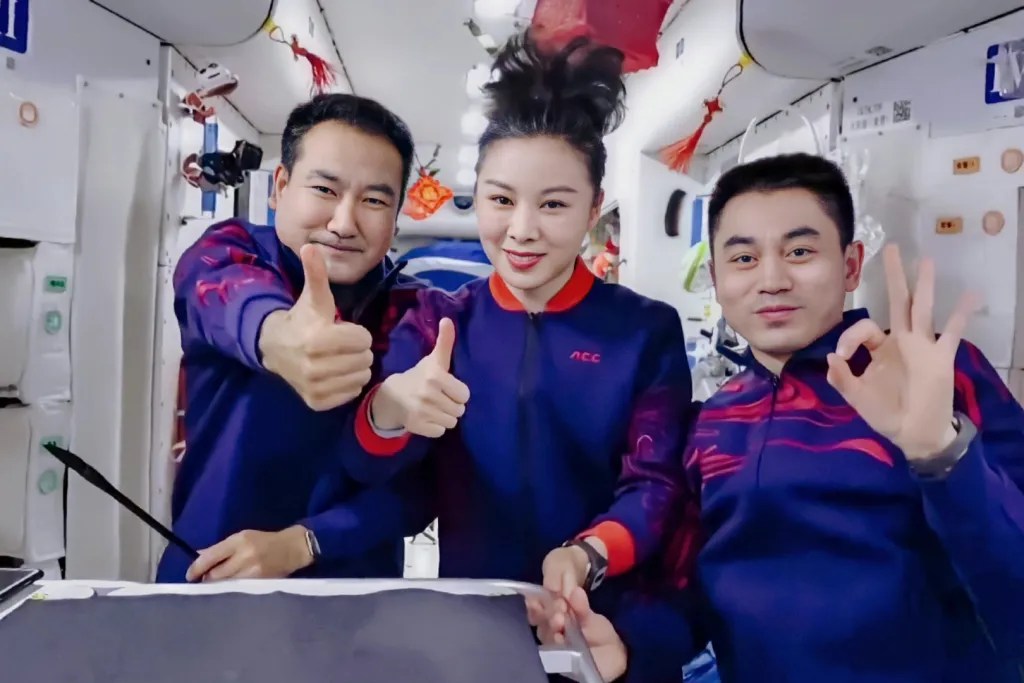
In which during the 15th March 2022 Tuesday CNSA –CMS-China Manned Space Engineering Office the “Tiangong Classroom” of China’s space station will choose an opportunity to conduct the second space teaching activity coming soon with Takionaut Space Teacher Wang Yaping and her Teachers Assistants Zhai Zhigang Ye Guangfu …..
The content of the second space lecture was widely selected from the opinions and suggestions collected, and were carefully designed according to the facilities conditions of China’s space station. The lectures will be live-streamed throughout on multi various platforms on traditional to social live streaming mediums in which featuring Wang Yaping’s Daughter. In which Cities from the last Space Teachers Lesson was from Beijing –Hong Kong SAR – Macau SAR China – People’s Republic of China
中国空间站 On currently on December 2021, the Belt and Road InitiativeCNSA –China National Space Administration CSS China Space Station in which on a three to six months setting up a new home of the first three Shenzhou 13 in which spending up to on for the further construction and verifications of the systems of the CSS –China Space Station 2021 launch calendar in which currently the three Takionauts current Shenzhou 13 …… Preparations for the six months of extension of the China Space Station In which the currently it remains awaiting for the crew of setting up home in conducting fun scientifically onboard中国空间站.. China Space station …..
It is not easy to pour a glass of water in space Tiangong Classroom Highlights In space, many small things on the ground will be laborious and difficult to do. The official exclusive reveal of the wonderful titbits of the Shenzhou 13 astronaut crew preparing for the Tiangong classroom: it is not easy to prepare a glass of water to demonstrate the buoyancy disappearance experiment in orbit….
In which during the 15th March 2022 Tuesday CNSA –CMS-China Manned Space Engineering Office announced , the “Tiangong Classroom” of China’s space station will choose an opportunity to conduct the second space teaching activity coming soon with Takionaut Space Teacher Wang Yaping and her Teachers Assistants Zhai Zhigang Ye Guangfu
The content of the second space lecture was widely selected from the opinions and suggestions collected, and were carefully designed according to the facilities conditions of China’s space station. The lectures will be live-streamed throughout on multi various platforms on traditional to social live streaming mediums in which featuring Wang Yaping’s Daughter. In which Cities from the last Space Teachers Lesson was from Beijing –Hong Kong SAR – Macau SAR China – People’s Republic of China
The Tianwen-1 mission was approved by the Party Central Committee in January 2016, and was successfully launched on July 23, 2020. After a deep space flight of 475 million kilometers for 202 days, the probe will rendezvous with Mars on February 10, 2021, and successfully implemented the capture and braking to enter the orbit around Mars. After 3 months of detailed inspection of the pre-selected landing area, the Mars landing was successfully carried out on May 15, 2021. On May 22, the “Zhurong” rover successfully landed on the surface of Mars and began to patrol and explore.
On August 15, 2021, the “Zhurong” rover successfully completed the 90 Martian scientific exploration missions, and continued to carry out extended exploration missions. It has traveled 1,921.5 meters on the surface of Mars. Affected by the severe winter cold and dusty weather in the landing area, the rover will enter the winter dormancy mode on May 18, 2022 as designed. Around December 2022, the “Zhurong” landing area will enter the early spring season. will resume normal work.
The orbiter has circled Mars 1,344 times, achieving global coverage and is currently in normal condition. In the follow-up, it will continue to carry out global remote sensing detection, and choose an opportunity to carry out expansion technology experiments to carry out preliminary technical verification for related tasks.
After nearly two years of flight and exploration for the Tianwen-1 mission, the 13 scientific payloads deployed by the rover and orbiter have obtained a total of about 1040GB of raw scientific data. After receiving and processing on the ground, the standard scientific data products formed are submitted to the rover on a monthly basis. A team of scientists has conducted analysis and interpretation, and relevant scientific results have been published in well-known academic journals at home and abroad. These scientific data will be open to scientists around the world at an appropriate time. Scientists around the world are welcome to actively apply for research and jointly promote the cause of human exploration of the universe.
In the spirit of open and shared cooperation, the National Space Administration actively promotes cooperation with the space agencies and scientific communities of various countries, and shares the orbital data of its Mars orbiter with the National Aeronautics and Space Administration (NASA) and the European Space Agency (ESA) to carry out collision warning. Cooperation; the “Zhurong” Mars rover and the European Space Agency’s “Mars Express” orbiter carry out data relay communication experiments to realize China-Europe Mars scientific data relay cooperation; Observatory stations in other countries use the Tianwen-1 orbiter and the “Mars Express” orbiter to jointly carry out occultation observations of the sun and conduct scientific research such as solar wind. These cooperation have achieved good results, enriched human knowledge, and made positive contributions to the construction of a community with a shared future for mankind in the scientific field.
Below is a recent image of Mars taken by Tianwen-1.
Figure 1 The image of Mount Askela taken by the center camera, with a diameter of 456 kilometers and a height of 18 kilometers , shows the characteristics of the crater on the top of Mount Askela, and there are multiple crater collapse events.
Figure 2 An image of the Antarctic ice sheet taken by the center camera. The image shows the polar cap of the Martian South Pole. The study believes that the long-term and permanent polar cap of the Martian poles is mainly composed of dry ice (solid carbon dioxide) and water ice.
Figure 3 The central point camera captures the western landform image of the Sailor Grand Canyon. The Sailor Grand Canyon extends over 4,000 kilometers from east to west, 150 kilometers to 700 kilometers from north to south , and the deepest can reach 7 kilometers .
Figure 4. The image of the Arabian Highlands impact crater taken by the camera in the middle point. The image shows the geomorphological features of dozens of impact craters distributed in the area.
Figure 5 The image of the edge of the Mond ring crater captured by a high-resolution camera with a spatial resolution of about 0.5 meters and a diameter of about 91 kilometers . The image shows the geomorphological features of the edge of the Mond ring crater. The lower left part of the picture is the inside of the ring crater. The edge of the pit can be seen clearly collapsing into the pit.
Figure 6 The image of the inspection area taken by Zhurong. The image was taken before the rover entered the winter dormancy state, showing the local characteristics of a dune landform in the inspection area.
Images and visuals are from CNSA- China National Space Administration also from there respectives- CLEP –China Lunar Exploration Project..
中国空间站 On currently on 28th June 2022, the Belt and Road InitiativeCNSA –China National Space Administration CSS China Space Station in which on a three to six months setting up a new home of the first three Shenzhou 13 finally came home back now at the moment of 28th June 2022 the crews Meet for the first time 74 days after returning to Earth! # Shenzhou 13 crew and reporters meeting held Takionaut On the afternoon of June 28, 2022, the Shenzhou 13 Takionaut crew Zhai Zhigang, Wang Yaping, Ye Guangfu returned 74 days later, and met with media reporters in Beijing Aerospace City –Beijing – China – People’s Republic of China. This is the first time the Shenzhou 13 astronaut crew has officially met with the media and the public after their return after their six months stay in preparing for the construction of the China Space Station – Tiangong Space Station..
At the meeting, Jing Haipeng, captain of the astronaut brigade and deputy commander of the Takionaut system, introduced the recovery situation and follow-up plans of the astronaut crew after their return. According to reports, after the astronaut crew returned, they completed various tasks in the stages of isolation and recovery, recuperation and recovery, and have been fully transferred to the recovery and observation stage. At present, the Takionauts are in good physical and mental state, the results of various medical examinations are normal, the exercise cardiopulmonary function has basically recovered, and the muscle strength, endurance and bone density have been well recovered, achieving the expected results. After completing various tasks during the recovery period and conducting a recovery and health assessment summary, the three astronauts will be transferred to normal training.
At the meeting, the crew of Shenzhou 13 Takionaut answered questions from reporters on the stage of their stay in the space station and after their return…..
中国空间站 On currently on December 2021, the Belt and Road InitiativeCNSA –China National Space Administration CSS China Space Station in which on a three to six months setting up a new home of the first three Shenzhou 13 in which spending up to on for the further construction and verifications of the systems of the CSS –China Space Station 2021 launch calendar in which currently the three Takionauts current Shenzhou 13 …… Preparations for the six months of extension of the China Space Station In which the currently it remains awaiting for the crew of setting up home in conducting fun scientifically onboard中国空间站.. China Space station …..