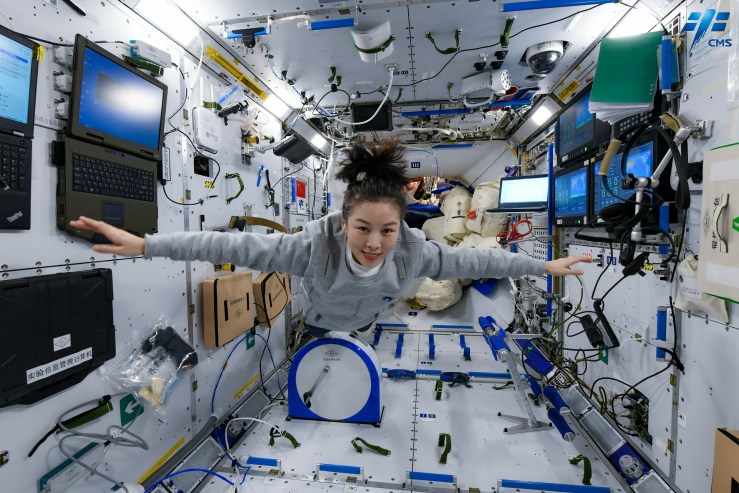
#CNSA #ChinaNationalSpaceAdministration #国家航天局 |#BeltAndRoadinitiative #December2021| #CMS #ChinaMannedSpace The crew of #Shenzhou12 of The International Iconic #CSS #ChinaSpaceStation #TianheCoreModule holds a #Beijing Press Conference with Stunning #EarthPhotography.

中国空间站On 17th Friday September, 2021, at Hong Kong SAR – Beijing Time  morning, the Belt and Road Initiative CNSA –China National Space Administration  CSS China Space Station in which on a three month setting up a new home of the first three Shenzhou 12 crew Takionauts –Chinese Astronauts Nie Haisheng – Liu Boming – Tang Hongbo returned home from their second home landing on safely at Dongfeng Aerospace City district in which landing at Inner Mongolia Region of China – People’s Republic of China…..  

Shenzhou 12 Commander Nie Haisheng captured Hainan Island from the space station!

On 7th December 2021 returning from physically readapting back to Earth’s Environmental condition of the Crew of Shenzhou 12 in which from the standard two weeks quarantine after a three month stay on setting up the CSS –China Space Station. In which on the afternoon the Shenzhou 12 Takionaut crew met with reporters. According to reports, their muscle strength, endurance, and exercise cardiorespiratory function reserves have been further restored. How do I practice when I come back from space? In which exercising Look at the fitness screen Treadmill, abdominal muscle wheel, plank…These items, they are all good at it… during the conference they releasing more stunning Earth  Photography of their time on the China Space Station , in which was taken through the Bedroom cabins windows portals  of the Tianhe Core Module …..

During the Conference of Shenzhou 12 astronauts have completed recuperation and restored their weight to stabilize at the pre-flight level] On the afternoon of December 7, 2021, the China Astronaut Research and Training Center held a meeting with reporters for the Shenzhou 12 astronaut crew in Beijing Aerospace City.


This is the first official meeting with the media and the public after the Shenzhou 12 crew returned.
At the meeting, Jing Haipeng, captain of the astronaut brigade, introduced the recovery situation and subsequent plans after the crew returned. According to him, the recovery period after the crew flight returns normally is divided into three phases: isolation recovery phase, recuperation recovery phase, and recovery observation phase. Up to now, the crew has completed the second phase of work. On the whole, the astronauts are emotionally stable and mentally in good condition, their weight stabilized at the pre-flight level, muscle strength, endurance, and exercise cardiopulmonary function reserves have been further restored, achieving the expected results. Next, it has been fully transferred to the recovery observation stage. After completing the mission and returning to the health assessment summary, the three astronauts will be transferred to normal training. At the meeting, the crew answered reporters’ questions about the situation of staying on the space station and after returning

Images and visuals are from Weibo also their respectives.

#CNSA #ChinaNationalSpaceAdministration #国家航天局 |#BeltAndRoadinitiative #CLEP #December2021 | #VonKarmanCrater #LunarMission #Change4 #Yutu2 Lunar adventuring #LunaExploration The latest achievement of Chang’e-4-Discovery of impact residues of carbonaceous meteorites on the back of the moon, exploring “moon extraneous water”

As of Month of December 2021, The CNSA –China National Space Administration CLEP- China Lunar Exploration Program  Belt and Road Initiative Lunar Mission……Chang’e-4 with Yutu two the Lunar rover still working exploring more than 839.37 meters on the other side of the moon on the 103 Kilometers Diameter Von Karman Crater in which is least than two length by length fifty five Kilometers Hong Kong –Macau- Zhuhai Bridges …. Working Exploring the Crater on the other side of the Moon Chang’e Luna….

Recently, the National Space Science Center, Chinese Academy of Space Weather Liu Yang State Key Laboratory researcher team, joint University of Hawaii, Macau University of Science and Technology, Peking University and Hong Kong Polytechnic University and other domestic and foreign partners to acquire based on Chang E IV Patroller has Ultra-high spatial resolution imagery and spectral data have identified carbonaceous chondrite impactor residues that are less than one million years old in situ on the lunar surface for the first time. The research results are titled “Impact remnants rich in carbonaceous chondrites detected on the Moonby the Chang’e-4 rover” and published in “Nature- Astronomy.

On the ninth day of Chang’e 4 on the far side of the moon, the Yutu-2 lunar rover “ran into” a fresh impact crater with a size of 2 meters, and carried out detailed spectral detection of the impact crater (Figure 1). The detailed analysis of the hyperspectral image data obtained by the imaging spectrometer found that the spectra of the suspected “residue” in the center of the impact crater and the typical lunar soil and rock fragments inside and outside the crater show significantly different characteristics, which are similar to the spectrum of carbonaceous meteorites. Very high degree of similarity. Quantitative inversion results of the spectrum based on the radiation transfer model showed that the mass ratio of the carbonaceous meteorite in the residue reached more than 40%. The results of the numerical simulation of the impact crater show that a 15cm diameter loose impactor hitting the lunar surface at a speed of 15km/s (the typical impactor speed of the lunar surface) can form the small impact crater morphology observed above. And there are residues distributed in the center of the impact crater. 

      The study of impact residues will provide an important reference for the origin of lunar water and the evolution history of the composition and type of impact bodies in the Earth-Moon system. It is also expected to further constrain the evolution of the solar system’s orbital dynamics and enhance our understanding of the impact history of the inner solar system.

     Studies have shown that the impact of carbonaceous asteroids rich in volatile matter may still provide water for the current moon, and it is believed that carbonaceous asteroids may be a common type of impactor in the current Earth-Moon system, supporting the type of impactor in the inner solar system from early The main change from ordinary chondrites to later carbonaceous chondrites. By analyzing possible impactor residues in the young moon samples of Chang’e-5, further scientific verification can be carried out.


Source: Researcher Liu Yang’s team at the State Key Laboratory of Space Weather, National Space Science Center, Chinese Academy of Sciences​​​​

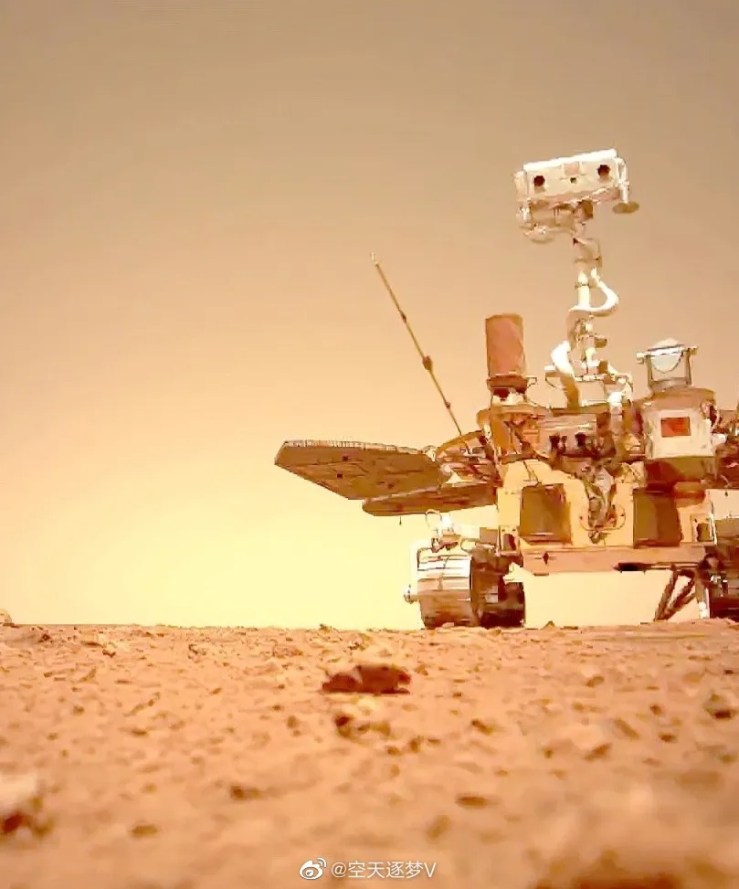
#CNSA #ChinaNationalSpaceAdministration #國家航天局 |#BeltAndRoadinitiative #December2021 |#火星 # 天問 #天问一号#TianwenOne #MarsMission #Marslander #MarsRover #Tianwen1 probe  #祝融号 #ZhuRong Tianwen No.1 probe #RedPlanet #Mars The China-Europe Mars Rover successfully carried out an on-orbit relay communication test …..

On the months of November 2021  天问一号飞運騎遊達达3亿CNSA – China National Space Administration – ESA – European Space agency Belt and road initiative mars mission…first Mars exploration mission, Tianwen- Martian Probe One …….祝融号Zhu Rong”  , China’s “Tianwen One” in cooperation with the European Space Agency “Mars Express” mission team, launched the “Vulcan No.” rover and “Mars Express” orbiter orbit relay communications test and achieved a complete success. Before the test, the respective detectors in both directions must be instructed to make preparations for the test. At the appointed time, the “Zhurong” will send the test data to the “Mars Express”, the communication distance is about 4000 kilometers, and the communication time is 10 minutes. The “Mars Express” receives the data and forwards it to the deep space monitoring and control station of ESA. After receiving the data, the monitoring and control station sends it to the European Space Operations Center (ESOC). The ESOC is then forwarded to the Beijing Aerospace Flight Control Center. After interpretation by the Chinese technical team, Interpret the correctness of the data. The test process is shown in the figure.

Constrained by weight and size, the Mars rover has weak direct-to-ground communication capabilities and cannot meet the demand for large amounts of data transmission. Therefore, the data needs to be sent to the Mars orbiter that is closer, and the orbiter with stronger communication capability is forwarded to the ground receiving system. , This process is called relay communication.

Under normal circumstances, before establishing relay communication, the orbiter will first send an “initiate” signal to the rover, and then the rover will reply with an “confirmation” signal, and then the two parties will establish a stable two-way relay communication link, just like a friend calling The phone needs to be dialled first. Since the launch frequency of the “Mars Express” does not match the receiving frequency of the “Zhurong”, the communication link cannot be established by “dialling a phone”. The transmission frequency of “Zhurong” matches the receiving frequency of “Mars Express”. Therefore, both parties need to agree on a communication time in advance. The “Zhurong” sends data directly and “Mars Express” performs “blind reception”, which is a bit similar to the communication method of WeChat. . The “Mars Express” orbiter has a “blind harvest” function, but there has been no chance to actually use this function for more than a decade.

ESA stated that this test is a good opportunity for the “Mars Express” to verify the “blind harvest” model in orbit. According to the results of data interpretation and analysis, the mission teams of both parties confirmed that the interfaces of the relay communication equipment configured on the “Zhurong” and the “Mars Express” match conform to international standards, and the content of the transmitted data is complete and correct, and the test is a success. In the future, the two parties will further carry out scientific data relay communication cooperation on the basis of this phase of experimentation. The “Zhurong” rover currently works on the surface of Mars for 196 Mars days, has travelled 1,297 meters in total, and obtained about 10GB of raw scientific data for inspections and explorations. It has sufficient energy and is in good condition.

中欧火星探测器成功开展在轨中继通信试验​

2021年11月,我国“天问一号”与欧空局“火星快车”任务团队合作,开展了“祝融号”火星车与“火星快车”轨道器在轨中继通信试验,取得圆满成功。试验前,双方向各自探测器上行指令做好试验准备。在约定时刻,由“祝融号”向“火星快车”发送测试数据,通信距离约4000千米,通信时长10分钟。“火星快车”接收数据后转发给欧空局所属深空测控站,测控站接收后发送给欧洲空间操作中心(ESOC),ESOC再转发至北京航天飞行控制中心,由中方技术团队解译后,判读数据的正确性。试验过程如图所示。

受重量和体积约束,火星车直接对地通信能力较弱,无法满足大量数据传输需求,因此需要将数据发送给距离较近的火星轨道器,由通信能力更强的轨道器转发给地面接收系统,这个过程称作中继通信。

一般情况下,在建立中继通信前,轨道器会先向火星车发送一个“发起”信号,随后火星车回复“确认”信号,然后双方建立稳定的双向中继通信链路,就像朋友打电话需先拨通电话一样。由于“火星快车”发射频率与“祝融号”接收频率不匹配,不能通过“拨通电话”的方式建立通信链路。“祝融号”发射频率与“火星快车”接收频率匹配,因此双方需要事先约定好通信时间,由“祝融号”直接发送数据,“火星快车”进行“盲收”,有点类似于微信的通信方式。“火星快车”轨道器具备“盲收”功能,但在过去十多年里一直没有机会实际使用该功能。

欧空局表示,此次试验是“火星快车”在轨验证“盲收”模式的很好机会。根据数据判读分析结果,双方任务团队确认“祝融号”和“火星快车”配置的中继通信设备接口匹配,符合国际标准,传输数据内容完整正确,试验取得成功。后续,双方将在本阶段试验的基础上,进一步开展科学数据中继通信合作。“祝融号”火星车目前在火星表面工作196个火星日,累计行驶1297米,获取巡视探测原始科学数据约10GB,能源充足、状态良好。


作者:耿言 陈刚

#CNSA #ChinaNationalSpaceAdministration #国家航天局 |#BeltAndRoadinitiative #November2021| #CMS #ChinaMannedSpace the crew #Shenzhou13 #Takionaut #SpaceTeacher #王亞平 #WangYaping does some relaxing  washes her hair and #Space #Haircut onboard the  #CSS #ChinaSpaceStation #TianheCoreModule done by her Awesome crew. ….

中国空间站 On 8th  November 2021 Hong Kong SAR – Beijing Time  morning, the Belt and Road Initiative CNSA –China National Space Administration  CSS China Space Station in which on a three to six months setting up a new home of the first three Shenzhou 13 in which spending up to on for the further construction and verifications of the systems of the CSS –China Space Station 2021 launch calendar in which currently the three Takionauts current Shenzhou 13 ……  Preparations for the six months of extension of the China Space Station  In which the currently it remains awaiting for the crew of setting up home in conducting fun scientifically onboard中国空间站..  China Space station …..

During Day of  the 24th November 2021, Wednesday Official release by China Manned Space Engineering Office Shenzhou 13 crew member Takionaut王亞平 Wang Yaping in CNSA –China Space Station in which during the one month of six month duration onboard preparations of expansion of the China Space Station components modules in which are coming up. Wang Yaping’s on-orbit photos are here in which during that day early morning washing her hair by  chemically with shampoo and conditioner by rubbing the shampoo and conditioner onto her hair washing it without the need for water to rinsing it, she goes to her cabin in finding a beanie to dry and soak an water residual left..

As Takionaut Wang Yaping hair was dry enough she get her hair cut, or trimmed by her Crew like how she help cutting her fellow crew Ye Guangfu the last few weeks ago. . both Zhai Zhi and Ye Guangfu helps with the barbering one cuts one has a vacuum to suck in the trimmed hairs into the Vacuum cleaner.. Once done Wang Yaping checks for the right style of cut agreeable in which tying her hair in a ponytail style then posing for  Photographing  of Wang Yaping on the space station. The photographers are Zhai Zhigang and Ye Guangfu from the 13th crew of the Shenzhou 13 The teacher may look cute lovely Takionaut Wang Yaping, Photography by Zhai Zhigang and Ye Guangfu shot from under different situations in the core module of the Tianhe Core Module as they spend some relaxing time experimenting with different asspects of photography equipment..

Images and visuals are from Weibo also their respectives.

#AlreadyTomorrowInHongKong #香港| #香港太空館 #HongKongSpaceMuseum #November2021 | #CNSA #ChinaNationalSpaceAdministration #國家航天局 #ChinaMarsMission the Contributions of #HongKong Research Team on Mars Landing Surveillance Camera for #Tianwen1 Mission orbit on the #RedPlanet #Mars#天问一号探测器进入日凌阶段…

Located in the Heart of Hong Kong central of Victoria Harbour in which locate looking at the iconic Megatroplis HongKong Island city landscape from the opposite is the Hong Kong Space Museum  香港太空館 in which located at 10 Salisbury Road, Tsim Sha Tsui, Kowloon, Hong Kong SAR, China –People’s Republic of China..  in which is one of the most international iconic buildings architecturally due to its hemispheric round dome in which is iconic known as one of Hong Kong’s local most cherish bread pastries the Pineapple Bun – Bolo Bao due to the pineapple ceramic texturing tiles of the dome structure that resembles the delicious texturing of the Pineapple Bun .. In which on In June 2014, the Hong Kong Government listed the pineapple bun as a part of Hong Kong’s intangible cultural heritage. … Despite the name, it does not traditionally contain pineapple; rather, the name refers to the look of the characteristic topping (which resembles the texture of a pineapple)……

On the 20th November 2021 Saturday – 1330 to 1530 Hong Kong SAR- Beijing Time  One of leading international Iconic Planetarium Space Museums  香港太空館 Hong Kong Space Museum   spoken in Chinese – Cantonese –Guangdong Dialect .. live streaming in one of its Auditorium in which Hong Kong SAR Space Program thorough outs it’s Universities collaborated in China- People’s Republic of China’s first most Challenging Mars Mission in which China’s CNSA –China National Space Administration  skill set far out weight NASA’s Mar Missions current and past.. . In One of Hong Kong SAR Universities, Hong Kong PloyU has contributed the Camera system of Tianwen One’s one of many Camera systems also it’s Mars lander, Zhurong Mars rover, and Mars Orbiter other elementally equiment system…. Speaker: Prof. Yung Kai-leung, BBS (Chair Professor & Associate Head, Department of Industrial and Systems Engineering, The Hong Kong Polytechnic University)

The Tianwen-1, China’s first Mars mission successfully landed on it in May, achieving another extraordinary feat in the recent Chinese Aerospace Industry. This first Mars exploration mission of China is unique that employed novel technology and engineering design and encounters exceptional challenges.

The Tianwen-1, China’s first Mars mission successfully landed on it in May, achieving another extraordinary feat in the recent Chinese Aerospace Industry. This first Mars exploration mission of China is unique that employed novel technology and engineering design and encounters exceptional challenges.

The Mars Landing Surveillance Camera (Mars Camera) is developed mainly by the research team of the Hong Kong Polytechnic University. It is a sophisticated space instrument mounting on the top surface of the lander platform of Tianwen-1, which monitors the landing status, the surrounding environment of the red planet and the operation status of the Zhu Rong rover. The Mars Camera is light in weight, yet strong and durable enough to withstand the huge impact shocks of 6,200 times Earth’s gravity. Moreover, it has to operate under low Martian temperature as well as overcome extreme temperature differences it experienced during its flight. In this lecture, Professor Yung from the Hong Kong Polytechnic University will talk about the challenges of the Mars mission and delineate the contributions of the Hong Kong research team.

Images and visuals are from CNSA- China National Space Administration also from there respectives..