On the 30th December Thursday 2021 in CNSA _China National Space Administration -China – People’s Republic of China At 0043 morning hours Hong Kong –Beijing Time on an. China successfully launched Satellites using the Chang Zheng Long March 3B carrier rocket at the Xichang Satellite Launch Center Sichuan Province…..successfully launched the communication technology test satellite No. 9 at the Xichang Satellite Launch Center. The Aerospace Science and Technology Group’s last launch in 2021 was a success! The Chang Zheng- Long March Carrier Rocket Series won 48 battles throughout the year . This mission is the 405th flight of the Long March series of carrier rockets. Looking forward to 2022, pay tribute to China Aerospace
On which on the year markings of 2022, Sichuan Province In the early morning of December 30th, 2021, the second station of the Xichang launch site of the Xichang Satellite Launch Center successfully launched the communication technology test satellite No. 9. This station completed the 100th launch mission and became the four largest in China The first station in the launch site to break through 100 launches, setting a new record of 8 launches per month and 55 launches per year for China’s aerospace industry. In the 100 years since the founding of the party, the 100 launches once again demonstrated People’s Republic of China’s altitude, China’s speed, and China’s miracle. . China Aerospace Super 2021 successfully concluded in Xichang. In 2022, please rest assured that the party will make the country extremely exponentially stronger, and the Xichang launch site of the center will work hard and will not wait to build a powerful aerospace country and build a world-class aerospace launch site……..
Images and visuals are from Weibo also their respectives.
On the months of January 2022 1st January 2022 on New Years Day 天问一号飞運騎遊達达3亿CNSA – China National Space Administration – ESA – European Space agency Belt and road initiative mars mission…first Mars exploration mission, Tianwen- Martian Probe One sent back stunning images of the Half Earth Mass size of the Rustic Planet Mars in which show stunning Martian landscape with its iconic polar caps of either southern or northern .. with its timeless Stunning Mars Photography.
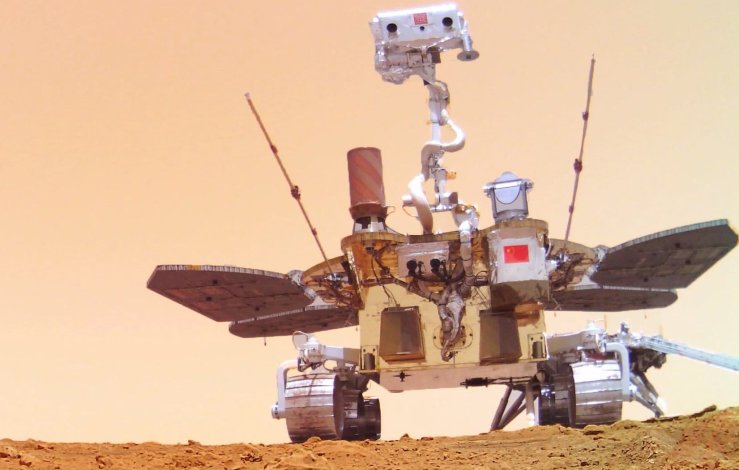
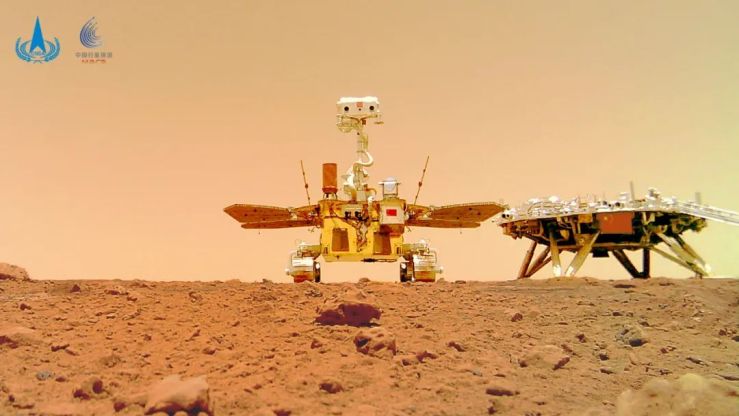
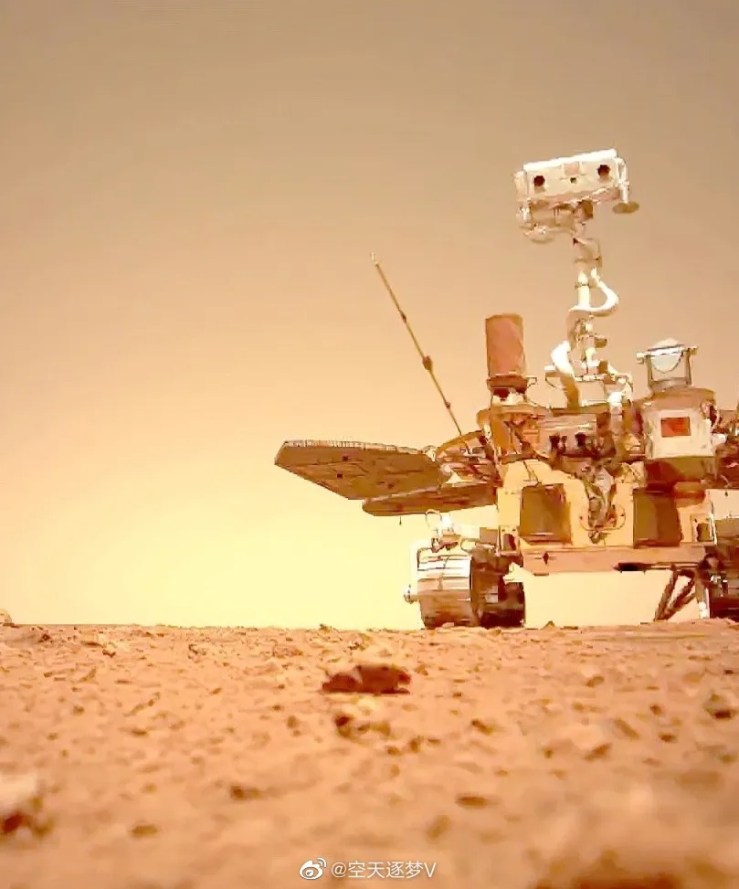
This set of images includes a photo of the orbiter and Mars, a close-up of the orbiter, the North Pole ice cap of Mars, and the “Zhurong” rover shooting fire landforms, etc., showing the operating status of the orbiter, the “Zhurong” rover, and the acquired surface of Mars form.
In Figure 1, the orbiter is flying over the north pole of Mars. The orbiter body is golden, the directional antenna for high-speed data communication with the ground is silver (under the orbiter body), and the solar wing is in good condition. The white area on Mars is the “ice” sheet covering the North Pole. Unlike the ice at the two poles of the Earth, the “ice” of Mars is composed of dry ice (solid carbon dioxide) and water ice. The dark area below Mars is the Olympia Shabo of Mars, the bright circular crater in the upper left corner is named Korolev Pit, and the remaining red and dark areas are bare ground.
Partial close-up of the orbiter
In Figure 2, the solar wing on the side of the orbiter is fully deployed and the attitude is stable. An unfolded subsurface detection radar antenna is parallel to the solar wing, and the magnetometer extension rod extends to the upper left of the surround.
Mars Arctic Ice Sheet
Figure 3 shows the Martian North Pole ice cap, the bedding is clearly visible. After years of deposition and ablation, it presents a spiral landform composed of a white ice layer centered on the pole and bare ground.
Figure 4 is a mosaic of 3 images acquired by the “Zhurong” Mars rover recently using a navigation terrain camera. In the figure, we can see typical Martian topography such as ring craters and rocks. As of December 31, 2021, the Tianwen-1 orbiter has been in orbit for 526 days, and is currently about 350 million kilometers away from the Earth. The communication delay is about 19.5 minutes. 1400 meters. At present, the Tianwen No. 1 mission is carrying out detection and related tests as planned, and a total of about 560GB of raw scientific data has been returned. The two devices are in good condition and operating normally.
Images and visuals are from CNSA- China National Space Administration also from there respectives..
中国空间站 On currently on December 2021, the Belt and Road InitiativeCNSA –China National Space Administration CSS China Space Station in which on a three to six months setting up a new home of the first three Shenzhou 13 in which spending up to on for the further construction and verifications of the systems of the CSS –China Space Station 2021 launch calendar in which currently the three Takionauts current Shenzhou 13 …… Preparations for the six months of extension of the China Space Station In which the currently it remains awaiting for the crew of setting up home in conducting fun scientifically onboard中国空间站.. China Space station …..
On the week of 23rd December 2021 Takionaut Space teacher Senior Colonel王亞平Wang Yaping photography from her bedroom cabin window portal of some amazing views of the planet earth as the CNSA – China National Space administration CSS China Space Station.. In which previously months she did photography some amazing Earth photography with onboard Nikon Camera also her smart phone. In which a lot of netizens spark a location spotting of what countries, cities that she photograph…
At 0:00 on December 16th 2021 Thursday, Hong Kong SAR- Beijing time, the international authoritative scientific magazine “Nature” published the top ten figures of 2021, and Zhang Rongqiao, the chief designer of my country’s first Mars exploration mission, was selected. On May 15, 2021, China’s Mars rover “Tianwen One” successfully landed on the pre-selected landing zone on the surface of Mars. China became the second country in the world to successfully land on Mars and deploy a Mars rover. After the “Zhurong” Mars rover sent back telemetry signals, the flight control center in Beijing lit up a festive red screen, and the engineer excitedly shouted “Hello, Mars!” Zhang Rongqiao took off his glasses silently at this time, tears in his eyes.
The character of the year in “Nature” describes Zhang Rongqiao as “Mars explorer”. Mars is a space nightmare for many countries. So far, the overall success rate is only about 50%, and the success rate for landing missions is only a little over 40%. China’s first Mars exploration mission completed the three major goals of Mars orbiting, landing and patrolling. It is even more difficult and risky. Behind the steadily accomplishing the three goals is the effort to “grind a sword in ten years.” “In order to win today’s first battle, we started planning 10 years ago. We have worked hard for 6 years, held at the launch site for 110 days, and held at the Beijing Aerospace Flight Control Center for 202 days. The first victory was to orbit Mars. After that, I held on for another 93 days to this day. What is the purpose? It is for today’s final victory!” Zhang Rongqiao said excitedly at the flight control center on May 15th.
At a press conference held by the National Space Administration in Beijing on June 12, Zhang Rongqiao said, “Achieving a circumnavigation in one step means that the development is more difficult. To put it more plainly, the possibility of failure increases. For our developers, we can bear it. Zhang Rongqiao said. Fortunately, there is the correct leadership of the Party Central Committee, and there are government organizations at all levels, especially the powerful organization of the National Space Administration, including the Aerospace Science and Technology Corporation, the Chinese Academy of Sciences, and the launch site and measurement and control The competent departments have vigorously coordinated, and the fire detection research and development personnel have worked hard and overcome difficulties. “To put it more bluntly, it is the fire-detector’s vigor. We succeeded today. Looking back, the choice of this technical route is very correct.” Zhang Rongqiao said that overall it is more cost-effective, especially in terms of technology. It can achieve leapfrog development and make my country enter the world’s advanced ranks in the field of planetary exploration in a relatively short period of time. “Therefore, we said that the first Mars exploration mission was based on China’s national conditions and embarked on a path of aerospace development with Chinese characteristics.”
In the future, China will implement deep space exploration missions such as Mars sampling and return missions, near-Earth asteroid sampling and return and main belt comet orbiting missions, Jupiter system orbiting and planetary crossing missions. “Looking up at the stars and keeping your feet on the ground” are two words that Zhang Rongqiao likes very much. He said: “This is precisely what society needs for each of us, and it is a way for us to settle down in society. We need to stand on the present and look to the future.” Zhang Rongqiao Said: “Our knowledge and understanding of the universe is still very superficial. We should see that the world beyond the cradle is infinitely vast. Innovation never ends.”
The Top Ten People of the Year in Nature are records of important scientific developments and events this year, as well as some of the key figures and their colleagues. The top ten figures were selected by the editors of Nature and gathered individuals who influenced some of the most important scientific events in 2021.
One year ago today 24th November 2020 Now it’s the 24th November 2021 , the Chang Zheng – Long March Five Carrier Rocket Launched away in CNSA – China National Space Administration China Wenchang spaceport launch, Change Five Lunar probe into orbit, opened up towards China – People’s Republic of China’s first celestial bodies sample return trip from Mons Rumker on the Lunar Surface.……
At 23:10 on December 3, 2020, the Chang’e-5 ascender carried a lunar sample to take off from the lunar surface. About 6 minutes later, it entered an elliptical orbit around the moon. At 2:13 on December 6, the ascender accurately reached the scheduled “handover” position 50 kilometers in front of the orbit-return assembly and about 10 kilometers above it. At 5:42, the ascender and the orbit-returning assembly completed the rendezvous and docking. At 6 o’clock, the sample packaging container was transferred from the ascender to the returner. This process of autonomous rendezvous and docking and sample transfer is like the handover process in a 100-meter relay race. It is brilliant and highly technical. Using a lunar orbital rendezvous and docking after take-off from the lunar surface, rather than a direct lunar-to-ground transfer after taking off from the lunar surface, this design is conducive to collecting and carrying more samples back to the earth, and for technical accumulation and verification for subsequent missions.
Aspect 1-chase in space
Both the ascender and the orbit-back assembly fly around the moon, but the orbital heights are different. The ascender runs on the outer track at a height of 210 kilometers, and the orbit-back assembly runs on the inner track at a height of 200 kilometers. The distance on the inner track is short, the track-back assembly runs slightly faster, and the ascender on the outer track runs slower. In order to realize the “transfer bar”, the rail-back assembly needs to raise the rail in the height direction and gradually approach the ascender in the front and rear direction. When approaching a certain distance, the orbit-back assembly will autonomously control the engine to change the direction of travel and take a shortcut to catch up with the ascender. During the entire chase process, multiple anchor points are set up, and the orbit-return assembly stops to keep the relative position unchanged, conducts a state inspection, and ensures that the measurement and control conditions meet the requirements during docking.
Picture: Lunar orbital rendezvous and docking flight phase division. (Source: Xu Yang, Ma Lin, Liu Tao, etc. Chang’e 5 Lunar Orbital Rendezvous and Docking Guidance, Navigation and Control System. Science in China: Technological Sciences, 2021, 51: 788–798)
Aspect 2-“High-precision measurement” + “Know yourself and the enemy”
During the rendezvous and docking process, it is necessary to make the orbit-return assembly and the ascender know the relative position, speed and attitude of each other. For this reason, a variety of sensors for relative measurement are configured to realize relative navigation. When the distance is 100 kilometers, the microwave radar starts to work. It not only provides the relative motion parameters of the two devices according to the traditional radar “call and answer” mode, but also upgrades to the “dialogue exchange” mode, between the orbital assembly and the ascender. Two-way transmission of remote control commands and telemetry parameters. At a distance of 20 kilometers, lidar “comes on the scene” to provide higher-precision measurement information. At about 100 meters, the optical sensor began to show its talents to achieve close distance and attitude measurement. These sensors are relayed to each other over the working distance and covered and connected, so as to ensure that there are at least two different systems of sensors available at any distance, so that the orbit-back assembly can be seen more accurately, the measurement is more precise, and the system is more reliable.
Aspect 3-precise “handover baton” from 380,000 kilometers away
The weight of the orbit-return assembly is more than 2 tons, but the mass of the ascender is only one-sixth of its mass. If the traditional collision docking is used, it is very easy to cause the ascender to be knocked into flight. For this reason, a claw-type catching and docking mechanism is specially designed. Each pair of claws is like two arms, which are quickly closed within 1 second to form a closed space, and the passive lock handle of the ascender is firmly restrained inside. Can’t escape. It has to be accurate, and the accuracy requirement after docking is better than 0.5 mm, which is like “threading a needle” in space. The use of 3 sets of claw mechanism star-shaped circumferential layout and self-centering design realizes the automatic centering of the two aircraft after docking, and realizes the lightweight design while ensuring high-precision docking.
The design of the transfer mechanism is also very clever. In order to realize the transfer of long-stroke sample containers of more than six hundred millimeters, the designers found inspiration from the inchworm. Based on the principle of movement stroke amplification + relay transfer, they proposed a relay mechanism for imitating the inchworm. The simple circular expansion and contraction movement of the parallel link can realize the continuous movement of the object. The entire transfer process is like the movement of a caterpillar, stretching and shrinking, continuously advancing.