On the 29th July 2022 hour in CNSA _China National Space Administration -China – People’s Republic of China At early morning 2128 hours Hong Kong –Beijing Time on an. China successfully launched Satellites using the Chang Zheng Long March 2D carrier rocket at the Xichang Satellite Launch Center Sichuan Province, China – People’s Republic of China …..
The Chang Zheng Long March 2D carrier rocket at the Xichang Satellite Launch Center Sichuan Province, China – People’s Republic of China ….. Chang Zheng Long March 2D carrier rocket successfully launched the satellites of Remote 35 and 03 groups At 21:28 on July 29, 2022, the Chang Zheng Long March 2D carrier rocket 65 carrier rocket was successfully launched at the Xichang Satellite Launch Center. Remote sensing 35 03 the group of satellites was sent into the predetermined orbit, and the launch mission was a complete success.
The Yaogan Satellites of Remote Sensing No. 35 launched in this mission were developed by the Aerospace Dongfanghong Satellite Company of the Fifth Academy of Aerospace Science and Technology Group, and are mainly used to carry out electromagnetic environment detection and related technical tests.
Remote sensing 35 group 03 satellites are mainly used in scientific experiments, land and resources census, agricultural product yield estimation, disaster prevention and mitigation and other fields. The satellite is mainly used for scientific experiments, land and resources census, agricultural production estimation, disaster prevention and mitigation and other fields. This mission is the 429th flight of the Long March series of launch vehicles
Images and visuals are from Weibo also their respectives.
中国空间站 On currently on 29th July 2022 2022, the Belt and Road Initiative CNSA –China National Space Administration on the currently developments of the latest progress of China’s Chang Zheng – LongMarch manned lunar landing carrier rockets Science and Technology Daily reporters learned from the First Academy of China Aerospace Science and Technology Corporationon July 28 2022 that the 702 Institute of the Academy recently successfully completed the multi-machine parallel static-motion joint test of my country’s new generation of manned launch vehicles. It strongly supported the smooth transition of the development of this type of rocket to the initial stage.
The key point is in picture 1 also pictured on the header. The pull rods carrying 350 tons and the thrust of 2800 tons are installed in the 8 columns. Obviously, this test is the core stage (refer to Figure 2), and the thrust of the entire rocket (including the two boosters) is to transmit from this.
This is the new ultra heavy large Chang Zheng –Long March domestically made Carrier rocket that I am most looking forward to, and it is the key model for realizing the dream of manned lunar moon landing…..
This test is an important test to verify the key technologies of multi-machine parallel connection and bottom-box force transmission of a new generation of manned launch vehicles. Wang Xiaohui, director of the 702 Institute, said that the successful completion of the test marks the first time that my country has broken through the large-load static-dynamic joint test technology. It is an important innovation in test methods and test capabilities. Solid foundation.
“This is the largest, most technically difficult, and most complicated test ever conducted in the field of mechanical testing in my country.” Zhu Xiquan, deputy chief designer of the 702 Institute, introduced that the test needs to break through the static thrust of multiple engines under actual flight conditions Combined loading with vibration load involves key test technologies such as vibration elastic boundary simulation, nearly 1,000-ton static load elastic loading, and multi-machine combined multi-dimensional vibration control and loading under large static load.
The new-generation manned launch vehicle base stage module has a diameter of 5 meters and is equipped with multiple 120-ton engines. Zhu Xiquan said that the high-thrust engine multi-machine parallel technology is the first time that my country’s launch vehicle has adopted it, which brings about the coupling effect of static and dynamic forces of complex structures and the nonlinear transmission problem under the action of combined loads. One of the key technologies to deepen research. In order to analyze and solve this problem and verify the effectiveness of the design scheme, the technical team designed and implemented the first multi-machine parallel static and dynamic joint test in my country.
Since 2019, the 702 Institute has demonstrated and determined the experimental technical plan with relevant units. According to the plan, the team successively broke through the key technologies required for the test, and this year developed a static and dynamic load consisting of 28 sets of 50-ton oil and gas support systems, multiple sets of 20-ton induction shaking tables and a set of 1,000-ton vibration elastic boundary systems. Combined loading test system…
中科宇航Zhongke Aerospace located in Room 1201, 12th Floor, Building 6, No. 18, Kechuang 13th Street, Beijing Economic and Technological Development Zone, Beijing- China – People’s Republic of China…. is the first domestic mixed-ownership commercial aerospace enterprise jointly initiated and established by the core team of the Aerospace Flight Technology Center of the Chinese Academy of Sciences and the Institute of Mechanics. Achievement transformation, providing aerospace launch services. The core team is a leading expert in the domestic aerospace field, with strong technical strength, rich experience in rocket engineering development, and familiarity with the domestic commercial rocket market. Its first-type rocket carrying capacity is second to none in the domestic solid carrier rocket. At present, the first-stage engine of the first-type rocket has passed the ground interview vehicle. It is expected that the first flight will succeed with high certainty. In addition, Zhongke Aerospace has deployed a series of models such as solid-liquid hybrid and liquid rockets. In the future, it will form an echelon launch capability that can meet various needs such as constellation networking, patching, and space station delivery.
On the 27th July 2022 the 中科宇航Zhongke Aerospacefirst flight of the Chinese Academy of Sciences Lijian-1 ZK 1A carrier rocket successfully flew for the first time At 12:12 Hours Afternoon Hong Kong SAR – Beijing Time ……the ZK-1A Lijian-1 carrier rocket successfully made its first flight at the Jiuquan Satellite Launch Center – Inner Mongolia – China – People’s Republic of China successfully launched the new space technology test satellite, orbital atmospheric density The six satellites of the detection test satellite, the low-orbit quantum key distribution test satellite, the electromagnetic assembly test double satellite and the Nanyue Science Star were sent into the predetermined orbit, and the launch mission was a complete success. The launch vehicle is a solid launch vehicle independently developed by the Chinese Academy of Sciences. The six satellites it carries are used for space exploration, atmospheric density detection and other related technical verification and test applications is mainly used for scientific experiments, educational popularization and research activities such as soil moisture detection, sea surface wind field detection, and data transmission….
Introducing CG video of the first flight of the Chinese Academy of Sciences Lijian-1 ZK 1A carrier rocket! ….Lijian No. 1 is a four-stage solid launch vehicle, which is currently the solid rocket with the largest carrying capacity in China. The rocket has a take-off weight of 135 tons and a 700-kilometer sun-synchronous orbit carrying capacity of 1330 kg. The first flight mission will be a one-shot, six-satellite launch mission.
“The Lijian-1 rocket is a major deployment project of the Chinese Academy of Sciences. It is of great strategic significance for leading the development of my country’s carrier rocket technology and model changes, and catching up with the world’s aerospace powers.” Zhongke Aerospace Chairman Yang Yiqiang said in an interview. The main launch equipment of the Lijian-1 rocket started in Haiyang on August 6 last year. It has successively completed 14 core technology researches that have been adopted for the first time in China, and completed the program demonstration, program design and engineering development work, which is about to be in March 2022. Implementation of the first launch mission of “One carrier and Six Satellites”…..
Beijing Zhongke Aerospace Exploration Technology Co., Ltd. is the first domestic aerospace enterprise with mixed ownership, and it is also the target enterprise that Oriental Aerospace Port focuses on introducing. Relying on the scientific research strength and resource advantages of the Institute of Mechanics of the Chinese Academy of Sciences and the Aerospace Flight Technology Center of the Chinese Academy of Sciences, China Aerospace Science and Technology has been committed to the research and development and integration of space technology and aerospace vehicles as a platform for the transformation of major national scientific research projects, as well as the transformation and provision of technological achievements. Aerospace launch service. The Lijian-1 rocket project also adds a brand-new name card to the Oriental Space Port, which will surely promote the construction of the Oriental Space Port to take a solid step forward.
Images and visuals are from Weibo and their respectives
the Zhongke Aerospace Chinese Academy of Sciences Lijian-1 ZK 1A carrier rocket!
中科宇航Zhongke Aerospace located in Room 1201, 12th Floor, Building 6, No. 18, Kechuang 13th Street, Beijing Economic and Technological Development Zone, Beijing- China – People’s Republic of China…. is the first domestic mixed-ownership commercial aerospace enterprise jointly initiated and established by the core team of the Aerospace Flight Technology Center of the Chinese Academy of Sciences and the Institute of Mechanics. Achievement transformation, providing aerospace launch services. The core team is a leading expert in the domestic aerospace field, with strong technical strength, rich experience in rocket engineering development, and familiarity with the domestic commercial rocket market. Its first-type rocket carrying capacity is second to none in the domestic solid carrier rocket. At present, the first-stage engine of the first-type rocket has passed the ground interview vehicle. It is expected that the first flight will succeed with high certainty. In addition, Zhongke Aerospace has deployed a series of models such as solid-liquid hybrid and liquid rockets. In the future, it will form an echelon launch capability that can meet various needs such as constellation networking, patching, and space station delivery.
Introducing CG video of the first flight of the Chinese Academy of Sciences Lijian-1 ZK 1A carrier rocket! ….Lijian No. 1 is a four-stage solid launch vehicle, which is currently the solid rocket with the largest carrying capacity in China. The rocket has a take-off weight of 135 tons and a 700-kilometer sun-synchronous orbit carrying capacity of 1330 kg. The first flight mission will be a one-shot, six-satellite launch mission.
“The Lijian-1 rocket is a major deployment project of the Chinese Academy of Sciences. It is of great strategic significance for leading the development of my country’s carrier rocket technology and model changes, and catching up with the world’s aerospace powers.” Zhongke Aerospace Chairman Yang Yiqiang said in an interview. The main launch equipment of the Lijian-1 rocket started in Haiyang on August 6 last year. It has successively completed 14 core technology researches that have been adopted for the first time in China, and completed the program demonstration, program design and engineering development work, which is about to be in March 2022. Implementation of the first launch mission of “One carrier and Six Satellites”…..
Beijing Zhongke Aerospace Exploration Technology Co., Ltd. is the first domestic aerospace enterprise with mixed ownership, and it is also the target enterprise that Oriental Aerospace Port focuses on introducing. Relying on the scientific research strength and resource advantages of the Institute of Mechanics of the Chinese Academy of Sciences and the Aerospace Flight Technology Center of the Chinese Academy of Sciences, China Aerospace Science and Technology has been committed to the research and development and integration of space technology and aerospace vehicles as a platform for the transformation of major national scientific research projects, as well as the transformation and provision of technological achievements. Aerospace launch service. The Lijian-1 rocket project also adds a brand-new name card to the Oriental Space Port, which will surely promote the construction of the Oriental Space Port to take a solid step forward.
Images and visuals are from Weibo and their respectives
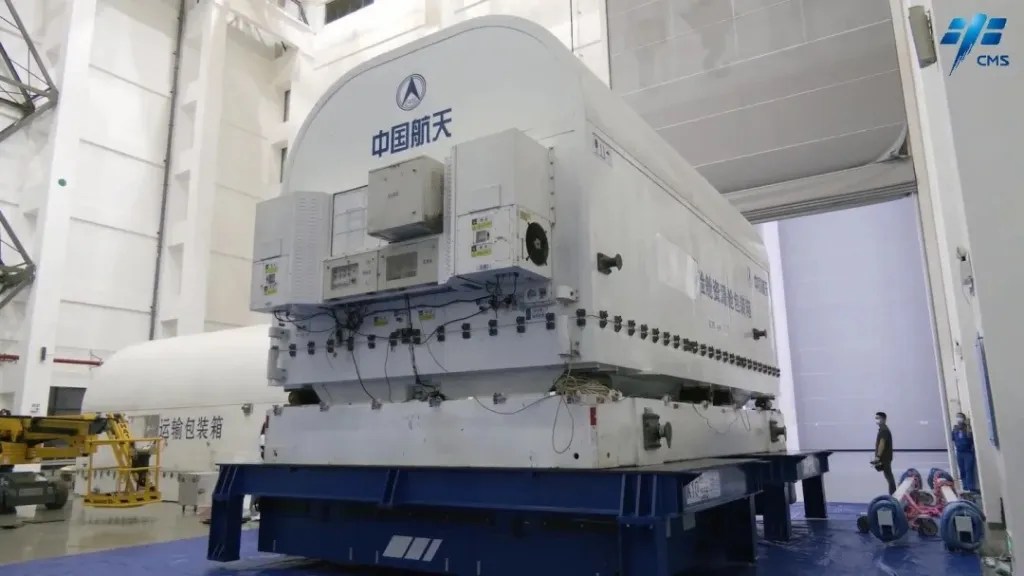
On Hainan Province –China –People’s Republic of China…. in the district area of the Wenchang – Wenchang Spacecraft launch center in which the awesome team at one of many CNSA –China National Space Administration that China National Space Administration…………… On 23rd July 2022 The Chang Zheng- Long March 5B Yao three carrier rocket successfully launch from the Wenchang Space Launch Site complex According to the China Manned Space Engineering Office, the Long March 5B Yao 3 carrier rocket that carried out the launch mission of the Wentian experimental module has completed all the research and development finalisation certification at the Factory also Wenchang Spacecraft Center…….
After Wentian experimental module entered orbit, the status setting was successfully completed. At 3:13 on July 25, 2022, Beijing time, it was successfully connected to the forward port of 天和 Tianhe Core Module . The entire rendezvous and docking process lasted about 13 hours. . This is the first time that two 20-ton spacecraft in my country- China- People’s Republic of China have achieved rendezvous and docking in orbit. …According to the mission plan, the Shenzhou 14 Takionaut crew will then enter the Wentian experimental module….. in which finally docked in early morning time of the 25th July 2022 in with CNSA –Beijing Aerospace City in which co-ordinated the docking maneuverers have achieved rendezvous and docking in orbit.…
On that day of the launch of the Chang Zheng –Long March 5B Y3文天Experimental Module Launch Successful Yesterday -July 24th 2022 on the eve of the Long March 5B launch of the Wentian Experimental Module (about 10 minutes before launch), the Tianhe core module transited over Hainan Island- Hainan Province- Hong Kong SAR, Macau SAR , Guangzhou also of Guangdong province of China- People’s Republic of China , and the Shenzhou 14 aerospace The crew took pictures of the beautiful Hainan Island. At this moment, on the Wenchang space launch site under the lens of the Takionauts, the Wentian experimental module is ready to go and is about to embark on the “Wentian” journey.
The axial length of the Wentian experimental cabin is 17.9 meters, and the maximum diameter of the cabin is 4.2 meters. After the solar wing was launched into orbit, the first deployment was about 6.5 meters, and the second deployment was about 23 meters in length. The Wentian experimental module is the largest single module in my country’s space station, with a launch mass of about 23 tons and a dry weight of 21.5 tons and a propellant of 1.5 tons. The Wentian experimental module uses a rapid rendezvous and docking method to dock the space station assembly the Tiangong –China Space Station of the small robotic arm (about 5 meters) of the Wentian experimental cabin…
After the construction of the China Space Station is completed, the two experimental cabins will be the main working places for Takionauts in orbit. In both experimental cabins, space science experiments and technical experiments in the sealed cabin and outside the sealed cabin can be carried out. Both cabins are equipped with The load test cabinet inside the cabin and the load installation platform outside the cabin also provide support and guarantee measures such as information, power supply and heat dissipation, and can carry out experiments in various fields such as space science, space materials, space medicine and space exploration.
The Wentian experimental module is equipped with the same Taikonauts’ living facilities as the core module, including 3 sleeping areas, 1 sanitary area, kitchen and other facilities, which can guarantee the astronauts’ life. It can also work with the core module to support the life of 6 astronauts during the rotation of the two manned spacecraft; in addition, a small robotic arm is also configured, which can be used alone or in combination with the large robotic arm of the core module. , to jointly complete the tasks of Taikonauts leaving the cabin, caring for extravehicular facilities, and patrolling. In addition, the Wentian experimental cabin is also equipped with an astronaut exit airlock. After the space station is completed, the airlock of the Wentian experimental cabin will be As the main airlock cabin for Takionauts to leave the cabin, the node cabin of the core cabin is used for other functions at this time, just as a backup; the Wentian experimental cabin also has a backup section for the core cabin to manage and control the assembly. That is to say, when the function of the core module platform fails, it can be switched to the Wentian experimental module to exercise the combined control and management functions, which can improve the reliability of the space station as a whole.
The Mengtian experimental cabin is equipped with a cargo airlock and an outboard deployment test platform. In the future, the scientific test equipment that needs to be installed outside the cabin can be transported to the space station through a cargo spacecraft, and then the load will be sent to the outside of the cabin through the cargo airlock, and the robotic arm or Takionauts will install it on the platform outside the cabin. Realize the continuous update of the extravehicular test project.