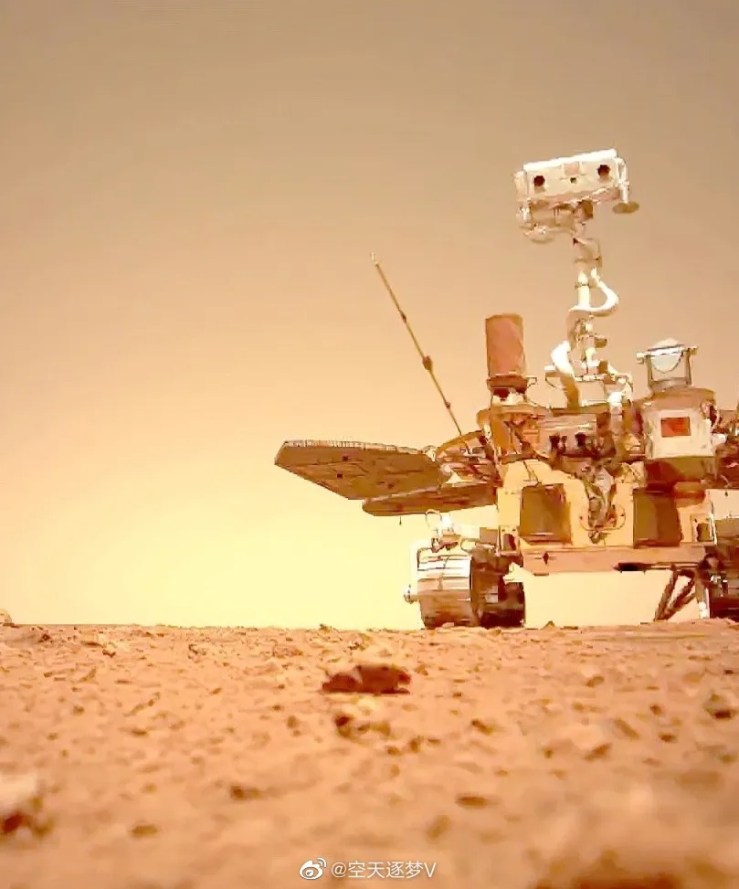
On the week of 13th March 2022 in CNSA _China National Space Administration -China – People’s Republic of China……..During the Two Sessions of which was held during in the People’s Hall during the week of 13th March 2022 China – People’s Republic of China CNSA China National Space Administration and its Partners plans to realize the Mars sampling return mission by 2030] China Daily reported on March 6 that Wu Weiren, member of the Standing Committee of the National Committee of the Chinese People’s Political Consultative Conference and chief designer of China’s lunar exploration project, said recently that my country plans to realize the Mars sampling return mission by 2030. The difficulty of the project is much greater than that of lunar sampling and return. The first problem to be solved is to develop a launch vehicle with greater thrust. In the follow-up, China is also preparing to conduct marginal exploration of the solar system. “The sun is about 150 million kilometers from the earth, which is an astronomical unit. We plan to achieve the ‘double hundred’ goal in 2049, that is, on the 100th anniversary of the founding of New China, to complete 100 astronomical units, which is 15 billion kilometers away “Deep space exploration” China plans to realize the Mars sampling return mission by 2030
China will carry on its moon research in the future with Chang’e-6, Chang’e-7 and Chang’e-8 missions by 2030. After 2030, a new set of missions will be carried out to complete the construction of an international lunar research station by 2030….he Chang’e-6 is scheduled to bring back to Earth lunar samples with a mass of up to 2 kilograms; the Chang’e-7 will be tasked with landing on the lunar south pole and detecting local natural resources; and the Chang’e-8, working in collaboration with Chang’e-7, is going to scout how to exploit lunar resources.
According to Wu, the Chang’e-6 and Chang’e-7 are expected to be launched around 2025.
Future missions also include the development of a special craft, which can fly from the landing site to lunar craters to help scientists look for traces of water. If water is present, it could provide resources for future crewed missions on the moon, Wu noted.
After 2030, a new set of missions will be carried out to complete the construction of an international lunar research station by 2035….
“There will be multiple rovers and landers working in the future moon station and a lunar-based communication network to support these spacecraft,” Wu said. “The lunar research station can also function as a transfer outpost for the solar system and even deeper space explorations.”
Images and visuals are from Weibo also their respectives.
On 10 February 2022 CNSA – China National Space Administration – CASC – China Aerospace Science and Technology Group plans to arrange more than 50 space launch missions this year upon On February 9th 2022 , China Aerospace Science and Technology Group Co., Ltd. released the “Blue Book of China Aerospace Science and Technology Activities (2021)” in Beijing, taking stock of global space activities in 2021. And announced the 2022 China Aerospace Science and Technology Corporation space program.
This year, China Aerospace Science and Technology Corporation plans to arrange more than 50 space launch missions and launch more than 140 spacecraft throughout the year. Among them, the construction of the space station is the top priority of the annual aerospace mission, and will focus on the development of models such as the fourth phase of the lunar exploration project.
In 2021, the world’s space launch activities will show a strong trend, with both the number and quality of launches reaching new highs. According to the statistics of the Blue Book, a total of 146 launch missions will be carried out around the world in 2021, the highest number of launches since 1957; the total number of launched spacecraft is 1,846, a record high, with a total mass of 777.70 tons, the largest since the retirement of the space shuttle.
In the Year 2021, China’s space launch activities will continue to make major breakthroughs. A total of 55 launch missions will be carried out throughout the year, ranking first in the world in the number of launches; 115 spacecraft will be launched, and the total mass of launched spacecraft will reach a new high of 191.19 tons, an increase of 85.5% year-on-year. .
As the leading force in China- People’s Republic of China my country’s aerospace science and technology industry, in 2021, the Aerospace Science and Technology Group’s Long March series of launch vehicles will complete 48 launch missions, all of which have been successful. .
According to the Blue Book, in 2022, my country’s annual manned spaceflight project will carry out six launch missions, with Tianhe core module as the control center, Wentian and Mengtian experimental modules as the main experimental platforms, and a space station that will be fully cared for all year round. The No. 6A launch vehicle and a variety of commercial launch vehicles will carry out their maiden flights.
It is understood that after the Shenzhou 13 manned spacecraft completed the longest six-month combined docking mission so far, it plans to perform a return mission in mid-April this year and land at the Dongfeng Landing Site. This year, the Chinese space station will complete missions such as the first flight of six spacecraft assemblies, and the first two crews of six Takionauts to be in orbit at the same time.
On the months of January 2022 1st January 2022 on New Years Day 天问一号飞運騎遊達达3亿CNSA – China National Space Administration – ESA – European Space agency Belt and road initiative mars mission…first Mars exploration mission, Tianwen- Martian Probe One sent back stunning images of the Half Earth Mass size of the Rustic Planet Mars in which show stunning Martian landscape with its iconic polar caps of either southern or northern .. with its timeless Stunning Mars Photography.
On the eve on 31st January 2022in which on the 1st February 2022 of the Chinese Lunar New year Spring Festival in the Year of the Tiger, the Tianwen-1 probe sent back a set of selfie videos from Mars orbit to extend New Year wishes to the people of the whole country- China – People’s Republic of China and the Chinese Communities . On the 29th of the twelfth lunar month last year (February 10, 2021), Tianwen-1 arrived on Mars and successfully implemented capture and braking. It became my country’s first artificial Mars satellite, and started a scientific exploration journey to the red planet. a lunar year.
rews are installing mascots on the Mars lander
Also on the 4th February 2022 Sunday the Winter Olympics begin! A blessing “falls from the sky” across 320 million kilometers! Previously, the mascots of the Beijing Winter Olympics and the Winter Paralympics, Bing DunDun and Xue RongRong, landed on Mars on Tianwen-1, and took a group photo with the Zhurong Mars rover, which was a dream ..
Also that Day the Tianwen-1 probe, the five-star red flag and the emblems of the Beijing Winter Olympics and Paralympic Games took a selfie in the same frame.
Crews are installing the emblem on the Mars orbiter
Beijing is the first city with both summer and winter Olympics, and Tianwen-1 is China’s first interplanetary exploration mission, sending the mascots and logos of the Winter Olympics and Paralympics to Mars. The Chinese expression is the Chinese nation’s advocacy and pursuit of faster, higher, stronger and more united.
This set of “cosmic-level” photos returned from Mars orbit was taken by the “selfie” camera carried by the Tianwen-1 probe. This group of photos is not only a “highest” Winter Olympics gift to friends on the ground, but also a highlight witness to the world’s shared Olympic moments!
As of February 4th 2022, Tianwen-1 has been in orbit for 561 days, and the Zhurong rover has worked for 259 Martian days, traveling a total of 1,537 meters. Both the orbiter and the rover are in good condition and operating normally.
Images and visuals are from CNSA- China National Space Administration also from there respectives- CLEP –China Lunar Exploration Project..
On the months of January 2022 1st January 2022 on New Years Day 天问一号飞運騎遊達达3亿CNSA – China National Space Administration – ESA – European Space agency Belt and road initiative mars mission…first Mars exploration mission, Tianwen- Martian Probe One sent back stunning images of the Half Earth Mass size of the Rustic Planet Mars in which show stunning Martian landscape with its iconic polar caps of either southern or northern .. with its timeless Stunning Mars Photography.
On the eve on 31st January 2022in which on the 1st February 2022 of the Chinese Lunar New year Spring Festival in the Year of the Tiger, the Tianwen-1 probe sent back a set of selfie videos from Mars orbit to extend New Year wishes to the people of the whole country- China – People’s Republic of China and the Chinese Communities . On the 29th of the twelfth lunar month last year (February 10, 2021), Tianwen-1 arrived on Mars and successfully implemented capture and braking. It became my country’s first artificial Mars satellite, and started a scientific exploration journey to the red planet. a lunar year.
The video is a video of the Mars group photo taken by the probe.
The video was shot by the “selfie” camera carried by the Tianwen-1 surround. The camera is installed at the end of the “selfie stick”. This selfie tool is designed to monitor and evaluate the status of key components outside the surround. In the video The orbiter’s 3000N engine, propellant storage tank, attitude control engine and other components are in good condition. The five-star red flag shining in the Mars orbit is particularly bright. During the attitude adjustment process, the angle of the sun’s illumination changes significantly. When flying over the north pole of Mars, the ice cap below was photographed. The “selfie stick” uses a special shape memory composite material, which is folded and folded before launch. After entering the orbit of Mars, the folded part is heated to a certain temperature, and the “selfie stick” gradually returns to a straight state. The “selfie stick” weighs only 0.8 kilograms and is 1.6 meters long when unfolded. The camera installed at the end can effectively complete various monitoring tasks.
As of January 31, 2022, Tianwen-1 has been in orbit for 557 days, about 325 million kilometers away from the earth, and the light travel time is about 18 minutes. The Zhurong rover has worked for 255 Martian days and travelled a total of 1524 meters. At present, the Tianwen-1 mission has returned a total of about 600GB of original scientific data, and the two devices are in good condition and operating normally
Images and visuals are from CNSA- China National Space Administration also from there respectives- CLEP –China Lunar Exploration Project..
During the week of the 12th January 2022 in CNSA – China National Space Administration…. The third anniversary of the spirit of lunar exploration: the fourth phase of the lunar exploration project has been established, and the planetary exploration project will also start a new journey
Three years ago today, January 11, 2019, the CPC Central Committee, the State Council put forwarding forward a “lunar Spirit” Chang E IV in lunar exploration mission a complete success of his message: chasing the dream, the courage to explore , collaborative tackling, and win-win cooperation .
The sixteen-character lunar exploration spirit is an important part of the Chinese Communists’ spiritual pedigree. It is a vivid portrayal of the “two bombs and one star” spirit passed down from generation to generation, and it is also the winning code to support the six battles and six victories of the lunar exploration project. . The spirit of lunar exploration enriches the connotation of the space spirit in the new era, and brings together magnificent spiritual power for the space dream and the Chinese dream.
Since the CPC Central Committee decided to implement the lunar exploration project, it has adhered to “integrated research and demonstration”, “one-stop tackling key problems” and “drawing a blueprint to the end”, and successfully completed the three-step strategic plan of “circling, falling, and returning” as scheduled, and China’s lunar exploration began. The new chapter of human lunar exploration has made China’s contribution to the development of aerospace technology and space science.
The four follow-up missions of China’s lunar exploration project include the Chang’e 6, Chang’e 7 and Chang’e 8 missions, which will be implemented successively in the next ten years.
According to the plan, China will first launch the Chang’e 7 probe to the south pole of the moon. Then, the backup Chang’e 6, the backup of Chang’e 5, will be launched for sampling return at the south pole of the moon. After Chang’e 6, Chang’e 8 will be launched to establish the basic model of the lunar scientific research station.
Wu Yanhua said: These three missions are mainly led by China, and we are also planning to cooperate with Russia to build a basic type of lunar scientific research station to better explore the lunar environment and resources, including how to peacefully utilize and develop lunar resources, in order to lay a solid foundation.
Wu Yanhua believes that open cooperation is an important way to get to the center of the world aerospace stage. At present, my country has signed nearly 160 cooperation agreements with more than 60 countries and international organizations, which have created conditions for China’s aerospace industry to go out and lead the implementation of large scientific plans and large scientific projects in the lunar and deep space fields.
Wu Yanhua emphasized that the first Mars exploration mission that has been implemented is the pioneering work of China’s interplanetary exploration, and the following tasks are still very long-term.
The country has approved the planetary exploration project. The planetary exploration project includes the first Mars exploration mission of Tianwen-1, and the follow-up mission of asteroid attachment and sampling return, Mars sampling return and Jupiter system exploration. The planetary exploration project is scheduled to be completed in the next 10 to 15 years. At present, my country is still carrying out the demonstration of the strategic plan for the medium and long-term development of aerospace, such as the detection of the edge of the solar system.
The starry sky is vast, and there is no end to exploration. Under the guidance of Xi Jinping Thought on Socialism with Chinese Characteristics for a New Era, and vigorously carry forward and practice the spirit of lunar exploration, Chinese astronauts will make new contributions at a new starting point, continuously promote the innovation and development of China’s aerospace industry, and achieve high-level scientific and technological self-reliance and self-improvement. Human beings make new and greater contributions to the peaceful use of space.