#CNSA #ChinaNationalSpaceAdministration #國家航天局 |#BeltAndRoadinitiative #February2022 | #火星 # 天問 #天问一号#TianwenOne #MarsMission #Marslander #MarsRover #Tianwen1 probe  #祝融号 #ZhuRong Tianwen1 #ChineseNewYear2022 with  #MarsPhotography Tianwen-1 probe #YearoftheTiger  congratulates the grand opening of the #BeijingWinterOlympics#Beijing2022 from Mars

On the months of January 2022 1st January 2022 on New Years Day  天问一号飞運騎遊達达3亿CNSA – China National Space Administration – ESA – European Space agency Belt and road initiative mars mission…first Mars exploration mission, Tianwen- Martian Probe One  sent back stunning images of the Half Earth Mass size of the Rustic Planet Mars in which show stunning Martian landscape with its iconic polar caps of either southern or northern .. with its timeless Stunning Mars Photography.

On 2022 New Year’s Day, China National Space Administration CLEP – China Lunar Exploration program  issued a set of beautiful images of the first Mars mission Heaven 1 spacecraft returned from distant Mars, report to the National People ‘Heaven One “peace, extended festival greetings .

On the eve on 31st January 2022 in which on the 1st February 2022 of the Chinese Lunar New year Spring Festival in the Year of the Tiger, the Tianwen-1 probe sent back a set of selfie videos from Mars orbit to extend New Year wishes to the people of the whole country- China – People’s Republic of China and the Chinese Communities . On the 29th of the twelfth lunar month last year (February 10, 2021), Tianwen-1 arrived on Mars and successfully implemented capture and braking. It became my country’s first artificial Mars satellite, and started a scientific exploration journey to the red planet. a lunar year.

rews are installing mascots on the Mars lander
 

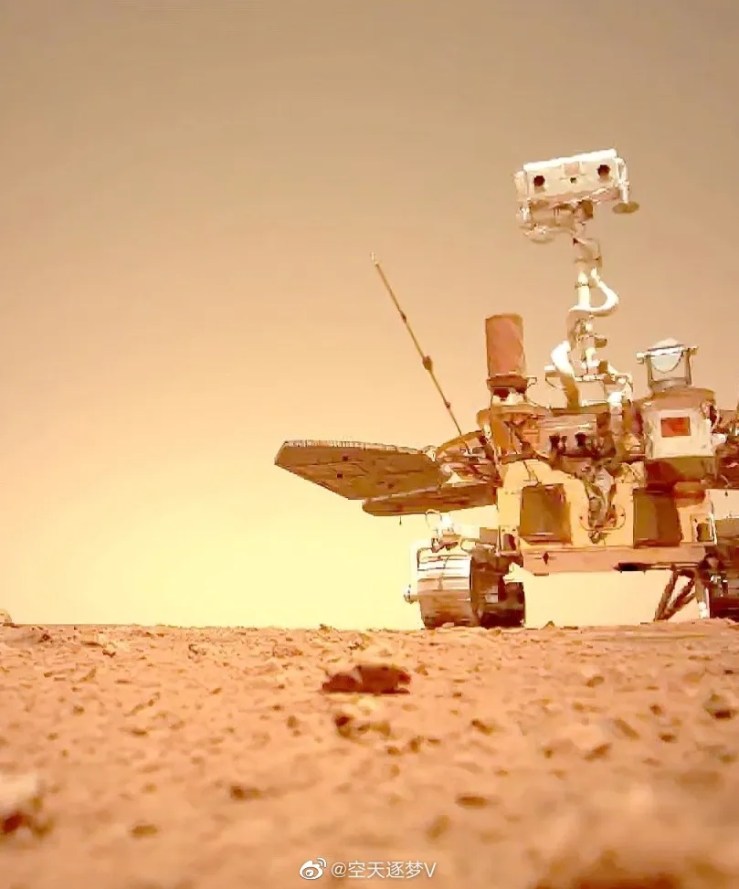
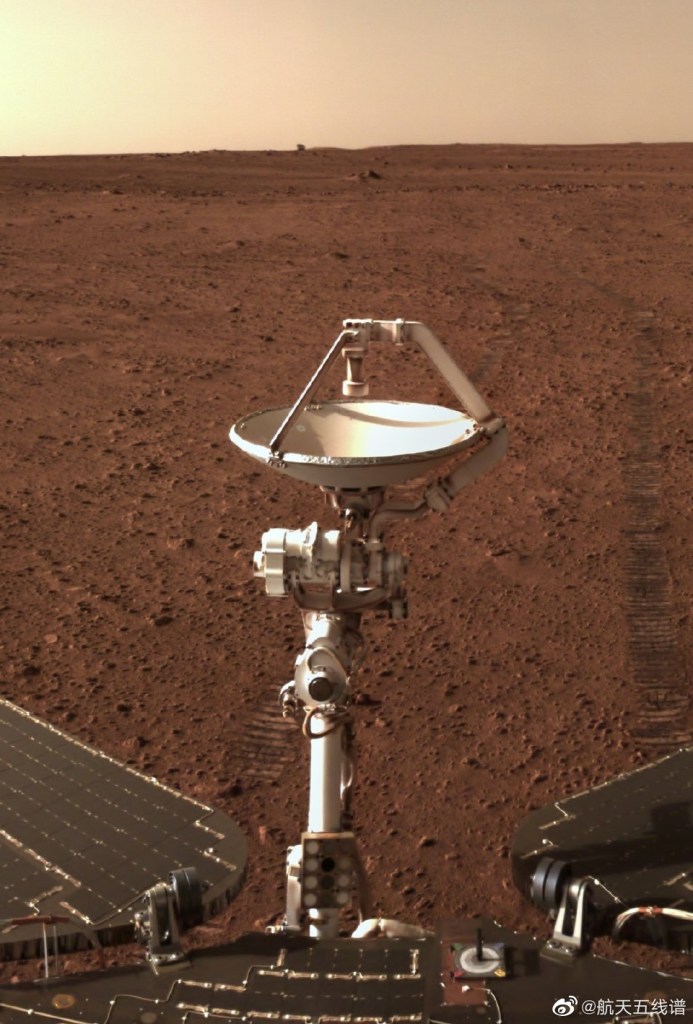
Also on the 4th February 2022 Sunday the Winter Olympics begin! A blessing “falls from the sky” across 320 million kilometers! Previously, the mascots of the Beijing Winter Olympics and the Winter Paralympics, Bing DunDun and Xue RongRong, landed on Mars on Tianwen-1, and took a group photo with the Zhurong Mars rover, which was a dream ..

Also that Day the Tianwen-1 probe, the five-star red flag and the emblems of the Beijing Winter Olympics and Paralympic Games took a selfie in the same frame.

Crews are installing the emblem on the Mars orbiter


Beijing is the first city with both summer and winter Olympics, and Tianwen-1 is China’s first interplanetary exploration mission, sending the mascots and logos of the Winter Olympics and Paralympics to Mars. The Chinese expression is the Chinese nation’s advocacy and pursuit of faster, higher, stronger and more united.

This set of “cosmic-level” photos returned from Mars orbit was taken by the “selfie” camera carried by the Tianwen-1 probe. This group of photos is not only a “highest” Winter Olympics gift to friends on the ground, but also a highlight witness to the world’s shared Olympic moments!

As of February 4th 2022, Tianwen-1 has been in orbit for 561 days, and the Zhurong rover has worked for 259 Martian days, traveling a total of 1,537 meters. Both the orbiter and the rover are in good condition and operating normally. 

Images and visuals are from CNSA- China National Space Administration also from there respectives- CLEP –China Lunar Exploration Project..

#CNSA #ChinaNationalSpaceAdministration #國家航天局 |#BeltAndRoadinitiative #January2022 |#火星 # 天問 #天问一号#TianwenOne #MarsMission #Marslander #MarsRover #Tianwen1 probe  #祝融号 #ZhuRong Tianwen1 #ChineseNewYear2022 #ChineseLunarNewYear Eve with  #MarsPhotography Tianwen-1 probe #SelfieStick  #UltimateMarSelfie celebrating the #YearoftheTiger  

On the months of January 2022 1st January 2022 on New Years Day  天问一号飞運騎遊達达3亿CNSA – China National Space Administration – ESA – European Space agency Belt and road initiative mars mission…first Mars exploration mission, Tianwen- Martian Probe One  sent back stunning images of the Half Earth Mass size of the Rustic Planet Mars in which show stunning Martian landscape with its iconic polar caps of either southern or northern .. with its timeless Stunning Mars Photography.

On 2022 New Year’s Day, China National Space Administration CLEP – China Lunar Exploration program  issued a set of beautiful images of the first Mars mission Heaven 1 spacecraft returned from distant Mars, report to the National People ‘Heaven One “peace, extended festival greetings .

On the eve on 31st January 2022 in which on the 1st February 2022 of the Chinese Lunar New year  Spring Festival in the Year of the Tiger, the Tianwen-1 probe sent back a set of selfie videos from Mars orbit to extend New Year wishes to the people of the whole country- China – People’s Republic of China and the Chinese Communities . On the 29th of the twelfth lunar month last year (February 10, 2021), Tianwen-1 arrived on Mars and successfully implemented capture and braking. It became my country’s first artificial Mars satellite, and started a scientific exploration journey to the red planet. a lunar year.

The video is a video of the Mars group photo taken by the probe.

The video was shot by the “selfie” camera carried by the Tianwen-1 surround. The camera is installed at the end of the “selfie stick”. This selfie tool is designed to monitor and evaluate the status of key components outside the surround. In the video The orbiter’s 3000N engine, propellant storage tank, attitude control engine and other components are in good condition. The five-star red flag shining in the Mars orbit is particularly bright. During the attitude adjustment process, the angle of the sun’s illumination changes significantly. When flying over the north pole of Mars, the ice cap below was photographed.
The “selfie stick” uses a special shape memory composite material, which is folded and folded before launch. After entering the orbit of Mars, the folded part is heated to a certain temperature, and the “selfie stick” gradually returns to a straight state. The “selfie stick” weighs only 0.8 kilograms and is 1.6 meters long when unfolded. The camera installed at the end can effectively complete various monitoring tasks.

As of January 31, 2022, Tianwen-1 has been in orbit for 557 days, about 325 million kilometers away from the earth, and the light travel time is about 18 minutes. The Zhurong rover has worked for 255 Martian days and travelled a total of 1524 meters. At present, the Tianwen-1 mission has returned a total of about 600GB of original scientific data, and the two devices are in good condition and operating normally

Images and visuals are from CNSA- China National Space Administration also from there respectives- CLEP –China Lunar Exploration Project..

#CNSA #ChinaNationalSpaceAdministration #國家航天局 |#BeltAndRoadinitiative #December2021 |#火星 # 天問 #天问一号#TianwenOne #MarsMission #Marslander #MarsRover #Tianwen1 probe  #祝融号 #ZhuRong Tianwen No.1 probe #RedPlanet #Mars The China-Europe Mars Rover successfully carried out an on-orbit relay communication test …..

On the months of November 2021  天问一号飞運騎遊達达3亿CNSA – China National Space Administration – ESA – European Space agency Belt and road initiative mars mission…first Mars exploration mission, Tianwen- Martian Probe One …….祝融号Zhu Rong”  , China’s “Tianwen One” in cooperation with the European Space Agency “Mars Express” mission team, launched the “Vulcan No.” rover and “Mars Express” orbiter orbit relay communications test and achieved a complete success. Before the test, the respective detectors in both directions must be instructed to make preparations for the test. At the appointed time, the “Zhurong” will send the test data to the “Mars Express”, the communication distance is about 4000 kilometers, and the communication time is 10 minutes. The “Mars Express” receives the data and forwards it to the deep space monitoring and control station of ESA. After receiving the data, the monitoring and control station sends it to the European Space Operations Center (ESOC). The ESOC is then forwarded to the Beijing Aerospace Flight Control Center. After interpretation by the Chinese technical team, Interpret the correctness of the data. The test process is shown in the figure.

Constrained by weight and size, the Mars rover has weak direct-to-ground communication capabilities and cannot meet the demand for large amounts of data transmission. Therefore, the data needs to be sent to the Mars orbiter that is closer, and the orbiter with stronger communication capability is forwarded to the ground receiving system. , This process is called relay communication.

Under normal circumstances, before establishing relay communication, the orbiter will first send an “initiate” signal to the rover, and then the rover will reply with an “confirmation” signal, and then the two parties will establish a stable two-way relay communication link, just like a friend calling The phone needs to be dialled first. Since the launch frequency of the “Mars Express” does not match the receiving frequency of the “Zhurong”, the communication link cannot be established by “dialling a phone”. The transmission frequency of “Zhurong” matches the receiving frequency of “Mars Express”. Therefore, both parties need to agree on a communication time in advance. The “Zhurong” sends data directly and “Mars Express” performs “blind reception”, which is a bit similar to the communication method of WeChat. . The “Mars Express” orbiter has a “blind harvest” function, but there has been no chance to actually use this function for more than a decade.

ESA stated that this test is a good opportunity for the “Mars Express” to verify the “blind harvest” model in orbit. According to the results of data interpretation and analysis, the mission teams of both parties confirmed that the interfaces of the relay communication equipment configured on the “Zhurong” and the “Mars Express” match conform to international standards, and the content of the transmitted data is complete and correct, and the test is a success. In the future, the two parties will further carry out scientific data relay communication cooperation on the basis of this phase of experimentation. The “Zhurong” rover currently works on the surface of Mars for 196 Mars days, has travelled 1,297 meters in total, and obtained about 10GB of raw scientific data for inspections and explorations. It has sufficient energy and is in good condition.

中欧火星探测器成功开展在轨中继通信试验​

2021年11月,我国“天问一号”与欧空局“火星快车”任务团队合作,开展了“祝融号”火星车与“火星快车”轨道器在轨中继通信试验,取得圆满成功。试验前,双方向各自探测器上行指令做好试验准备。在约定时刻,由“祝融号”向“火星快车”发送测试数据,通信距离约4000千米,通信时长10分钟。“火星快车”接收数据后转发给欧空局所属深空测控站,测控站接收后发送给欧洲空间操作中心(ESOC),ESOC再转发至北京航天飞行控制中心,由中方技术团队解译后,判读数据的正确性。试验过程如图所示。

受重量和体积约束,火星车直接对地通信能力较弱,无法满足大量数据传输需求,因此需要将数据发送给距离较近的火星轨道器,由通信能力更强的轨道器转发给地面接收系统,这个过程称作中继通信。

一般情况下,在建立中继通信前,轨道器会先向火星车发送一个“发起”信号,随后火星车回复“确认”信号,然后双方建立稳定的双向中继通信链路,就像朋友打电话需先拨通电话一样。由于“火星快车”发射频率与“祝融号”接收频率不匹配,不能通过“拨通电话”的方式建立通信链路。“祝融号”发射频率与“火星快车”接收频率匹配,因此双方需要事先约定好通信时间,由“祝融号”直接发送数据,“火星快车”进行“盲收”,有点类似于微信的通信方式。“火星快车”轨道器具备“盲收”功能,但在过去十多年里一直没有机会实际使用该功能。

欧空局表示,此次试验是“火星快车”在轨验证“盲收”模式的很好机会。根据数据判读分析结果,双方任务团队确认“祝融号”和“火星快车”配置的中继通信设备接口匹配,符合国际标准,传输数据内容完整正确,试验取得成功。后续,双方将在本阶段试验的基础上,进一步开展科学数据中继通信合作。“祝融号”火星车目前在火星表面工作196个火星日,累计行驶1297米,获取巡视探测原始科学数据约10GB,能源充足、状态良好。


作者:耿言 陈刚

#AlreadyTomorrowInHongKong #香港| #香港太空館 #HongKongSpaceMuseum #November2021 | #CNSA #ChinaNationalSpaceAdministration #國家航天局 #ChinaMarsMission the Contributions of #HongKong Research Team on Mars Landing Surveillance Camera for #Tianwen1 Mission orbit on the #RedPlanet #Mars#天问一号探测器进入日凌阶段…

Located in the Heart of Hong Kong central of Victoria Harbour in which locate looking at the iconic Megatroplis HongKong Island city landscape from the opposite is the Hong Kong Space Museum  香港太空館 in which located at 10 Salisbury Road, Tsim Sha Tsui, Kowloon, Hong Kong SAR, China –People’s Republic of China..  in which is one of the most international iconic buildings architecturally due to its hemispheric round dome in which is iconic known as one of Hong Kong’s local most cherish bread pastries the Pineapple Bun – Bolo Bao due to the pineapple ceramic texturing tiles of the dome structure that resembles the delicious texturing of the Pineapple Bun .. In which on In June 2014, the Hong Kong Government listed the pineapple bun as a part of Hong Kong’s intangible cultural heritage. … Despite the name, it does not traditionally contain pineapple; rather, the name refers to the look of the characteristic topping (which resembles the texture of a pineapple)……

On the 20th November 2021 Saturday – 1330 to 1530 Hong Kong SAR- Beijing Time  One of leading international Iconic Planetarium Space Museums  香港太空館 Hong Kong Space Museum   spoken in Chinese – Cantonese –Guangdong Dialect .. live streaming in one of its Auditorium in which Hong Kong SAR Space Program thorough outs it’s Universities collaborated in China- People’s Republic of China’s first most Challenging Mars Mission in which China’s CNSA –China National Space Administration  skill set far out weight NASA’s Mar Missions current and past.. . In One of Hong Kong SAR Universities, Hong Kong PloyU has contributed the Camera system of Tianwen One’s one of many Camera systems also it’s Mars lander, Zhurong Mars rover, and Mars Orbiter other elementally equiment system…. Speaker: Prof. Yung Kai-leung, BBS (Chair Professor & Associate Head, Department of Industrial and Systems Engineering, The Hong Kong Polytechnic University)

The Tianwen-1, China’s first Mars mission successfully landed on it in May, achieving another extraordinary feat in the recent Chinese Aerospace Industry. This first Mars exploration mission of China is unique that employed novel technology and engineering design and encounters exceptional challenges.

The Tianwen-1, China’s first Mars mission successfully landed on it in May, achieving another extraordinary feat in the recent Chinese Aerospace Industry. This first Mars exploration mission of China is unique that employed novel technology and engineering design and encounters exceptional challenges.

The Mars Landing Surveillance Camera (Mars Camera) is developed mainly by the research team of the Hong Kong Polytechnic University. It is a sophisticated space instrument mounting on the top surface of the lander platform of Tianwen-1, which monitors the landing status, the surrounding environment of the red planet and the operation status of the Zhu Rong rover. The Mars Camera is light in weight, yet strong and durable enough to withstand the huge impact shocks of 6,200 times Earth’s gravity. Moreover, it has to operate under low Martian temperature as well as overcome extreme temperature differences it experienced during its flight. In this lecture, Professor Yung from the Hong Kong Polytechnic University will talk about the challenges of the Mars mission and delineate the contributions of the Hong Kong research team.

Images and visuals are from CNSA- China National Space Administration also from there respectives..

#CNSA #ChinaNationalSpaceAdministration #國家航天局 |#BeltAndRoadinitiative #November2021 |#火星 # 天問 #天问一号#TianwenOne #MarsMission #Marslander #MarsRover #Tianwen1 probe  #祝融号 #ZhuRong Tianwen No.1 probe orbiter enters remote sensing mission orbit on the #RedPlanet #Mars#天问一号探测器进入日凌阶段…

On the  8TH November 2021 Friday 天问一号飞運騎遊達达3亿CNSA – China National Space Administration – ESA – European Space agency Belt and road initiative mars mission…first Mars exploration mission, Tianwen- Martian Probe One …….祝融号Zhu Rong”  also have been exploration Roamingly1,253 meterson the Rustic half diameter planet size Red planet Mars… During that time Tianwen-1 orbiter enters remote sensing mission orbit…


November 8, 2021, “Heaven” successfully implemented around the fifth brake near the fire, into the exact orbit remote sensing mission, the Mars Global to carry out remote sensing. In the early stage, the “Zhurong” Mars rover has successfully completed the established inspection mission objectives, and is in good condition, and continues to carry out the detection mission. Considering the global remote sensing detection of the orbiter and the relay communication requirements of the Mars rover, the engineering development team optimized the orbit design and determined a remote sensing orbit plan with a near fire point of about 265 kilometers, a far fire point of about 10,700 kilometers, and a period of about 7.08 hours. While ensuring the development of orbiting scientific exploration, it will provide more relay communication support for the Mars rover to improve the efficiency of mission development.

n the remote sensing orbit, seven scientific payloads including mid-resolution cameras, high-resolution cameras, subsurface detection radars, mineral spectrum analyzers, magnetometers, ion and neutral particle analyzers, and energy particle analyzers will be acquired Scientific data such as fire star morphology and geological structure, surface material composition and soil type distribution, atmospheric ionosphere, Martian space environment, etc., focusing on typical landforms and geological units such as craters, volcanoes, canyons, and dry river beds, and implement high-resolution detection.

Up to now, the orbiter has been in orbit for 473 days, the ground fire distance is 384 million kilometers, and the light travel time is 21 minutes and 20 seconds; the rover has worked on the surface of Mars for 174 Mars days and travelled 1,253 meters in total. The two devices are in good condition. The working condition is normal. 

​2021年11月8日,“天问一号”环绕器成功实施第五次近火制动,准确进入遥感使命轨道,开展火星全球遥感探测。前期,“祝融号”火星车已圆满完成既定巡视探测任务目标,各项状态良好,继续开展探测任务。综合考虑环绕器全球遥感探测和火星车中继通信需求,工程研制团队优化了轨道设计,确定了近火点约265千米、远火点约1.07万千米、周期约7.08小时的遥感轨道方案,在保证开展环绕科学探测的同时,为火星车提供更多的中继通信支持,提升任务开展的效率…


在遥感轨道,环绕器中分辨率相机、高分辨率相机、次表层探测雷达、矿物光谱分析仪、磁强计、离子与中性粒子分析仪、能量粒子分析仪等7台科学载荷,将获取火星形貌与地质构造、表面物质成分与土壤类型分布、大气电离层、火星空间环境等科学数据,重点关注陨石坑、火山、峡谷、干涸河床等典型地貌和地质单元,实施高分辨率探测。

截至目前,环绕器在轨运行473天,地火距离3.84亿千米,光行时21分20秒;火星车在火星表面工作174个火星日,累计行驶1253米,两器状态良好,各系统工况正常。  


Images and visuals are from CNSA- China National Space Administration also from there respectives..

Author: Geng Yan Chen Gang