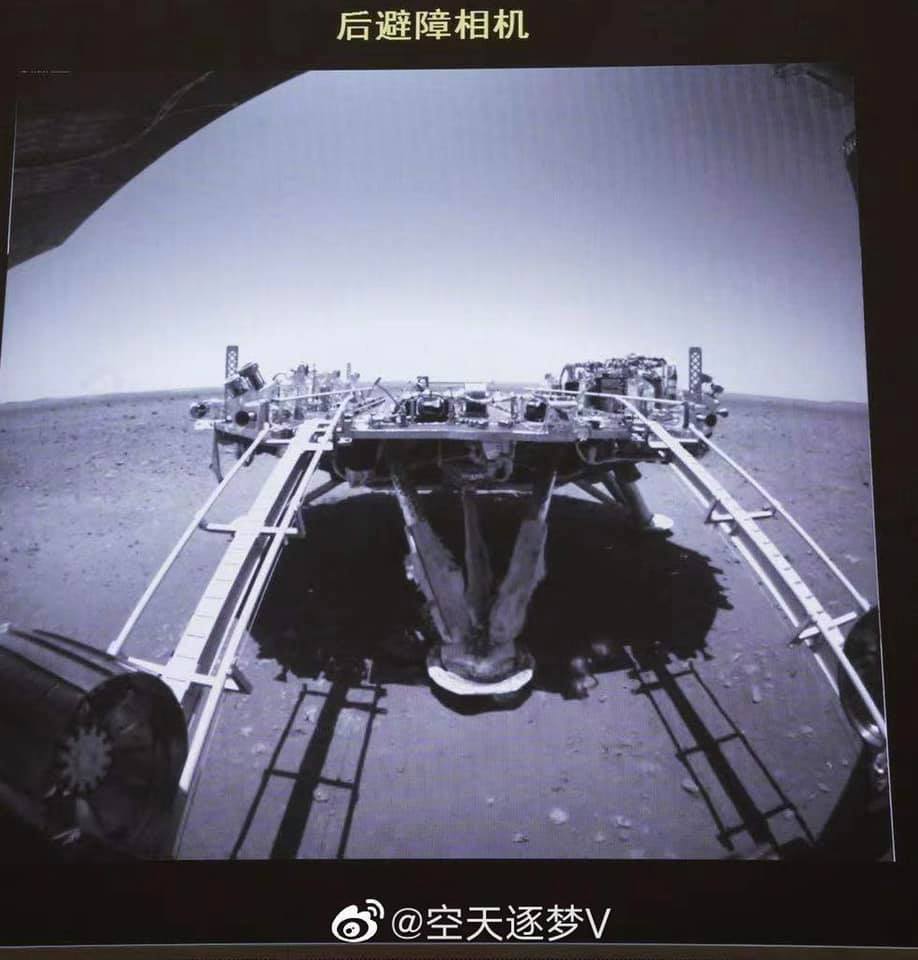
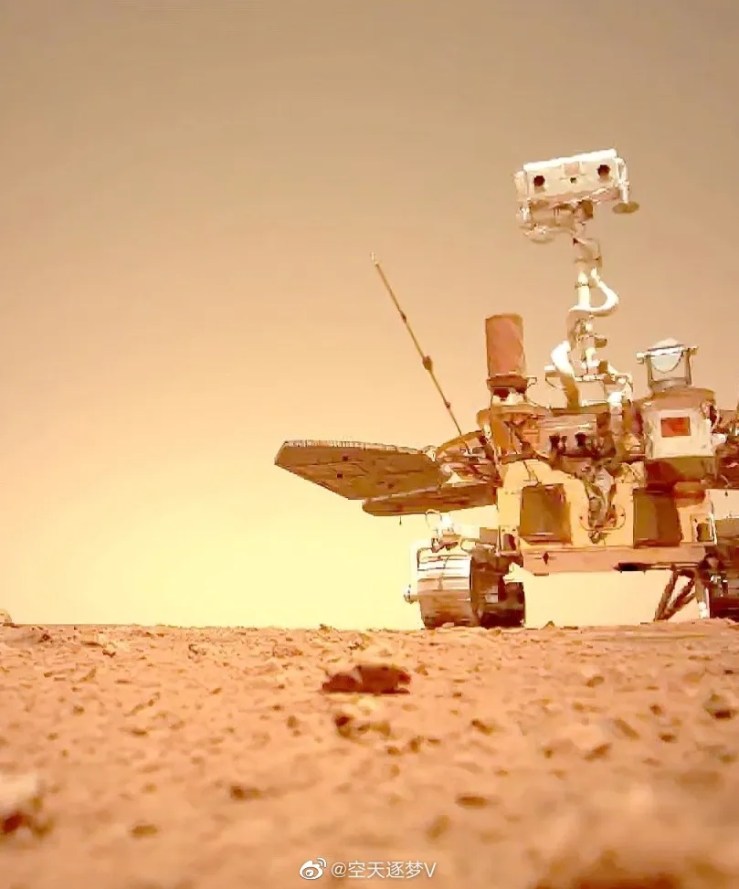
#CNSA #ChinaNationalSpaceAdministration #國家航天局 |#BeltAndRoadinitiative #May2022 | #火星 # 天問 #天问一号#TianwenOne #MarsMission #Marslander #MarsRover #Tianwen1 probe  #祝融号 #ZhuRong #Tianwen1 #CCTV #HelloMars first year anniversary of China’s first Mars exploration mission….

On the months week of  19th May 2022   天问一号飞運騎遊達达3亿CNSA – China National Space Administration – ESA – European Space agency Belt and road initiative mars mission…first Mars exploration mission, Tianwen- Martian Probe One  sent back stunning images of the Half Earth Mass size of the Rustic Planet Mars in which show stunning Martian landscape with its iconic polar caps of either southern or northern … With its timeless Stunning Mars Photography. Tianwen-1″ returned high-resolution images of the Mars inspection area The “Zhurong” rover is preparing for winter, and the orbiter continues to carry out orbital exploration….. in which one year ago it was it’s first landing on Utopia Planitia region on the planet Mars .. in celebrating a CCTV five part Episode was produced..

Hello everyone, I would like to tell you some good news about the documentary “Hello!” about China’s first Mars exploration mission. “Mars” is finally on the air, friends who want to know more about Mars can stay in front of the TV tonight

“Hello! “Mars” is a large-scale scientific documentary jointly produced by the National Space Administration and China Central Radio and Television to commemorate the first anniversary of the Tianwen-1 Mars probe’s successful landing on Mars. It took three years to complete the filming and is divided into “Departure” and “Journey” “Surrounding”, “Landing” and “Patrol” have 5 episodes, each of which is 30 minutes long. They focus on the important stages of the Tianwen-1 mission, and describe a large number of astronomy, astrophysics, space applications, aerospace engineering and other disciplines in a simple way. Knowledge, in-depth analysis of Chinese wisdom and Chinese solutions in Mars exploration. Since May 2020, the co-production team has continued to track the key nodes of the Tianwen-1 mission, filmed many wonderful moments, and obtained a large number of first-hand precious materials. Many of the contents of the documentary were made public for the first time and were released authoritatively.


Broadcasting plan CCTV-1 CCTV integrated channel every night at 22:36, five days of continuous broadcast from May 18th to 22nd; CCTV-10 CCTV science and education channel every night at 20:10, from May 19th to 23rd five days of continuous broadcast

大家好,告诉大家一个好消息,讲述中国首次火星探测任务的纪录片《你好!火星》终于要开播啦,想更多了解火星的朋友们今晚可以守在电视机前哟《你好!火星》是为纪念天问一号火星探测器成功着陆火星一周年,由国家航天局和中央广播电视总台联合出品的大型科学纪录片,共历时3年摄制完成,分为《出发》《征途》《环绕》《着陆》《巡视》5集,每集30分钟,分别聚焦天问一号任务的重要阶段,以深入浅出的形式讲述了大量天文学、天体物理学、空间应用学、航天工程学等学科知识,深度解析了火星探索中的中国智慧、中国方案。联合摄制团队自2020年5月起,持续跟踪天问一号任务关键节点,拍摄众多精彩瞬间,获得大量一手珍贵素材,纪录片中很多内容是首次公开,并权威发布。


播出计划CCTV-1央视综合频道 每晚22:36,5月18日至22日五天连播;CCTV-10央视科教频道 每晚20:10,5月️19日至23日五天连播

Images and visuals are from CNSA- China National Space Administration also from there respectives- CLEP –China Lunar Exploration Project..

#CNSA #ChinaNationalSpaceAdministration #國家航天局 |#BeltAndRoadinitiative #May2022 | #火星 # 天問 #天问一号#TianwenOne #MarsMission #Marslander #MarsRover probe  #祝融号 #ZhuRong The first anniversary of Tianwen-1 landing on Mars…..

On today is of 15TH  May 2022   天问一号飞運騎遊達达3亿CNSA – China National Space Administration – ESA – European Space agency Belt and road initiative mars mission…first Mars exploration mission, Tianwen- Martian Probe One year anniversary…The first anniversary of Tianwen-1 landing on Mars….. Tianwen-1 successfully landed in the southern part of the Martian Utopia Plain, leaving China’s mark on Mars for the first time. So far, it has worked on the surface of Mars for 356 Martian days and has travelled a total of mileage1921 meters. The orbiter has flown for 661 days since its launch, and has continued to carry out remote sensing detection since it entered the orbit around the fire red planet Mars of least haft diameter of Earth.

The first anniversary of Tianwen-1 landing on Mars On May 15, 2021, from since then At present, the two devices are in good condition, and about 940GB of original scientific data has been acquired and returned. Teams of scientists are conducting data analysis, interpretation and research…. .

​​​

​Now we describe the one-year work process of Tianwen-1 through a long picture.

At present, the “Zhurong” Mars rover inspection area has entered winter, the highest temperature during the day has dropped to below minus 20 ℃, and the minimum temperature at night has dropped to minus 100 ℃, and sand and dust weather is frequent. Affected by the gradual reduction of the sun irradiation angle and the local sand and dust weather, the energy acquisition capacity of the “Zhurong” Mars rover has gradually decreased, and the thermal insulation consumption has gradually increased. To cope with this harsh environment, according to the design, the rover will switch to winter mode. The orbiter continues to carry out remote sensing exploration, and will soon achieve global coverage of Mars, while providing relay communication support for the rover.

Video review of Tianwen-1 – CNSA China National Space Administration Beijing Flight Control Center at the moment when Zhurong successfully landed on Mars, the achievement was hard-won, but the achievement was difficult, thank you for every effort and perseverance!

Commemorating the first anniversary of the Tianwen-1 Mars probe’s successful landing on Mars!
2021.05.15-2022.05.15 At 7:18 Hong Kong SAR-Beijing Time.

on May 15, 2021, the scientific research team confirmed according to the telemetry signal sent by the “Zhurong” Mars rover that the Tianwen-1 landing rover successfully landed in the pre-selected landing area in the southern Utopia Plain of Mars , China’s first Mars exploration mission to land on Mars was a complete success…..

As the first mission of China – People’s Republic of China’s planetary exploration project, Tianwen-1 has realized the leap of my country’s space exploration from the Earth-Moon system to the interplanetary system. It is the first time in the world to complete the orbiting, landing, and inspection of Mars through a single mission. It is China- People’s Republic of China’s aerospace industry. Another milestone in development.


作者:耿言 戚铁磊
海报:顾天莹 赛凡科幻空间​​​​

Images and visuals are from CNSA- China National Space Administration also from there respectives- CLEP –China Lunar Exploration Project..

#CNSA #ChinaNationalSpaceAdministration #國家航天局 |#BeltAndRoadinitiative #May2022 | #火星 # 天問 #天问一号#TianwenOne #MarsMission #Marslander #MarsRover #Tianwen1 probe  #祝融号 #ZhuRong #Tianwen1 is preparing for winter, and the orbiter continues to carry out orbital exploration….

On the months of 5th May 2022   天问一号飞運騎遊達达3亿CNSA – China National Space Administration – ESA – European Space agency Belt and road initiative mars mission…first Mars exploration mission, Tianwen- Martian Probe One  sent back stunning images of the Half Earth Mass size of the Rustic Planet Mars in which show stunning Martian landscape with its iconic polar caps of either southern or northern … With its timeless Stunning Mars Photography. Tianwen-1″ returned high-resolution images of the Mars inspection area The “Zhurong” rover is preparing for winter, and the orbiter continues to carry out orbital exploration…..

As of May 5, 2022, the “Tianwen-1” orbiter has been in orbit for 651 days and is 240 million kilometers away from the earth. The “Zhurong” rover has worked on the surface of Mars for 347 Martian days, with a cumulative travel of 1921 meters, the two devices have accumulated about 940GB of original scientific data, and the operation is normal.

During the ring fire, all seven payloads carried by the “Tianwen-1” orbiter were powered on, and continued to carry out global remote sensing exploration of Mars. Figure 1 is a 0.8 m/pixel image taken by a high-resolution camera on April 17, 2022, of the Triolle crater on Mars, showing the “seasonal slope pattern” on the crater wall. Figure 2 is a local landform image of the Martian Sailor Valley captured by a medium-resolution camera on April 1, 2022, with a resolution of about 65 meters per pixel. 

Figure 1. “Seasonal slope pattern” of the crater wall of the Triolet crater on Mars, captured by a high-resolution camera 
Fig. 2 Local landform of Martian Sailor Valley captured by medium-resolution camera

After the “Zhurong” Mars rover completed the 90-Mars day inspection mission on August 15, 2021, it will continue to carry out the expansion inspection and exploration mission. Figure 3 is an image of rocks distributed near impact craters on the Martian surface taken by the Navigation Terrain Camera on April 10, 2022 (the 323rd Martian day after landing). At present, the area where the “Zhurong” rover is located has entered winter. Similar to our earth, after entering winter, the altitude angle of solar illumination in the northern hemisphere area decreases and the duration of illumination shortens. According to the measurements, the local maximum temperature at noon on the rover has dropped to -20°C, and the ambient temperature at night is as low as -100°C. In addition, due to the presence of sand and dust weather, the light intensity is further weakened, which affects the power generation capacity of the solar wing battery array of the Mars rover. Recently, the engineering team adopted the rotation of the solar wing to adjust the light angle, reduce the daily work items and time, and achieve energy balance. 

Figure 3. Images of rocks distributed near impact craters on the Martian surface captured by the Navigation Terrain Camera

The rotation period of Mars is close to that of Earth. A Martian day is only about 40 minutes longer than that of Earth. The inclination of Mars’ rotation axis is 25.19°, which is also very close to Earth. Therefore, Mars also has day and night alternations and seasonal changes like Earth. The orbital period of Mars is about 687 days, that is, 1 Martian year is equivalent to 1.9 Earth years, which means that the average duration of each season on Mars is about twice as long as on Earth.

When the “Zhurong” first landed last year, when Mars moved to the vicinity of the aphelion, the direct sunlight point was in the northern hemisphere. At that time, the northern hemisphere had just entered summer and the southern hemisphere had entered winter. Now, nearly a year after landing on Mars, Mars is running near the perihelion, and the direct sun is in the southern hemisphere. The northern hemisphere where “Zhurong” is located is entering winter and the southern hemisphere is entering summer.

In the next two months, the direct sun point will continue to move to the south of Mars, reaching around the Tropic of Cancer around mid-to-late July, when Mars’ northern hemisphere will enter the coldest season of the year. In order to safely survive extreme weather such as Martian winter and sandstorms, the “Zhurong” rover has designed working modes such as autonomous sleep. When the energy is reduced to a certain level, it will automatically enter the sleep mode. After the environmental conditions gradually improve, it will return to normal Operating mode. 

作者:耿言 李佳威

Images and visuals are from CNSA- China National Space Administration also from there respectives- CLEP –China Lunar Exploration Project..

#CNSA #ChinaNationalSpaceAdministration #國家航天局 |#BeltAndRoadinitiative #March2022 | #火星 # 天問 #天问一号#TianwenOne #MarsMission #Marslander #MarsRover #Tianwen1 probe  #祝融号 #ZhuRong #Tianwen1 returned high-resolution images of the Mars inspection area…..

On the months of March 2022  the week of 20th March 2022   天问一号飞運騎遊達达3亿CNSA – China National Space Administration – ESA – European Space agency Belt and road initiative mars mission…first Mars exploration mission, Tianwen- Martian Probe One  sent back stunning images of the Half Earth Mass size of the Rustic Planet Mars in which show stunning Martian landscape with its iconic polar caps of either southern or northern .. With its timeless Stunning Mars Photography. Tianwen-1″ returned high-resolution images of the Mars inspection area

Figure 1 The image of the inspection area of ​​”Zhurong” taken by a high-resolution camera

 A few days ago, the “Tianwen No. 1” orbiter passed over the inspection area of ​​the Mars rover again, and took a 0.5-meter resolution image of the “Zhurong” inspection area. As of March 24, 2022, the “Zhurong” rover has been working on the surface of Mars for 306 Martian days and has traveled 1,784 meters in total. The “Tianwen-1” orbiter has been in orbit for 609 days and is 277 million kilometers away from the earth. Both are operating normally.

(a) Taken on May 19 , 
2021 ( the 
5th

 Martian day after landing ), the surface of the rover is not covered by sand and dust
(b) Taken on 
January 
22 , 
2022 (the 247th

 Martian day 

after landing ), there is obvious dust coverage on the surface of the 
rover
Figure 2 Comparison of images of the rover taken by the Navigation Terrain Camera in different periods

The “Zhurong” rover also sent back selfies from the surface of Mars. Compared with the photos taken just after landing, it can be seen that a thin layer of dust has accumulated on the surface of the rover. At the same time, according to the telemetry information of the rover, the power generation efficiency of the solar wing is affected to a certain extent, but the energy is still sufficient. In order to cope with the dust coverage, the solar wing of the Mars rover has been specially designed, and various measures can be taken to deal with the problem of the reduction of power generation efficiency caused by the sand and dust.

(a) 
Taken at the 
center of the 

 image on January 22 , 2022 ( 30.7 °E, 74.0 ° N )
(b) 
Taken at the center of the image on February 10 , 2022 ( 37.8 ° east longitude , 7 2.9 ° north latitude), a local sandstorm occurred, and the ground objects were difficult to distinguish

 
Fig. 3 Comparison of wind and sand activities in high latitude regions of the Northern Hemisphere captured by medium-resolution cameras

The Martian dust storm will directly affect the energy acquisition of the Mars rover, which has always attracted much attention. The engineering team continued to monitor the Martian sand and dust weather through images obtained by the medium-resolution camera of the “Tianwen-1” orbiter, and found that from late January this year, obvious wind and sand activities began to appear in the area north of 60 ° N latitude on Mars. It can be seen from the figure below that a local sandstorm occurred in this area in February this year, and typical features were covered by a large amount of sand and dust, making it difficult to distinguish.

At present, the northern hemisphere of Mars has begun to enter autumn. According to the analysis of previous detection data, autumn is the season of frequent occurrence of dusty weather on Mars, but no obvious dusty weather has been observed in the inspection area of ​​”Zhurong”.

(a) Taken on March 24 , 2021 , at the center of the image ( 110.2 ° E, 24.6 °N)
(b) Taken on January 30 , 2022 , at the center of the image ( 107.4 ° E longitude , 24.4 ° N latitude )
Figure 4. Medium resolution image of “Zhurong” landing inspection area

The “Tianwen-1” orbiter continues to carry out global remote sensing exploration of Mars, and focuses on typical landforms and geological units such as craters, volcanoes, canyons, and dry riverbeds, and obtains high-resolution images. On March 7 this year, the American “Perseverance” rover was photographed while imaging the “Jezero” crater, which is currently located about 200 meters southeast of its landing site.

Figure 5 The American “Perseverance” rover photographed by “Tianwen-1”

Source Cartography: National Astronomical Observatory -Author: Geng Yan Chen Gang

Images and visuals are from CNSA- China National Space Administration also from there respectives- CLEP –China Lunar Exploration Project..

#CNSA #ChinaNationalSpaceAdministration #国家航天局 |#BeltAndRoadinitiative #March2022 |#TwoSessions #Beijing plans to realize the #Planet #Mars #Change7 #Change8  sampling return mission by 2030 #ASummery

On the week of 13th March 2022 in  CNSA _China National Space Administration -China – People’s Republic of China……..During the Two Sessions of which was held during in the People’s Hall during the week of 13th March 2022 China – People’s Republic of China CNSA China National Space Administration  and its Partners plans to realize the Mars sampling return mission by 2030] China Daily reported on March 6 that Wu Weiren, member of the Standing Committee of the National Committee of the Chinese People’s Political Consultative Conference and chief designer of China’s lunar exploration project, said recently that my country plans to realize the Mars sampling return mission by 2030. The difficulty of the project is much greater than that of lunar sampling and return. The first problem to be solved is to develop a launch vehicle with greater thrust. In the follow-up, China is also preparing to conduct marginal exploration of the solar system. “The sun is about 150 million kilometers from the earth, which is an astronomical unit. We plan to achieve the ‘double hundred’ goal in 2049, that is, on the 100th anniversary of the founding of New China, to complete 100 astronomical units, which is 15 billion kilometers away “Deep space exploration” China plans to realize the Mars sampling return mission by 2030

China will carry on its moon research in the future with Chang’e-6, Chang’e-7 and Chang’e-8 missions by 2030. After 2030, a new set of missions will be carried out to complete the construction of an international lunar research station by 2030….he Chang’e-6 is scheduled to bring back to Earth lunar samples with a mass of up to 2 kilograms; the Chang’e-7 will be tasked with landing on the lunar south pole and detecting local natural resources; and the Chang’e-8, working in collaboration with Chang’e-7, is going to scout how to exploit lunar resources.

According to Wu, the Chang’e-6 and Chang’e-7 are expected to be launched around 2025.

Future missions also include the development of a special craft, which can fly from the landing site to lunar craters to help scientists look for traces of water. If water is present, it could provide resources for future crewed missions on the moon, Wu noted.

After 2030, a new set of missions will be carried out to complete the construction of an international lunar research station by 2035….

“There will be multiple rovers and landers working in the future moon station and a lunar-based communication network to support these spacecraft,” Wu said. “The lunar research station can also function as a transfer outpost for the solar system and even deeper space explorations.”  

Images and visuals are from Weibo also their respectives.