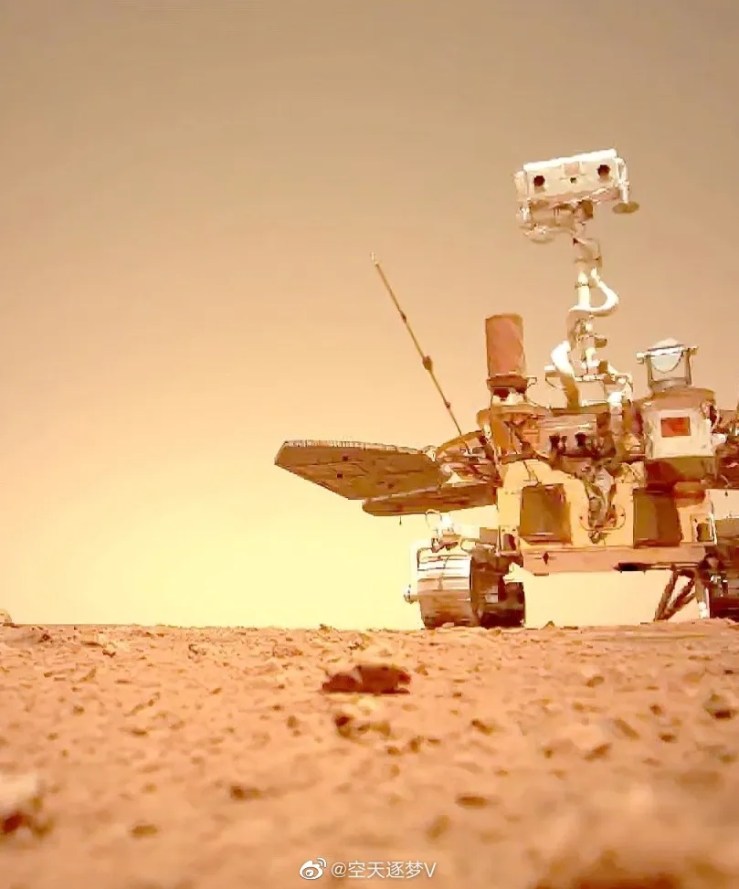
#CNSA #ChinaNationalSpaceAdministration #國家航天局 |#BeltAndRoadinitiative #May2022 | #火星 # 天問 #天问一号#TianwenOne #MarsMission #Marslander #MarsRover #Tianwen1 probe  #祝融号 #ZhuRong #Tianwen1 is preparing for winter, and the orbiter continues to carry out orbital exploration….

On the months of 5th May 2022   天问一号飞運騎遊達达3亿CNSA – China National Space Administration – ESA – European Space agency Belt and road initiative mars mission…first Mars exploration mission, Tianwen- Martian Probe One  sent back stunning images of the Half Earth Mass size of the Rustic Planet Mars in which show stunning Martian landscape with its iconic polar caps of either southern or northern … With its timeless Stunning Mars Photography. Tianwen-1″ returned high-resolution images of the Mars inspection area The “Zhurong” rover is preparing for winter, and the orbiter continues to carry out orbital exploration…..

As of May 5, 2022, the “Tianwen-1” orbiter has been in orbit for 651 days and is 240 million kilometers away from the earth. The “Zhurong” rover has worked on the surface of Mars for 347 Martian days, with a cumulative travel of 1921 meters, the two devices have accumulated about 940GB of original scientific data, and the operation is normal.

During the ring fire, all seven payloads carried by the “Tianwen-1” orbiter were powered on, and continued to carry out global remote sensing exploration of Mars. Figure 1 is a 0.8 m/pixel image taken by a high-resolution camera on April 17, 2022, of the Triolle crater on Mars, showing the “seasonal slope pattern” on the crater wall. Figure 2 is a local landform image of the Martian Sailor Valley captured by a medium-resolution camera on April 1, 2022, with a resolution of about 65 meters per pixel. 

Figure 1. “Seasonal slope pattern” of the crater wall of the Triolet crater on Mars, captured by a high-resolution camera 
Fig. 2 Local landform of Martian Sailor Valley captured by medium-resolution camera

After the “Zhurong” Mars rover completed the 90-Mars day inspection mission on August 15, 2021, it will continue to carry out the expansion inspection and exploration mission. Figure 3 is an image of rocks distributed near impact craters on the Martian surface taken by the Navigation Terrain Camera on April 10, 2022 (the 323rd Martian day after landing). At present, the area where the “Zhurong” rover is located has entered winter. Similar to our earth, after entering winter, the altitude angle of solar illumination in the northern hemisphere area decreases and the duration of illumination shortens. According to the measurements, the local maximum temperature at noon on the rover has dropped to -20°C, and the ambient temperature at night is as low as -100°C. In addition, due to the presence of sand and dust weather, the light intensity is further weakened, which affects the power generation capacity of the solar wing battery array of the Mars rover. Recently, the engineering team adopted the rotation of the solar wing to adjust the light angle, reduce the daily work items and time, and achieve energy balance. 

Figure 3. Images of rocks distributed near impact craters on the Martian surface captured by the Navigation Terrain Camera

The rotation period of Mars is close to that of Earth. A Martian day is only about 40 minutes longer than that of Earth. The inclination of Mars’ rotation axis is 25.19°, which is also very close to Earth. Therefore, Mars also has day and night alternations and seasonal changes like Earth. The orbital period of Mars is about 687 days, that is, 1 Martian year is equivalent to 1.9 Earth years, which means that the average duration of each season on Mars is about twice as long as on Earth.

When the “Zhurong” first landed last year, when Mars moved to the vicinity of the aphelion, the direct sunlight point was in the northern hemisphere. At that time, the northern hemisphere had just entered summer and the southern hemisphere had entered winter. Now, nearly a year after landing on Mars, Mars is running near the perihelion, and the direct sun is in the southern hemisphere. The northern hemisphere where “Zhurong” is located is entering winter and the southern hemisphere is entering summer.

In the next two months, the direct sun point will continue to move to the south of Mars, reaching around the Tropic of Cancer around mid-to-late July, when Mars’ northern hemisphere will enter the coldest season of the year. In order to safely survive extreme weather such as Martian winter and sandstorms, the “Zhurong” rover has designed working modes such as autonomous sleep. When the energy is reduced to a certain level, it will automatically enter the sleep mode. After the environmental conditions gradually improve, it will return to normal Operating mode. 

作者:耿言 李佳威

Images and visuals are from CNSA- China National Space Administration also from there respectives- CLEP –China Lunar Exploration Project..

#CNSA #ChinaNationalSpaceAdministration #國家航天局 |#BeltAndRoadinitiative #March2022 | #火星 # 天問 #天问一号#TianwenOne #MarsMission #Marslander #MarsRover #Tianwen1 probe  #祝融号 #ZhuRong #Tianwen1 returned high-resolution images of the Mars inspection area…..

On the months of March 2022  the week of 20th March 2022   天问一号飞運騎遊達达3亿CNSA – China National Space Administration – ESA – European Space agency Belt and road initiative mars mission…first Mars exploration mission, Tianwen- Martian Probe One  sent back stunning images of the Half Earth Mass size of the Rustic Planet Mars in which show stunning Martian landscape with its iconic polar caps of either southern or northern .. With its timeless Stunning Mars Photography. Tianwen-1″ returned high-resolution images of the Mars inspection area

Figure 1 The image of the inspection area of ​​”Zhurong” taken by a high-resolution camera

 A few days ago, the “Tianwen No. 1” orbiter passed over the inspection area of ​​the Mars rover again, and took a 0.5-meter resolution image of the “Zhurong” inspection area. As of March 24, 2022, the “Zhurong” rover has been working on the surface of Mars for 306 Martian days and has traveled 1,784 meters in total. The “Tianwen-1” orbiter has been in orbit for 609 days and is 277 million kilometers away from the earth. Both are operating normally.

(a) Taken on May 19 , 
2021 ( the 
5th

 Martian day after landing ), the surface of the rover is not covered by sand and dust
(b) Taken on 
January 
22 , 
2022 (the 247th

 Martian day 

after landing ), there is obvious dust coverage on the surface of the 
rover
Figure 2 Comparison of images of the rover taken by the Navigation Terrain Camera in different periods

The “Zhurong” rover also sent back selfies from the surface of Mars. Compared with the photos taken just after landing, it can be seen that a thin layer of dust has accumulated on the surface of the rover. At the same time, according to the telemetry information of the rover, the power generation efficiency of the solar wing is affected to a certain extent, but the energy is still sufficient. In order to cope with the dust coverage, the solar wing of the Mars rover has been specially designed, and various measures can be taken to deal with the problem of the reduction of power generation efficiency caused by the sand and dust.

(a) 
Taken at the 
center of the 

 image on January 22 , 2022 ( 30.7 °E, 74.0 ° N )
(b) 
Taken at the center of the image on February 10 , 2022 ( 37.8 ° east longitude , 7 2.9 ° north latitude), a local sandstorm occurred, and the ground objects were difficult to distinguish

 
Fig. 3 Comparison of wind and sand activities in high latitude regions of the Northern Hemisphere captured by medium-resolution cameras

The Martian dust storm will directly affect the energy acquisition of the Mars rover, which has always attracted much attention. The engineering team continued to monitor the Martian sand and dust weather through images obtained by the medium-resolution camera of the “Tianwen-1” orbiter, and found that from late January this year, obvious wind and sand activities began to appear in the area north of 60 ° N latitude on Mars. It can be seen from the figure below that a local sandstorm occurred in this area in February this year, and typical features were covered by a large amount of sand and dust, making it difficult to distinguish.

At present, the northern hemisphere of Mars has begun to enter autumn. According to the analysis of previous detection data, autumn is the season of frequent occurrence of dusty weather on Mars, but no obvious dusty weather has been observed in the inspection area of ​​”Zhurong”.

(a) Taken on March 24 , 2021 , at the center of the image ( 110.2 ° E, 24.6 °N)
(b) Taken on January 30 , 2022 , at the center of the image ( 107.4 ° E longitude , 24.4 ° N latitude )
Figure 4. Medium resolution image of “Zhurong” landing inspection area

The “Tianwen-1” orbiter continues to carry out global remote sensing exploration of Mars, and focuses on typical landforms and geological units such as craters, volcanoes, canyons, and dry riverbeds, and obtains high-resolution images. On March 7 this year, the American “Perseverance” rover was photographed while imaging the “Jezero” crater, which is currently located about 200 meters southeast of its landing site.

Figure 5 The American “Perseverance” rover photographed by “Tianwen-1”

Source Cartography: National Astronomical Observatory -Author: Geng Yan Chen Gang

Images and visuals are from CNSA- China National Space Administration also from there respectives- CLEP –China Lunar Exploration Project..

#CNSA #ChinaNationalSpaceAdministration #国家航天局 |#BeltAndRoadinitiative #March2022 |#TwoSessions #Beijing plans to realize the #Planet #Mars #Change7 #Change8  sampling return mission by 2030 #ASummery

On the week of 13th March 2022 in  CNSA _China National Space Administration -China – People’s Republic of China……..During the Two Sessions of which was held during in the People’s Hall during the week of 13th March 2022 China – People’s Republic of China CNSA China National Space Administration  and its Partners plans to realize the Mars sampling return mission by 2030] China Daily reported on March 6 that Wu Weiren, member of the Standing Committee of the National Committee of the Chinese People’s Political Consultative Conference and chief designer of China’s lunar exploration project, said recently that my country plans to realize the Mars sampling return mission by 2030. The difficulty of the project is much greater than that of lunar sampling and return. The first problem to be solved is to develop a launch vehicle with greater thrust. In the follow-up, China is also preparing to conduct marginal exploration of the solar system. “The sun is about 150 million kilometers from the earth, which is an astronomical unit. We plan to achieve the ‘double hundred’ goal in 2049, that is, on the 100th anniversary of the founding of New China, to complete 100 astronomical units, which is 15 billion kilometers away “Deep space exploration” China plans to realize the Mars sampling return mission by 2030

China will carry on its moon research in the future with Chang’e-6, Chang’e-7 and Chang’e-8 missions by 2030. After 2030, a new set of missions will be carried out to complete the construction of an international lunar research station by 2030….he Chang’e-6 is scheduled to bring back to Earth lunar samples with a mass of up to 2 kilograms; the Chang’e-7 will be tasked with landing on the lunar south pole and detecting local natural resources; and the Chang’e-8, working in collaboration with Chang’e-7, is going to scout how to exploit lunar resources.

According to Wu, the Chang’e-6 and Chang’e-7 are expected to be launched around 2025.

Future missions also include the development of a special craft, which can fly from the landing site to lunar craters to help scientists look for traces of water. If water is present, it could provide resources for future crewed missions on the moon, Wu noted.

After 2030, a new set of missions will be carried out to complete the construction of an international lunar research station by 2035….

“There will be multiple rovers and landers working in the future moon station and a lunar-based communication network to support these spacecraft,” Wu said. “The lunar research station can also function as a transfer outpost for the solar system and even deeper space explorations.”  

Images and visuals are from Weibo also their respectives.

#CNSA #ChinaNationalSpaceAdministration #國家航天局 |#BeltAndRoadinitiative #February2022 | #火星 # 天問 #天问一号#TianwenOne #MarsMission #Marslander #MarsRover #Tianwen1 probe  #祝融号 #ZhuRong Tianwen1 #ChineseNewYear2022 with  #MarsPhotography Tianwen-1 probe #YearoftheTiger  congratulates the grand opening of the #BeijingWinterOlympics#Beijing2022 from Mars

On the months of January 2022 1st January 2022 on New Years Day  天问一号飞運騎遊達达3亿CNSA – China National Space Administration – ESA – European Space agency Belt and road initiative mars mission…first Mars exploration mission, Tianwen- Martian Probe One  sent back stunning images of the Half Earth Mass size of the Rustic Planet Mars in which show stunning Martian landscape with its iconic polar caps of either southern or northern .. with its timeless Stunning Mars Photography.

On 2022 New Year’s Day, China National Space Administration CLEP – China Lunar Exploration program  issued a set of beautiful images of the first Mars mission Heaven 1 spacecraft returned from distant Mars, report to the National People ‘Heaven One “peace, extended festival greetings .

On the eve on 31st January 2022 in which on the 1st February 2022 of the Chinese Lunar New year Spring Festival in the Year of the Tiger, the Tianwen-1 probe sent back a set of selfie videos from Mars orbit to extend New Year wishes to the people of the whole country- China – People’s Republic of China and the Chinese Communities . On the 29th of the twelfth lunar month last year (February 10, 2021), Tianwen-1 arrived on Mars and successfully implemented capture and braking. It became my country’s first artificial Mars satellite, and started a scientific exploration journey to the red planet. a lunar year.

rews are installing mascots on the Mars lander
 

Also on the 4th February 2022 Sunday the Winter Olympics begin! A blessing “falls from the sky” across 320 million kilometers! Previously, the mascots of the Beijing Winter Olympics and the Winter Paralympics, Bing DunDun and Xue RongRong, landed on Mars on Tianwen-1, and took a group photo with the Zhurong Mars rover, which was a dream ..

Also that Day the Tianwen-1 probe, the five-star red flag and the emblems of the Beijing Winter Olympics and Paralympic Games took a selfie in the same frame.

Crews are installing the emblem on the Mars orbiter


Beijing is the first city with both summer and winter Olympics, and Tianwen-1 is China’s first interplanetary exploration mission, sending the mascots and logos of the Winter Olympics and Paralympics to Mars. The Chinese expression is the Chinese nation’s advocacy and pursuit of faster, higher, stronger and more united.

This set of “cosmic-level” photos returned from Mars orbit was taken by the “selfie” camera carried by the Tianwen-1 probe. This group of photos is not only a “highest” Winter Olympics gift to friends on the ground, but also a highlight witness to the world’s shared Olympic moments!

As of February 4th 2022, Tianwen-1 has been in orbit for 561 days, and the Zhurong rover has worked for 259 Martian days, traveling a total of 1,537 meters. Both the orbiter and the rover are in good condition and operating normally. 

Images and visuals are from CNSA- China National Space Administration also from there respectives- CLEP –China Lunar Exploration Project..

#CNSA #ChinaNationalSpaceAdministration #國家航天局 |#BeltAndRoadinitiative #January2022 |#火星 # 天問 #天问一号#TianwenOne #MarsMission #Marslander #MarsRover #Tianwen1 probe  #祝融号 #ZhuRong Tianwen1 #ChineseNewYear2022 #ChineseLunarNewYear Eve with  #MarsPhotography Tianwen-1 probe #SelfieStick  #UltimateMarSelfie celebrating the #YearoftheTiger  

On the months of January 2022 1st January 2022 on New Years Day  天问一号飞運騎遊達达3亿CNSA – China National Space Administration – ESA – European Space agency Belt and road initiative mars mission…first Mars exploration mission, Tianwen- Martian Probe One  sent back stunning images of the Half Earth Mass size of the Rustic Planet Mars in which show stunning Martian landscape with its iconic polar caps of either southern or northern .. with its timeless Stunning Mars Photography.

On 2022 New Year’s Day, China National Space Administration CLEP – China Lunar Exploration program  issued a set of beautiful images of the first Mars mission Heaven 1 spacecraft returned from distant Mars, report to the National People ‘Heaven One “peace, extended festival greetings .

On the eve on 31st January 2022 in which on the 1st February 2022 of the Chinese Lunar New year  Spring Festival in the Year of the Tiger, the Tianwen-1 probe sent back a set of selfie videos from Mars orbit to extend New Year wishes to the people of the whole country- China – People’s Republic of China and the Chinese Communities . On the 29th of the twelfth lunar month last year (February 10, 2021), Tianwen-1 arrived on Mars and successfully implemented capture and braking. It became my country’s first artificial Mars satellite, and started a scientific exploration journey to the red planet. a lunar year.

The video is a video of the Mars group photo taken by the probe.

The video was shot by the “selfie” camera carried by the Tianwen-1 surround. The camera is installed at the end of the “selfie stick”. This selfie tool is designed to monitor and evaluate the status of key components outside the surround. In the video The orbiter’s 3000N engine, propellant storage tank, attitude control engine and other components are in good condition. The five-star red flag shining in the Mars orbit is particularly bright. During the attitude adjustment process, the angle of the sun’s illumination changes significantly. When flying over the north pole of Mars, the ice cap below was photographed.
The “selfie stick” uses a special shape memory composite material, which is folded and folded before launch. After entering the orbit of Mars, the folded part is heated to a certain temperature, and the “selfie stick” gradually returns to a straight state. The “selfie stick” weighs only 0.8 kilograms and is 1.6 meters long when unfolded. The camera installed at the end can effectively complete various monitoring tasks.

As of January 31, 2022, Tianwen-1 has been in orbit for 557 days, about 325 million kilometers away from the earth, and the light travel time is about 18 minutes. The Zhurong rover has worked for 255 Martian days and travelled a total of 1524 meters. At present, the Tianwen-1 mission has returned a total of about 600GB of original scientific data, and the two devices are in good condition and operating normally

Images and visuals are from CNSA- China National Space Administration also from there respectives- CLEP –China Lunar Exploration Project..