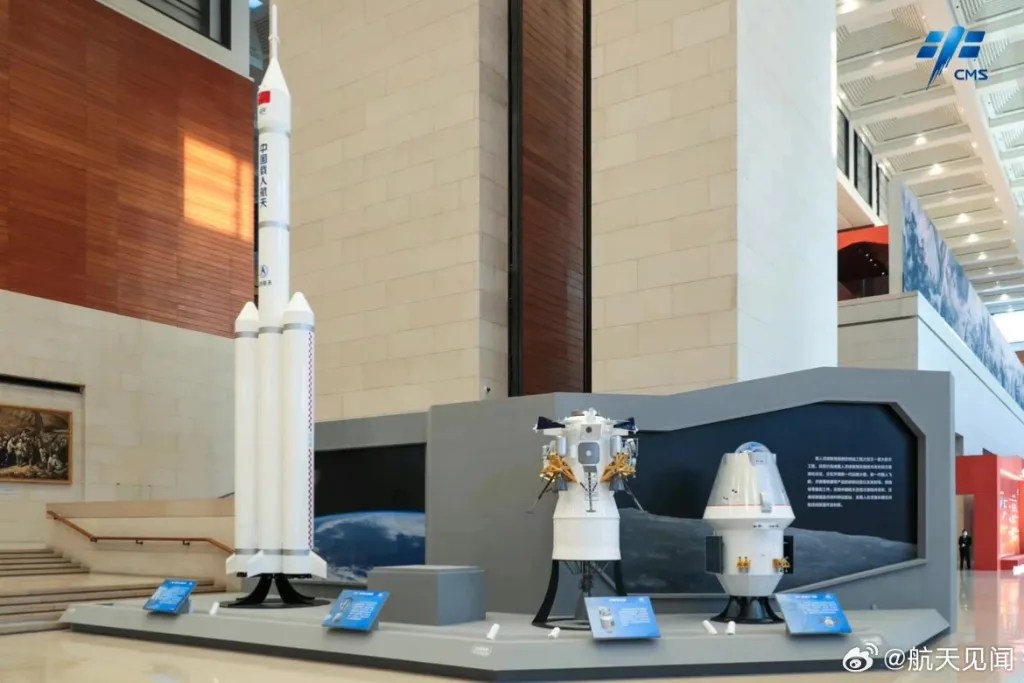
#MadeInChina #中國製造| #中科宇航 #ZhongkeAerospace #ChinaAcademyOfScience #CASSPace #May2024 | #CarrierRocket #ReusableCarrierRocket #MannedReusableCarrierRocket #CarrierRocket Series … its Sub Orbital Vehicle  first flight in 2027, and manned space travel will be carried out in 2028  #ASummary

Beijing Zhongke Aerospace Exploration Technology Co., Ltd. is the first domestic aerospace enterprise with mixed ownership, and it is also the target enterprise that Oriental Aerospace Port focuses on introducing. Relying on the scientific research strength and resource advantages of the Institute of Mechanics of the Chinese Academy of Sciences and the Aerospace Flight Technology Center of the Chinese Academy of Sciences, China Aerospace Science and Technology has been committed to the research and development and integration of space technology and aerospace vehicles as a platform for the transformation of major national scientific research projects, as well as the transformation and provision of technological achievements. Aerospace launch service. The Lijian-1 rocket project also adds a brand-new name card to the Oriental Space Port, which will surely promote the construction of the Oriental Space Port to take a solid step forward.

In 2028, take a trip to space! Come and experience the space tourism capsule first|High-quality development research trip

[China Aerospace’s “space travel vehicle” will make its first flight in 2027, and manned space travel will be carried out in 2028]

 The space travel vehicle uses a combination of a single-stage rocket and a tourist cabin. The tourist cabin has 4 panoramic windows and can accommodate 7 passengers in a single flight.  Passengers. During the 10-minute flight, passengers will cross the Kármán Line at an altitude of 100 kilometers and experience the feeling of weightlessness that escapes the earth’s gravity for 3 minutes. Finally, the tourist capsule will land via parachute.

The project meets a 100-hour launch cycle each time, and the supporting aerospace theme park will have 10 space tourism aircraft on standby to perform space travel experiences in shifts. The landing site for aircraft launch and recovery will be planned and constructed in coordination with the aerospace theme park, space experience hall and aerospace science education base. Passengers will also receive short-term training in the park before flying.

With the development of China, People’s Republic of China aerospace technology, it is no longer a dream for the public to travel to space. On May 15, the 2024 “High-Quality Development Research Tour” Guangdong-themed interview event came to the Zhongke Aerospace Flight Technology Industrialization Base in Nansha District, Guangzhou. Here, reporters experienced a 1:1 replica of the space tourism capsule and learned that in 2028, passengers may be able to take a real rocket to sub orbit and experience the feeling of weightlessness.

According to the staff of Guangzhou Zhongke Aerospace Exploration Technology Co., Ltd. (referred to as “Zhongke Aerospace”), the suborbital vehicle that will take passengers to space will use a combination of a single-stage rocket and a tourist cabin. The tourist cabin will have four panoramic windows. , can carry 7 passengers on a single flight. During the 10-minute flight, passengers will cross the Kármán Line at an altitude of 100 kilometers and experience the feeling of weightlessness that escapes the earth’s gravity for 3 minutes. Finally, the tourist capsule will land via parachute.

The project meets a 100-hour launch cycle each time, and the supporting aerospace theme park will have 10 space tourism aircraft on standby to perform space travel experiences in shifts. The landing site for aircraft launch and recovery will be planned and constructed in coordination with the aerospace theme park, space experience hall and aerospace science education base. Passengers will also receive short-term training in the park before flying.

According to the reporter’s understanding, with the continuous advancement of technology, the ticket prices for space travel will continue to decrease, giving the public the opportunity to travel in space.

Images and visuals are from their respectives

#CNSA #ChinaNationalSpaceAdministration #国家航天局 | #BRI #July2023 |#CASC #ChinaAerospaceScienceAndTechnologyCorporation – #长征十号 #MannedCarrierRocket #CarrierRocketFreighter  #3DPrinting #CarrierRocketEngine Testing the #ChangZheng10 #LongMarch10 engine at Thrust of 130 Tons Successfully …..

长征十号 At 22nd  23rd July  2023 Hong Kong SAR- Beijing time , China- People’s Republic of China- CNSA –China National Space Administration   Successfully Carrier Rocket  engine tested for the New Next Generation Chang Zheng – Long March 10 Manned Lunar mission landing Carrier rocket freighter The main engine of China’s manned lunar landing rocket Long March 10 completed another ignition test run yesterday, which verified all the requirements of the rocket mission for the engine, and provided strong support for the solidification of the engine’s technical status, the establishment of product technology baselines, and the improvement of reliability.


The engine used in this test run uses advanced liquid oxygen kerosene as fuel, which is improved and iterated from the high-thrust liquid oxygen kerosene engine used by the new generation of launch vehicles such as the active Long March 5, with a thrust of 130 tons. (The Sixth Academy of Aerospace Science and Technology Group)

Created with GIMP

The reporter learned from China Aerospace Science and Technology Group Co., Ltd. on July 23 that the main engine of my country’s manned moon landing rocket was tested in the Fengzhou Test Area of ​​the Sixth Academy of Aerospace Science and Technology Corporation, and achieved continuous success. This test run verified the engine flight mission profile, and provided strong support for the solidification of the engine technical state, the establishment of the product technical baseline, and the improvement of reliability.

The engine is the power source of the rocket, and its development process is very complicated. Test run is an important link in the engine development process, and there are dozens of types. In layman’s terms, engine test run is the process of igniting the engine and verifying the rationality of its design scheme and process reliability. This is an indispensable and important part of the development and delivery of a type 1 engine. It will run through all stages before and after engine development. Each stage of test run has different meanings, and the ignition time varies from a few seconds to hundreds of seconds.

It is reported that the engine used in this test run uses advanced liquid oxygen kerosene as fuel, which is improved and iterated from the high-thrust liquid oxygen kerosene engine used by the new generation of launch vehicles such as the Long March 5. The thrust reaches 130 tons. The R&D team of the Sixth Academy of Aerospace Science and Technology Group adheres to the concept of digital design, and has successively overcome key technical problems such as engine start-up and shutdown sequence, engine wide-range continuously variable thrust, and engine long life and high reliability.

In addition, the continuous success of the test run has fully verified the reliability of a number of new carrying process technologies. The engine production of this test run adopts the concept of intelligent manufacturing, and actively applies new materials, new processes, and new technologies. The inner wall of the thrust chamber of the core component adopts a new protective coating, key assemblies adopt automatic welding technology, and a large number of components adopt 3D printing technology.

During the preparation of the engine test run, the participants in the research and test conducted tests and verifications on each subsystem of the test through comprehensive means such as digital modelling, simulation calculation, and system debugging. The successful test run shows that the test area has greatly improved the multi-station parallel test run capability and test efficiency by optimizing the workflow.

Images and visuals are from their Respectives CMS China Manned SpaceCNSA-China National Space Administration  the Sixth Academy of Aerospace Science and Technology Group

#MadeInChina #中國製造| #ISpace #星际荣耀#InterstellarGlory #July2023 | #ChinesePrivateSpaceCompany –#ReusableCarrierRocket #CarrierRocket Ninth China (International) Commercial Aerospace Summit Forum Summary of the latest Reusable Carrier Rocket development launch vehicle…

In which iSpace- Interstellar Glory in which it is the first Chinese Private Space Company to do so successfully commercially first out from sixty known private space companies in China People’s Republic of China…  Founded in Beijing 2016 located in Beijing Economic and Technological Development Zone or known for short as E-Town in Capital of China – People’s Republic of China …

Beijing Interstellar Glory Space Technology Co., Ltd. (referred to as “Interstellar Glory”) was established in October 2016, with Peng Xiaobo as the legal representative. The company is committed to developing excellent commercial launch vehicles and providing systematic launch solutions, providing global commercial aerospace customers with more efficient, higher-quality, and more cost-effective launch services, so as to greatly improve the ability of human beings to freely enter and exit space.

The company focuses on the research and development of intelligent launch vehicles, and provides integrated commercial launch services for global satellite and constellation customers.

 On July 12, 2023, the Ninth China (International) Commercial Aerospace Summit Forum opened in Wuhan. This forum is jointly directed by China National Space Administration, China Meteorological Administration, China Manned Space Engineering Office, Hubei Provincial People’s Government, Wuhan Municipal People’s Government, China Aerospace Science and Industry Corporation, China Aerospace Science and Technology Corporation, China Electronics Technology Co., Ltd. It is co-sponsored by Group Co., Ltd., China Aerospace Foundation and Chinese Society of Astronautics. Ji Qiming, Assistant Director of China Manned Space Engineering Office, Zhang Hailian, Deputy Chief Designer of China Manned Space Engineering and other leaders attended the forum.

【Summary of the latest development of the Interstellar Glory launch vehicle】

▲The rocket type spectrum is only hyperbolic No. 1, hyperbolic No. 2 Y, hyperbolic No. 3, hyperbolic No. 3 B, SQZ-2 and the abstract asymmetrical SQX- 3A does not seem to engage in.

▲ Hyperbolic No. 1 Yaoqijian is scheduled to be launched in August 2023, and the final assembly of 4 rounds of Hyperbolic No. 1 will be completed by the end of this year. It is expected to have a launch capacity of 10 rounds per year by 2025.

▲ The 15-ton methane machine “Focus No. 1” has been tested for more than 12,000 seconds on the ground.

▲ The 105-ton methane machine “Focus No. 2” completed the semi-system test run in March this year, and this month is carrying out the hot test run of the whole system. It is planned to complete the engine reliability test run by December 2024 (the test run time will reach 10,000 seconds)


▲Hyperbola No. 2 Verification (SQX-2Y) The arrow has a diameter of 3.35 meters and a total length of 17 meters. It uses a Focus No. 1 engine. It is currently planned to carry out vertical take-off and landing tests in the second half of this year. The landing accuracy is expected to be better than 3 meters.

▲The basic type of Hyperbola No. 3 is a two-stage liquid oxygen methane rocket, with a diameter of 4.2 meters, a total length of 69 meters, a take-off mass of 490 tons, 9 units of Focus No. 2 in parallel, and a LEO capacity of 13.4 tons (not recycled)/8.5 tons ( Reuse), 500kmSSO capacity is 10.4 tons (non-recycling)/6.2 tons (reuse). It is currently planned to make its first flight in 2025, realize rocket recovery in 2026, and have a launch capacity of 25 rounds per year in 2030.

▲The hyperbolic No. 3 extended model includes: the hyperbolic No. 3 B bundled with CBC, and the three-stage configuration high-orbit rocket with the addition of a low-temperature final stage. Among them, the LEO transportation capacity of Hyperbola No. 3 B in the recovery state is not less than 15 tons, and the 500km SSO transportation capacity is 26.2 tons (non-recycling)/10.6 tons (reuse).

▲The hyperbolic No. 3 series of liquid rockets adopts the “three-level” test and launch mode. The expected test and launch cycle is 14 days, and the rocket takes up 2.5 days at the station. The 4.2-meter rocket body is transported into the field by road and is expected to be launched at the Hainan Commercial Launch Site in Wenchang.

▲Interstellar Glory plans to finally realize the annual production capacity of 50 liquid oxygen methane engines, 8 attitude control engine systems, and 10 liquid rockets. At present, the storage tank production line is undergoing equipment debugging and some process verification, and it is expected to be in the state of final assembly and debugging by the end of this year.

Images-visuals are from Weibo and their respectives..

#CNSA #ChinaNationalSpaceAdministration #国家航天局 |#BRI #January2023 #Tiangong #ChinaSpaceStation #CMS #ChinaMannedSpace #Shenzhou16, #Shenzhou17 #Shenzhou18 #Shenzhou19 #ChangZheng2F #MannedCarrierRocket Launches planned for the year 2023..

On the week of 19th January 2023 just before days of Chinese Lunar New Years for the Year of the Rabbit.. in which this year  CMS China Manned Space CNSA-China National Space Administration   this year the crew of Jiuquan Satellite launch Center, Inner Mongolia, China, People’s Republic of China will be studious busy in preparing for the Manned Chang Zheng- Long March 2F Manned Carrier Rocket..

Currently This year, Chang Zheng- Long March 2F will launch 2 manned launches and rocket final assembly 3 rounds…..  the Year  2023 is an important stage for the application and development of Tiangong- China manned space station, and a key stage for accelerating the construction of Finalisation of the construction of China’s orbital outpost. The Chang Zheng Long March 2F manned Carrier rocket will also enter a year For the normalized manned launch of two rounds and the mission of emergency rescue duty, the rocket is still carried out in a rolling manner of “one for one and one for one”.


In 2023, the Chang Zheng Long March 2F manned Carrier rocket will complete two manned launches and three rocket final assemblies. The former is Yao 16 and Yao 17, and the latter is Shenzhou Yao 17, Yao 18 and Yao 19.


After the Chang Zheng Long March 2F manned Carrier rocket Yao16 rocket was launched by the Yao15 rocket at the end of November last year, it has been turned into an emergency rescue state. It is currently on duty at the technical workshop of the launch site and is in good condition. As the emergency rescue arrow of Yao 16 Manned Carrier rocket, the Yao17 rocket has completed the final assembly of the whole rocket in Beijing, and will soon carry out the matching and factory testing of the whole rocket. It is expected that it will enter the field with the launch team in the first half of the year. The two rockets launched this year are basically the same as last year in terms of major technical status, but there are nearly 20 technical status improvements and upgrades in terms of further improving product reliability, process improvement and upgrading the Carrier Rocket also it’s Command Module..

Images and visuals are from their Respectives CMS China Manned SpaceCNSA-China National Space Administration

#CNSA #ChinaNationalSpaceAdministration #国家航天局 |#BRI #September2022 | #ChinaSpaceStation #TiangongSpaceStation | #实验舱 #文天 #Wentian #Shenzhou14 Crew Takionauts The Shenzhou 14 Takionaut crew sends blessings in orbit on the 30th anniversary of the manned space project …

On the 17th September 2022 it is the second Shenzhou 14 EVA Spacewalk for  CNSA –China National Space Administration    China Space Tiangong Space Station .  First exiting out is Commander陈冬Chen Dong opened the airlock door of the airlock cabin Today on 17th September 2022 crew successfully completed all the scheduled tasks of the second outing activity….. At 17:47 Hong Kong SAR- Beijing Time on September 17, 2022, after about 5 hours of outing, Shenzhou 14 Takionauts Chen Dong, Liu Yang, and Cai Xuzhe worked closely together to complete all the scheduled tasks during the outboard activity. Takionauts Chen Dong and Takionaut Cai Xuzhe have returned to the Wentian experimental module safely, and the outboard activity was a complete success.

The Shenzhou 14 Takionaut crew sends blessings in orbit on the 30th anniversary of the manned space project

Shenzhou Cress 14 Takionaut Tribute Project 30 Years of China’s manned space project has gone through 30 years of hard work and continuous struggle under the guidance of the spirit of manned spaceflight in accordance with the central “three-step” development strategy. Years, has achieved world-renowned achievements. With the steady progress of the orbital construction of China’s space station, the Chinese nation’s thousand-year-old dream of flying will fly even higher. The Shenzhou 14 Takionaut crew pays the highest respect to every manned Takionaut who has bravely climbed the peak of science and technology in our “space home”! 30 years of blessing manned spaceflights..

Images and Visuals are from their Respectives…