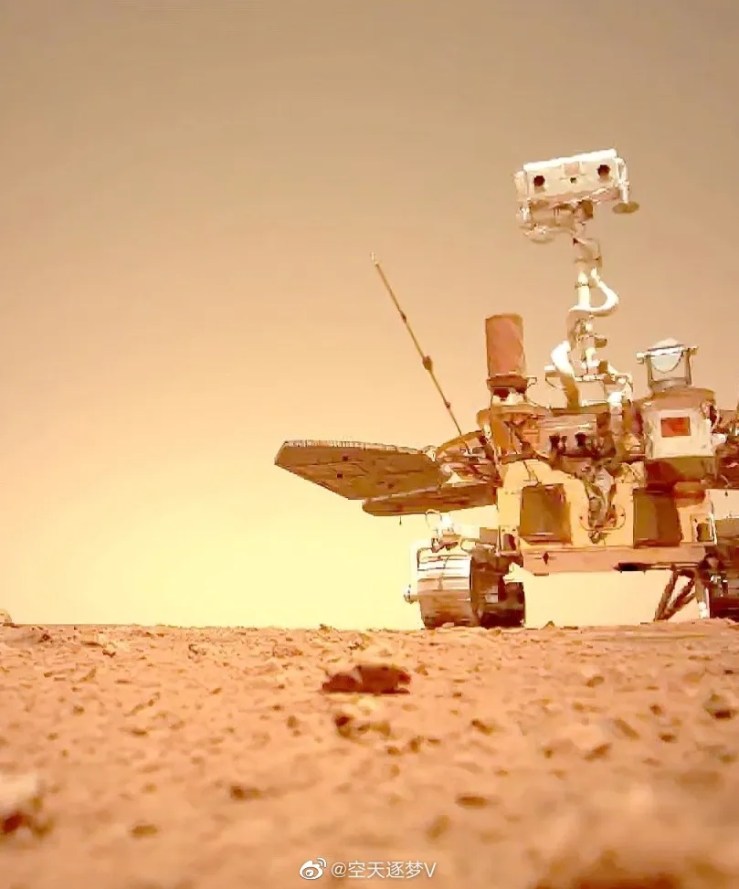
More than One year ago on 24th November 2020, the Chang Zheng – Long March Five Carrier Rocket Launched away in CNSA – China National Space Administration China Wenchang spaceport launch, Change Five Lunar probe into orbit, opened up towards China – People’s Republic of China’s first celestial bodies sample return trip from Mons Rumker on the Lunar Surface.……
[The new results of Chang’e 5 reveal the distribution characteristics of lunar surface water in the landing area. The lunar soil contains water in the form of hydroxyl groups]
On June 15, “Nature Communications” published an important research result of my country’s Chang’e 5 online. Whether there is water on the moon, how much water there is, what form of water it is, and where the water comes from is controversial, and it has always been a research hotspot in lunar science. At the beginning of the Chang’e-5 mission project demonstration, the research team proposed to extend the spectral range of the lunar mineral spectrometer on the lander to 3.2 μm, and realized the first in-situ detection of the spectral absorption characteristics of lunar surface water in the world. In order to avoid the impact of the dynamic “water” (hydroxyl OH) when the engine plume and the solar wind bombard the lunar surface on the in-situ spectral analysis, the research team carefully designed the timing of acquiring the in-situ detection spectral data. The detection timing was selected 6 hours after landing to avoid the influence of the engine plume composition when the CE-5 probe landed; The dynamic “water” of the lunar surface; the moon (landing zone) is under the protection of the earth’s magnetic field during the spectral measurement, which shields the solar wind and avoids the dynamic “water” (hydroxyl OH) factor produced by the bombardment of the solar wind. In this environment, the Chang’e-5 spectrometer can obtain a “clean” absorption spectrum of “water”. After strict correction and analysis, the research team found that the lunar soil in the Chang’e-5 landing area obviously contains “water” in the form of hydroxyl groups. But the average content is low, only about 30ppm.
At present, it is believed that there are three main sources of lunar “water”: one is (dynamic) hydroxyl substances produced by the interaction between solar wind particles and lunar surface materials; the other is water and hydroxyl-containing substances brought by comets or meteorites that hit the moon; Lunar primary (internal) water. After the lunar samples were returned to Earth, the research team conducted a systematic analysis of the returned lunar samples in the laboratory. The laboratory spectral analysis once again verified the clear existence of hydroxy water, but the research on the existence form, content and source of “water” requires detailed research. Mineral petrological analysis. The Apollo lunar sample study believes that the (impact) cemented glass in the lunar soil contains hydroxyl substances formed by the long-term injection of the solar wind, and the content of cemented glass is an important factor affecting the “water” content in the lunar sample. Laboratory analysis of the returned samples showed that the Chang’e 5 lunar sample is a type of young basalt with a very small content of cemented glass (less than 16%), which is only 1/3 of the Apollo 11 lunar sample, so it is estimated that the Chang’e 5 lunar soil sample The “water” from the solar wind injected into the cemented glass is not more than 18ppm. At the same time, the foreign impact sputters in the lunar soil samples of the Chang’e-5 landing area are very low, and their contribution to “water” can be ignored. Therefore, there must be primary water originating from the interior of the moon in the Chang’e-5 lunar soil samples. Laboratory analysis of the Chang’e-5 lunar samples found at least one hydrous mineral, hydroxyapatite, whose content was uneven, ranging from 0 ppm to 179 ppm (average about 17 ppm) in equivalent samples of hydroxy water, proving that The presence of “water” from the magma crystallization process in the Chang’e-5 lunar soil samples indicates that “water” not only existed, but also played a very important role in the late lunar magmatic activity.
The lunar in-situ detection spectral data of this research result were obtained by the Lunar Mineral Spectrum Analyzer developed by the Shanghai Institute of Technical Physics, Chinese Academy of Sciences. The operation management, data reception and processing of the scientific detection load were carried out by the National Astronomical Observatory of the Chinese Academy of Sciences (Lunar Exploration Engineering Ground Application System).
Via CNSA China Space Administration –CLEP China Lunar Exploration project management office
On 24th April 2022, China- People’s Republic of China- CNSA –China National Space Administration throughout the China- People’s Republic of China in which on that Day it’s China National Space Day in which it is the sixth China National Space Day in which there’s promotional events across the whole nation.. in which this week there’s promotional release themes on the previously hard working campaigns in space collaboratively in which features many successfully accomplishments in between various sectors among with governmentally to commercially industrial innovative designs of space ..
Long March 9 is a Chinese super-heavy carrier rocket concept that is currently under development. It is the ninth iteration of the Chang Zheng Long March Series Carrier rocket family, named for the Chinese Red Army’s 1934–35 Long March campaign during the Chinese Civil War against the illegal KMT Republic of China government…. During the Space Day of China or中国天文日China Space Day 2022 celebrating there was massive celebrationally events across the China- People’s Republic of China. The newly advancement of the Chang Zheng – Long March Nine Ultra Heavy Carrier Rocket has undergone many design generationally evolutions in the final approach that is with a cluster of ten more engines in which the new design arrangement configuration which is thicker durable taller with that the Chang Zheng – Long March Nine Ultra Heavy Carrier Rocket can be Reusable- reused..
The Chang Zheng Long March 9 Ultra Heavy Carrier- Reusable Rocket has a new polished rod configuration, with a thickness of 11 meters and a height of 111 meters or more, adding 10 new engines….Long Lehao is the chief designer and general consultant of the launch vehicle series of the China Academy of Launch Vehicle Technology, an academician of the Chinese Academy of Engineering, and the deputy chief designer of the lunar exploration project. On March 23, my country’s seventh “China Space Day”, Academician Long Lehao and a number of authoritative figures in the aerospace field were invited to the School of Astronautics of Beijing Institute of Technology. At the first report meeting, Academician Long Lehao gave a lecture on aerospace knowledge and communicated with teachers and students. During this period, he announced the latest design plan of the Long March 9, which quickly attracted widespread attention.
Many friends know that Academician Long announced a new configuration plan of the Chang Zheng Long March 9 when he visited the University of Hong Kong just last year. It is often called “21 version of Chang Zheng Long March 9 (2021 version)” on the Internet. The new version released this year is basically the same. Yu overthrew last year’s version, so what about this 22nd version (2022 version) Long March 9? Let’s take a look first.
The picture above is the PPT picture of the evolution of the configuration of the Long March 9 rocket announced by Academician Long Lehao during his visit to the University of Hong Kong in 2021. The far right is the 2021 version of the Long March 9.
The picture above shows the latest version of the Long March No. 9 PPT screen released by Academician Long Lehao at Beijing Institute of Technology on April 23 this year.
According to the composition and data of the 22nd version of Chang Zheng Long March 9, which appeared in Academician Long’s PPT presentation, this latest version of the Long March 9 continues the 21st version of the bare rod without booster configuration, but it is thicker and longer than the 21st version. Now, the core stage of the latter has a diameter of 10.6 meters, while the diameter of the 22 Chang Zheng Long March 9 has reached 11 meters, and both the first and second stage rockets are 11 meters in diameter, which is larger than the Saturn V used by the United States to land on the moon. (The diameter of the first stage is 10.1 meters) and it is nearly 1 meter thicker, which is also thicker than NASA’s SLS super-heavy rocket (the first stage of the rocket core stage is 8.4 meters in diameter) and Musk’s starship (9 meters in diameter). If it is successfully developed, it can be called the thickest rocket in history.
The picture above shows the size comparison of the three Long March 9 rockets and my country’s “Hainan” amphibious assault ship. The third from the left is the 2021 version of the Long March 9.
In terms of the diameter of the rocket, this is actually at least the third time that the Chang Zheng Long March 9 plan has become thicker. The design plan of the Long March 9 launched in 2011 has a diameter of 9.5 meters (another 4 boosters). It is 10.6 meters, and this year it has become 11 meters. It can be said that it is getting thicker and thicker.
However, the configuration of this rocket is not only thick, but also magical. When the second-stage rocket transitions to the third-stage rocket, it suddenly shrinks to a diameter of 7.5 meters, but when it reaches the fairing, it suddenly thickens to a diameter of 10 meters. The shape of the third stage to the fairing is like a waist gourd, which is very strange.
The height of the 22nd version of Chang Zheng Long March 9 has also changed, and it has become taller! The total length has reached 111 meters, which is comparable to the height of a 37-story building, 0.4 meters higher than Saturn 5, and 13 meters higher than NASA’s SLS rocket (98 meters in height for the manned version). It is 103 meters, and the height of the 2021 version of Chang Zheng Long March 9 is 108 meters, and now it has increased by 3 meters, and the height is constantly being refreshed.
The far right side of the picture above is the 2021 version of the Long March 9. It can be seen that it is much larger than the 2011 version of the three different configurations of the Long March 9 on the right. The new version of the Long March 9 released this year is larger than the 2021 version, it is conceivable How amazing its physique should be.
Not only is it thicker and longer (or taller), it also has more rocket launches. In the key equipment components, the biggest change in the new configuration of the Long March 9 is its engine. The 2011 version of the Long March 9 design plan is equipped with four YF-130 liquid oxygen kerosene engines for the core stage rocket (a single thrust of about 480 tons) ,), each of the 4 boosters is equipped with 2 YF-130 liquid oxygen kerosene engines, so that the total thrust of the first-stage rocket can reach about 5,800 tons; The core three-stage rocket is equipped with four 25-ton YF-79 hydrogen-oxygen engines.
In the 2021 version of the Chang Zheng Long March 9plan, 4 boosters were abandoned, and the bottom of the core-level polished rod rocket was replaced with 16 YF135 liquid oxygen kerosene engines (a single thrust of about 370 tons). This design is similar to the original version. The thrust is the same, but the boosterless configuration becomes simpler, the aerodynamic efficiency is better, the weight is also reduced by 15 tons, and the launch efficiency is also improved.
The engines of the 2021 version of Chang Zheng Long March 9 second- and third-stage rockets have also been replaced. The core two-stage rocket has been replaced by 2 YF-90 hydrogen-oxygen engines with a thrust of 220 tons to four 120HO hydrogen-oxygen engines with a thrust of 120 tons. The ratio increased by 40 tons, and the core three-stage rocket was replaced by a 120HO hydrogen-oxygen engine from four 25-ton YF-79 hydrogen-oxygen engines, and the thrust was increased by 20 tons.
After such an improvement, the take-off weight of the rocket has been reduced by dozens of tons, and the carrying capacity and carrying efficiency have also been improved. The capacity of the low-Earth orbit has increased from 140 tons in the 2011 version of the Chang Zheng Long March 9 plan to 150 tons, the capacity of the Earth-Moon transfer orbit has increased from 50 tons to 53 tons, and the capacity of the ground-fire transfer orbit has reached between 45 and 50 tons. Load factor and load efficiency.
But the most eye-catching change in the 2022 version of the Long March No. 9 plan is the engine. First, the number of engines has increased, and 26 200-ton liquid oxygen methane engines are used, and there is no model for this engine, so it should not be a project. The thrust of such a first-stage rocket is 5,200 tons, which is lower than the previous two versions, about 700 tons, but the carrying capacity has not been reduced. The transfer rail carrying capacity is 50 tons.
As for why a liquid oxygen methane engine is used, it is because methane has many advantages over kerosene and liquid hydrogen. First, the storage temperature of methane and liquid oxygen is not much different. Methane is minus 161 ℃, and liquid oxygen is At minus 183°C, set up a refrigeration device to separate two spaces, and set them at different temperatures to store them together. However, the storage temperature of liquid hydrogen is minus 253°C, which is quite different, while kerosene can be stored at room temperature. Therefore, in terms of refrigeration, it is more troublesome to place liquid oxygen together with kerosene or liquid hydrogen. If the insulation is not done well, liquid hydrogen will freeze liquid oxygen to solidify, and liquid oxygen will freeze kerosene to solidification. , it is necessary to add a lot of necessary things or equipment, which increases the weight of the rocket and reduces the launch efficiency ratio.
Nowadays, liquid hydrogen and liquid oxygen engines are considered ideal, but in fact the density of liquid hydrogen is very low. The liquid hydrogen storage tank in the rocket is at least 5 times larger than the liquid oxygen storage tank. The huge storage tank also increases the weight of the rocket. The methane storage tank is similar in size to the liquid oxygen storage tank, so considering all aspects of data and characteristics, the liquid oxygen methane rocket is the best choice.
Moreover, this liquid oxygen methane engine is also the best choice for building a recyclable and reusable rocket. This is also the “Raptor” liquid oxygen methane engine that Musk must use to build the starship (the original thrust is 180 tons, and the upgraded version has a thrust of 250 tons) The reason for this, and the new version of the Long March 9 PPT picture released by Academician Long, the first design purpose of the program is “reusable” use, so this time the main focus is also the “reusable” function of Chang Zheng Long March 9.
The picture above shows the three “Raptor” liquid oxygen methane engines used on the starship.
Perhaps it is precisely because of the configuration of the liquid oxygen methane rocket and the various advantages of this engine that Academician Long Lehao updated last year’s design with the 2022 version of the Long March 9 plan announced this year. This liquid oxygen methane rocket is also a giant The most ideal choice for rockets, it can even be recycled and reused in the future, and if the design is in place, the thrust-to-weight ratio of this engine will be very ideal, which also allows the volume of the engine to be made very small, so the lower end of the first stage rocket can be used. Install a number of liquid oxygen methane engines.
The number of engines of our rocket is not fixed. There are 29 to 32 Raptor engines under the first stage of Musk’s starship, and a maximum of 37 engines can be installed, but its diameter is only 9 meters. If we can develop If there is a liquid oxygen methane engine with the same thrust-to-weight ratio as the “Raptor”, then the number of engines that can be installed under the first level of the 2022 Long March 9 is not only 26, so the 26 engines mentioned by Academician Long are likely to be the minimum basic The version, if it is opened, can even put 50 “Raptor” equivalent engines under the super rocket with a diameter of 11 meters, and the thrust can reach 10,000 tons. If it can achieve 1/3 of the thrust upgrade like the Raptor, the total thrust can even reach With a total thrust of 13,000 tons, the carrying capacity can be greatly increased by 1 to 3 times.
Of course, this is only an idea at present. my country’s Long March 9 super-heavy rocket was approved last year. The manufacturing plan is basically the 2011 version of Chang 9. The various components used have also been rolled off the assembly line. It is estimated that in the next few years The assembly will be completed one after another, and the first flight will take place before 2029 at the latest. It will be a major power in my country’s aerospace field in the new era.
The picture above shows the interstage ring of the Long March 9, which is under development, and has already begun to be manufactured.
The above picture shows the actual scale simulation of the Long March 5 rocket (small left) and the 2011 version of the Long March 9 rocket (large right).
But this does not mean that the new version of the Long March 9 will not be manufactured. What Long Lao proposed is an improved optimization plan. It is not only the digestion, absorption and re-innovation of the world’s advanced aerospace technology, but also represents the future development direction of my country’s aerospace industry. The two Chang 9 versions proposed by Long Lao in the past two years are both bare-rod and non-boosted configurations, indicating that this configuration of the Long March 9 giant rocket will become a new development direction, and maybe there will be better configurations in the future. , but at present, the 22nd version of Chang Zheng Long March 9 is the most advantageous configuration scheme…..
References:
“Guangming.com” article on April 24 “Aerospace lights up dreams, BIT launches “Space Moon” activity”
“The Paper” June 24, 2021 article “The Diary of Space Entering Hong Kong, the University of Hong Kong welcomes the 83-year-old Academician Long Lehao, and changes to the scene of chasing stars in seconds “
Images and visuals are from their respectives. 科技前沿技术信息 | 科普博览
As of Month of April 2022, The CNSA –China National Space AdministrationCLEP- China Lunar Exploration Program Belt and Road Initiative Lunar Mission……Chang’e-4 with Yutu two the Lunar rover still working exploring more than moved 1142.39 meters on the other side of the moon on the 103 Kilometers Diameter Von Karman Crater in which is least than two length by length fifty five Kilometers Hong Kong –Macau- Zhuhai Bridges …. Working Exploring the Crater on the other side of the Moon Chang’e Luna….
Figure 1 The trajectory of the “Yutu” 2 lunar rover (cover of Science Robotics magazine)
The latest research results of Chang’e-4 …..At the beginning of 2022, by the State Key Laboratory of Robotics and Systems of Harbin Institute of Technology, Beijing Aerospace Flight Control Center, State Key Laboratory of Remote Sensing Science, Institute of Aeronautical and Astronautical Information, Chinese Academy of Sciences, China Academy of Space Technology, Ryerson University in Canada, etc. A number of units cooperated and published the title of “A 2-year locomotive exploration and scientific investigation of the lunar farside by the Yutu-2 rover” in the internationally renowned academic journal “Science Robotics”. and Scientific Exploration)” cover paper.
Fig. 2 Analysis of physical and mechanical properties of lunar soil based on “Yutu” 2 wheel-earth interaction
The team estimated the mechanical properties of the lunar soil based on the information on the interaction between the lunar rover wheel and the lunar surface and the ground mechanical model. The results show that the pressure-bearing properties of the lunar soil regolith are similar to the dry sand and sandy loam on the earth, and are similar to those in the American Apollo program. Compared with typical lunar soil, it has stronger pressure bearing characteristics. Large lumps of soil were observed adhering to the wheels of “Yutu 2” in images from different locations, while the wheels of “Yutu 2” basically had no clay phenomenon, indicating that the lunar soil cohesion near the landing area of Chang’e 4 is relatively large , the reason may be that it contains a higher proportion of aggregates, which makes soil particles more likely to agglomerate after being rolled by wheels.
Figure 3 The impact craters and rocks discovered by the “Yutu-2” observation
The research is based on my country’s lunar exploration missions and faces engineering scientific issues. The relevant results can provide theoretical and technical support for future lunar exploration missions. This research was supported by the National Natural Science Foundation of China (51822502, 91948202, 41771488), the National Key Research and Development Program (2019YFB1309500), and the “111” Innovation and Talent Introducing Program (BP0719002). The link to the original publication of the results: https://www.science.org/doi/10.1126/scirobotics.abj6660 At present, Chang’e-4 is on the 41st night of the moon. The rover has moved 1142.39 meters, and the two devices and one satellite are in good condition.
Images and visuals are from Chinese lunar exploration project CNSA- China National Space Administration also from their respectives…!
On the week of 13th March 2022 in CNSA _China National Space Administration -China – People’s Republic of China……..During the Two Sessions of which was held during in the People’s Hall during the week of 13th March 2022 China – People’s Republic of China CNSA China National Space Administration and its Partners plans to realize the Mars sampling return mission by 2030] China Daily reported on March 6 that Wu Weiren, member of the Standing Committee of the National Committee of the Chinese People’s Political Consultative Conference and chief designer of China’s lunar exploration project, said recently that my country plans to realize the Mars sampling return mission by 2030. The difficulty of the project is much greater than that of lunar sampling and return. The first problem to be solved is to develop a launch vehicle with greater thrust. In the follow-up, China is also preparing to conduct marginal exploration of the solar system. “The sun is about 150 million kilometers from the earth, which is an astronomical unit. We plan to achieve the ‘double hundred’ goal in 2049, that is, on the 100th anniversary of the founding of New China, to complete 100 astronomical units, which is 15 billion kilometers away “Deep space exploration” China plans to realize the Mars sampling return mission by 2030
China will carry on its moon research in the future with Chang’e-6, Chang’e-7 and Chang’e-8 missions by 2030. After 2030, a new set of missions will be carried out to complete the construction of an international lunar research station by 2030….he Chang’e-6 is scheduled to bring back to Earth lunar samples with a mass of up to 2 kilograms; the Chang’e-7 will be tasked with landing on the lunar south pole and detecting local natural resources; and the Chang’e-8, working in collaboration with Chang’e-7, is going to scout how to exploit lunar resources.
According to Wu, the Chang’e-6 and Chang’e-7 are expected to be launched around 2025.
Future missions also include the development of a special craft, which can fly from the landing site to lunar craters to help scientists look for traces of water. If water is present, it could provide resources for future crewed missions on the moon, Wu noted.
After 2030, a new set of missions will be carried out to complete the construction of an international lunar research station by 2035….
“There will be multiple rovers and landers working in the future moon station and a lunar-based communication network to support these spacecraft,” Wu said. “The lunar research station can also function as a transfer outpost for the solar system and even deeper space explorations.”
Images and visuals are from Weibo also their respectives.
More than One year ago on 24th November 2020, the Chang Zheng – Long March Five Carrier Rocket Launched away in CNSA – China National Space Administration China Wenchang spaceport launch, Change Five Lunar probe into orbit, opened up towards China – People’s Republic of China’s first celestial bodies sample return trip from Mons Rumker on the Lunar Surface.……