CNSA #ChinaNationalSpaceAdministration #國家航天局 |#BeltAndRoadinitiative #June2022 | #火星 # 天問 #天问一号#TianwenOne #MarsMission #Tianwen1 probe  #祝融号 #ZhuRong #Tianwen1 completes the established scientific exploration mission…

Tianwen-1 completes the established scientific exploration mission

天问一号飞運騎遊達达3亿CNSA – China National Space Administration – ESA – European Space agency Belt and road initiative mars mission…first Mars exploration mission, Tianwen- Martian Probe One ​​​As of June 29, 2022, the Tianwen-1 mission orbiter has been flying normally for 706 days, and has acquired medium-resolution image data covering the entire world of Mars. All scientific payloads have achieved global exploration of Mars. Both the Tianwen-1 mission orbiter and the Mars rover have completed the established scientific exploration missions.

The Tianwen-1 mission was approved by the Party Central Committee in January 2016, and was successfully launched on July 23, 2020. After a deep space flight of 475 million kilometers for 202 days, the probe will rendezvous with Mars on February 10, 2021, and successfully implemented the capture and braking to enter the orbit around Mars. After 3 months of detailed inspection of the pre-selected landing area, the Mars landing was successfully carried out on May 15, 2021. On May 22, the “Zhurong” rover successfully landed on the surface of Mars and began to patrol and explore.

On August 15, 2021, the “Zhurong” rover successfully completed the 90 Martian scientific exploration missions, and continued to carry out extended exploration missions. It has traveled 1,921.5 meters on the surface of Mars. Affected by the severe winter cold and dusty weather in the landing area, the rover will enter the winter dormancy mode on May 18, 2022 as designed. Around December 2022, the “Zhurong” landing area will enter the early spring season. will resume normal work.

The orbiter has circled Mars 1,344 times, achieving global coverage and is currently in normal condition. In the follow-up, it will continue to carry out global remote sensing detection, and choose an opportunity to carry out expansion technology experiments to carry out preliminary technical verification for related tasks.

After nearly two years of flight and exploration for the Tianwen-1 mission, the 13 scientific payloads deployed by the rover and orbiter have obtained a total of about 1040GB of raw scientific data. After receiving and processing on the ground, the standard scientific data products formed are submitted to the rover on a monthly basis. A team of scientists has conducted analysis and interpretation, and relevant scientific results have been published in well-known academic journals at home and abroad. These scientific data will be open to scientists around the world at an appropriate time. Scientists around the world are welcome to actively apply for research and jointly promote the cause of human exploration of the universe.

In the spirit of open and shared cooperation, the National Space Administration actively promotes cooperation with the space agencies and scientific communities of various countries, and shares the orbital data of its Mars orbiter with the National Aeronautics and Space Administration (NASA) and the European Space Agency (ESA) to carry out collision warning. Cooperation; the “Zhurong” Mars rover and the European Space Agency’s “Mars Express” orbiter carry out data relay communication experiments to realize China-Europe Mars scientific data relay cooperation; Observatory stations in other countries use the Tianwen-1 orbiter and the “Mars Express” orbiter to jointly carry out occultation observations of the sun and conduct scientific research such as solar wind. These cooperation have achieved good results, enriched human knowledge, and made positive contributions to the construction of a community with a shared future for mankind in the scientific field.
 

Below is a recent image of Mars taken by Tianwen-1. 

Figure 1 The image of Mount Askela taken by the center camera, with a diameter of 456 kilometers and a height of 18 kilometers , shows the characteristics of the crater on the top of Mount Askela, and there are multiple crater collapse events.
Figure 2 An image of the Antarctic ice sheet taken by the center camera. The image shows the polar cap of the Martian South Pole. The study believes that the long-term and permanent polar cap of the Martian poles is mainly composed of dry ice (solid carbon dioxide) and water ice.

Figure 3 The central point camera captures the western landform image of the Sailor Grand Canyon. The Sailor Grand Canyon extends over 4,000 kilometers from east to west, 150 kilometers to 700 kilometers from north to south , and the deepest can reach 7 kilometers .
Figure 4. The image of the Arabian Highlands impact crater taken by the camera in the middle point. The image shows the geomorphological features of dozens of impact craters distributed in the area.

Figure 5 The image of the edge of the Mond ring crater captured by a high-resolution camera with a spatial resolution of about 0.5 meters and a diameter of about 91 kilometers . The image shows the geomorphological features of the edge of the Mond ring crater. The lower left part of the picture is the inside of the ring crater. The edge of the pit can be seen clearly collapsing into the pit.
Figure 6 The image of the inspection area taken by Zhurong. The image was taken before the rover entered the winter dormancy state, showing the local characteristics of a dune landform in the inspection area.

Images and visuals are from CNSA- China National Space Administration also from there respectives- CLEP –China Lunar Exploration Project..

#CNSA #ChinaNationalSpaceAdministration #国家航天局 |#BeltAndRoadinitiative #May2022 | #WenchangSpacecraftLaunchCenter #文昌航天發射場 | #ChinaSpaceStation #ChangZheng5B Longmarch5B Carrier Rocket arrives at Wechang Space Launch Center for实验舱#Wentian #ExperimentalCabinModule ….

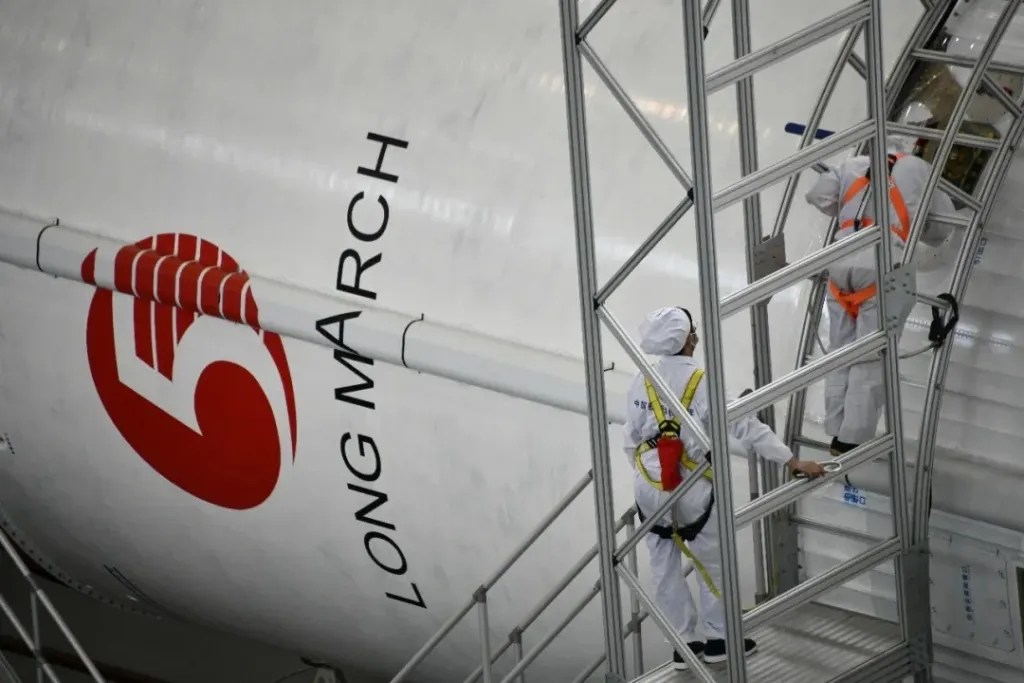
On Hainan Province –China –People’s Republic of China…. in the district area of the Wenchang – Wenchang Spacecraft launch center in which the awesome team at one of many CNSA –China National Space Administration  that China National Space Administration…………… On May 29th 2022 The Chang Zheng- Long March 5B Yao three carrier rocket arrived at Wenchang Space Launch Site safely] According to the China Manned Space Engineering Office, the Long March 5B Yaosan carrier rocket that carried out the launch mission of the Wentian experimental module has completed all the research and development work before leaving the factory.

Arrived safely at Wenchang Space Launch Site on after that, Chang Zheng- Long March 5B Yao three carrier rocket will carry out the final assembly and test work at the launch site together with the Wentian experimental module that arrived earlier. At present, each participating system in the launch site area is carrying out mission preparations as planned….  

According to the China Manned Space Engineering Office, Chang Zheng- Long March 5B Yao three carrier rocket that carried out the launch mission of the Wentian experimental module has completed all the research and development before leaving the factory.

The work will be safely delivered to Wenchang Space Launch Site on May 29, 2022. After that, the Long March 5B Yaosan carrier rocket will carry out the final assembly and test work at the launch site together with the Wentian experimental module that arrived earlier.

中国空间站 On currently on May 2022, the Belt and Road Initiative CNSA –China National Space Administration  the two extensions modules of Tiangong China Space Station are now ready and verify certified in which forms the right and left parts of the Tiangong China Space Station in which completion of the China Space Station is expected to finalised its construction in the late 2022 year.. 

On the 24th May 2022 on the Earliest Morning the components of the Chang Zheng – Long March 5B Carrier Rocket has arrived at the Wechang Qinglan Port in Hainan Province – China – People’s Republic of China.. of the Chang Zheng –Long March Carrier Rocket Cargo ship of Yuanwang 21 and Yuanwang 22… in which it was previously left from Tianjin….

It was on at about 8:00 a.m. on 19th May 2022, Beijing time, two rocket carriers, Yuanwang 21 and Yuanwang 22, set sail from Tianjin Port, targeting Hainan Wenchang Qinglan Port, and are expected to arrive on the 24th.

Chang Zheng –Long March Carrier Rocket Cargo ship Yuanwang 21 and Yuanwang 22 transporting the Long March 5B Yao 3 carrier rocket are being loaded in Tianjin Port Yuanwang 21 entered the inner berth of Tianjin Port on 14th  May  2022  to load the rocket transport container, and completed loading and evacuated on 16th  May 2022  After leaving the berth, Yuanwang 22 then entered the berth to load the remaining containers, which are expected to be fully loaded by tomorrow morning.

Previously As of May 2022 both The experimental cabin is progressing smoothly, waiting for the launch The Wentian experimental cabin to be launched in July is ready for finally and the Mengtian experimental cabin is also making corresponding preparations.

After the construction of the China Space Station is completed, the two experimental cabins will be the main working places for astronauts in orbit. In both experimental cabins, space science experiments and technical experiments in the sealed cabin and outside the sealed cabin can be carried out. Both cabins are equipped with The load test cabinet inside the cabin and the load installation platform outside the cabin also provide support and guarantee measures such as information, power supply and heat dissipation, and can carry out experiments in various fields such as space science, space materials, space medicine and space exploration.


  The Wentian experimental module is equipped with the same Taikonauts’ living facilities as the core module, including 3 sleeping areas, 1 sanitary area, kitchen and other facilities, which can guarantee the astronauts’ life. It can also work with the core module to support the life of 6 astronauts during the rotation of the two manned spacecraft; in addition, a small robotic arm is also configured, which can be used alone or in combination with the large robotic arm of the core module. , to jointly complete the tasks of Taikonauts leaving the cabin, caring for extravehicular facilities, and patrolling. In addition, the Wentian experimental cabin is also equipped with an astronaut exit airlock. After the space station is completed, the airlock of the Wentian experimental cabin will be As the main airlock cabin for astronauts to leave the cabin, the node cabin of the core cabin is used for other functions at this time, just as a backup; the Wentian experimental cabin also has a backup section for the core cabin to manage and control the assembly. That is to say, when the function of the core module platform fails, it can be switched to the Wentian experimental module to exercise the combined control and management functions, which can improve the reliability of the space station as a whole.


  The Mengtian experimental cabin is equipped with a cargo airlock and an outboard deployment test platform. In the future, the scientific test equipment that needs to be installed outside the cabin can be transported to the space station through a cargo spacecraft, and then the load will be sent to the outside of the cabin through the cargo airlock, and the robotic arm or astronaut will install it on the platform outside the cabin. Realize the continuous update of the extravehicular test project.

Images and visuals are from their respectives.

#CNSA #ChinaNationalSpaceAdministration #國家航天局 |#BeltAndRoadinitiative #March2021 | International Iconic #CarrierRocket #LongMarch5B #ChangZheng5B engine testing before assembly launch of the are getting ready for the #CMS #ChinaMannedSpaceflight #CSS #ChinaSpaceStation #SpaceStationConstruction…..


On 28th February 2021 Sunday on a nearby Rocket engine testing facilities nearby the VAB – Vertical Assembly building of the CNSA – China National Space Administration– Wenchang Space Craft launch Center – Hainan Province – China – People’s Republic of China…  The Long March 5B launch vehicle high thrust hydrogen oxygen engine completed a 520-second test run to further verify the optimized engine performance to ensure China the launch mission of the core module of the space station went smoothly. It is reported that this spring, my country will launch the Tianhe core module with the Long March 5B Carrier Rocket …..

This round of test runs is to further verify the optimized engine performance to ensure that the mission of the Long March 5B Yao-2 carrier rocket launching the core module of the space station is on schedule..

With the High-thrust hydrogen-oxygen engine completed 520-second long-distance test run On February 28th 2021……..  the  high-thrust hydrogen-oxygen engine completed a 520-second long-distance test run in Yungang, Beijing. This is the fifth long-distance test run of the engine successfully. The cumulative test duration of the same engine reached 2520 seconds, which greatly improved the reliability of the high-thrust hydrogen-oxygen engine.


In the future, the engine will undergo three long-distance test runs of 500 seconds, and the cumulative test run time will reach about 4000 seconds by then, further verifying the reliability of the high-thrust hydrogen-oxygen engine……

Previously on 2021 January there’s three types of Long March-Chang Zheng Carrier Rocket series in its final stages of assembly in which is undertaking one of the construction of the CNSA –China National Space Administration CMS China Manned Spaceflight Belt and Road Initiative CSS China Space Station in which will core module be launched on during this year 2021 spring launch calendar ….

In which there are three series  Long March rocket undertaking the mission of the China Space Station will debut again 中国空间站 Core module will be launched next spring China Academy of Launch Vehicle Technology is responsible for the development of the Long March 2F, Long March 7 and Long March 5B launch vehicles………  According to the plan, the Long March 2F, Long March 7 and long March 5B three-type carrier rockets will respectively undertake the launch missions of manned spacecraft, cargo spacecraft and the core cabin of the space station. During the festival, the final assembly test of the Type III rocket is being carried out in an orderly manner in Beijing and Tianjin.

The Long March 2 F Yao 13 carrier rocket is undergoing testing in the final assembly plant. The test team has established a “chief command” system to coordinate and guarantee resources to ensure close cohesion and orderly progress. This type of rocket plans to complete the final assembly test after the Spring Festival.

The Long March 7 Yaosan launch vehicle is undergoing final assembly. The model team strictly follows the requirements of refined final assembly to ensure that all operations and tests are done correctly and well at a time. At present, the rocket final assembly is progressing smoothly.

In the Tianjin General Assembly Test Plant, the Long March 5B Yao-2 launch vehicle has just completed its test, and the model team is preparing for the rocket’s work before it leaves the factory to ensure that the rocket is shipped to the launch site as planned…..

Images and visuals are from Weibo.

#CNSA #ChinaNationalSpaceAdministration #國家航天局 |#BeltAndRoadinitiative #January2021 |#火星 # 天問 #天问一号 #LongMarch5 #ChangZheng5 #TianwenOne #MarsMission #Marslander #MarsRover #MarsProbe does a course correction early January heading towards the #UtopiaPlanitia #Mars For collaborative exploration..


天问一号飞運騎遊達达3亿 …….As of the early morning January 3rd 2021, CNSA – China National Space Administration- ESA – European Space agency Belt and road initiative mars mission…first Mars exploration mission, Tianwen- Martian Probe One …… The Tianwen-1’s flight mileage exceeded 400 million kilometers….. As of 6:00 on January 3, the Tianwen-1 probe has been in orbit for 163 earth days, with a flight mileage of over 400 million kilometers, about 130 million kilometers from the earth, and about 8.3 million kilometers. The probe has a stable attitude. According to the plan, it will implement near-fire braking in more than a month, enter the ring-fire orbit, and prepare to land on Mars.

The Tianwen-1 mission is the first step in China- People’s Republic of China independent interplanetary exploration. It will “circle, land, and patrol” Mars through a single launch, that is, Mars orbit, Mars landing, and fire patrol. The Tianwen-1 probe has a total weight of about 5 tons and is composed of an orbiter and a landing patrol device. The landing patrol device mainly includes an entry module and a Mars rover. At present, the orbiter has completed the third on-orbit self-check, and all systems are working normally…..

截至2021年1月3日6时,天问一号探测器已在轨飞行163天,飞行里程突破4亿公里,距离地球约1.3亿公里,距离火星约830万公里,飞行状态良好。按计划将在一个多月后实施近火制动,进入环火轨道。

天问一号任务是我国独立开展行星际探测的第一步,旨在通过一次发射实现对火星的“绕、着、巡”,即火星环绕、火星着陆、火面巡视。天问一号探测器总重约5吨,由环绕器和着陆巡视器组成,着陆巡视器主要包括进入舱和火星车。目前,环绕器已完成第三次在轨自检,各系统工作正常。

探月逐火共奋进,追梦求真向天行。行星探测“天问工程”是月球探测“嫦娥工程”的再发展,是中国人探索宇宙星辰征程的再延伸。中国深空探测事业一步一个脚印,一棒接力一棒,继承与创新并举,稳妥与挑战兼具。现在,探月工程“绕、落、回”三步走发展规划圆满收官,天问一号正在抵近火星,带着中国人民的期愿飞向这颗神秘的红色星球。

天问一号飞運騎遊達达3亿 …….As of the early morning Monday of 14th December, 2020, CNSA – China National Space Administration- ESA – European Space agency Belt and road initiative mars mission…first Mars exploration mission, Tianwen-1 …….Tianwen-1 probe is more than 100 million kilometers away from the earth] It is learned from the National Space Administration that as of 21:00 Hong Kong – Beijing Time on December 14, the Tianwen-1 probe has been in orbit for 144 days, with a flight mileage of approximately 360 million kilometers, and is far from the earth. Over 100 million kilometers, about 12 million kilometers away from Mars, the flight is in good condition. Affected by the laws of movement of celestial bodies, the distance between Mars and the Earth varies periodically from 50 million kilometers to more than 400 million kilometers. When the Tianwen-1 rover arrived near Mars, it was about 190 million kilometers away from Earth. Since the launch of Tianwen 1 on July 23, it has successfully completed a group photo of the earth and the moon, “Selfie” of the probe, three midway corrections, a deep-space manoeuvre, and payload self-check. In the follow-up, several orbit corrections will be carried out. It is expected that after approaching Mars in mid-February next year, “brake” braking will be implemented to enter the ring fire orbit in preparation for Mars landing. (杨璐戚铁磊) #Tianwen 1 probe is more than 100 million kilometers away from the earth 我们的空间…… In the follow-up, Tianwen-1 will conduct several orbit corrections. It is expected to “brake” after approaching Mars in February next year and implement braking into the ring fire orbit.

The hometown is far away and the goal is getting closer. 100 million kilometers is equivalent to 2,499 the length of the earth’s equator. Now, Tianwen-1 is flying to Mars at a ground speed of 17.4 kilometers per second…….

 Previously………天问一号飞運騎遊達达3亿 …….As of the previously morning Tuesday of November 17th, 2020, CNSA – China National Space Administration- ESA – European Space agency Belt and road initiative mars mission…first Mars exploration mission, Tianwen-1, has been in orbit for 116 days, with a flight mileage of more than 300 million kilometers. The earth is approximately 63.8 million kilometers. The detector’s attitude is stable, the energy is balanced, some sub-systems have completed self-checking, and each system is working normally.

During its orbital flight, Tianwen-1 has completed three midway corrections and one deep-space manoeuvre and other flight control tasks. In early November, the landing patrol vehicle entry module and multiple sub-systems of the Mars rover completed the first on-orbit self-check, and the results were normal.

Tianwen-1 is scheduled to reach Mars in February 2021 and carry out Mars capture. In May 2021, it will choose an opportunity to de-orbit, and the landing patrol will be separated from the orbiter, soft landing on the surface of Mars, the rover will leave the landing platform, and the inspection will be carried out…. For the Martian exploration..

Previously On the 9th October 2020 Friday 2300 hours Beijing time CNSA – China National Space Administration that under the control of the flight control team of China’s first Mars exploration mission, the main engine of the Tianwen-1 probe was ignited. In more than 480 seconds, the deep space manoeuvre was successfully completed. The orbital manoeuvre was carried out in deep space approximately 29.4 million kilometers from the earth. The orbit design of Tianwen-1 comprehensively considered various constraints from launch to Mars capture and made the propellant consumption as small as possible, and adopted the strategy of a deep space manoeuvre during the transfer process. The probe will rendezvous with Mars about 4 months after its current orbit, during which two or three midway corrections will be implemented……

Previous the last course correction … during On October 1st 2020, as China- People’s Republic of China also throughout the Chinese also the Asian Communities celebrates the National Day and Mid-Autumn Festival; CNSA China National Space Administration released China’s first Mars exploration mission Tianwen-1 exploration….. The image of the CNSA Belt and Road Initiative European Space Agency collaboration Martian Probe flying, the five-star red flag on the picture is dazzling, showing a bright Chinese red. This is the first deep space self-portrait of our country 天问一号 Martian probe. In the vast universe, the silver landing patrol device and the golden orbiter are shining brightly. Tianwen No.1 uses this to report safety to China and express birthday wishes.

As we all know, when taking selfies on the ground, you can use auxiliary tools such as selfie sticks to shoot after choosing the angle, light and shadow, but the selfie of “Tianwen No. 1” is not that simple. Due to its large size, if the selfie stick strategy is adopted, “Tianwen No.1” needs to use a 15-meter-long selfie stick to achieve a full-view selfie, which not only consumes resources, but is also prone to safety risks. For this reason, the Mars Orbiter Engineering Survey Sub-system Team of the Eighth Academy of Sciences proposed a “separated monitoring plan”, which is to “throw out” a light camera under suitable lighting conditions to take pictures of “Tianwen No. 1” and transmit the images in real time. Go back to the “Tianwen No. 1” probe.

Have you seen a one-time dual-head super wifi camera?………In order to successfully implement the separate monitoring program, the Eighth Academy Mars Orbiter Engineering Measurement Sub-system team needs a little guy who can “divide, shoot clearly, pass back, and hold on”: use a small, small, low-impact unlocking separation device The camera can be “divided out”; the use of colour imaging, the configuration of 800×600, 1600X1200 two-level resolution camera allows the image to be “clearly captured”; the use of super Wi-Fi communication that can achieve 400 meters of wireless communication allows data “Passed back”; the use of disposable batteries that can provide power for longer than 1 hour allows the camera to “hold on”, allowing the ground to see the full picture of the “Tianwen No. 1” rushing to the fire.

Considering that the camera may turn over as it gradually moves away from the detector, the development team designed the camera as a dual-headed front and back to ensure that the camera can capture as many detector images as possible during the turning process. After four years of research and development, this little guy weighing about 950g successfully carried the “Tianwen-1” Mars probe into space, and successfully separated the head weighing about 680g, and obtained a clear image. Successfully completed the overall visual monitoring task of “Tianwen No. 1”

The name “Tianwen”: 天問 ….. Comes from the long poem of the same name written by Qu Yuan (about 340–278 BC), one of the greatest poets of Ancient China. It is a poem of a series of questions starting with how the universe was created.

Images and visuals are from Weibo

#CNSA #ChinaNationalSpaceAdministration #国家航天局 |#BeltAndRoadinitiative #December2020 | #WenchangSpacecraftLaunchCenter #文昌航天發射場 #嫦娥五号The #Moon #Change5 probe successfully maneuvering #Change5 #LunaOrbiter in position to return to Planet Earth.- China. Finishing its #MonsRumker #LunaExploration collecting Lunar Samples ……


On 12th December 2020 morning Hong Kong -Beijing Saturday, the Beijing flight control team of the CNSA China National Space AdministrationCLEP- China Lunar Exploration Program Belt and Road Initiative Mons Rumker Luna Mission  during  at that time stamp at 9:54 morning Hong Kong –Beijing time on December 12th 2020…., the Chang’e-5 orbiter and returner combination experienced about 6 days of waiting around the moon, and implemented the first lunar-to-ground transfer incident, changing from a near-circular orbit to a near-moon height An elliptical orbit of about 200 kilometers. The main purpose of the lunar-to-earth transfer and incidence is to move the orbital maneuver on the lunar orbit to make the orbiter and returner assembly enter the lunar-to-earth transfer orbit.

Later, the orbiter and returner assembly carrying the lunar sample will choose the opportunity to implement the second lunar-to-earth transfer incident, so as to get rid of the lunar gravity, enter the lunar-earth transfer orbit and return to the earth.

The engine is turned on and the orbital control begins” “According to the Beijing real-time data monitoring and judgment, the Chang’e-5 orbiter combination has the first lunar-ground incident control, normal and finished, and the follow-up work will fly as normal Implementation of the control planning to returning back to earth in which is expected to land at the Inner Mongolia …..

嫦娥五号轨道器和返回器组合体实施第一次月地转移入射

​​ 12月12日9时54分,嫦娥五号轨道器和返回器组合体经历了约6天的环月等待,实施了第一次月地转移入射,从近圆形轨道变为近月点高度约200公里的椭圆轨道。月地转移入射的主要目的是通过月球轨道上的轨道机动,使轨道器和返回器组合体进入月地转移轨道。

后续,携带月球样品的轨道器和返回器组合体将择机实施第二次月地转移入射,从而摆脱月球引力,进入月地转移轨道返回地球。

On 8th December 2020 morning Hong Kong -Beijing Wednesday, the Beijing flight control team of the China National Space Administration- CLEP- China Lunar Exploration Program Belt and Road Initiative Mons Rumker Luna Mission ….At 6:59 on December 8, the Chang’e-5 ascender was controlled off-orbit according to ground instructions, and landed at the scheduled landing point near 0 degrees longitude of the lunar surface and 30 degrees south latitude at about 7:30.

Previously, the Chang’e-5 ascender achieved the first take-off of an extraterrestrial celestial body in my country. It rendezvoused and docked with the orbital return assembly in a predetermined orbit, completed the transfer of lunar samples, and was separated from the orbital return assembly smoothly at 12 o’clock on December 6. Experts from the National Space Administration’s Lunar Exploration and Space Engineering Center said that the Chang’e-5 ascender has successfully completed its mission. The controlled deorbiting and landing of the moon can prevent it from becoming space junk and avoid affecting the international community’s subsequent lunar exploration missions. This is China’s responsibility also an important commitment of major powers to the peaceful exploration and use of space by mankind…..

完成使命——嫦娥五号上升器受控撞月

12月8日6时59分,嫦娥五号上升器按照地面指令受控离轨,7时30分左右降落在月面经度0度、南纬30度附近的预定落点

此前,嫦娥五号上升器实现我国首次地外天体起飞,在预定轨道与轨返组合体交会对接,完成月球样本转移,并于12月6日12时许与轨返组合体顺利在轨分离。国家航天局探月与航天工程中心专家表示,嫦娥五号上升器已圆满完成使命,受控离轨落月可避免其成为太空垃圾,避免影响国际社会后续月球探测任务,这是中国作为负责任大国对人类和平探索利用太空的重要承诺。

Previously.. On 6th December 2020 Afternoon Hong Kong -Beijing lunch time Sunday, the Beijing flight control team of the China National Space Administration- CLEP- China Lunar Exploration Program Belt and Road Initiative Mons Rumker Luna Mission – December 6th 2020- Sunday Separate again, choose an opportunity to return-Chang’e-5 docking complex separates smoothly….At 12:35 Hong Kong – Beijing Time on December 6th 2020 , the Chang’e-5 orbital return assembly was successfully separated from the ascender and entered the waiting phase of the moon, and it will return to the earth at an opportunity.

再次分离,择机返回——嫦娥五号对接组合体顺利分离

12月6日12时35分,嫦娥五号轨返组合体与上升器成功分离,进入环月等待阶段,将择机返回地球。

Previously On 6th December 2020 Sunday, the Beijing flight control team of the China National Space Administration- CLEP- China Lunar Exploration Program Belt and Road Initiative Mons Rumker Luna Mission – December 6th 2020- Sunday, the Chang’e-5 ascender successfully rendezvous and docked with the orbiter and returner assembly, and the sample container was safely transferred to the returner at 6:12 Morning Hong Kong – Beijing Time. This is the first time that my country has realized lunar orbital rendezvous and docking.

From the moment the ascender enters the orbit around the moon, through long-range guidance and short-range autonomous control, the orbiter and returner assembly gradually approach the ascender, capture the ascender by claws, and complete the rendezvous and docking….. In which the Chang’e-5 ascender successfully rendezvous and docked with the orbiter and returner assembly, and the sample container was safely transferred to the returner at 6:12. This is China’s first lunar orbital rendezvous and docking……..  In the future, the Chang’e-5 orbiter and returner combination will be separated from the ascender and return to Earth at the right time.

In the future, the Chang’e-5 orbiter and returner combination will be separated from the ascender and return to Earth at the right time.

12月6日5时42分,嫦娥五号上升器成功与轨道器和返回器组合体交会对接,并于6时12分将样品容器安全转移至返回器中。这是我国首次实现月球轨道交会对接。

从上升器进入环月飞行轨道开始,通过远程导引和近程自主控制,轨道器和返回器组合体逐步靠近上升器,以抱爪的方式捕获上升器,完成交会对接。

后续,嫦娥五号轨道器和返回器组合体将与上升器分离,择机返回地球。

Previously On 3rd December 2020 Thursday, the Beijing flight control team of the China National Space Administration- CLEP- China Lunar Exploration Program Belt and Road Initiative Mons Rumker Luna Mission – At 23:10 Hong Kong Beijing time on December 3rd Thursday 2020, the 3000N engine of the Chang’e-5 ascender worked for about 6 minutes and successfully sent the ascender carrying the sample to the scheduled orbit around the moon. This is the first time that my country has realized the take-off of an extraterrestrial body.

Unlike ground take-off, the Chang’e-5 ascender does not have a mature launch tower system for lunar take-off. The lander is equivalent to the “temporary tower” of the ascender. The plume diversion space is limited and the earth-moon environment is different; in addition, because there is no navigation constellation on the moon, after the ascender takes off, it needs to use its own special sensors to realize autonomous positioning and attitude determination with the help of ground measurement and control.

Before taking off, the upper assembly is used to realize the deployment of the lunar flag and the unlocking and separation of the ascender and the lander. This national flag deployment is the first time that my country has achieved an “independent display” of the national flag on the surface of the moon. In the photo, the national flag in the hands of “Chang’e” is shining in the sun, and the “Chinese red” on the moon is particularly bright. After igniting take-off, the ascender undergoes three stages of vertical ascent, attitude adjustment and orbit injection, and enters the scheduled orbit around the moon. Subsequently, the ascender will rendezvous and dock with the orbital assembly waiting around the moon and transfer the lunar sample to the returner, which will wait for a suitable lunar-earth entrance window to prepare for its return to Earth.

飞离月球——嫦娥五号上升器进入预定轨道 实现我国首次地外天体起飞

12月3日23时10分,嫦娥五号上升器3000N发动机工作约6分钟,成功将携带样品的上升器送入到预定环月轨道。这是我国首次实现地外天体起飞。

与地面起飞不同,嫦娥五号上升器月面起飞不具备成熟的发射塔架系统,着陆器相当于上升器的“临时塔架”,上升器起飞面临起飞初始基准与起飞平台姿态不确定、发动机羽流导流空间受限、地月环境差异等挑战;另外由于月球上没有导航星座,上升器起飞后,需在地面测控辅助下,借助自身携带的特殊敏感器实现自主定位、定姿。

点火起飞前,着上组合体实现月面国旗展开以及上升器、着陆器的解锁分离。此次国旗展开是我国在月球表面首次实现国旗的“独立展示”,照片中“嫦娥”手中的国旗在阳光的照耀下,月球上的一抹“中国红”格外鲜艳。点火起飞后,上升器经历垂直上升、姿态调整和轨道射入三个阶段,进入预定环月飞行轨道。随后,上升器将与环月等待的轨返组合体交会对接,将月球样品转移到返回器,后者将等待合适的月地入射窗口,做好返回地球的准备。

On 6th December 2020 Sunday, the Beijing flight control team of the China National Space Administration- CLEP- China Lunar Exploration Program Belt and Road Initiative Mons Rumker Luna Mission – December 6th 2020- Sunday, the Chang’e-5 ascender successfully rendezvous and docked with the orbiter and returner assembly, and the sample container was safely transferred to the returner at 6:12 Morning Hong Kong – Beijing Time. This is the first time that my country has realized lunar orbital rendezvous and docking.

From the moment the ascender enters the orbit around the moon, through long-range guidance and short-range autonomous control, the orbiter and returner assembly gradually approach the ascender, capture the ascender by claws, and complete the rendezvous and docking….. In which the Chang’e-5 ascender successfully rendezvous and docked with the orbiter and returner assembly, and the sample container was safely transferred to the returner at 6:12. This is China’s first lunar orbital rendezvous and docking……..  In the future, the Chang’e-5 orbiter and returner combination will be separated from the ascender and return to Earth at the right time.

In the future, the Chang’e-5 orbiter and returner combination will be separated from the ascender and return to Earth at the right time.

12月6日5时42分,嫦娥五号上升器成功与轨道器和返回器组合体交会对接,并于6时12分将样品容器安全转移至返回器中。这是我国首次实现月球轨道交会对接。

从上升器进入环月飞行轨道开始,通过远程导引和近程自主控制,轨道器和返回器组合体逐步靠近上升器,以抱爪的方式捕获上升器,完成交会对接。

后续,嫦娥五号轨道器和返回器组合体将与上升器分离,择机返回地球。

Previously On 3rd December 2020 Thursday, the Beijing flight control team of the China National Space Administration- CLEP- China Lunar Exploration Program Belt and Road Initiative Mons Rumker Luna Mission – At 23:10 Hong Kong Beijing time on December 3rd Thursday 2020, the 3000N engine of the Chang’e-5 ascender worked for about 6 minutes and successfully sent the ascender carrying the sample to the scheduled orbit around the moon. This is the first time that my country has realized the take-off of an extraterrestrial body.

Unlike ground take-off, the Chang’e-5 ascender does not have a mature launch tower system for lunar take-off. The lander is equivalent to the “temporary tower” of the ascender. The plume diversion space is limited and the earth-moon environment is different; in addition, because there is no navigation constellation on the moon, after the ascender takes off, it needs to use its own special sensors to realize autonomous positioning and attitude determination with the help of ground measurement and control.

Before taking off, the upper assembly is used to realize the deployment of the lunar flag and the unlocking and separation of the ascender and the lander. This national flag deployment is the first time that my country has achieved an “independent display” of the national flag on the surface of the moon. In the photo, the national flag in the hands of “Chang’e” is shining in the sun, and the “Chinese red” on the moon is particularly bright. After igniting take-off, the ascender undergoes three stages of vertical ascent, attitude adjustment and orbit injection, and enters the scheduled orbit around the moon. Subsequently, the ascender will rendezvous and dock with the orbital assembly waiting around the moon and transfer the lunar sample to the returner, which will wait for a suitable lunar-earth entrance window to prepare for its return to Earth.

飞离月球——嫦娥五号上升器进入预定轨道 实现我国首次地外天体起飞

12月3日23时10分,嫦娥五号上升器3000N发动机工作约6分钟,成功将携带样品的上升器送入到预定环月轨道。这是我国首次实现地外天体起飞。

与地面起飞不同,嫦娥五号上升器月面起飞不具备成熟的发射塔架系统,着陆器相当于上升器的“临时塔架”,上升器起飞面临起飞初始基准与起飞平台姿态不确定、发动机羽流导流空间受限、地月环境差异等挑战;另外由于月球上没有导航星座,上升器起飞后,需在地面测控辅助下,借助自身携带的特殊敏感器实现自主定位、定姿。

点火起飞前,着上组合体实现月面国旗展开以及上升器、着陆器的解锁分离。此次国旗展开是我国在月球表面首次实现国旗的“独立展示”,照片中“嫦娥”手中的国旗在阳光的照耀下,月球上的一抹“中国红”格外鲜艳。点火起飞后,上升器经历垂直上升、姿态调整和轨道射入三个阶段,进入预定环月飞行轨道。随后,上升器将与环月等待的轨返组合体交会对接,将月球样品转移到返回器,后者将等待合适的月地入射窗口,做好返回地球的准备。

Images and visuals are from Weibo