中国空间站 On 8th November 2021 Hong Kong SAR – Beijing Time morning, the Belt and Road InitiativeCNSA –China National Space Administration CSS China Space Station in which on a three to six months setting up a new home of the first three Shenzhou 13 in which spending up to on for the further construction and verifications of the systems of the CSS –China Space Station 2021 launch calendar in which currently the three Takionauts current Shenzhou 13 …… Preparations for the six months of extension of the China Space Station In which the currently it remains awaiting for the crew of setting up home in conducting fun scientifically onboard中国空间站.. China Space station …..
On today is the 5th December 2021 in which the occasion of the 36th International Volunteer Day, the Shenzhou 13 flight crew is on a mission at the Chinese Space Station, In the form of video, to extend holiday blessings to the majority of young volunteers…..
Hello Young Volunteers.. We’re the Shenzhou 13 Crew…
I am Zhai Zhigang- I am Wang Yaping- I am Ye Guangfu – December 5th is international Volunteer Day, Here, in China’s Space Station we send our greetings to young volunteers from space “ Happy International Volunteer Day”
In recent years a lot of Chinese Young Volunteers serve China’s overall situation, serve the people and devote their young passions to areas such as pandemic prevention, poverty alleviation, rural revitalisation community development and emergency rescue which shows their ideal faith kindness and great sense of responsibility and has compost the song for young volunteers in the New Era ..
Put Volunteerism into action and devote to the New Era, Let’s carry forward the volunteerism of “Dedication, Friendship, Mutual _ Help and progress” and be a striver who combines knowledge with practice insist on keeping pace with our Motherland and serving the people and make great contribution to realize the Chinese Dream with young dreams and practical actions
Images and visuals are from Weibo also their respectives.
As of Month of December 2021, The CNSA –China National Space AdministrationCLEP- China Lunar Exploration Program Belt and Road Initiative Lunar Mission……Chang’e-4 with Yutu two the Lunar rover still working exploring more than 839.37 meters on the other side of the moon on the 103 Kilometers Diameter Von Karman Crater in which is least than two length by length fifty five Kilometers Hong Kong –Macau- Zhuhai Bridges …. Working Exploring the Crater on the other side of the Moon Chang’e Luna….
Recently, the National Space Science Center, Chinese Academy of Space Weather Liu Yang State Key Laboratory researcher team, joint University of Hawaii, Macau University of Science and Technology, Peking University and Hong Kong Polytechnic University and other domestic and foreign partners to acquire based on Chang E IV Patroller has Ultra-high spatial resolution imagery and spectral data have identified carbonaceous chondrite impactor residues that are less than one million years old in situ on the lunar surface for the first time. The research results are titled “Impact remnants rich in carbonaceous chondrites detected on the Moonby the Chang’e-4 rover” and published in “Nature- Astronomy.
On the ninth day of Chang’e 4 on the far side of the moon, the Yutu-2 lunar rover “ran into” a fresh impact crater with a size of 2 meters, and carried out detailed spectral detection of the impact crater (Figure 1). The detailed analysis of the hyperspectral image data obtained by the imaging spectrometer found that the spectra of the suspected “residue” in the center of the impact crater and the typical lunar soil and rock fragments inside and outside the crater show significantly different characteristics, which are similar to the spectrum of carbonaceous meteorites. Very high degree of similarity. Quantitative inversion results of the spectrum based on the radiation transfer model showed that the mass ratio of the carbonaceous meteorite in the residue reached more than 40%. The results of the numerical simulation of the impact crater show that a 15cm diameter loose impactor hitting the lunar surface at a speed of 15km/s (the typical impactor speed of the lunar surface) can form the small impact crater morphology observed above. And there are residues distributed in the center of the impact crater.
The study of impact residues will provide an important reference for the origin of lunar water and the evolution history of the composition and type of impact bodies in the Earth-Moon system. It is also expected to further constrain the evolution of the solar system’s orbital dynamics and enhance our understanding of the impact history of the inner solar system.
Studies have shown that the impact of carbonaceous asteroids rich in volatile matter may still provide water for the current moon, and it is believed that carbonaceous asteroids may be a common type of impactor in the current Earth-Moon system, supporting the type of impactor in the inner solar system from early The main change from ordinary chondrites to later carbonaceous chondrites. By analyzing possible impactor residues in the young moon samples of Chang’e-5, further scientific verification can be carried out.
Source: Researcher Liu Yang’s team at the State Key Laboratory of Space Weather, National Space Science Center, Chinese Academy of Sciences
中国空间站 On 8th November 2021 Hong Kong SAR – Beijing Time morning, the Belt and Road InitiativeCNSA –China National Space Administration CSS China Space Station in which on a three to six months setting up a new home of the first three Shenzhou 13 in which spending up to on for the further construction and verifications of the systems of the CSS –China Space Station 2021 launch calendar in which currently the three Takionauts current Shenzhou 13 …… Preparations for the six months of extension of the China Space Station In which the currently it remains awaiting for the crew of setting up home in conducting fun scientifically onboard中国空间站.. China Space station …..
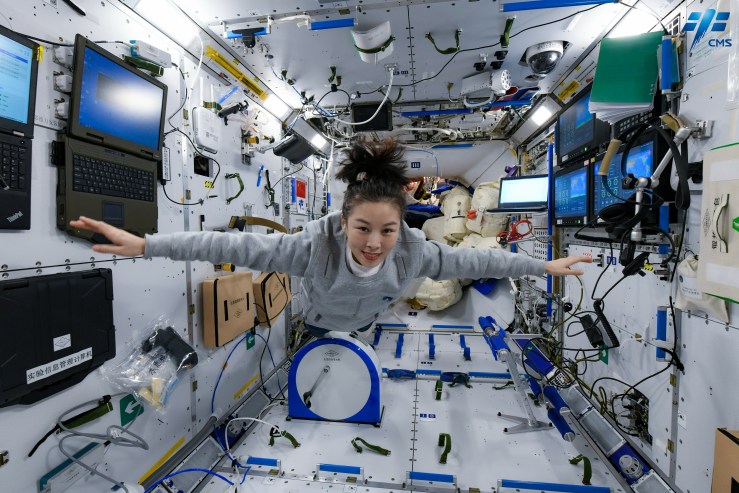
During Day of the 24th November 2021, Wednesday Official release by China Manned Space Engineering Office Shenzhou 13 crew member Takionaut王亞平 Wang Yaping in CNSA –China Space Station in which during the one month of six month duration onboard preparations of expansion of the China Space Station components modules in which are coming up. Wang Yaping’s on-orbit photos are here in which during that day early morning washing her hair by chemically with shampoo and conditioner by rubbing the shampoo and conditioner onto her hair washing it without the need for water to rinsing it, she goes to her cabin in finding a beanie to dry and soak an water residual left..
As Takionaut Wang Yaping hair was dry enough she get her hair cut, or trimmed by her Crew like how she help cutting her fellow crew Ye Guangfu the last few weeks ago. . both Zhai Zhi and Ye Guangfu helps with the barbering one cuts one has a vacuum to suck in the trimmed hairs into the Vacuum cleaner.. Once done Wang Yaping checks for the right style of cut agreeable in which tying her hair in a ponytail style then posing for Photographing of Wang Yaping on the space station. The photographers are Zhai Zhigang and Ye Guangfu from the 13th crew of the Shenzhou 13 The teacher may look cute lovely Takionaut Wang Yaping, Photography by Zhai Zhigang and Ye Guangfu shot from under different situations in the core module of the Tianhe Core Module as they spend some relaxing time experimenting with different asspects of photography equipment..
Images and visuals are from Weibo also their respectives.
中国空间站 On 8th November 2021 Hong Kong SAR – Beijing Time morning, the Belt and Road InitiativeCNSA –China National Space Administration CSS China Space Station in which on a three to six months setting up a new home of the first three Shenzhou 13 in which spending up to on for the further construction and verifications of the systems of the CSS –China Space Station 2021 launch calendar in which currently the three Takionauts current Shenzhou 13 …… Preparations for the six months of extension of the China Space Station In which the currently it remains awaiting for the crew of setting up home in conducting fun scientifically onboard中国空间站.. China Space station …..
Today on the 24th November 2021, Wednesday Official release by China Manned Space Engineering Office Shenzhou 13 crew member Takionaut王亞平 Wang Yaping in CNSA –China Space Station in which during the one month of six month duration onboard preparations of expansion of the China Space Station components modules in which are coming up. Wang Yaping’s on-orbit photos are here! In just over a month, Wang Yaping not only completed all kinds of in-orbit work as planned, but also became China’s first female astronaut out of the cabin. Today, Zhai Zhigang and Ye Guangfu officially released the in-orbit photos taken by Mr. Yaping!
Today, the China Manned Space Engineering Office officially released the photos of Wang Yaping on the space station. The photographers are Zhai Zhigang and Ye Guangfu from the 13th crew of the Shenzhou 13 The teacher may look cute lovely Takionaut Wang Yaping, Photography by Zhai Zhigang and Ye Guangfu shot from under different situations in the core module of the Tianhe Core Module as they spend some relaxing time experimenting with different asspects of photography equipment..
Images and visuals are from Weibo also their respectives.
One year ago today 24th November 2020 Now it’s the 24th November 2021 , the Chang Zheng – Long March Five Carrier Rocket Launched away in CNSA – China National Space Administration China Wenchang spaceport launch, Change Five Lunar probe into orbit, opened up towards China – People’s Republic of China’s first celestial bodies sample return trip from Mons Rumker on the Lunar Surface.……
Highlight 1: Narrow window launch The launch window is the ignition time period for the launch vehicle to meet the needs of the transfer to the moon. Due to the typhoon and strong tropical cyclone in Wenchang area, high-altitude wind, heavy rainfall, thunderstorms and other meteorological conditions are very complicated, it can be imagined. The narrower the window, the greater the risk of launching large cryogenic launch vehicles. There are many factors that determine the launch window, such as the relative position of the launch site and the target point, the safe landing zone of the rocket wreckage, the time of sunlight after the launch probe (satellite) enters orbit, the measurement and control arc, the lunar landing zone, and the lunar take-off time , Re-entry return time, etc. The more the launch constraint conditions, the narrower the launch window. In order to ensure the reliable implementation of the Chang’e-5 mission, it is necessary to solve the design difficulties of the multi-orbit moon launch scheme under the constraints of the range of launch, the safety of the landing zone, the measurement and control of the ascent section, and the rocket taxi time.
Aspect 2: During the two-stage taxiing process of the accurate low-temperature launch vehicle in the landing zone of the rocket, the quality of the propellant will decline with the passage of time, so the longer the taxiing time, the more unfavourable the startup of the low-temperature power system. For this reason, the rocket system has carried out a large number of ground tests, and the three flights of the Long March 5 have fully evaluated and verified the long sliding ability of the model. The rocket area of the Chang’e-5 mission must fly over the Philippine Islands. The booster landing area is located west of the Philippines, the fairing landing area is located east of the Philippines, and the core landing area is located in the Pacific Ocean. Multi-ballistic launching has caused significant horizontal and vertical dispersion in the sub-level wreckage landing area. Therefore, if the mission permits, the range of the shooting direction and dispersion must be minimized to optimize the safety of the landing area. The scientific research team carried out multiple rounds of optimization design for the horizontal and vertical dispersion of the multi-ballistic trajectory to the moon with variable firing direction and variable glide time. In the end, the rocket wreckage landed exactly in the intended sea area. Aspect 3: Multi-trajectory, “moving target shooting”
A key technology in the launch phase of the Chang’e-5 mission is multi-ballistic launch, that is, within 3 consecutive days, there are 5 nominal trajectories with 10 minute intervals between take-offs every day, evenly covering the 50-minute launch window. The purpose of multiple ballistics is to achieve “mobile shooting” with different take-off points and the same destination during the relative movement of the earth and the moon. As long as the launch vehicle ignites within the launch window and sends the probe into a predetermined Earth-Moon transfer orbit, the probe can fly to the near-moon point at exactly the same time, altitude, incident angle, illumination, and measurement and control conditions. Through the detailed orbit design, the outstanding performance of the launch vehicle systems, and the concerted cooperation of various departments, the Chang’e-5 probe was sent into the scheduled orbit with very high accuracy, laying a solid foundation for the subsequent flight missions.
Aspect 3: Multi-trajectory, “moving target shooting” A key technology in the launch phase of the Chang’e-5 mission is multi-ballistic launch, that is, within 3 consecutive days, there are 5 nominal trajectories with 10 minute intervals between take-offs every day, evenly covering the 50-minute launch window. The purpose of multiple ballistics is to achieve “mobile shooting” with different take-off points and the same destination during the relative movement of the earth and the moon. As long as the launch vehicle ignites within the launch window and sends the probe into a predetermined Earth-Moon transfer orbit, the probe can fly to the near-moon point at exactly the same time, altitude, incident angle, illumination, and measurement and control conditions. Through the detailed orbit design, the outstanding performance of the launch vehicle systems, and the concerted cooperation of various departments, the Chang’e-5 probe was sent into the scheduled orbit with very high accuracy, laying a solid foundation for the subsequent flight missions.
Images and visuals are from Weibo and their respectives…. Of CNSA China National Space Administration …