#Airbus #Arianespace | #FlightST27 | Launching of the #Soyuz #CarrierRocket in launching the thirty four #OneWeb #CommunicationSatellite …. Launching from the # BaikonurCosmodrome…….

 On Sixth of December 2020 launching from the Baikonur Cosmodrome Airbus Arianespace, it’s is the second mission for the year in which will perform the second launch for the OneWeb constellation, orbiting 34 satellites…….In which launching the Medium lift carrier rocket the iconic Soyuz, deploying in the establishments of the One Web  constellation’s deployment phase − for which Arianespace is to perform 19 more medium-lift Soyuz launches from three spaceports (Kourou, Baikonur and Vostochny) during 2020 and 2021, without mentioning the Ariane 62 maiden flight  The deployment of the One Web Satellite will be Deployed into LEO- Low Earth Orbit ……

One web satellite constellation Manufactured by Airbus Space and Defense..  provisionment is to provide an high velocity Internet Global Communications in which providing the next generation abilities of Seamless Connectivity on a global scale… on bring a high velocity, low latency services that provides towards a diverse range of users in which include aeronautics, maritime, backhaul services, community Wi-Fi, emergency response services and more. Central to its mission, OneWeb also will focus on connecting schools and bridging the digital divide for people everywhere.
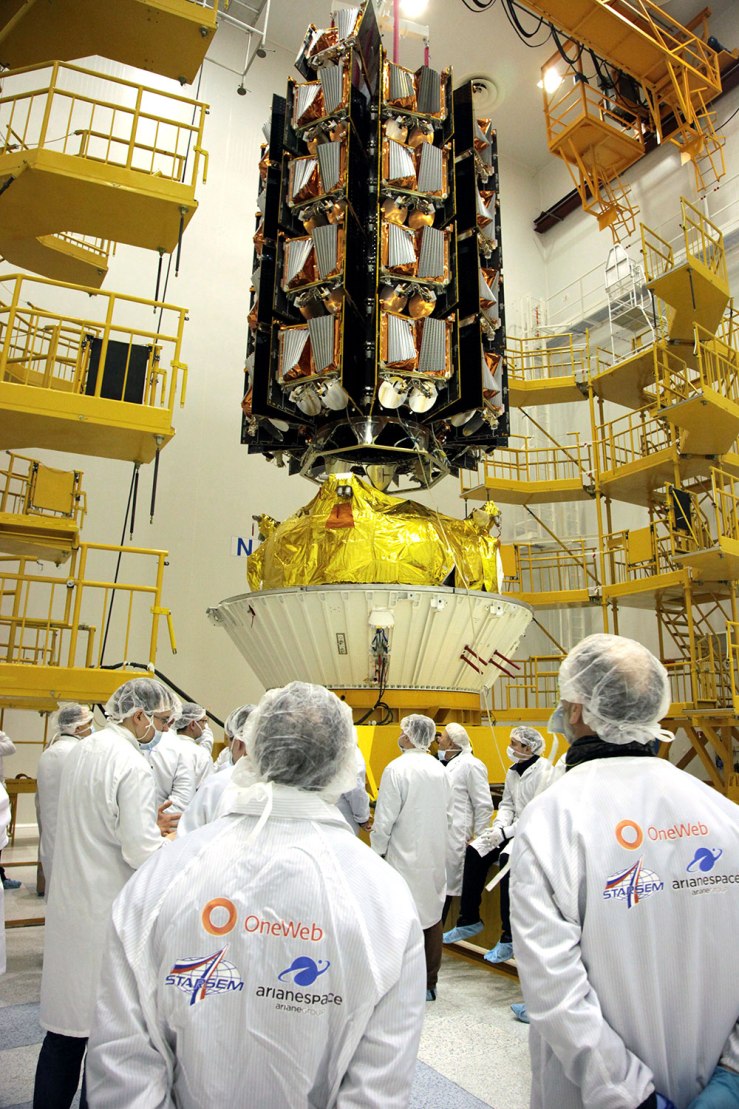
Once deployed, the OneWeb constellation will enable user terminals capable of offering 3G, LTE, 5G and Wi-Fi coverage, providing high-speed access around the world − by air, sea and land….. OneWeb’s initial constellation is based on approximately 650 satellites as it grows to meet demand around the world. OneWeb will begin customer demos in 2020 and provide global, 24-hour coverage to customers in 2021…….  Another contractor is RUAG Space AB (Linköping, Sweden) is the prime contractor in charge of development and production of the dispenser system used on Flight ST27. It will carry the satellites during their flight to low Earth orbit and then release them into space…….

Images and Visual are from Airbus- Arianespace

#SpaceX #FalconNineReusable | launching of the #CSA #CanadianSpaceAgency #RADARSAT Constellation providing intense analysis for #EarthSciences observations- #OC #California (California) Here we come!


On a 12th Jun 2019 California OC’s 0717 Los Angles PDT- Pacific Date Time–  morning, it’s the launch of the CSA -Canadian Space Agency Canadian- RCM- RADARSAT Constellation Mission, launching from the west coast this time of Space X‘s Vandenberg Air Force Base, form California, launching from SLC-4E, Space Launch Complex 4E..  In which the launch three satellites will be deployed form the secondary stage, in least fifty four minutes after the launch…

As the deployment  of the three RADARSAT Satellites, into the deployment is the landing of the reusable Falcon Nine carrier rocket least eight minutes after lift-off, back on a non-traditional drone ship landing in which it’ll land back on Space X’s  Landing Zone 4- LZ-4… in which this a land based landing..

The currently first staging of the Space X –Falcon Nine reusable was previously used in Dragon’s first demonstration flight in March 2019, in which used again for this mission.. To deploy RADARSAT Satellites of three constellations, for Earth Sciences observation from space in which it utilised a three C-Band Synthetic Aperture Radar –SAR Earth Observation Satellites…

The Manufacturer of the RADARSAT is MDAa Maxar Company… In which it’s provisionment of the constellation of the three satellites will provide Canadian also Arctic region observations of four times daily   also globally ninety percent.. also providing maritime surveillance, ecosystem and climate change monitoring, and helping disaster relief efforts. … Each satellite also carries an Automatic Identification System receiver, allowing improved detection and tracking of vessels of interest.  Also providing assists to farmers on maximising crop yields, reduction on energy consumption reduction of pollutants…. Also the second Is provide high quality resolution data on disaster relief also assisting on organize emergency response efforts and protect the local population….. .

#CNSA #China National Space Administration #國家航天局 | #BeltAndRoadinitiative | #Change4 #Yutu2 mission press conference held by the #SCIO State Council Information Office of China announcements more Chang’e lunar series missions to come..

Change four- CNSA- China National Space Administration -Belt and Road Initiative partners exploring on the dark side of the moon -Van Karam Crater..

On the third of January 2019, in Beijing, China Capital held a press conference at the SCIO – State Council Information Office of China of the first time historic mission in which to land a lunar rover also a platform on the dark side of the moon… In which it’s the first country to do so… in collaboration with CNSA- China National Space Administration among with its Belt and Road Initiative partners..  in which it landed on third of January 2019, only to be launched after a previous launching from few months ago to set up communications relay network on the far side orbit of the moon to establish a continuous  communications in a figure eight pattern . Communicating with the Queqiao relay satellite with the ground operators at CNSA that was deployed a 20th May 2018 that followed on seventh of December 2018, it was Change4 time to be launched also awaiting in orbit to make the right landing spot within the Von Karman crater a 180 Kilometer diameter Crater..

The press conference held at Beijing , along with Wu Yanhua the vice administrator of the China National Space Administration and deputy chief commander of China lunar exploration program; Wu Weiren, academician of Chinese Academy of Engineering; Sun Zezhou, chief engineer of the Chang’e-4 probe and several other experts are present to answer questions from the media.

Along with the Press conferences, there was other articles of CNSA Partnership launches that are coming along its way with the Change 6 mission is set out to be launched later 2019 calendar in which will land on the south pole of the moon. Collect samples then return to Earth for study..

departing from CHange 4 is Yutu 2 – Yutu is the name of the Jade Rabbit…. Change is the name of the Moon Goddess…

Change 5 will be on the same mission specifications like the Change 4, in which seventh mission will have the same mission specifications like the Change six, studying lunar landscape, its formation, physical composition as well the spatial environments..  Change eight mission specifications are heavier than its previous seventh… with additional studying on the surveying, experimentations to construct  the very ground work for a lunar surface research out post ……

#CNSA China National Space Administration | #BeltAndRoadinitiative – #ZhuhaiAirShow #AirShowChina Displaying revealing the Command Core module of the Tianhe Space Station…..

CNSA -China National Space Administration – Command Core Module – Tianhe Space Station shown on the Air Show China- in Zhuhai..

During the week of sixth of November 2018, in which only fifty five Kilometers away from Already Tomorrow In Hong Kong, travelling from the Hong Kong, Macau, Zhuhai planet Earth’s longest sea bridge..  Is the 2018 Zhuhai Air Show, in which displaying on many genres of the Space, Defense, Aviation Industry…. In which is the third Space Station in which CNSA China National Space Administration and CAST –China Academy of Space Technology have been developing for the Belt and Road Initiative over the past few years in leading to replace its second generation Space Station Tiangong two.. in which “Term as Heavenly palace two..”

During the Zhuhai Air Show, or Air Show 2018, in which is the twelfth show running, CGTN’s television presenter Sun Ye look with various guest from the CNSA, CAST-China Academy of Science Technology, also CASC – China Aerospace Science and Technology Corporation..    gave a tour of what’s to come with the next generation of Long March Carrier Rockets with the manned version of the Long March eight also the next generation of the Shenzhou module..

CNSA- Tainhe 1 core module.. in preparations for the 2019 launch calendar..

The seventeen meters in length..  New Command module component Station for in which was displayed for the Zhuhai Air Show, in which is the main Command Module Component Tianhe –termed Harmony of Heavens..  In which was test finally on 2017 year on finalizing the Assembly Integration and Testing center in Tianjin…  in which the Tainhe command station module is larger, also wider in diameter than the previous generations in which to accommodate more instrumentation…  also with an expanding crew from three towards six as each more modules are added..

CNSA – China National Space Administration final stage one look for the Belt and Road Initiative Space Station.. in collaboration with ESA- European Space Agency, ROSCOMMOS, UNOOSA- United Nations Office for Outer Space

Orthough the size of the CNSA Belt and Road Initiative – Tiangong three Space Station partnerships with ESA- European Space Agency, ROSCOMOS, UNOOSA- United Nations Office for Outer Space… each agency of its own is larger than NASA – National Aeronautics and Space Administration….   In which the CNSA-ESA Partnership as already began with the collaboration training of ESA Astronauts among with Chinese astronauts – Taikonauts during the 2017 Training year..

The Command Module Core of the Tianhe Space Station in which provide servicement towards operations, of control, management of the space station, in which be ready to launch from CNSA’s 2019 launch calendar… With stage one of all the module components completed assemble by the year 2022 at the most… within it two additional modules added conducting with experiments of space sciences, medical in various genres in which the enormous spin offs from the research benefiting humanity,    With the operational life cycle of a decade more with regular maintained repairing schedule…

#CNSA #China National Space Administration | #BeltAndRoadinitiative – training readiness on a #GobiDesert #Martian Simulation outpost base for Mission Planet Mars for education …..


Located in the Gobi Desert in the PROC China, outside the forty Kilometers from Jinchang Northwest China, is in the location within Gansu Province in which its iconic ancient Silk Road rustic landscape is CNSA- China National Space AdministrationCAS-Chinese Academy of Sciences  Martian educational training outpost simulator base in which the rustic red Gobi Desert sand environment simulates the visual conditions of Mars… as part of CNSA’s educational preparations in with the collaboration in with its Belt and Road Initiative partners, ESA-European Space Agency, ROSCOMOS, also the UNOSA-United Nations Office for Outer Space Affairs..  In developing a world leading in Space Sciences and exploration in exploration in Space..

CNSA’s Chinese Academy of Sciences’s Martian’s simulator Outpost, known as “Space Plan C” in which features all the simulated capabilities to live, Mission operations to various requirements on Mars, in which helps to understand inspired students  to work in their related Space Sciences, or sciences field in which the educational base has nine module cabins interconnected with a typical airlock, with its mission control bridge, with BioPak featuring a Bio Cabin in the features grown vegetation on mars for food consumption for a long term mission requirement mission stay..   Tian Rusen-Space Science noted the experiences of visiting the site is that”….  Visitors are able to learn how to live on Mars and Utilize those experiences.. To help future developments on Earth…..”