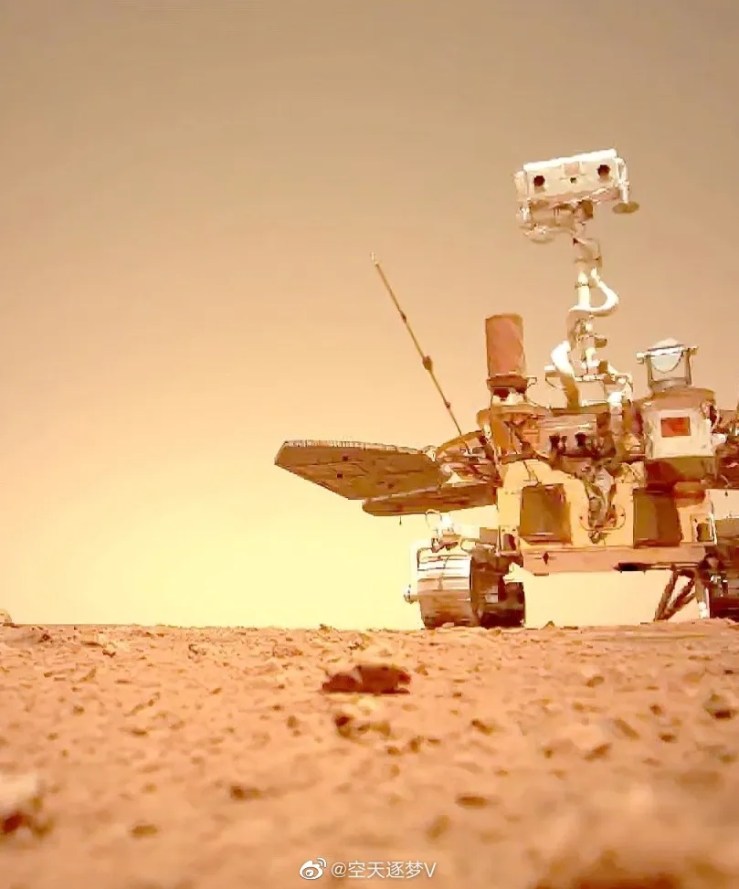
#CNSA #ChinaNationalSpaceAdministration #國家航天局 |#BeltAndRoadinitiative #May2022 | #火星 # 天問 #天问一号#TianwenOne #MarsMission #Marslander #MarsRover probe  #祝融号 #ZhuRong finds signs of recent water activity on the planet Mars……

On the months of March 2022  the week of 13th May 2022   天问一号飞運騎遊達达3亿CNSA – China National Space Administration – ESA – European Space agency Belt and road initiative mars mission…first Mars exploration mission, Tianwen- Martian Probe One  and the cute Mars Rover have reportingly to everyone, have a new discovery acquired recently : According to the obtained short-wave infrared spectrum and navigation and terrain camera data, a rocky plate-shaped hard shell was found in the landing area. By analysing the spectral data, it was found that these plate-like crusts similar to sedimentary rocks are rich in minerals such as hydrous sulfate. The research team of scientists deduced that these sulfate-rich crusts may have been formed by lithification after groundwater overflow or capillary evaporation and crystallization of salt minerals cemented the Martian soil. For the first time, water-bearing minerals were detected in situ on Mars using the short-wave infrared spectrometer on the rover…..

The findings suggest that water activity on Mars may have been more active during the Amazonian period than previously thought. My landing zone utopia Planitia and the broad area of ​​the northern plains of Mars may contain large amounts of available water in the form of hydrous minerals for in situ resource utilization for future manned Mars exploration.


As of now, I have been in Utopia in the northern lowlands of Mars. After driving in the plain area for one year, the accumulated driving distance is nearly 2 kilometers, and a large amount of valuable scientific detection data has been obtained. Existing crater dating work shows that the landing zone is located in the Amazonian strata that have undergone late remodelling events, at the end of several major stages of Martian geological age (Pre-Noah, Noah, Occidental, and Amazonian), The climate has changed from warm and humid to cold and dry. Analysis of orbital remote sensing data shows that various geomorphological features distributed around the landing site (Fig. 1) indicate that there may have been a large amount of volatiles in the Utopian Plain. However, limited by the spatial resolution and coverage, orbital remote sensing data did not find water-bearing minerals near the landing area, which raised many questions about the formation mechanism of such landforms and the nature of water activity in the area.


Using short-wave infrared spectroscopy, the researchers detected water-bearing minerals in these bright-colored plate-like rocks that were not identified in the region by previous orbital data, presumed to be water-containing silica or water-containing sulfates (Figure 2). The research team believes that these bright-colored rocks are related to pirates. The broken rock observed in situ by the Mars 1 lander is similar in morphology, and is a layer of locally developed duricrust. However, the hard crust of the Viking 1 landing area is relatively brittle and thin, which may be formed by the long-term interaction of water vapor in the atmosphere and the soil on the surface of Mars. The hard crust of Zhurong’s landing site appears to be more resistant to erosion and forms a thick layer in the surrounding loose soil (Figure 3), which requires large amounts of liquid water, which cannot be formed by atmospheric water vapor alone. At the same time, the study found that there was no obvious surface runoff or traces left by the river in the landing area, and no fluffy surface and salt residues formed by the

(The above research results were published in the international authoritative academic journal Science Advances. The first author and corresponding author of the paper is Liu Yang, a researcher at the National Space Science Center, Chinese Academy of Sciences. Link to the paper

#CNSA #ChinaNationalSpaceAdministration #國家航天局 |#BeltAndRoadinitiative #May2022 | #火星 # 天問 #天问一号#TianwenOne #MarsMission #祝融号 #ZhuRong | #ChinaNationalYouthDay – a youthful woman CNSA Space engineer Boa Shuo on seizing seize the moment, working hard  aim for a goal, a dream…

On the months of 5th May 2022   天问一号飞運騎遊達达3亿CNSA – China National Space Administration – ESA – European Space agency Belt and road initiative mars mission…first Mars exploration mission, Tianwen- Martian Probe One  sent back stunning images of the Half Earth Mass size of the Rustic Planet Mars in which show stunning Martian landscape with its iconic polar caps of either southern or northern … With its timeless Stunning Mars Photography. Tianwen-1″ returned high-resolution images of the Mars inspection area The “Zhurong” rover is preparing for winter, and the orbiter continues to carry out orbital exploration…..

As of May 5, 2022, the “Tianwen-1” orbiter has been in orbit for 651 days and is 240 million kilometers away from the earth. The “Zhurong” rover has worked on the surface of Mars for 347 Martian days, with a cumulative travel of 1921 meters, the two devices have accumulated about 940GB of original scientific data, and the operation is normal.

Currently this month of 4th May 2022 it was National Youth Day on China – People’s Republic of China it’s been celebrated very year on the 4th of May, China celebrates Youth Day. The holiday is a day off for the citizens of China and it has been observed since 1949. It is a part of the May holidays, where the whole of China celebrate different occasions during 7 days of May, which is called the ‘golden week’ at one of many Observances. At Peking University, one of the top world top universities where the May Fourth Movement began, the holiday is celebrated with speeches, singing competitions, and other activities.

“Struggle is the most beautiful background of youth, and action is the most effective tempering of youth. With responsibility and responsibility, youth will shine.”

Youth is just as good as youth Actually Beijing understands that it is a young team of CNSA China National Space Administration Bao Shuo, 29, is a dispatcher of the Beijing Space Flight Control Center. “. She said that youth is for struggle; we must seize the moment, aim for a goal, a dream, and then work hard for it. Contribute to the country, regardless of age or gender; all  Space Scientist Space Engineers ,Takionauts to whom are working hard for their aerospace dreams. Today, we walk with her and share the story of her and her team’s dream of spaceflight and writing youth with struggle….

On 4 May, 1919, student protests in Beijing erupted in the wake of the signing of the Treaty of Versailles, which ended World War I. The treaty, among other things, granted Japan control of Chinese territory in the Shandong Peninsula that Germany had held before the war. This enraged many Chinese who felt they had been betrayed.

Some of the students were arrested at first, but when protests spread and intensified, the Chinese government released the arrested student leaders.

The Fourth of May Movement came out of the protests. At first, it was a movement against imperialism and an attempt to reassert Chinese nationalism and culture. But it quickly diverted into a Communist ideology, and thus is seen as a beginning point to the establishment of the Communist People’s Republic of China.

In 1949, China established Youth Day as a public holiday to be observed every 4 May to remember the events of 1919 and all that followed them. There are special youth events, community service projects, and more organised all over China- People’s Republic of China

Images and visuals are from CNSA- China National Space Administration also from there respectives- CLEP –China Lunar Exploration Project..

.

#CNSA #ChinaNationalSpaceAdministration #國家航天局 |#BeltAndRoadinitiative #May2022 | #火星 # 天問 #天问一号#TianwenOne #MarsMission #Marslander #MarsRover #Tianwen1 probe  #祝融号 #ZhuRong #Tianwen1 is preparing for winter, and the orbiter continues to carry out orbital exploration….

On the months of 5th May 2022   天问一号飞運騎遊達达3亿CNSA – China National Space Administration – ESA – European Space agency Belt and road initiative mars mission…first Mars exploration mission, Tianwen- Martian Probe One  sent back stunning images of the Half Earth Mass size of the Rustic Planet Mars in which show stunning Martian landscape with its iconic polar caps of either southern or northern … With its timeless Stunning Mars Photography. Tianwen-1″ returned high-resolution images of the Mars inspection area The “Zhurong” rover is preparing for winter, and the orbiter continues to carry out orbital exploration…..

As of May 5, 2022, the “Tianwen-1” orbiter has been in orbit for 651 days and is 240 million kilometers away from the earth. The “Zhurong” rover has worked on the surface of Mars for 347 Martian days, with a cumulative travel of 1921 meters, the two devices have accumulated about 940GB of original scientific data, and the operation is normal.

During the ring fire, all seven payloads carried by the “Tianwen-1” orbiter were powered on, and continued to carry out global remote sensing exploration of Mars. Figure 1 is a 0.8 m/pixel image taken by a high-resolution camera on April 17, 2022, of the Triolle crater on Mars, showing the “seasonal slope pattern” on the crater wall. Figure 2 is a local landform image of the Martian Sailor Valley captured by a medium-resolution camera on April 1, 2022, with a resolution of about 65 meters per pixel. 

Figure 1. “Seasonal slope pattern” of the crater wall of the Triolet crater on Mars, captured by a high-resolution camera 
Fig. 2 Local landform of Martian Sailor Valley captured by medium-resolution camera

After the “Zhurong” Mars rover completed the 90-Mars day inspection mission on August 15, 2021, it will continue to carry out the expansion inspection and exploration mission. Figure 3 is an image of rocks distributed near impact craters on the Martian surface taken by the Navigation Terrain Camera on April 10, 2022 (the 323rd Martian day after landing). At present, the area where the “Zhurong” rover is located has entered winter. Similar to our earth, after entering winter, the altitude angle of solar illumination in the northern hemisphere area decreases and the duration of illumination shortens. According to the measurements, the local maximum temperature at noon on the rover has dropped to -20°C, and the ambient temperature at night is as low as -100°C. In addition, due to the presence of sand and dust weather, the light intensity is further weakened, which affects the power generation capacity of the solar wing battery array of the Mars rover. Recently, the engineering team adopted the rotation of the solar wing to adjust the light angle, reduce the daily work items and time, and achieve energy balance. 

Figure 3. Images of rocks distributed near impact craters on the Martian surface captured by the Navigation Terrain Camera

The rotation period of Mars is close to that of Earth. A Martian day is only about 40 minutes longer than that of Earth. The inclination of Mars’ rotation axis is 25.19°, which is also very close to Earth. Therefore, Mars also has day and night alternations and seasonal changes like Earth. The orbital period of Mars is about 687 days, that is, 1 Martian year is equivalent to 1.9 Earth years, which means that the average duration of each season on Mars is about twice as long as on Earth.

When the “Zhurong” first landed last year, when Mars moved to the vicinity of the aphelion, the direct sunlight point was in the northern hemisphere. At that time, the northern hemisphere had just entered summer and the southern hemisphere had entered winter. Now, nearly a year after landing on Mars, Mars is running near the perihelion, and the direct sun is in the southern hemisphere. The northern hemisphere where “Zhurong” is located is entering winter and the southern hemisphere is entering summer.

In the next two months, the direct sun point will continue to move to the south of Mars, reaching around the Tropic of Cancer around mid-to-late July, when Mars’ northern hemisphere will enter the coldest season of the year. In order to safely survive extreme weather such as Martian winter and sandstorms, the “Zhurong” rover has designed working modes such as autonomous sleep. When the energy is reduced to a certain level, it will automatically enter the sleep mode. After the environmental conditions gradually improve, it will return to normal Operating mode. 

作者:耿言 李佳威

Images and visuals are from CNSA- China National Space Administration also from there respectives- CLEP –China Lunar Exploration Project..

#CNSA #ChinaNationalSpaceAdministration #國家航天局 |#BeltAndRoadinitiative #March2022 | #火星 # 天問 #天问一号#TianwenOne #MarsMission #Marslander #MarsRover #Tianwen1 probe  #祝融号 #ZhuRong #Tianwen1 returned high-resolution images of the Mars inspection area…..

On the months of March 2022  the week of 20th March 2022   天问一号飞運騎遊達达3亿CNSA – China National Space Administration – ESA – European Space agency Belt and road initiative mars mission…first Mars exploration mission, Tianwen- Martian Probe One  sent back stunning images of the Half Earth Mass size of the Rustic Planet Mars in which show stunning Martian landscape with its iconic polar caps of either southern or northern .. With its timeless Stunning Mars Photography. Tianwen-1″ returned high-resolution images of the Mars inspection area

Figure 1 The image of the inspection area of ​​”Zhurong” taken by a high-resolution camera

 A few days ago, the “Tianwen No. 1” orbiter passed over the inspection area of ​​the Mars rover again, and took a 0.5-meter resolution image of the “Zhurong” inspection area. As of March 24, 2022, the “Zhurong” rover has been working on the surface of Mars for 306 Martian days and has traveled 1,784 meters in total. The “Tianwen-1” orbiter has been in orbit for 609 days and is 277 million kilometers away from the earth. Both are operating normally.

(a) Taken on May 19 , 
2021 ( the 
5th

 Martian day after landing ), the surface of the rover is not covered by sand and dust
(b) Taken on 
January 
22 , 
2022 (the 247th

 Martian day 

after landing ), there is obvious dust coverage on the surface of the 
rover
Figure 2 Comparison of images of the rover taken by the Navigation Terrain Camera in different periods

The “Zhurong” rover also sent back selfies from the surface of Mars. Compared with the photos taken just after landing, it can be seen that a thin layer of dust has accumulated on the surface of the rover. At the same time, according to the telemetry information of the rover, the power generation efficiency of the solar wing is affected to a certain extent, but the energy is still sufficient. In order to cope with the dust coverage, the solar wing of the Mars rover has been specially designed, and various measures can be taken to deal with the problem of the reduction of power generation efficiency caused by the sand and dust.

(a) 
Taken at the 
center of the 

 image on January 22 , 2022 ( 30.7 °E, 74.0 ° N )
(b) 
Taken at the center of the image on February 10 , 2022 ( 37.8 ° east longitude , 7 2.9 ° north latitude), a local sandstorm occurred, and the ground objects were difficult to distinguish

 
Fig. 3 Comparison of wind and sand activities in high latitude regions of the Northern Hemisphere captured by medium-resolution cameras

The Martian dust storm will directly affect the energy acquisition of the Mars rover, which has always attracted much attention. The engineering team continued to monitor the Martian sand and dust weather through images obtained by the medium-resolution camera of the “Tianwen-1” orbiter, and found that from late January this year, obvious wind and sand activities began to appear in the area north of 60 ° N latitude on Mars. It can be seen from the figure below that a local sandstorm occurred in this area in February this year, and typical features were covered by a large amount of sand and dust, making it difficult to distinguish.

At present, the northern hemisphere of Mars has begun to enter autumn. According to the analysis of previous detection data, autumn is the season of frequent occurrence of dusty weather on Mars, but no obvious dusty weather has been observed in the inspection area of ​​”Zhurong”.

(a) Taken on March 24 , 2021 , at the center of the image ( 110.2 ° E, 24.6 °N)
(b) Taken on January 30 , 2022 , at the center of the image ( 107.4 ° E longitude , 24.4 ° N latitude )
Figure 4. Medium resolution image of “Zhurong” landing inspection area

The “Tianwen-1” orbiter continues to carry out global remote sensing exploration of Mars, and focuses on typical landforms and geological units such as craters, volcanoes, canyons, and dry riverbeds, and obtains high-resolution images. On March 7 this year, the American “Perseverance” rover was photographed while imaging the “Jezero” crater, which is currently located about 200 meters southeast of its landing site.

Figure 5 The American “Perseverance” rover photographed by “Tianwen-1”

Source Cartography: National Astronomical Observatory -Author: Geng Yan Chen Gang

Images and visuals are from CNSA- China National Space Administration also from there respectives- CLEP –China Lunar Exploration Project..

#CNSA #ChinaNationalSpaceAdministration #国家航天局 |#BeltAndRoadinitiative #March2022 |#TwoSessions #Beijing plans to realize the #Planet #Mars #Change7 #Change8  sampling return mission by 2030 #ASummery

On the week of 13th March 2022 in  CNSA _China National Space Administration -China – People’s Republic of China……..During the Two Sessions of which was held during in the People’s Hall during the week of 13th March 2022 China – People’s Republic of China CNSA China National Space Administration  and its Partners plans to realize the Mars sampling return mission by 2030] China Daily reported on March 6 that Wu Weiren, member of the Standing Committee of the National Committee of the Chinese People’s Political Consultative Conference and chief designer of China’s lunar exploration project, said recently that my country plans to realize the Mars sampling return mission by 2030. The difficulty of the project is much greater than that of lunar sampling and return. The first problem to be solved is to develop a launch vehicle with greater thrust. In the follow-up, China is also preparing to conduct marginal exploration of the solar system. “The sun is about 150 million kilometers from the earth, which is an astronomical unit. We plan to achieve the ‘double hundred’ goal in 2049, that is, on the 100th anniversary of the founding of New China, to complete 100 astronomical units, which is 15 billion kilometers away “Deep space exploration” China plans to realize the Mars sampling return mission by 2030

China will carry on its moon research in the future with Chang’e-6, Chang’e-7 and Chang’e-8 missions by 2030. After 2030, a new set of missions will be carried out to complete the construction of an international lunar research station by 2030….he Chang’e-6 is scheduled to bring back to Earth lunar samples with a mass of up to 2 kilograms; the Chang’e-7 will be tasked with landing on the lunar south pole and detecting local natural resources; and the Chang’e-8, working in collaboration with Chang’e-7, is going to scout how to exploit lunar resources.

According to Wu, the Chang’e-6 and Chang’e-7 are expected to be launched around 2025.

Future missions also include the development of a special craft, which can fly from the landing site to lunar craters to help scientists look for traces of water. If water is present, it could provide resources for future crewed missions on the moon, Wu noted.

After 2030, a new set of missions will be carried out to complete the construction of an international lunar research station by 2035….

“There will be multiple rovers and landers working in the future moon station and a lunar-based communication network to support these spacecraft,” Wu said. “The lunar research station can also function as a transfer outpost for the solar system and even deeper space explorations.”  

Images and visuals are from Weibo also their respectives.