#CNSA #ChinaNationalSpaceAdministration #国家航天局 |#BeltAndRoadinitiative #October2021 | #嫦娥五号The #Moon #Change5 probe its Heroic Lunar Mission from #MonsRumker #LunaExploration #Chang’e5 Research lunar samples refreshing Traditional Understanding of Lunar Evolution…

On October 19th Thursday 2021, the Chinese Academy of Sciences  released the latest research results of the Chang’e-5 lunar scientific research samples. A number of breakthroughs have given a new understanding of the evolution of the moon. The research results of the lunar samples of Chang’e 5 show that magma activity still existed on the moon until 2 billion years ago. The lunar mantle source area of ​​late magma activity is not rich in radioactive heat-generating elements and is very “dry”. This series of research is led by the Institute of Geology and Geophysics of the Chinese Academy of Sciences and the National Astronomical Observatory, and jointly carried out by a number of research institutions. The related results have formed 4 papers, one published in the “National Science Review”, and published in the international academic journal “Nature” 3 articles.

The duration and geochemical characteristics of the lunar basalt magma are the “keys” for understanding the thermal-chemical evolution of the moon. Previous studies have confirmed that magma activity on the moon lasted at least approximately 2.8 to 3 billion years ago. However, there has been controversy in the scientific community about the exact time when the lunar magma activity ceased. The study found that the lunar sample of Chang’e 5 is a new type of lunar basalt, which is different from the lunar samples collected and returned by the United States and the Soviet Union. Researchers analyzed more than 50 uranium-rich minerals in the basalt cuttings of the Chang’e 5 lunar sample and determined that the basalt formation age was 20.30±0.04 billion years, indicating that there was still magma activity on the moon until 2 billion years ago, which is more than the limit of previous lunar samples. Magma activity has been extended for about 800 million years.

​10月19日,中国科学院发布嫦娥五号月球科研样品最新研究成果,多项突破性进展给出了对月球演化的全新认识。嫦娥五号月球样品研究结果显示,月球直到20亿年前仍存在岩浆活动,晚期岩浆活动的月幔源区并不富含放射性生热元素,而且非常“干”。该系列研究由中国科学院地质与地球物理研究所和国家天文台主导,联合多家研究机构共同开展,相关成果形成4篇论文,在《国家科学评论》发表1篇,在国际学术期刊《自然》发表3篇。

月海玄武岩浆的持续时间和地球化学特征是理解月球热-化学演化的“钥匙”。此前的研究已证实,月球岩浆活动至少持续到大约28亿至30亿年前。但对于月球岩浆活动停止的确切时间,科学界一直存在争议。研究发现,嫦娥五号月球样品为一类新的月海玄武岩,不同于美国和苏联采集返回的月球样品。科研人员对嫦娥五号月球样品玄武岩岩屑中50余颗富铀矿物进行分析,确定玄武岩形成年龄为20.30±0.04亿年,表明月球直到20亿年前仍存在岩浆活动,比以往月球样品限定的岩浆活动延长了约8亿年。

The cause of the most recent magmatic activity on the Moon has always been an unsolved mystery. At present, there are two possible explanations in the scientific community: the lunar mantle source is rich in radioactive elements to provide a heat source, or the lunar mantle is rich in water to lower its melting point. The latest study found that the lunar mantle source area of ​​the basalt from the lunar sample of Chang’e 5 is not enriched in “Krip material.” Since the “Krip material” is rich in radioactive heat-generating elements, this result proves that the radioactive heat-generating elements of the lunar mantle are not the main reason for the formation of the basalt of the Chang’e-5 lunar sample. Regarding whether the magma source area is rich in water, the research team measured the water content and hydrogen isotopic composition in the basalt of the Chang’e 5 lunar sample, and found that the water content in the lunar mantle source area was only 1 to 5 micrograms/g, which means that the lunar mantle Very “dry”. This discovery also excludes the hypothesis that the lunar mantle is rich in water and has a low melting point, resulting in an abnormally prolonged duration of magma activity in this area.

月球最晚期岩浆活动的成因一直是未解之谜,目前科学界存在两种可能的解释:月幔源区富含放射性元素以提供热源,或月幔富含水从而降低其熔点。最新研究发现,嫦娥五号月球样品玄武岩的月幔源区并不富集“克里普物质”。由于“克里普物质”富含放射性生热元素,这一结果证明月幔放射性生热元素并不是形成嫦娥五号月球样品玄武岩的主要原因。对于岩浆源区是否富含水,科研团队测定了嫦娥五号月球样品玄武岩中的水含量和氢同位素组成,发现月幔源区的水含量仅为1至5微克/克,也就是说月幔非常“干”。这一发现也排除了月幔富水而具有低熔点,导致该区域岩浆活动持续时间异常延长的猜想。

Water content and hydrogen isotopic composition of apatite and melt inclusions in the Chang’e-5 basalt sample
Backscattered scanning electron microscope image of apatite and magma inclusions in the Chang’e-5 basalt (a) A complete picture of the basalt cuttings (406-010,023) in the alloy target. The cuttings are mainly composed of olivine (Ol), It is composed of pyroxene (Px), feldspar (Pl) and ilmenite (Ilm), and a small amount of iron olivine (Fa), meteorite (Tro), spinel (Sp), apatite (Apa) and Quartz (Q). 
(B), (c) and (d) are the partial images of the cuttings respectively. 
(B) The figure shows the melt inclusion (MI) surrounded by ilmenite. 
(C) and (d) show that apatite is mainly produced in the intergranular area and is euhedral or semi-automorphic

According to the hypothesis of the origin of the big impact, the original Earth collided with a planetary planet the size of Mars, forming a “disk” composed of high-temperature magma and gas around the earth. When the temperature begins to cool, materials such as silicate first gather to form the moon (Figure 1), and water is a highly volatile material that escapes into space in a gaseous form and is lost. Therefore, the moon born in this way contains almost no water and is a nearly dry planet. The research results of the lunar samples of Chang’e 5 further provided supporting evidence for the origin and evolution of the moon, raised new scientific questions for the study of the lunar thermal evolution history, and proposed new directions for future lunar exploration and research.

We welcome domestic and foreign scientists to join the ranks of the research on these data and samples. At present, research on lunar samples is mainly carried out by domestic scientific research institutions, and foreign scientists have joined the Chinese team to carry out joint research. In the follow-up, we will issue relevant policies, uphold the principles of “equality and mutual benefit, peaceful use, and inclusive development”, expand international exchanges and cooperation, and provide more Chinese wisdom, Chinese solutions, and Chinese power for the peaceful use of space and the promotion of a community with a shared future for mankind.

根据大撞击起源假说,原始地球与一个火星大小的星子碰撞,形成了一个围绕地球的、由高温岩浆和气体组成的“盘”。当温度开始冷却时,硅酸盐等物质首先聚集形成月球(图1),而水属于强挥发的物质,会以气态形式向太空逃逸而丢失。因此,这种方式诞生的月球,几乎不含水,是一个近乎干透了的星球。嫦娥五号月球样品的研究成果进一步为月球起源及演变提供了支撑证据,为月球热演化历史研究提出了新的科学问题,对未来的月球探测和研究提出了新的方向。

我们欢迎国内外科学家加入对这些数据和样品的研究行列。目前,月球样品研究主要由国内科研机构牵头开展,也有国外的科学家加入中国团队开展联合研究。后续,我们将出台相关政策,秉持“平等互利、和平利用、包容发展”的原则,扩大国际交流与合作,为人类和平利用太空、推动人类命运共同体提供更多中国智慧、中国方案、中国力量。

Images and visuals are from Weibo and there respectives.

#CNSA #ChinaNationalSpaceAdministration #国家航天局 |#BeltAndRoadinitiative #October2021 | #嫦娥五号The #Moon #Change5 probe its Heroic  Lunar Mission from #MonsRumker #LunaExploration among with iconic China’s Collaborative first research results of #Chang’e5 lunar samples were published in #Science

On 9th October 2021 Month in a Hong Kong –Beijing CNSA China National Space Administration- CLEP- China Lunar Exploration Program Belt and Road Initiative Mons Rumker Luna Mission …..  The team of CLEP – China Lunar Exploration CNSA’s lunar and Martian  exploration department  have release The first research results of Chang’e 5 lunar samples were published in “Science”

Recently, an international research team led by researcher Liu Dunyi from the Beijing Ion Probe Center of the Institute of Geology, Chinese Academy of Geological Sciences, China Geological Survey and Professor Alexander Nemchin, a senior overseas visiting scholar from the Institute of Geology, Australia, is conducting research on the Chang’e-5 lunar samples. Significant progress has been made. The team conducted chronological, elemental, and isotope analysis of the Chang’e 5 lunar basalt, which proved that magma activity still existed on the moon 1.96 billion years ago, providing key scientific evidence for perfecting the evolution of the moon. The related research paper “The Age and Composition of Chang’e 5 Young Basalt” was published online in the international academic journal “Science” in the early morning of October 8, Beijing time. This is the first academic achievement published based on the Chang’e-5 lunar sample. Researcher Liu Dunyi and Professor Alexander Nemchin are the co-corresponding authors of this article. Dr. Xiaochao Che is the first author of this article.

When the moon’s magmatism ceases has always been one of the major scientific issues in the study of the history of the moon’s evolution. Previous studies on lunar samples have not found that there is a magma activity younger than 2.9 billion years on the moon. The sampling location of the Chang’e-5 mission was designed in the lunar sea basalt area, which is the youngest on the lunar surface. A total of 1731 grams of lunar samples were collected through surface sampling and drilling. They were reviewed by the Lunar Sample Expert Committee and reviewed by the Lunar Exploration and Aerospace Engineering Center. , And reported to the National Space Administration for approval that on July 12 this year, the first batch of lunar scientific research samples totaling 31 were distributed to 13 scientific research institutions. Scientists all over the world are full of hope and look forward to obtaining the results of younger magma events from the study of the Chang’e-5 sample, so as to improve the evolution history of lunar magma.

The research team used detailed micro-area in-situ high-resolution secondary ion mass spectrometry (SHRIMP) dating data and solid rock mineral geochemical data to prove that there was still magma activity on the moon until 1.96 billion years ago, making the previously known lunar geology The life span has been extended by about 1 billion years.

At present, scientific research on lunar samples is in progress, the second batch of lunar samples is issued according to procedures, and relevant scientific results will be released in time.

(Link to the original publication of the results: https://www.science.org/doi/10.1126/science.abl7957)

Images and visuals are from Weibo and there respectives.

#CNSA #ChinaNationalSpaceAdministration #国家航天局 |#BeltAndRoadinitiative #CLEP #September2021 | #VonKarmanCrater #LunarMission #Change4 #Yutu2 Lunar adventuring #LunaExploration 839.37 meters more  Exploring more on a one thousand days working holiday ….

As of 29th September 2021, The CNSA –China National Space Administration CLEP- China Lunar Exploration Program  Belt and Road Initiative Lunar Mission……Chang’e-4 with Yutu two the Lunar rover still working exploring more than 839.37 meters on the other side of the moon on the 103 Kilometers Diameter Von Karman Crater in which is least than two length by length fifty five Kilometers Hong Kong –Macau- Zhuhai Bridges …. Working Exploring the Crater on the other side of the Moon Chang’e Luna….

Having exploring more than 839.37 meters taking lunar photography exploring  with the ultimate Lunar Selfies in which gathering then Yutu two Lunar Rover team China Lunar and Deep Space Exploration Engineering Ground Application System also the breaking the milestone off working up to the 30th September 2021 is Martyrs’ Day in Tiananmen Square in celebrating before National Day on the 1st October of China – People’s Republic of China throughout in the international Chinese Communities in celebrating at the Monument to the People’s Heroes in Tiananmen Square on Thursday morning. President Xi Jinping and other leaders of the Communist Party of China (CPC) and the state join representatives from all walks of life to present flowers to fallen national heroes. This year marks the centenary of the CPC and the 72nd anniversary of the founding of the People’s Republic of China….

In the golden autumn of China, the moon is on the back of the journey. On September 29th Wednesday, 2021, on the occasion of the 72nd birthday of the motherland – China – People’s Republic of China, the Chang’e 4 lander and Yutu 2 lunar rover worked in orbit for more than 1,000 days, continuing to refresh the work record on the back of the moon…..  

The overall working conditions of the Chang’e 4 lander and the Yutu 2 lunar rover are in good condition, the payload is working normally, and scientific exploration continues. Up to now, the Yutu 2 lunar rover has travelled 839.37 meters and acquired a total of 3,632.01 GB of scientific data. It is currently on the 34th moon night, and scientific results will be released in time.

华夏金秋,月背征途。2021年9月29日,在祖国72华诞来临之际,嫦娥四号着陆器与玉兔二号月球车在轨工作突破1000天,继续刷新月球背面工作记录。嫦娥四号着陆器与玉兔二号月球车整体工况良好,载荷工作正常,持续开展科学探测。

截至目前,玉兔二号月球车累计行驶839.37米,累计获取科学数据3632.01GB,目前处于第34月夜,科学成果将及时发布。

Images and visuals are from CNSA- China National Space Administration also from there respectives…!

#CNSA #ChinaNationalSpaceAdministration #国家航天局 |#BeltAndRoadinitiative #CLEP #September2021 | #VonKarmanCrater #LunarMission #Change4 #Yutu2 Lunar adventuring #LunaExploration 799 meters more Exploring working holiday #LunarPhotography #LunarSelifes.. #AGallery

As of 6th September 2021, The CNSA –China National Space Administration CLEP- China Lunar Exploration Program  Belt and Road Initiative Lunar Mission……Chang’e-4 with Yutu two the Lunar rover still working exploring more than 799 meters on the other side of the moon on the 103 Kilometers Diameter Von Karman Crater in which is least than two length by length fifty five Kilometers Hong Kong –Macau- Zhuhai Bridges …. Working Exploring the Crater on the other side of the Moon Chang’e Luna….

Having exploring more than 799 meters taking lunar photography with the ultimate Lunar Selfies in which gathering then Yutu two Lunar Rover team China Lunar and Deep Space Exploration Engineering Ground Application System also : Lunar and Planetary Data Publishing System​​​… After processing the eighteenth batch of scientific data just released by Chang’e-4, a part of it was selected to synthesize several large pictures to continue to show the desolation of the moon. The first three shots were taken in full color mode, and the fourth shot was a high-definition photo in color mode.

 Processing the eighteenth batch of scientific data of Chang’e 4 was released, and the mileage of Yutu 2 reached 799 meters On September 3, 2021, the ground application system of the lunar exploration project publicly released the 18th batch of scientific data of Chang’e 4. As of the end of August 2021, the Chang’e 4 lander and the Yutu 2 lunar rover have completed the 33rd month of scientific exploration, and the lunar rover has accumulated a mileage of 799 meters. The data released this time is provided by the ground application system, including the scientific data obtained by the four scientific payloads on the Chang’e 4 lander and the patrol vehicle (Yutu 2 lunar rover) during the second December day. There are a total of 603 data files, with a total data volume of 2.82GB……  

Images and visuals are from CNSA- China National Space Administration also from there respectives…!

#CNSA #ChinaNationalSpaceAdministration #国家航天局 |#BeltAndRoadinitiative #CLEP #August2021 | #VonKarmanCrater #LunarMission #Change4 #Yutu2 Lunar adventuring #LunaExploration still Exploring working with newly recently release Lunar Photography images.. #AGallery

As of 7th August 2021, The CNSA –China National Space Administration CLEP- China Lunar Exploration Program  Belt and Road Initiative Lunar Mission……Chang’e-4 with Yutu two the Lunar rover still working exploring more than 708 meters on the other side of the moon on the 103 Kilometers Diameter Von Karman Crater in which is least than two length by length fifty five Kilometers Hong Kong –Macau- Zhuhai Bridges ….

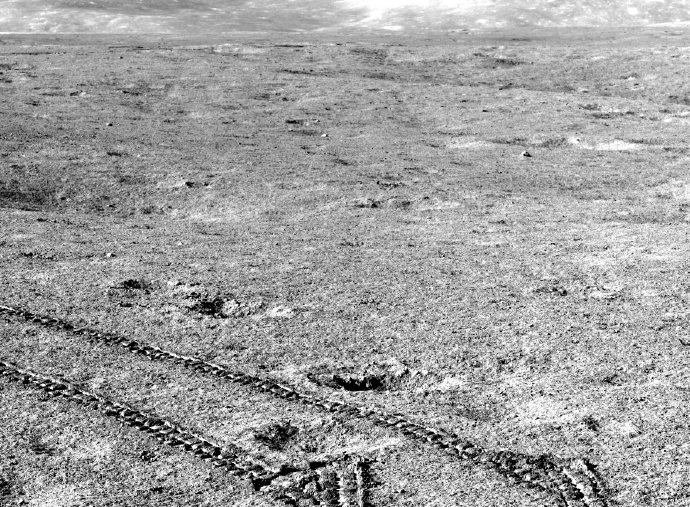
Today The team of the Lunar Exploration Engineering Ground Application System recently announced a new batch of scientific data on Chang’e-4 on the website. Among them, the panoramic camera part of the patrol has a total of about 400 photos, and some of them are selected and put up here.


Most of this batch of photos was taken between July 16th and August 23rd, 2020, and they were taken in full-color mode, so they were black and white photos after processing, but they also magically “included” two Color photo taken on February 7, 2021 (the last two). The photos can be seen from the surface of the moon is really timeless scientifically wild in exploration with wonder, in that wondering hopefully with the Mars rover photographically images data could be fully disclosure….  

Also worth mentioning is the original “lunar exploration data publishing and information service system” website is now fully Revised and renamed “Moon and Planetary Data Release System”, with two different data release pages for “Moon” and “Mars”. At present, the Mars data part is in the protection period application status. Looking forward to the data and images from Tianwen-1 Full disclosure…..

Images and visuals are from CNSA- China National Space Administration also from there respectives…!