#CNSA #ChinaNationalSpaceAdministration #国家航天局 |#BRI #August2023 || #酒泉卫星发射中心 #JiuquanSatelliteLaunchCenter #长征四号  #ChangZheng4C #LongMarch4C Yao 44  successful launched deployed #WeatherSatellite #MeteorologicalSatellite # Fengyun-3C 06 #Satellite

On the 3rd August 2023 early morning Thursday 1147 Hours Hong- Kong SAR – Beijing time CNSA –China National Space Administration , China, People’s Republic of China. Successfully launched the Fengyun-3 06 satellite with the Chang Zheng- Long March 4C Yao 44 carrier rocket at the Jiuquan Satellite Launch Center- Inner Mongolia, and the satellite entered the schedule smoothly. Track, the mission was a complete success. The satellite will replace the Fengyun-3C satellite that has been in orbit for an extended period of time. The detection data will be mainly used for weather forecasting, atmospheric chemistry and climate change monitoring operations and research….. Successfully sent Fengyun 3-06 into sun-synchronous orbit, and the launch mission was a complete success.

长征四号 This is the 100th launch of the Chang Zheng- Long March 4 Carrier Rocket  series of launch vehicles

The launch weight of FY-3 F is about 2,700 kg, and its operating altitude is 830 km. As a sun-synchronous morning orbit satellite, the satellite will replace FY-3 C, which has been in orbit for nearly 10 years. While ensuring the continuity of observation data from global numerical weather prediction satellites, the new generation of Fengyun-3 morning satellites has formed a network of observations with D (afternoon satellite), E (dawn satellite), and G (precipitation satellite) to form four low-earth orbit meteorological satellites in my country. Satellite business network observation “the strongest echelon”, as of now, my country has a total of 9 Fengyun meteorological satellites in orbit.

长征四号 This is the 100th launch of the Chang Zheng- Long March 4 Carrier Rocket  series of launch vehicles. The Long March 4 series of launch vehicles has become the second type of launch vehicle in China with more than 100 launches!

The Long March 4 carrier rocket is one of the main carrier rockets in active service in my country, including three models, the Long March 4A (retired), the Long March 4B, and the Long March 4C. They were launched on September 7, 1988 and May 1999 respectively. The first flight was successful on 10th and April 27th, 2006. At present, Chang Sijia has carried out 2 launch missions, Changsi B has carried out 48 launch missions, and Changsi C has carried out 50 launch missions. This mission is the 191st launch of the Long March series of carrier rockets developed by the General Manager of the Eighth Academy, and the 481st launch of the Long March series of carrier rockets

The first flight, the hundred-flying situation. On September 7, 1988, the Long March 4 Jiayao-1 carrier rocket made its maiden flight and successfully sent my country’s first meteorological satellite, Fengyun-1, into the predetermined orbit, setting a record for a successful first flight of a large-scale carrier rocket in my country and making it my country has become the third country in the world that can independently launch sun-synchronous orbit and polar orbit satellites. According to statistics, the Long March 4 launch vehicle has carried out 4 Fengyun-1 and 7 Fengyun-3 missions, all of which have achieved complete success.

The Long March-4 carrier rocket continues to improve reliability, safety, and adaptability, and has realized that it has only undertaken the launch of polar-orbiting meteorological satellites at the beginning, and now it can perform multiple types of satellite launches such as earth observation, scientific experiments, and lunar relay communications; From one arrow and one satellite to one arrow and multiple satellites in series and parallel; from a specific time….

Images and visuals are from their Respectives CMS China Manned SpaceCNSA-China National Space Administration

#CNSA #ChinaNationalSpaceAdministration #国家航天局 |#BRI #July2023 #August2023 | #天宫 #Tiangong #ChinaSpaceStation #CMS #ChinaMannedSpace #神舟十六号 #Shenzhou16 Awesome #EarthViews with different angles with #SpaceGym #SpaceFitnessClass Action..

On the 30th  May 2023 clear 0931 Hours Morning Hong Kong SAR- Beijing time , the Belt and Road InitiativeCNSA –China National Space Administration from Jiuquan Satellite Launch Center – Inner Mongolia –China – People’s Republic of China deployment of  the Chang Zheng – The Chang Zheng – Long March 2F Yao 16 –Shenzhou 16  carrier rocket.. On which Takionauts Jing Haipeng, Zhu Yangzhu, and Gui Haichao took to the predetermined orbit. The first manned flight mission in the application and development stage was a complete success. The three astronauts will stay in the space station and “join up” with the crew of Shenzhou 15 to carry out on-orbit handover “face-to-face” meeting in which brings the total crew of six with a handover ceremony from Shenzhou 15 towards 16..

On the 28th July 2023 Beijing Time , The  Shenzhou 16 Takionaut crew raised up multiple camera angles to get different perspectives, different stories, backstories videography of  the hat does the earth and the space station look like after seeing it? The crew of Shenzhou 16 astronauts completed the lifting of three external panoramic cameras during the recent out-of-vehicle mission. Today, I will show you the Chinese space station and the A wonderful picture of the earth in the same frame…

On the week of 26th July 2023 awesome Shenzhou 16 A fitness video is out During this hot summer, have you “shut up and open your legs”? Today, our #神舟六号 “Space Coach” will take you to punch in the “golden action” of space fitness, and experience a space exercise in 4 minutes!

Images and visuals are from their Respectives CMS China Manned SpaceCNSA-China National Space Administration

#CNSA #ChinaNationalSpaceAdministration #国家航天局 | #BRI #JuLY2023 #August2023 |#天宫#Tiangong #ChinaSpaceStation #神舟十五号 #Shenzhou15 crew – Highlights The Heroes Returns with Press meeting in #BeijingAerospaceCity ..  

On the Week of 3rd June 2023 Hour Hong- Kong SAR – Beijing time CNSA –China National Space Administration  At the  CNSA- Tiangong –China Space Station At Saturday 21:29 on June 3rd , 2023,  Hong Kong SAR- Beijing time, the manned spacecraft of Shenzhou 15 and the space station assembly successfully separated. Before the separation, the astronaut crew of Shenzhou 15, with the cooperation of the ground personnel, completed various tasks before the evacuation, such as setting the status of the space station assembly, sorting and downloading experimental data, cleaning and transferring materials left in orbit, and cooperated with the crew of Shenzhou 16. The group completed the work handover.

Held in Beijing Aerospace City – CNSA – Beijing, China, People’s Republic of China…… On the afternoon of July 31st , 2023 Monday , 57 days after the return of the Shenzhou 15 astronauts, the China Astronaut Research and Training Center held a During the group and press meeting, the three Takionauts appeared in Beijing Aerospace City full of energy and spirits, officially meeting the public. More than 20 media including People’s Daily, Xinhua News Agency, China Central Radio and Television, PLA Daily, Manned Space Engineering Network,

According to reports, the Takionauts are in good physical and mental condition and have achieved the expected results…… At the meeting, the crew answered reporters’ questions about the stage of staying on the space station and the situation after returning. On the whole, the Takionauts are in good physical and mental condition, and have fully entered the recovery observation stage. After completing the mission and returning to the health assessment summary, the 3 Takionauts will be transferred to normal training work….

Images and visuals are from their Respectives CMS China Manned SpaceCNSA-China National Space Administration

#CNSA #ChinaNationalSpaceAdministration #国家航天局 |#BRI  #July2023 |#西昌衛星發射中心 #XichangSatelliteLaunchCenter  the advance iconic #ChangZheng2D #LongMarch2D launches the #RemoteSensing three  #Yaogan 36 #Satellite .. #AGallery

On the 27th July 2023  in  CNSA _China National Space Administration -China – People’s Republic of China At 0402 Morning hours Hong Kong –Beijing Time China- People’s Republic of China launch the Chang Zheng – Long march 2D  Carrier Rocket launching from station form Xichang Satellite Launch Center Sichuan Province…..successfully launched the Yaogan 36 satellite and successfully launched 150 consecutive Long March series rockets to set a record….  At 4:02 Beijing time 27th July 2023 today, the Long March 2D carrier rocket ignited and took off at the Xichang Satellite Launch Center, and then successfully sent the Yaogan 36 satellite into the predetermined orbit.

The Remote Sensing No. 36 satellite was developed by the Fifth Academy and the Eighth Academy of Aerospace Science and Technology Corporation. This launch is the 480th launch of the Long March series of launch vehicles. So far, the Long March series of launch vehicles has set a record of 150 consecutive successful launches…

Images and visuals are from their Respectives CMS China Manned SpaceCNSA-China National Space Administration

#CNSA #ChinaNationalSpaceAdministration #国家航天局 | #BRI #July2023 |#CASC #ChinaAerospaceScienceAndTechnologyCorporation – #长征十号 #MannedCarrierRocket #CarrierRocketFreighter  #3DPrinting #CarrierRocketEngine Testing the #ChangZheng10 #LongMarch10 engine at Thrust of 130 Tons Successfully …..

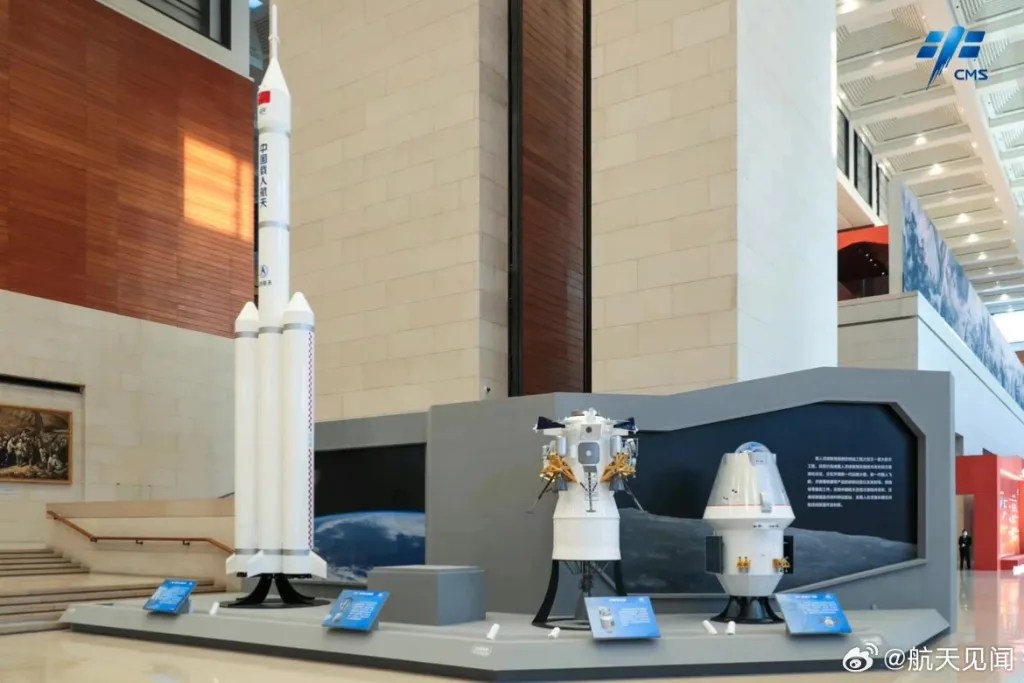
长征十号 At 22nd  23rd July  2023 Hong Kong SAR- Beijing time , China- People’s Republic of China- CNSA –China National Space Administration   Successfully Carrier Rocket  engine tested for the New Next Generation Chang Zheng – Long March 10 Manned Lunar mission landing Carrier rocket freighter The main engine of China’s manned lunar landing rocket Long March 10 completed another ignition test run yesterday, which verified all the requirements of the rocket mission for the engine, and provided strong support for the solidification of the engine’s technical status, the establishment of product technology baselines, and the improvement of reliability.


The engine used in this test run uses advanced liquid oxygen kerosene as fuel, which is improved and iterated from the high-thrust liquid oxygen kerosene engine used by the new generation of launch vehicles such as the active Long March 5, with a thrust of 130 tons. (The Sixth Academy of Aerospace Science and Technology Group)

Created with GIMP

The reporter learned from China Aerospace Science and Technology Group Co., Ltd. on July 23 that the main engine of my country’s manned moon landing rocket was tested in the Fengzhou Test Area of ​​the Sixth Academy of Aerospace Science and Technology Corporation, and achieved continuous success. This test run verified the engine flight mission profile, and provided strong support for the solidification of the engine technical state, the establishment of the product technical baseline, and the improvement of reliability.

The engine is the power source of the rocket, and its development process is very complicated. Test run is an important link in the engine development process, and there are dozens of types. In layman’s terms, engine test run is the process of igniting the engine and verifying the rationality of its design scheme and process reliability. This is an indispensable and important part of the development and delivery of a type 1 engine. It will run through all stages before and after engine development. Each stage of test run has different meanings, and the ignition time varies from a few seconds to hundreds of seconds.

It is reported that the engine used in this test run uses advanced liquid oxygen kerosene as fuel, which is improved and iterated from the high-thrust liquid oxygen kerosene engine used by the new generation of launch vehicles such as the Long March 5. The thrust reaches 130 tons. The R&D team of the Sixth Academy of Aerospace Science and Technology Group adheres to the concept of digital design, and has successively overcome key technical problems such as engine start-up and shutdown sequence, engine wide-range continuously variable thrust, and engine long life and high reliability.

In addition, the continuous success of the test run has fully verified the reliability of a number of new carrying process technologies. The engine production of this test run adopts the concept of intelligent manufacturing, and actively applies new materials, new processes, and new technologies. The inner wall of the thrust chamber of the core component adopts a new protective coating, key assemblies adopt automatic welding technology, and a large number of components adopt 3D printing technology.

During the preparation of the engine test run, the participants in the research and test conducted tests and verifications on each subsystem of the test through comprehensive means such as digital modelling, simulation calculation, and system debugging. The successful test run shows that the test area has greatly improved the multi-station parallel test run capability and test efficiency by optimizing the workflow.

Images and visuals are from their Respectives CMS China Manned SpaceCNSA-China National Space Administration  the Sixth Academy of Aerospace Science and Technology Group