#CNSA #ChinaNationalSpaceAdministration #国家航天局 |#BeltAndRoadinitiative #CLEP #July2022 | #VonKarmanCrater #LunarMission #Change4 #Yutu2 travelling 1239.88 meters on #LunaExploration reveal the secrets of the Antarctic-Aiken Basin ……

As of Month of 7th July 2022, The CNSA –China National Space Administration CLEP- China Lunar Exploration Program  Belt and Road Initiative Lunar Mission……Chang’e-4 with Yutu two the Lunar rover still working exploring more than moved more than 1239.88  meters on the other side of the moon on the 103 Kilometers Diameter Von Karman Crater in which is least than two length by length fifty five Kilometers Hong Kong –Macau- Zhuhai Bridges …. Working Exploring the Crater on the other side of the Moon Chang’e Luna…. Chang’e-4 completed the 44th day of work, and the results revealed the cause of the abnormal area of ​​​​the Moon’s South Pole-Aiken ….composition travelling The “Yutu 2” lunar rover and lander of the Chang’e The total mileage of the lunar rover on the far side of the moon is 1239.88 meters

In which Chang’e-4 research results reveal the secrets of the Antarctic-Aiken Basin The cause of the abnormal area of ​​composition…..

The South Pole-Aiken Basin is the largest impact basin on the Moon, with a diameter of over 2,400 kilometers. The study of the South Pole-Aiken Basin is of great significance for revealing the origin of the lunar asymmetry, the impact process, the early evolution process and the composition of the deep material. Orbital remote sensing observations show that there is a compositional anomaly in the center of the Antarctic-Aiken Basin. The planetary science team of Shandong University analyzed and interpreted the in-situ visible and near-infrared spectral data of the Yutu-2 lunar rover and found that the lunar crust is the Antarctic-Aiken composition anomaly. The main material source provides important constraints for the future exploration of materials in the Antarctic-Aiken Basin and even the deep parts of the moon.


​The main material components on the lunar The material composition at the bottom of the South Pole-Aiken Basin is abnormal, and the content of mafic silicate minerals and iron is significantly higher than that in the peripheral area of ​​the basin (Figure 1).

Figure 1. The distribution of iron and pyroxene content inside and outside the Antarctic-Aiken Basin

Most of the previous studies on the material composition of the Antarctic-Aiken Basin only focused on mafic minerals. Due to the anomalous characteristics of mafic in this region, there has even been a debate about whether the lunar mantle is peridotite or pyroxene. Although according to the lunar magma ocean hypothesis, olivine and pyroxene are the main minerals of the lunar mantle, the plutonic magma intrusion after the formation of the lunar crust can also form rocks rich in olivine or pyroxene in the lunar crust, so olivine is enriched Or pyroxene does not serve as evidence of origin from the lunar mantle. So far, humans have not obtained samples from the Antarctic-Aiken Basin and returned to Earth, and their trace elements and isotopic characteristics cannot be known. Among the material composition information available through remote sensing or in situ detection, the plagioclase content also distinguishes crust-derived and mantle-derived rocks. key indicators.

Figure 2. Mineral composition and source reservoir of Chang’e-4 landing area

​The content of plagioclase in the material of the Antarctic-Aiken composition anomaly area sputtered by the Finsen
Numerical simulation studies believe that during the excavation process of the South Pole-Aiken impact, the lunar crust has been completely stripped, but in the subsequent transformation stage, the collapse of the instantaneous crater wall may cause the lunar crustal material to slip off the bottom of the basin. In addition, other basin impact events after the Antarctic-Aiken impact event also produced a backfilling effect on the bottom of the Antarctic-Aiken Basin, and the exposed lunar mantle material or impact melting products during the formation of the basin is likely to have been diluted by the lunar crust material. Mineralogical and geochemical unmixing analysis results show that the lunar soil on the surface of the anomalous area is composed of about 70% of the lunar crust material and about 30% of the material enriched in iron and incompatible elements.

The first author of this research is postdoctoral fellow Chen Jian of Shandong University, and the corresponding author is Professor Ling Zongcheng, head of the planetary science team of Shandong University and senior researcher of the Center for Excellence in Comparative Planetology, Chinese Academy of Sciences. It was published in The Astrophysical Journal Letters, an international astronomy journal …..

Images and visuals are from their Respectives source CLEP – China Lunar Exploration Project

CNSA #ChinaNationalSpaceAdministration #國家航天局 |#BeltAndRoadinitiative #June2022 | #火星 # 天問 #天问一号#TianwenOne #MarsMission #Tianwen1 probe  #祝融号 #ZhuRong #Tianwen1 completes the established scientific exploration mission…

Tianwen-1 completes the established scientific exploration mission

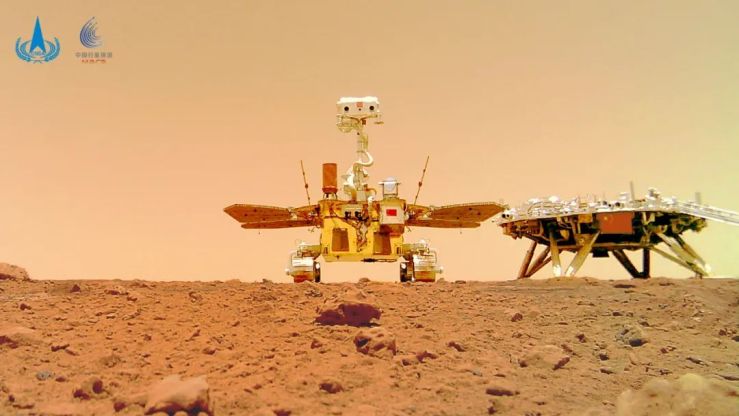
天问一号飞運騎遊達达3亿CNSA – China National Space Administration – ESA – European Space agency Belt and road initiative mars mission…first Mars exploration mission, Tianwen- Martian Probe One ​​​As of June 29, 2022, the Tianwen-1 mission orbiter has been flying normally for 706 days, and has acquired medium-resolution image data covering the entire world of Mars. All scientific payloads have achieved global exploration of Mars. Both the Tianwen-1 mission orbiter and the Mars rover have completed the established scientific exploration missions.

The Tianwen-1 mission was approved by the Party Central Committee in January 2016, and was successfully launched on July 23, 2020. After a deep space flight of 475 million kilometers for 202 days, the probe will rendezvous with Mars on February 10, 2021, and successfully implemented the capture and braking to enter the orbit around Mars. After 3 months of detailed inspection of the pre-selected landing area, the Mars landing was successfully carried out on May 15, 2021. On May 22, the “Zhurong” rover successfully landed on the surface of Mars and began to patrol and explore.

On August 15, 2021, the “Zhurong” rover successfully completed the 90 Martian scientific exploration missions, and continued to carry out extended exploration missions. It has traveled 1,921.5 meters on the surface of Mars. Affected by the severe winter cold and dusty weather in the landing area, the rover will enter the winter dormancy mode on May 18, 2022 as designed. Around December 2022, the “Zhurong” landing area will enter the early spring season. will resume normal work.

The orbiter has circled Mars 1,344 times, achieving global coverage and is currently in normal condition. In the follow-up, it will continue to carry out global remote sensing detection, and choose an opportunity to carry out expansion technology experiments to carry out preliminary technical verification for related tasks.

After nearly two years of flight and exploration for the Tianwen-1 mission, the 13 scientific payloads deployed by the rover and orbiter have obtained a total of about 1040GB of raw scientific data. After receiving and processing on the ground, the standard scientific data products formed are submitted to the rover on a monthly basis. A team of scientists has conducted analysis and interpretation, and relevant scientific results have been published in well-known academic journals at home and abroad. These scientific data will be open to scientists around the world at an appropriate time. Scientists around the world are welcome to actively apply for research and jointly promote the cause of human exploration of the universe.

In the spirit of open and shared cooperation, the National Space Administration actively promotes cooperation with the space agencies and scientific communities of various countries, and shares the orbital data of its Mars orbiter with the National Aeronautics and Space Administration (NASA) and the European Space Agency (ESA) to carry out collision warning. Cooperation; the “Zhurong” Mars rover and the European Space Agency’s “Mars Express” orbiter carry out data relay communication experiments to realize China-Europe Mars scientific data relay cooperation; Observatory stations in other countries use the Tianwen-1 orbiter and the “Mars Express” orbiter to jointly carry out occultation observations of the sun and conduct scientific research such as solar wind. These cooperation have achieved good results, enriched human knowledge, and made positive contributions to the construction of a community with a shared future for mankind in the scientific field.
 

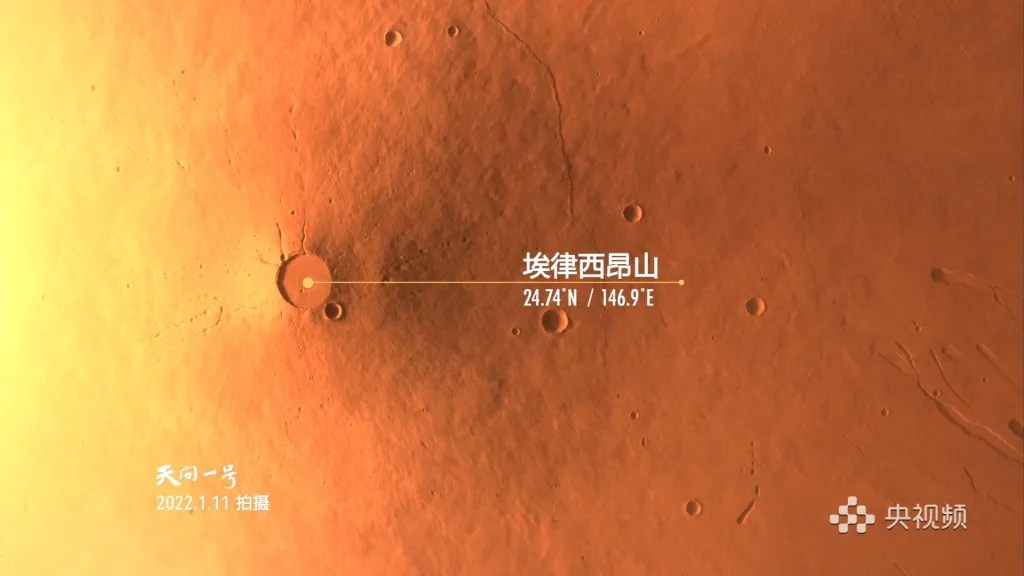
Below is a recent image of Mars taken by Tianwen-1. 

Figure 1 The image of Mount Askela taken by the center camera, with a diameter of 456 kilometers and a height of 18 kilometers , shows the characteristics of the crater on the top of Mount Askela, and there are multiple crater collapse events.
Figure 2 An image of the Antarctic ice sheet taken by the center camera. The image shows the polar cap of the Martian South Pole. The study believes that the long-term and permanent polar cap of the Martian poles is mainly composed of dry ice (solid carbon dioxide) and water ice.

Figure 3 The central point camera captures the western landform image of the Sailor Grand Canyon. The Sailor Grand Canyon extends over 4,000 kilometers from east to west, 150 kilometers to 700 kilometers from north to south , and the deepest can reach 7 kilometers .
Figure 4. The image of the Arabian Highlands impact crater taken by the camera in the middle point. The image shows the geomorphological features of dozens of impact craters distributed in the area.

Figure 5 The image of the edge of the Mond ring crater captured by a high-resolution camera with a spatial resolution of about 0.5 meters and a diameter of about 91 kilometers . The image shows the geomorphological features of the edge of the Mond ring crater. The lower left part of the picture is the inside of the ring crater. The edge of the pit can be seen clearly collapsing into the pit.
Figure 6 The image of the inspection area taken by Zhurong. The image was taken before the rover entered the winter dormancy state, showing the local characteristics of a dune landform in the inspection area.

Images and visuals are from CNSA- China National Space Administration also from there respectives- CLEP –China Lunar Exploration Project..

#CNSA #ChinaNationalSpaceAdministration #国家航天局 |#BeltAndRoadinitiative #CLEP #June2022 | #VonKarmanCrater #LunarMission #Change4 #Yutu2 #ChineseAcademyOfSciences Research Reveals the Constraints of the Chang’e-4 Infrared Imaging Spectroscopic Ground Validation Experiment on the Material Composition of the Lunar SPA Surface…

As of Month of April 2022, The CNSA –China National Space Administration CLEP- China Lunar Exploration Program  Belt and Road Initiative Lunar Mission……Chang’e-4 with Yutu two the Lunar rover still working exploring more than moved more than 1142.39 meters on the other side of the moon on the 103 Kilometers Diameter Von Karman Crater in which is least than two length by length fifty five Kilometers Hong Kong –Macau- Zhuhai Bridges …. Working Exploring the Crater on the other side of the Moon Chang’e Luna….

On 27th June 2022 the Chinese Academy of Sciences Research Reveals the Constraints of the Chang’e-4 Infrared Imaging Spectroscopic Ground Validation Experiment on the Material Composition of the Lunar SPA Surface

The Infrared Imaging Spectrometer (VNIS) on the Yutu No. 2 Lunar Rover has measured infrared imaging spectral data at multiple locations along the rover’s walking route. VNIS is the main method used to study the composition of lunar soil and lunar surface rocks in the landing area and to trace their origin. The research of the Institute of Geology and Earth Sciences, Chinese Academy of Sciences revealed the constraints on the composition of the lunar SPA surface by the Chang’e-4 infrared imaging spectroscopy ground verification experiment.

The Yutu-2 rover has been working on the lunar surface for more than 40 months, and the infrared imaging spectrometer (VNIS) it carried has measured infrared imaging spectral data at multiple locations along the rover’s walking route. VNIS is the main method used to study the composition of lunar soil and lunar surface rocks in the landing area and to trace their origin. However, factors such as space weathering, particle size and multiple scattering, the spectral response of the instrument, and observation conditions all affect the spectral characteristics and lead to large uncertainties in the mineral composition calculated from the lunar surface spectral data.

  In order to quantitatively evaluate the reliability of different VNIS data processing methods, Chang Rui, a doctoral student in the Key Laboratory of Earth and Planetary Physics, Institute of Geology and Geophysics, Chinese Academy of Sciences, under the guidance of his supervisor researcher Yang Wei and associate researcher Lin Honglei, selected a mineral composition with Spectroscopic ground verification experiments were performed on the Suchang-gabbro with similar lunar highland rocks (Fig. 1). The rock (CR-1) studied by the ground verification experiment has an actual mineral pattern content of 12.9% olivine, 35.0% pyroxene and 52.2% plagioclase, as measured by scanning electron microscopy. In order to more accurately calculate the spectral results of CR-1, the researchers ground and sorted the olivine, low-calcium pyroxene, high-calcium pyroxene and plagioclase from the rock samples in CR-1. -4, ASD) to measure the visible-near-infrared spectral results of each single mineral (Fig. 2a), and each single mineral has its own spectral absorption characteristics. The spectrum of CR-1 measured by the VNIS identifier showed distinct absorption features at the 971 (±1) nm and 1957 (±8) nm bands (Fig. 2b). This absorption feature is similar to the rock absorption feature detected by VNIS on the Yutu-2 rover on the third day of the month. The Hapke model of the VNIS spectrum of CR-1 calculated the mineral pattern content of the sample to be 7.5% olivine, 39.3% pyroxene and 53.2% plagioclase, which were consistent with the true results within the error range.

  According to the data processing method in this study combined with the photometric correction of the Chang’e-4 lunar surface data by Yang et al. (2020), the more accurate mineral model content of the rocks detected by the Yutu-2 rover on the third day should be 11.7 % olivine, 42.8% pyroxene and 45.5% plagioclase. The rover found another lunar surface rock on the 26th day with spectral absorption characteristics similar to those found on the 3rd day, with mineral pattern contents of 3.2% olivine, 24.6% pyroxene, and 72.2% plagioclase. The two lunar surface rocks belong to the sutraite category in the “Anorthosite-Norite-Troctolite” (ANT) system (Fig. 3) (Heiken G, 1991), which means that the Chang’e-4 landing area lunar The rock formations under the soil are mainly ANT rocks. The rocks detected by the Yutu-2 rover on the 26th day contained more plagioclase and were closer to the mineral composition of the average lunar crust.

  To sum up, the lunar surface of the Chang’e-4 landing area has su-long and plagio-like rocks, which represent the material formed by the rapid crystallization in the impact melting pool and the composition of the average lunar crust, respectively. On the one hand, an impact event excavated material from the underlying layers of lunar soil to the lunar surface. These excavated materials have the characteristics of crystalline plutonic rocks in the molten pool of the South Pole Aitken Basin (SPA). On the other hand, the initial lunar crustal material formed before the SPA big impact event can also be retained in the SPA.

  The related research results were published in Remote Sensing . The research work has been funded by the Strategic Pilot Science and Technology Project of the Chinese Academy of Sciences, the Key Deployment Project of the Chinese Academy of Sciences, the Innovation Interdisciplinary Team of the Chinese Academy of Sciences, the Civil Aerospace Pre-research Project of the National Space Administration, and the Key Deployment Project of the Institute of Geology and Geophysics of the Chinese Academy of Sciences.
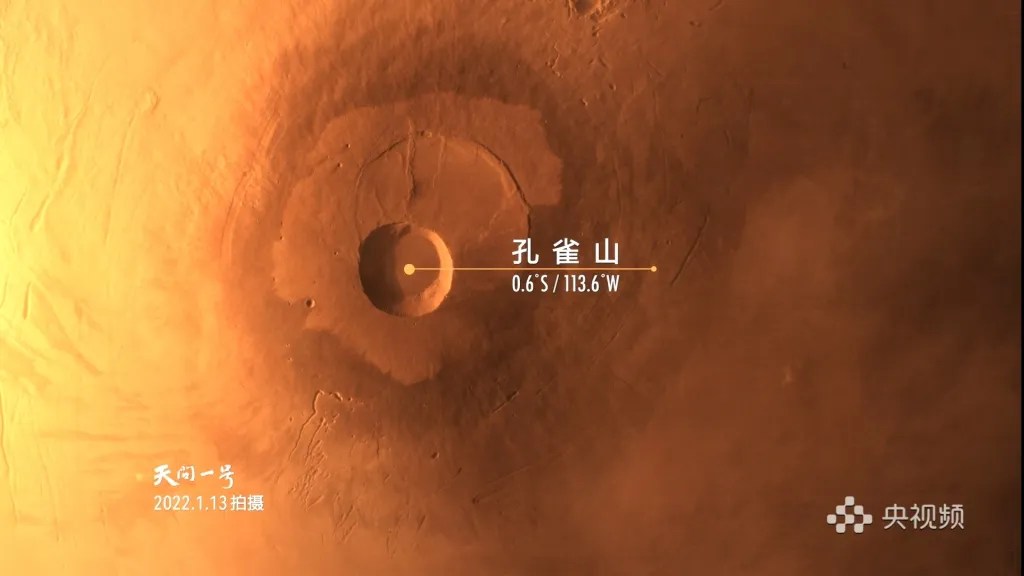
Figure 1. (a) The image of the lunar surface rock detected by Chang’e-4 on the third month; (b) the spectral detection status of the lunar surface rock (the yellow circle represents the near-infrared spectral detection field); (c) the ground verification of this study The rock used in the experiment (CR-1)

Figure 2. (a) Visible-NIR spectra of single minerals in CR-1; (b) VNIS spectra of rocks and CR-1 measured on the third day of Chang’e-4

Fig. 3. Mineral composition distribution of olivine-pyroxene-plagioclase in lunar surface rocks measured by Chang’e-4 (Heiken G, 1991). The lunar sample sampling points are marked in the figure, for example: A-11 is Apollo 11, L-16 is Luna 16, (H) and (M) represent high ground and lunar soil, respectively

Images and visuals are from their Respectives source Chinese Academy of Sciences .. 52 Sanlihe Rd., Xicheng District, Beijing, China (100864)- People’s Republic of China.

#CNSA #ChinaNationalSpaceAdministration #国家航天局 |#BeltAndRoadinitiative #June2022 | #嫦娥五号#CLEP The #Moon #Change5 #LunarMission #MonsRumker #LunaExploration Announcement The new results reveal the distribution characteristics of lunar surface water in the landing area. The lunar soil contains water in the form of hydroxyl groups …

More than One year ago on 24th November 2020, the Chang Zheng – Long March Five Carrier Rocket Launched away  in CNSA – China National Space Administration China Wenchang spaceport launch, Change Five  Lunar probe into orbit, opened up towards China – People’s Republic of China’s first celestial bodies sample return trip from Mons Rumker on the Lunar Surface.……  

[The new results of Chang’e 5 reveal the distribution characteristics of lunar surface water in the landing area. The lunar soil contains water in the form of hydroxyl groups]

On June 15, “Nature Communications” published an important research result of my country’s Chang’e 5 online.
Whether there is water on the moon, how much water there is, what form of water it is, and where the water comes from is controversial, and it has always been a research hotspot in lunar science. At the beginning of the Chang’e-5 mission project demonstration, the research team proposed to extend the spectral range of the lunar mineral spectrometer on the lander to 3.2 μm, and realized the first in-situ detection of the spectral absorption characteristics of lunar surface water in the world. In order to avoid the impact of the dynamic “water” (hydroxyl OH) when the engine plume and the solar wind bombard the lunar surface on the in-situ spectral analysis, the research team carefully designed the timing of acquiring the in-situ detection spectral data. The detection timing was selected 6 hours after landing to avoid the influence of the engine plume composition when the CE-5 probe landed; The dynamic “water” of the lunar surface; the moon (landing zone) is under the protection of the earth’s magnetic field during the spectral measurement, which shields the solar wind and avoids the dynamic “water” (hydroxyl OH) factor produced by the bombardment of the solar wind. In this environment, the Chang’e-5 spectrometer can obtain a “clean” absorption spectrum of “water”. After strict correction and analysis, the research team found that the lunar soil in the Chang’e-5 landing area obviously contains “water” in the form of hydroxyl groups. But the average content is low, only about 30ppm.


At present, it is believed that there are three main sources of lunar “water”: one is (dynamic) hydroxyl substances produced by the interaction between solar wind particles and lunar surface materials; the other is water and hydroxyl-containing substances brought by comets or meteorites that hit the moon; Lunar primary (internal) water. After the lunar samples were returned to Earth, the research team conducted a systematic analysis of the returned lunar samples in the laboratory. The laboratory spectral analysis once again verified the clear existence of hydroxy water, but the research on the existence form, content and source of “water” requires detailed research. Mineral petrological analysis. The Apollo lunar sample study believes that the (impact) cemented glass in the lunar soil contains hydroxyl substances formed by the long-term injection of the solar wind, and the content of cemented glass is an important factor affecting the “water” content in the lunar sample. Laboratory analysis of the returned samples showed that the Chang’e 5 lunar sample is a type of young basalt with a very small content of cemented glass (less than 16%), which is only 1/3 of the Apollo 11 lunar sample, so it is estimated that the Chang’e 5 lunar soil sample The “water” from the solar wind injected into the cemented glass is not more than 18ppm. At the same time, the foreign impact sputters in the lunar soil samples of the Chang’e-5 landing area are very low, and their contribution to “water” can be ignored. Therefore, there must be primary water originating from the interior of the moon in the Chang’e-5 lunar soil samples. Laboratory analysis of the Chang’e-5 lunar samples found at least one hydrous mineral, hydroxyapatite, whose content was uneven, ranging from 0 ppm to 179 ppm (average about 17 ppm) in equivalent samples of hydroxy water, proving that The presence of “water” from the magma crystallization process in the Chang’e-5 lunar soil samples indicates that “water” not only existed, but also played a very important role in the late lunar magmatic activity.


The lunar in-situ detection spectral data of this research result were obtained by the Lunar Mineral Spectrum Analyzer developed by the Shanghai Institute of Technical Physics, Chinese Academy of Sciences. The operation management, data reception and processing of the scientific detection load were carried out by the National Astronomical Observatory of the Chinese Academy of Sciences (Lunar Exploration Engineering Ground Application System).

Via CNSA China Space Administration –CLEP China Lunar Exploration project management office

CNSA #ChinaNationalSpaceAdministration #國家航天局 |#BeltAndRoadinitiative #May2022 | #火星 # 天問 #天问一号#TianwenOne #MarsMission #Tianwen1 probe  #祝融号 #ZhuRong #Tianwen1 #CCTV #HelloMars Episode Five What skills does it take to drive on Mars? See how the Zhurong rover visits Mars Hello Mars

“Hello! Mars” Episode 5 What skills do you need to learn to drive on Mars? See how the Zhurong rover visits Mars Hello Mars…….!

On the months week of 19th May 2022   天问一号飞運騎遊達达3亿CNSA – China National Space Administration – ESA – European Space agency Belt and road initiative mars mission…first Mars exploration mission, Tianwen- Martian Probe One sent back stunning images of the Half Earth Mass size of the Rustic Planet Mars in which show stunning Martian landscape with its iconic polar caps of either southern or northern … With its timeless Stunning Mars Photography. Tianwen-1″ returned high-resolution images of the Mars inspection area The “Zhurong” rover is preparing for winter, and the orbiter continues to carry out orbital exploration….. in which one year ago it was it’s first landing on Utopia Planitia region on the planet Mars .. in celebrating a CCTV five part Episode was produced..

《你好!火星》Hello Mars Episode five  Two Driving on Earth pays attention to “there are thousands of roads, and safety is the first”, but on Mars, it becomes “there is no road, and safety is more important”. This place in the southern part of the Utopia Plain, although it is flat and open as far as the eye can see, is full of small pits and sand dunes. Driving in this place requires not only superb driving skills, but more importantly, a good car with eighteen martial arts skills. The rover’s design team finally designed this good car with experience and bold innovation.

本期内容:在地球上开车讲究“大路万千条,安全第一条”,在火星上就变成了“大路没一条,安全更重要”。乌托邦平原南部这块地方,虽然一望无际平坦开阔,但石块小坑沙丘比比皆是,在这种地方行车不仅需要车技高超,更重要的是需要一辆具有十八般武艺的好车。火星车的设计团队凭着经验和大胆创新最终设计出了这辆好车。

Hello everyone, I would like to tell you some good news about the documentary “Hello!” about China’s first Mars exploration mission. “Mars” is finally on the air, friends who want to know more about Mars can stay in front of the TV tonight

“Hello! “Mars” is a large-scale scientific documentary jointly produced by the National Space Administration and China Central Radio and Television to commemorate the first anniversary of the Tianwen-1 Mars probe’s successful landing on Mars. It took three years to complete the filming and is divided into “Departure” and “Journey” “Surrounding”, “Landing” and “Patrol” have 5 episodes, each of which is 30 minutes long. They focus on the important stages of the Tianwen-1 mission, and describe a large number of astronomy, astrophysics, space applications, aerospace engineering and other disciplines in a simple way. Knowledge, in-depth analysis of Chinese wisdom and Chinese solutions in Mars exploration. Since May 2020, the co-production team has continued to track the key nodes of the Tianwen-1 mission, filmed many wonderful moments, and obtained a large number of first-hand precious materials. Many of the contents of the documentary were made public for the first time and were released authoritatively.


Broadcasting plan CCTV-1 CCTV integrated channel every night at 22:36, five days of continuous broadcast from May 18th to 22nd; CCTV-10 CCTV science and education channel every night at 20:10, from May 19th to 23rd five days of continuous broadcast

大家好,告诉大家一个好消息,讲述中国首次火星探测任务的纪录片《你好!火星》终于要开播啦,想更多了解火星的朋友们今晚可以守在电视机前哟《你好!火星》是为纪念天问一号火星探测器成功着陆火星一周年,由国家航天局和中央广播电视总台联合出品的大型科学纪录片,共历时3年摄制完成,分为《出发》《征途》《环绕》《着陆》《巡视》5集,每集30分钟,分别聚焦天问一号任务的重要阶段,以深入浅出的形式讲述了大量天文学、天体物理学、空间应用学、航天工程学等学科知识,深度解析了火星探索中的中国智慧、中国方案。联合摄制团队自2020年5月起,持续跟踪天问一号任务关键节点,拍摄众多精彩瞬间,获得大量一手珍贵素材,纪录片中很多内容是首次公开,并权威发布。


播出计划CCTV-1央视综合频道 每晚22:36,5月18日至22日五天连播;CCTV-10央视科教频道 每晚20:10,5月️19日至23日五天连播

Images and visuals are from CNSA- China National Space Administration also from there respectives- CLEP –China Lunar Exploration Project..