#CNSA #ChinaNationalSpaceAdministration #国家航天局 |#BeltAndRoadinitiative #November2021 | #嫦娥五号The #Moon #Change5 probe its Heroic #LunarMission from #MonsRumker #LunaExploration #Review of the first anniversary of the Chang’e 5 mission-the  #ChangZheng5 #LongMarch5 #CarrierRocket arrow points to the sky …..

One year ago today 24th November 2020 Now it’s the 24th November 2021 , the Chang Zheng – Long March Five Carrier Rocket Launched away  in CNSA – China National Space Administration China Wenchang spaceport launch, Change Five  Lunar probe into orbit, opened up towards China – People’s Republic of China’s first celestial bodies sample return trip from Mons Rumker on the Lunar Surface.……  

Highlight 1: Narrow window launch The launch window is the ignition time period for the launch vehicle to meet the needs of the transfer to the moon. Due to the typhoon and strong tropical cyclone in Wenchang area, high-altitude wind, heavy rainfall, thunderstorms and other meteorological conditions are very complicated, it can be imagined. The narrower the window, the greater the risk of launching large cryogenic launch vehicles. There are many factors that determine the launch window, such as the relative position of the launch site and the target point, the safe landing zone of the rocket wreckage, the time of sunlight after the launch probe (satellite) enters orbit, the measurement and control arc, the lunar landing zone, and the lunar take-off time , Re-entry return time, etc. The more the launch constraint conditions, the narrower the launch window. In order to ensure the reliable implementation of the Chang’e-5 mission, it is necessary to solve the design difficulties of the multi-orbit moon launch scheme under the constraints of the range of launch, the safety of the landing zone, the measurement and control of the ascent section, and the rocket taxi time.

Aspect 2: During the two-stage taxiing process of the accurate low-temperature launch vehicle in the landing zone of the rocket, the quality of the propellant will decline with the passage of time, so the longer the taxiing time, the more unfavourable the startup of the low-temperature power system. For this reason, the rocket system has carried out a large number of ground tests, and the three flights of the Long March 5 have fully evaluated and verified the long sliding ability of the model. The rocket area of ​​the Chang’e-5 mission must fly over the Philippine Islands. The booster landing area is located west of the Philippines, the fairing landing area is located east of the Philippines, and the core landing area is located in the Pacific Ocean. Multi-ballistic launching has caused significant horizontal and vertical dispersion in the sub-level wreckage landing area. Therefore, if the mission permits, the range of the shooting direction and dispersion must be minimized to optimize the safety of the landing area. The scientific research team carried out multiple rounds of optimization design for the horizontal and vertical dispersion of the multi-ballistic trajectory to the moon with variable firing direction and variable glide time. In the end, the rocket wreckage landed exactly in the intended sea area. Aspect 3: Multi-trajectory, “moving target shooting”

A key technology in the launch phase of the Chang’e-5 mission is multi-ballistic launch, that is, within 3 consecutive days, there are 5 nominal trajectories with 10 minute intervals between take-offs every day, evenly covering the 50-minute launch window. The purpose of multiple ballistics is to achieve “mobile shooting” with different take-off points and the same destination during the relative movement of the earth and the moon. As long as the launch vehicle ignites within the launch window and sends the probe into a predetermined Earth-Moon transfer orbit, the probe can fly to the near-moon point at exactly the same time, altitude, incident angle, illumination, and measurement and control conditions. Through the detailed orbit design, the outstanding performance of the launch vehicle systems, and the concerted cooperation of various departments, the Chang’e-5 probe was sent into the scheduled orbit with very high accuracy, laying a solid foundation for the subsequent flight missions.

Aspect 3: Multi-trajectory, “moving target shooting” A key technology in the launch phase of the Chang’e-5 mission is multi-ballistic launch, that is, within 3 consecutive days, there are 5 nominal trajectories with 10 minute intervals between take-offs every day, evenly covering the 50-minute launch window. The purpose of multiple ballistics is to achieve “mobile shooting” with different take-off points and the same destination during the relative movement of the earth and the moon. As long as the launch vehicle ignites within the launch window and sends the probe into a predetermined Earth-Moon transfer orbit, the probe can fly to the near-moon point at exactly the same time, altitude, incident angle, illumination, and measurement and control conditions. Through the detailed orbit design, the outstanding performance of the launch vehicle systems, and the concerted cooperation of various departments, the Chang’e-5 probe was sent into the scheduled orbit with very high accuracy, laying a solid foundation for the subsequent flight missions.

Images and visuals are from Weibo and their respectives…. Of CNSA China National Space Administration …  

#CNSA #ChinaNationalSpaceAdministration #国家航天局 |#BeltAndRoadinitiative #October2021 | #嫦娥五号The #Moon #Change5 probe its Heroic Lunar Mission from #MonsRumker #LunaExploration #Chang’e5 Research lunar samples refreshing Traditional Understanding of Lunar Evolution…

On October 19th Thursday 2021, the Chinese Academy of Sciences  released the latest research results of the Chang’e-5 lunar scientific research samples. A number of breakthroughs have given a new understanding of the evolution of the moon. The research results of the lunar samples of Chang’e 5 show that magma activity still existed on the moon until 2 billion years ago. The lunar mantle source area of ​​late magma activity is not rich in radioactive heat-generating elements and is very “dry”. This series of research is led by the Institute of Geology and Geophysics of the Chinese Academy of Sciences and the National Astronomical Observatory, and jointly carried out by a number of research institutions. The related results have formed 4 papers, one published in the “National Science Review”, and published in the international academic journal “Nature” 3 articles.

The duration and geochemical characteristics of the lunar basalt magma are the “keys” for understanding the thermal-chemical evolution of the moon. Previous studies have confirmed that magma activity on the moon lasted at least approximately 2.8 to 3 billion years ago. However, there has been controversy in the scientific community about the exact time when the lunar magma activity ceased. The study found that the lunar sample of Chang’e 5 is a new type of lunar basalt, which is different from the lunar samples collected and returned by the United States and the Soviet Union. Researchers analyzed more than 50 uranium-rich minerals in the basalt cuttings of the Chang’e 5 lunar sample and determined that the basalt formation age was 20.30±0.04 billion years, indicating that there was still magma activity on the moon until 2 billion years ago, which is more than the limit of previous lunar samples. Magma activity has been extended for about 800 million years.

​10月19日,中国科学院发布嫦娥五号月球科研样品最新研究成果,多项突破性进展给出了对月球演化的全新认识。嫦娥五号月球样品研究结果显示,月球直到20亿年前仍存在岩浆活动,晚期岩浆活动的月幔源区并不富含放射性生热元素,而且非常“干”。该系列研究由中国科学院地质与地球物理研究所和国家天文台主导,联合多家研究机构共同开展,相关成果形成4篇论文,在《国家科学评论》发表1篇,在国际学术期刊《自然》发表3篇。

月海玄武岩浆的持续时间和地球化学特征是理解月球热-化学演化的“钥匙”。此前的研究已证实,月球岩浆活动至少持续到大约28亿至30亿年前。但对于月球岩浆活动停止的确切时间,科学界一直存在争议。研究发现,嫦娥五号月球样品为一类新的月海玄武岩,不同于美国和苏联采集返回的月球样品。科研人员对嫦娥五号月球样品玄武岩岩屑中50余颗富铀矿物进行分析,确定玄武岩形成年龄为20.30±0.04亿年,表明月球直到20亿年前仍存在岩浆活动,比以往月球样品限定的岩浆活动延长了约8亿年。

The cause of the most recent magmatic activity on the Moon has always been an unsolved mystery. At present, there are two possible explanations in the scientific community: the lunar mantle source is rich in radioactive elements to provide a heat source, or the lunar mantle is rich in water to lower its melting point. The latest study found that the lunar mantle source area of ​​the basalt from the lunar sample of Chang’e 5 is not enriched in “Krip material.” Since the “Krip material” is rich in radioactive heat-generating elements, this result proves that the radioactive heat-generating elements of the lunar mantle are not the main reason for the formation of the basalt of the Chang’e-5 lunar sample. Regarding whether the magma source area is rich in water, the research team measured the water content and hydrogen isotopic composition in the basalt of the Chang’e 5 lunar sample, and found that the water content in the lunar mantle source area was only 1 to 5 micrograms/g, which means that the lunar mantle Very “dry”. This discovery also excludes the hypothesis that the lunar mantle is rich in water and has a low melting point, resulting in an abnormally prolonged duration of magma activity in this area.

月球最晚期岩浆活动的成因一直是未解之谜,目前科学界存在两种可能的解释:月幔源区富含放射性元素以提供热源,或月幔富含水从而降低其熔点。最新研究发现,嫦娥五号月球样品玄武岩的月幔源区并不富集“克里普物质”。由于“克里普物质”富含放射性生热元素,这一结果证明月幔放射性生热元素并不是形成嫦娥五号月球样品玄武岩的主要原因。对于岩浆源区是否富含水,科研团队测定了嫦娥五号月球样品玄武岩中的水含量和氢同位素组成,发现月幔源区的水含量仅为1至5微克/克,也就是说月幔非常“干”。这一发现也排除了月幔富水而具有低熔点,导致该区域岩浆活动持续时间异常延长的猜想。

Water content and hydrogen isotopic composition of apatite and melt inclusions in the Chang’e-5 basalt sample
Backscattered scanning electron microscope image of apatite and magma inclusions in the Chang’e-5 basalt (a) A complete picture of the basalt cuttings (406-010,023) in the alloy target. The cuttings are mainly composed of olivine (Ol), It is composed of pyroxene (Px), feldspar (Pl) and ilmenite (Ilm), and a small amount of iron olivine (Fa), meteorite (Tro), spinel (Sp), apatite (Apa) and Quartz (Q). 
(B), (c) and (d) are the partial images of the cuttings respectively. 
(B) The figure shows the melt inclusion (MI) surrounded by ilmenite. 
(C) and (d) show that apatite is mainly produced in the intergranular area and is euhedral or semi-automorphic

According to the hypothesis of the origin of the big impact, the original Earth collided with a planetary planet the size of Mars, forming a “disk” composed of high-temperature magma and gas around the earth. When the temperature begins to cool, materials such as silicate first gather to form the moon (Figure 1), and water is a highly volatile material that escapes into space in a gaseous form and is lost. Therefore, the moon born in this way contains almost no water and is a nearly dry planet. The research results of the lunar samples of Chang’e 5 further provided supporting evidence for the origin and evolution of the moon, raised new scientific questions for the study of the lunar thermal evolution history, and proposed new directions for future lunar exploration and research.

We welcome domestic and foreign scientists to join the ranks of the research on these data and samples. At present, research on lunar samples is mainly carried out by domestic scientific research institutions, and foreign scientists have joined the Chinese team to carry out joint research. In the follow-up, we will issue relevant policies, uphold the principles of “equality and mutual benefit, peaceful use, and inclusive development”, expand international exchanges and cooperation, and provide more Chinese wisdom, Chinese solutions, and Chinese power for the peaceful use of space and the promotion of a community with a shared future for mankind.

根据大撞击起源假说,原始地球与一个火星大小的星子碰撞,形成了一个围绕地球的、由高温岩浆和气体组成的“盘”。当温度开始冷却时,硅酸盐等物质首先聚集形成月球(图1),而水属于强挥发的物质,会以气态形式向太空逃逸而丢失。因此,这种方式诞生的月球,几乎不含水,是一个近乎干透了的星球。嫦娥五号月球样品的研究成果进一步为月球起源及演变提供了支撑证据,为月球热演化历史研究提出了新的科学问题,对未来的月球探测和研究提出了新的方向。

我们欢迎国内外科学家加入对这些数据和样品的研究行列。目前,月球样品研究主要由国内科研机构牵头开展,也有国外的科学家加入中国团队开展联合研究。后续,我们将出台相关政策,秉持“平等互利、和平利用、包容发展”的原则,扩大国际交流与合作,为人类和平利用太空、推动人类命运共同体提供更多中国智慧、中国方案、中国力量。

Images and visuals are from Weibo and there respectives.

#CNSA #ChinaNationalSpaceAdministration #国家航天局 |#BeltAndRoadinitiative #October2021 | #嫦娥五号The #Moon #Change5 probe its Heroic  Lunar Mission from #MonsRumker #LunaExploration among with iconic China’s Collaborative first research results of #Chang’e5 lunar samples were published in #Science

On 9th October 2021 Month in a Hong Kong –Beijing CNSA China National Space Administration- CLEP- China Lunar Exploration Program Belt and Road Initiative Mons Rumker Luna Mission …..  The team of CLEP – China Lunar Exploration CNSA’s lunar and Martian  exploration department  have release The first research results of Chang’e 5 lunar samples were published in “Science”

Recently, an international research team led by researcher Liu Dunyi from the Beijing Ion Probe Center of the Institute of Geology, Chinese Academy of Geological Sciences, China Geological Survey and Professor Alexander Nemchin, a senior overseas visiting scholar from the Institute of Geology, Australia, is conducting research on the Chang’e-5 lunar samples. Significant progress has been made. The team conducted chronological, elemental, and isotope analysis of the Chang’e 5 lunar basalt, which proved that magma activity still existed on the moon 1.96 billion years ago, providing key scientific evidence for perfecting the evolution of the moon. The related research paper “The Age and Composition of Chang’e 5 Young Basalt” was published online in the international academic journal “Science” in the early morning of October 8, Beijing time. This is the first academic achievement published based on the Chang’e-5 lunar sample. Researcher Liu Dunyi and Professor Alexander Nemchin are the co-corresponding authors of this article. Dr. Xiaochao Che is the first author of this article.

When the moon’s magmatism ceases has always been one of the major scientific issues in the study of the history of the moon’s evolution. Previous studies on lunar samples have not found that there is a magma activity younger than 2.9 billion years on the moon. The sampling location of the Chang’e-5 mission was designed in the lunar sea basalt area, which is the youngest on the lunar surface. A total of 1731 grams of lunar samples were collected through surface sampling and drilling. They were reviewed by the Lunar Sample Expert Committee and reviewed by the Lunar Exploration and Aerospace Engineering Center. , And reported to the National Space Administration for approval that on July 12 this year, the first batch of lunar scientific research samples totaling 31 were distributed to 13 scientific research institutions. Scientists all over the world are full of hope and look forward to obtaining the results of younger magma events from the study of the Chang’e-5 sample, so as to improve the evolution history of lunar magma.

The research team used detailed micro-area in-situ high-resolution secondary ion mass spectrometry (SHRIMP) dating data and solid rock mineral geochemical data to prove that there was still magma activity on the moon until 1.96 billion years ago, making the previously known lunar geology The life span has been extended by about 1 billion years.

At present, scientific research on lunar samples is in progress, the second batch of lunar samples is issued according to procedures, and relevant scientific results will be released in time.

(Link to the original publication of the results: https://www.science.org/doi/10.1126/science.abl7957)

Images and visuals are from Weibo and there respectives.

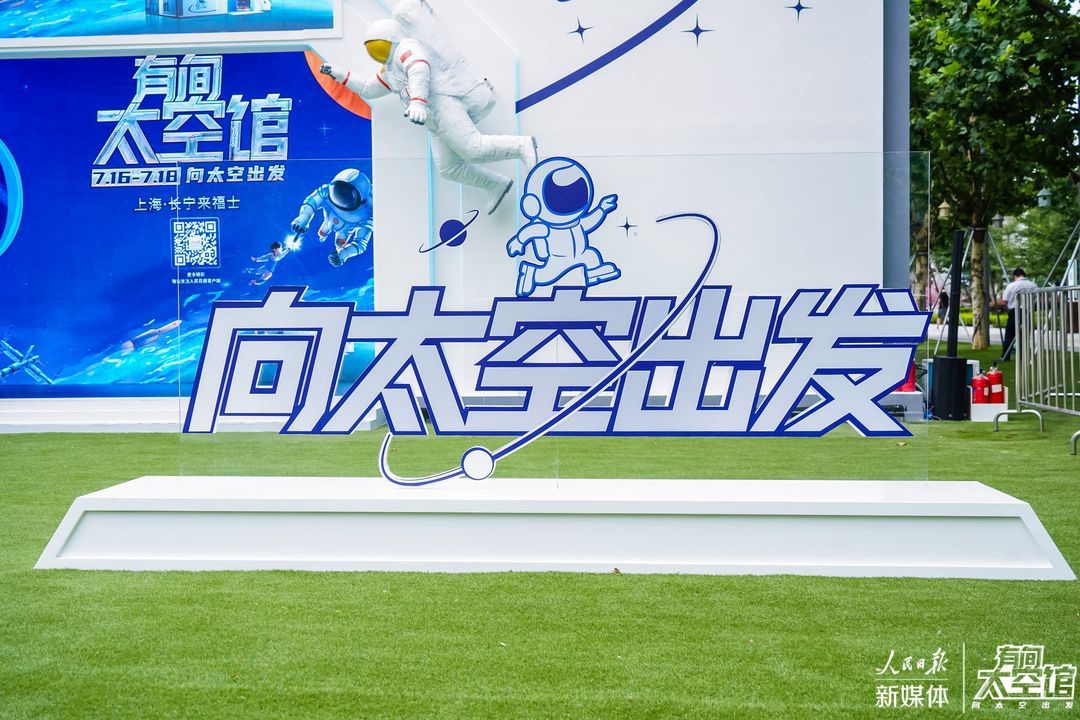
#CNSA #ChinaNationalSpaceAdministration #國家航天局 |#上海 #Shanghai #RafflesCity #July2021 |#人民日報# PeoplesDaily #YoujianSpaceMuseum #SpaceScience opens in Shanghai’s Ultra Mega Super Mall #ChangningDistrict …#中國 #中華人民共和國

This week of July 2021 located in the newest Shanghai Mall in China – People’s Republic of China is the crazy Hot Newly Opened Mall! Shanghai Next Generation Modern Mega Mall-Raffles City the Bund Walk located in 1191 Changning Rd, Changning District, Shanghai, China – People’s Republic of China.. in which they outside the Super Ultra Mega Raffles City Mall is new Youjian Space Museum” elaborately created by People’s Daily New Media was officially opened in Raffles City, Changning District, Shanghai. 4 major regions and 15 major creative sections will show you the “Chinese Space Dream” in an all-round way. 

Opening in the Next three days from 16th to 18th July 2021 for three day only in which is displaying  iconic moments elements of China’s Space Program from various sectors with various interactive museum exhibits in showcasing various Space Sciences that are used and researching from explaining questions of How many layers are there in #神舟 12 extravehicular spacesuit# ? What are the ingredients in the samples brought back from the moon? What do the carefully cultivated space plants and fruits look like? Hurry up and bring your friends to Shanghai Changning Raffles City “Youjian Space Museum.. in which there’s various lunar and Martian rovers from the Lunar and Mars missions also the newly constructed CNSA-CSS China National Space Administration China Space Station.

Images and visuals are from Weibo and their Respectives..

#CNSA #ChinaNationalSpaceAdministration #国家航天局 |#BeltAndRoadinitiative #June2021 |#魏一凡 #PosterDesigner #WeiYifan created memorable #Chinesepoetry posters illustrated moments of China’s Successful Space Programme ….

Illustrating poster Designer 魏一凡 Wei Yifan creating Successfully Memorable moments of CNSA – China National Space Administration – China’s People’s Republic of China’s collaborative Space programme in which over the last half century more with that first flight of the long lines of series carrier rockets from the  Long March –Chang Zheng One with the Dongfeng shinny round hexagonal ball  communications Satellite .. To more now self -learning hardworking innovatively on various innovatively from towards the Far side of the moon with the CNSA –CLEP China Lunar Exploration program on the moon lunar surface, towards the most world’s number one advance navigation BeiDou Constellation system  towards first time landing on the rustic red planet Mars on Utopia Planitia.. Now it’s the construction of the Belt and Road Initiative CSS China Space Station for international partnership with furthering more international collaboration for more extremely challenging deep space missions manned and unmanned ..

[Romance is carved in the bones! 我们正把古人的传说一一 implementation】Shenzhou patrols the sky, harmony between heaven and earth, Zhu Rongluohuo, Chang’e flying to the moon, not reconciled to the mythology only exists in the yellowed scrolls, Chinese astronauts in the Geng Geng Xinghe will Chinese civilization The poems and the distance are fascinating. The poetic and pictorial meaning of the spaceman is to turn the myth into reality and continue to move forward and continue to climb. Come on, Chinese astronauts! (Poster design: Wei Yifan) 神舟十二号天地通信

Images and visuals are from Weibo and their respectives..