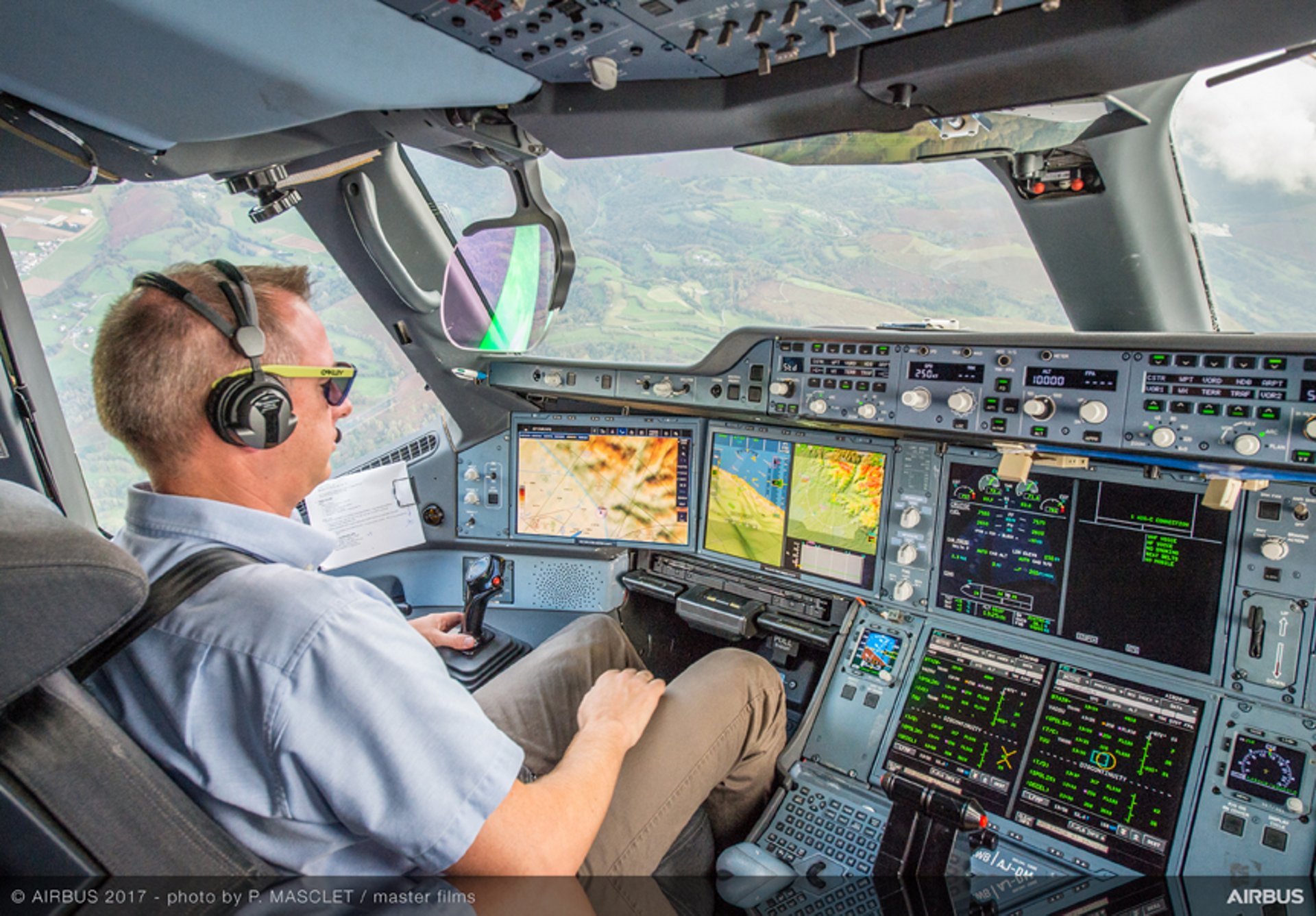
#AIRBUS #A350 |#SVSPF3D #SyntheticVisionSystem – innovating instrumentation merging in between old and the new for an inflight piloting experience..


Airbus always had been key leading aviation innovators… in which innovating to give beyond exceeding flight experience…. Currently innovating with its glass cockpit primary flight displays is merging the old instrumentation of flight dials and gauges of the analogue composing with the new digital environment in which gives the pilot more real time informationally data  to assess on what best course of action to take…

In utilization of Airbus 350-900 Demonstrators as a test case installed with the new Synthetic Vision System One of the changes is the digitization of the Primary flight display in merging the many combinations of flight displays that cluttering up the flight deck is to streamline in which gives the full potential of informationally readiness of a full screen technologies in which is known as PF3D – Full Format Flight Display..  in which the one gauge you’ll only see the artificial horizon only through an analogue dial transitioning that into digital with the forwarding simulate terrain that you can see even you’re flying above the clouds… in which giving you natural features in three dimension rather than seeing it in a two dimension terrain topography map.. in which gives the pilots an informational assessment to working it out inflight, flight trajectory to give the best data visualization in the new system to allow in various environments with visually informational screens in which will be introduce in the year 2021, as before the trails begins in fine tweaking with various airline focus groups within, relative to the industry to tweak out any issues to maximized the benefits with the new Cockpit redesign..
#Airbus #Testia | #MRO – innovating advancing aircraft inspection using #drones in Maintenance, Repair also overhaul… decreasing downtime on informational repairs…


Recently there’s been a new way of Aircraft inspections in which it reduces the amount of time.. In which current traditional ways of having a team of engineers of inspecting visually of every details for any fatigue, stress or imperfections along the hulling of the fuselage for in which that takes time, costing in operational time..

Airbus in collaboration with its subsidiary Testia… has developed an advance rapid approach increasing efficient way of facility visual checks also reducing downtime for an aircraft readiness also increasing the quality control of inspections of complying reports for any repairs that needs acquiring..

One major feature is the is the high resolution spectra camera in which the Testia Drone has to through scan all of the fuselage of the aircraft.. In which with the visual data it creates the outlay of the aircraft in which it creates a three dimensional model of the aircraft then within thirty minutes in which is process onto a mobile inspection unit laptop or Desktop to find any required needing to fix defects for attention…. Then it’s ready for the engineers to amend on the go…

Testia Inspection drone utilities anti-collision systems that’s while scanning in a safe distance in which once launched using its laser based obstacle anti-collision systems  in which in a distance keeping the scanning versa its three dimension model at a safe distance but also providing a consistent high quality of optical detail with the right portions..

#Arianespace | #VA238 – The launch of the Hellas Sat – Inmarsat S EAN also GSAT-17 – Highlights-


On 28 June 2017 Wednesday  from the Arianespace CSG- Guiana Space Center, from European space port in French Guiana, it is also within  Arianespace launch of VA238 is the launch of two payloads of Hellas Sat – Inmarsat S EAN also GSAT-17 in which both will be place in Geo Stationary orbit..  The Launch took place at 1815 Hours local time….. in which this marks eightieth launch with the Ariane 5 ECA Rocket with the seventh launched this year’s calendar to date ..

During this launch, there are two payloads within one launch; it is not unusual for one launch to have multiple payloads, like in the recent SpaceX launch with the Iridium two networks… the launcher carrier rocket was on launched from an Ariane 5 ECA Rocket with two boosters…

The two main satellite contractors are hales Alenia Space, also ISRO ISAC (ISRO Satellite Centre) in which are responsible in which hales Alenia Space is constructed the Hellas Sat – Inmarsat S EAN a telecommunications satellite that offers the provisions of Direct Data of high- ultra high data video content, telecom- communications services to Europe, Middle east also South Africa..  also providing advanced Wi-Fi services for aviation..

The other is ISRO ISAC (ISRO Satellite Centre), is contractor to construct GSAT-17, in which is also a communications satellite in which provides high velocities data communications towards the Indian Consentient also providing services to search and rescue efforts..  its other instrumentations is an educationally providing broadcast on educationally science, navigations programming,

#AIRBUS |Space and Defense- The #SpaceTug – revolution the space industry extending life..


In development of launching spacecraft, or satellites in which most do come with an operational life cycle in which till the next generation series that replaces its core operation, in which replacing the current satellites that nearing its life cycle can be costly to its operators..   in results there’s one interesting case that could be learnt during the STS –Space Transportation Systems, the Space Shuttle mission where that lessons learnt in repairing the HST- Hubble Space Telescope, also to with along with other satellites- ISS- International Space Station repairs during that STS mission era..

That lesson learnt is extending the satellites operations life cycle, before it reaching its maximum expiring operations cycle…. One Airbus Space and Defense have in mind is The Space Tug, in which designing to operations a multipurpose –application robotic satellite that does numerous tasks in helping other satellites for repositioning, refueling them aswell also exchanging other payloads as technologies progresses also it introduces reusability in space with the aid of solar electric propulsion in which enhances its services also as it rendezvous with its Patient with the aid of vision based navigation also rendezvous with others  in and proximity operations even for satellites that are not design for rendezvous…