During today on 25th November 2021 launching from one of many complexes酒泉衛星發射中心 Jiuquan Satellite Launch Center in Dongfeng Aerospace City – inner Mongolia –China – People’s Republic of China on中國製造 Expace Technology Corporation, , the Kuaizhou No. 1A solid carrier rocket ignited and lifted off at the Jiuquan Satellite Launch Center. Successfully launched and deployed mode, Shiyan 11 satellite was sent into the scheduled orbit, and the launch mission was a complete success.
Launched at Hong Kong SAR Beijing at 07:41 Morning on November 2021 Aerospace division, China’s Jiuquan Satellite Launch Center in the Kuaizhou No. 1A solid carrier rocket, will test the success of the 11th satellite launch. The satellite successfully entered the scheduled orbit and the launch mission was a complete success. This mission is the 13th flight …..
The Expace Kuaizhou-1A rocket for this launch mission is a small solid launch vehicle developed by China Aerospace Science and Industry’s Aerospace Sanjiang. It has international interfaces and mainly provides launch services for 300 kg low-orbit small satellites. Features such as high reliability, high precision into orbit, short preparation period, less guarantee demand, and low launch cost.
The Kuaizhou-1A rocket is a small solid launch vehicle launched by the Rocket Company of China Aerospace Science and Industry Corporation Limited. It has high flight reliability, high precision into orbit, short preparation period, less guarantee demand, and low launch cost. Features.
The Shiyan Experimental Satellite It was jointly designed provisions for The satellite was, officially, mainly to be used to carry out a photographic survey of China’s land resources, monitor its geographical environment and conduct scientific mapping research. It was to be handed over to the Satellite Remote-Sensing Ground Station of CAS following the on-orbit testing.
Currently at the moment中國製造 Expace Technology Corporation- a CASIC -China aerospace science and industry corporation has been very busy in building a New Carrier Rocket Factory in Wuhan National Aerospace Industrial Base in which the base will be in operations in May 2020 Kuaizhou Rocket Industrial Park that forms the manufacturing of twenty plus more Kuaizhou Rockets also its other sister larger carrier rockets in process of The assembly test capability of 20 solid launch vehicles……
Images and visuals are from Weibo also from their respectives ..
中国空间站On 17th Friday September, 2021, at Hong Kong SAR – Beijing Time morning, the Belt and Road InitiativeCNSA –China National Space Administration CSS China Space Station in which on a three month setting up a new home of the first three Shenzhou 12 crew Takionauts –Chinese Astronauts Nie Haisheng – Liu Boming – Tang Hongbo returned home from their second home landing on safely at Dongfeng Aerospace City district in which landing at Inner Mongolia Region of China – People’s Republic of China…..
During this week of 25th November 2021… Awesome congratulations on the hardworking praise of Takionauts Nie Haisheng, Liu Boming, Tang Hongbo, listen to Jing Cong, are determined to serve the country, defy hardships and dangers, unite and cooperate, and show the world a strong Chinese spirit , Chinese power. To commend them for their outstanding achievements in the establishment of my country’s manned space industry, the Central Committee of the Communist Party of China, the State Council, and the Central Military Commission decided to award Comrade Nie Haisheng the “First Class Aerospace Meritorious Medal”, and to Comrade Liu Boming the “Second Aerospace Meritorious Medal” and Tang Hongbo. Comrades were awarded the honorary title of “Heroic Astronaut” and awarded the “Grade Three Space Meritorious Medal ……
Images and visuals are from Weibo also their respectives.
中国空间站 On 8th November 2021 Hong Kong SAR – Beijing Time morning, the Belt and Road InitiativeCNSA –China National Space Administration CSS China Space Station in which on a three to six months setting up a new home of the first three Shenzhou 13 in which spending up to on for the further construction and verifications of the systems of the CSS –China Space Station 2021 launch calendar in which currently the three Takionauts current Shenzhou 13 …… Preparations for the six months of extension of the China Space Station In which the currently it remains awaiting for the crew of setting up home in conducting fun scientifically onboard中国空间站.. China Space station …..
Today on the 24th November 2021, Wednesday Official release by China Manned Space Engineering Office Shenzhou 13 crew member Takionaut王亞平 Wang Yaping in CNSA –China Space Station in which during the one month of six month duration onboard preparations of expansion of the China Space Station components modules in which are coming up. Wang Yaping’s on-orbit photos are here! In just over a month, Wang Yaping not only completed all kinds of in-orbit work as planned, but also became China’s first female astronaut out of the cabin. Today, Zhai Zhigang and Ye Guangfu officially released the in-orbit photos taken by Mr. Yaping!
Today, the China Manned Space Engineering Office officially released the photos of Wang Yaping on the space station. The photographers are Zhai Zhigang and Ye Guangfu from the 13th crew of the Shenzhou 13 The teacher may look cute lovely Takionaut Wang Yaping, Photography by Zhai Zhigang and Ye Guangfu shot from under different situations in the core module of the Tianhe Core Module as they spend some relaxing time experimenting with different asspects of photography equipment..
Images and visuals are from Weibo also their respectives.
One year ago today 24th November 2020 Now it’s the 24th November 2021 , the Chang Zheng – Long March Five Carrier Rocket Launched away in CNSA – China National Space Administration China Wenchang spaceport launch, Change Five Lunar probe into orbit, opened up towards China – People’s Republic of China’s first celestial bodies sample return trip from Mons Rumker on the Lunar Surface.……
Highlight 1: Narrow window launch The launch window is the ignition time period for the launch vehicle to meet the needs of the transfer to the moon. Due to the typhoon and strong tropical cyclone in Wenchang area, high-altitude wind, heavy rainfall, thunderstorms and other meteorological conditions are very complicated, it can be imagined. The narrower the window, the greater the risk of launching large cryogenic launch vehicles. There are many factors that determine the launch window, such as the relative position of the launch site and the target point, the safe landing zone of the rocket wreckage, the time of sunlight after the launch probe (satellite) enters orbit, the measurement and control arc, the lunar landing zone, and the lunar take-off time , Re-entry return time, etc. The more the launch constraint conditions, the narrower the launch window. In order to ensure the reliable implementation of the Chang’e-5 mission, it is necessary to solve the design difficulties of the multi-orbit moon launch scheme under the constraints of the range of launch, the safety of the landing zone, the measurement and control of the ascent section, and the rocket taxi time.
Aspect 2: During the two-stage taxiing process of the accurate low-temperature launch vehicle in the landing zone of the rocket, the quality of the propellant will decline with the passage of time, so the longer the taxiing time, the more unfavourable the startup of the low-temperature power system. For this reason, the rocket system has carried out a large number of ground tests, and the three flights of the Long March 5 have fully evaluated and verified the long sliding ability of the model. The rocket area of the Chang’e-5 mission must fly over the Philippine Islands. The booster landing area is located west of the Philippines, the fairing landing area is located east of the Philippines, and the core landing area is located in the Pacific Ocean. Multi-ballistic launching has caused significant horizontal and vertical dispersion in the sub-level wreckage landing area. Therefore, if the mission permits, the range of the shooting direction and dispersion must be minimized to optimize the safety of the landing area. The scientific research team carried out multiple rounds of optimization design for the horizontal and vertical dispersion of the multi-ballistic trajectory to the moon with variable firing direction and variable glide time. In the end, the rocket wreckage landed exactly in the intended sea area. Aspect 3: Multi-trajectory, “moving target shooting”
A key technology in the launch phase of the Chang’e-5 mission is multi-ballistic launch, that is, within 3 consecutive days, there are 5 nominal trajectories with 10 minute intervals between take-offs every day, evenly covering the 50-minute launch window. The purpose of multiple ballistics is to achieve “mobile shooting” with different take-off points and the same destination during the relative movement of the earth and the moon. As long as the launch vehicle ignites within the launch window and sends the probe into a predetermined Earth-Moon transfer orbit, the probe can fly to the near-moon point at exactly the same time, altitude, incident angle, illumination, and measurement and control conditions. Through the detailed orbit design, the outstanding performance of the launch vehicle systems, and the concerted cooperation of various departments, the Chang’e-5 probe was sent into the scheduled orbit with very high accuracy, laying a solid foundation for the subsequent flight missions.
Aspect 3: Multi-trajectory, “moving target shooting” A key technology in the launch phase of the Chang’e-5 mission is multi-ballistic launch, that is, within 3 consecutive days, there are 5 nominal trajectories with 10 minute intervals between take-offs every day, evenly covering the 50-minute launch window. The purpose of multiple ballistics is to achieve “mobile shooting” with different take-off points and the same destination during the relative movement of the earth and the moon. As long as the launch vehicle ignites within the launch window and sends the probe into a predetermined Earth-Moon transfer orbit, the probe can fly to the near-moon point at exactly the same time, altitude, incident angle, illumination, and measurement and control conditions. Through the detailed orbit design, the outstanding performance of the launch vehicle systems, and the concerted cooperation of various departments, the Chang’e-5 probe was sent into the scheduled orbit with very high accuracy, laying a solid foundation for the subsequent flight missions.
Images and visuals are from Weibo and their respectives…. Of CNSA China National Space Administration …
Located in the Heart of Hong Kong central of Victoria Harbour in which locate looking at the iconic Megatroplis HongKong Island city landscape from the opposite is the Hong Kong Space Museum 香港太空館 in which located at 10 Salisbury Road, Tsim Sha Tsui, Kowloon, Hong Kong SAR, China –People’s Republic of China.. in which is one of the most international iconic buildings architecturally due to its hemispheric round dome in which is iconic known as one of Hong Kong’s local most cherish bread pastries the Pineapple Bun – Bolo Bao due to the pineapple ceramic texturing tiles of the dome structure that resembles the delicious texturing of the Pineapple Bun .. In which on In June 2014, the Hong Kong Government listed the pineapple bun as a part of Hong Kong’s intangible cultural heritage. … Despite the name, it does not traditionally contain pineapple; rather, the name refers to the look of the characteristic topping (which resembles the texture of a pineapple)……
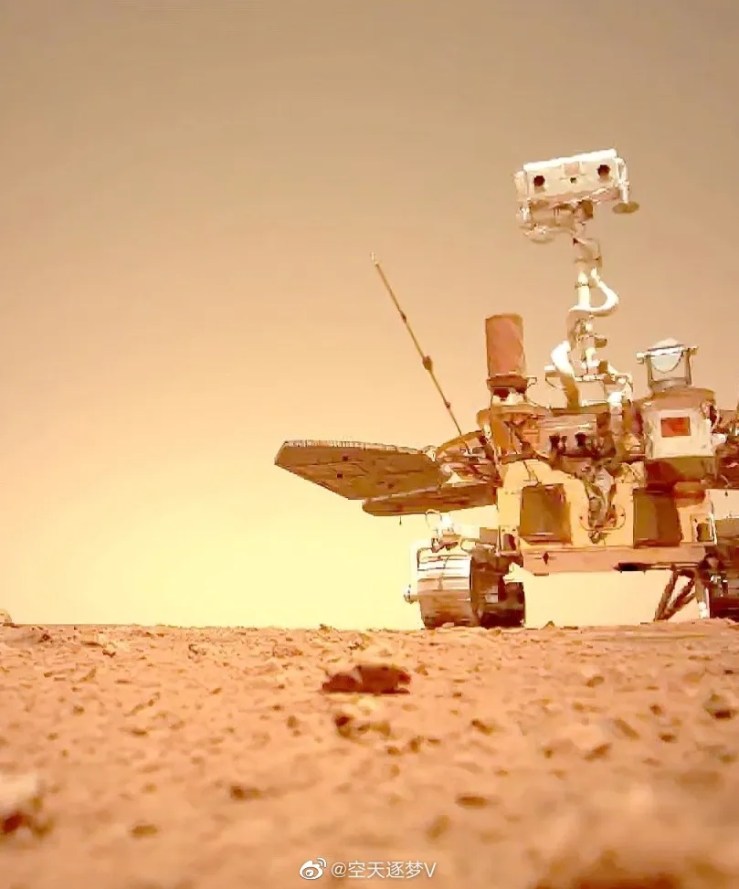
On the 20th November 2021 Saturday – 1330 to 1530 Hong Kong SAR- Beijing Time One of leading international Iconic Planetarium Space Museums 香港太空館Hong Kong Space Museum spoken in Chinese – Cantonese –Guangdong Dialect .. live streaming in one of its Auditorium in which Hong Kong SAR Space Program thorough outs it’s Universities collaborated in China- People’s Republic of China’s first most Challenging Mars Mission in which China’s CNSA –China National Space Administration skill set far out weight NASA’s Mar Missions current and past.. . In One of Hong Kong SAR Universities, Hong Kong PloyU has contributed the Camera system of Tianwen One’s one of many Camera systems also it’s Mars lander, Zhurong Mars rover, and Mars Orbiter other elementally equiment system…. Speaker: Prof. Yung Kai-leung, BBS (Chair Professor & Associate Head, Department of Industrial and Systems Engineering, The Hong Kong Polytechnic University)
The Tianwen-1, China’s first Mars mission successfully landed on it in May, achieving another extraordinary feat in the recent Chinese Aerospace Industry. This first Mars exploration mission of China is unique that employed novel technology and engineering design and encounters exceptional challenges.
The Tianwen-1, China’s first Mars mission successfully landed on it in May, achieving another extraordinary feat in the recent Chinese Aerospace Industry. This first Mars exploration mission of China is unique that employed novel technology and engineering design and encounters exceptional challenges.
The Mars Landing Surveillance Camera (Mars Camera) is developed mainly by the research team of the Hong Kong Polytechnic University. It is a sophisticated space instrument mounting on the top surface of the lander platform of Tianwen-1, which monitors the landing status, the surrounding environment of the red planet and the operation status of the Zhu Rong rover. The Mars Camera is light in weight, yet strong and durable enough to withstand the huge impact shocks of 6,200 times Earth’s gravity. Moreover, it has to operate under low Martian temperature as well as overcome extreme temperature differences it experienced during its flight. In this lecture, Professor Yung from the Hong Kong Polytechnic University will talk about the challenges of the Mars mission and delineate the contributions of the Hong Kong research team.