On the week of 23rd December 2021, Wenchang Spacecraft launch Center –Hainan Province –China – People’s Republic of China.. CNSA – China National Space Administration– China successfully launched test twelve satellites 01 and 02 …… At 18:12 Hong Kong SAR Beijing time on December 23, 2021, Beijing time, China used the Chang Zheng Long March 7 Carrier Rocket at the Wenchang Spacecraft Launch Centre at the Hainan province Site and successfully tested the twelfth series satellite deploying the Satellites 01 and 02 were launched into space, the satellites entered the scheduled orbit smoothly, and the launch mission was a complete success. This mission is the 402th flight of the Long March series of carrier rockets….
The Chang Zheng Long March seven Carrier Rocket is the of China Academy of Launch Vehicle Technology (“Rocket Academy” for short) is a new generation of medium-sized high-orbit three-stage liquid bundled launch vehicle developed based on the Chang Zheng Long March seven.
The booster, first and second stage of the Chang Zheng Long March seven. Are used, but the third stage inherits the third sub-stage of the Long March ⅢA series rocket, so as to achieve 7 tons of geosynchronous transfer orbit carrying capacity, filling my country’s geosynchronous transfer orbit 5.5 The blank of carrying capacity between t~7t.
The total length of the rocket is 60.13 meters, the diameter of the first and second cores is 3.35 meters, the diameter of the third core is 3 meters, the diameter of a single booster is 2.25 meters, and the rocket take-off mass is about 573 tons. It is mainly used for geosynchronous satellite launch missions and geosynchronous transfers. The orbital carrying capacity is 7 tons, which fills the gap of the carrying capacity between 5.5t and 7t in my country’s geosynchronous transfer orbit.
The first, second and booster basically inherited the Long March 7 carrier rocket, using the 120-ton YF-100 engine and the 18-ton YF-115 engine.
The third sub-stage basically inherits the last stage of the liquid hydrogen and liquid oxygen of the Long March 3A series carrier rocket. It uses two 8-ton thrust YF-75 engines and has the ability to start twice.
Images and visuals is from Weibo and their Respectives
中国空间站 On currently on 24th to 26th December 2021 Christmas eve, CNSA –China National Space Administrationin collaboration with CCTV9 China Central Radio and Television will telecast “Our Journey” is the first panoramic documentary produced by China National Space Administration and China Central Radio and Television in 4 years to show the complete course of China’s lunar exploration project in 17 years . It is a documentary . Documentary works with international vision, international expression, and international standards are excellent works that tell Chinese stories, spread space culture, and popularize space knowledge
The documentary consists of three episodes, each of 50 minutes, which truly presents the development of China’s lunar exploration project over the past 17 years, which has been through ups and downs, and left a tortuous but full history. This imprint records not only a huge and complicated super project, but also a testimony to the rapid growth of China’s aerospace industry and the common progress of the Chinese nation. The film fully and vividly interprets the spirit of lunar exploration of “chasing dreams, exploring courageously, coordinating fortifications, and win-win cooperation” , promotes the spiritual pedigree of the Chinese Communists , and conveys the spiritual power that China’s scientific and technological development and progress rely on.
Through character interviews, important development scenarios, and the combined application of various methods such as related materials, the film outlines the continuous and staggered cooperation and support between the various development units of the major systems, and demonstrates the Chinese people’s fearlessness in scientific exploration. Pursuit, as well as the admirable courage and wisdom devoted to this journey full of risks and challenges.
“Our journey” documentary will be held December 24 – the 26th in the Central Radio and Television CCTV-9 record channel 20:00 prime time heavy launch a new media center video, CCTV and other platforms will also be broadcast simultaneously.
中国空间站 On currently on December 2021, the Belt and Road InitiativeCNSA –China National Space Administration CSS China Space Station in which on a three to six months setting up a new home of the first three Shenzhou 13 in which spending up to on for the further construction and verifications of the systems of the CSS –China Space Station 2021 launch calendar in which currently the three Takionauts current Shenzhou 13 …… Preparations for the six months of extension of the China Space Station In which the currently it remains awaiting for the crew of setting up home in conducting fun scientifically onboard中国空间站.. China Space station …..
This week of 22 December 2021, on which is the Winter solstice in which is on the 21st December 2021 Tuesday.. during this month Shenzhou Commander Zhai Zhigang has been very gentlemanly in doing the household chores of housekeeping in which keep him busy apart from on a previous week after the Tiangong Classroom lesson from space orbiting from Space Teacher Wang Yaping this week of 15th December 2021 Shenzhou 13 Commander翟志剛 Zhai Zhigang does the house hold chores of cleaning in which he vacuums the ventilation system vents grids and cleans the China Space Station Complex . Showing a great example teaching of a good humble gentleman ….
This time on a break, work break doing fancy moves watching his favourite television dramas on a busy schedule can’t take any time off. All kinds of fancy tricks, seize every opportunity Do stretching to fight muscle atrophy and keeping fit in space on China Space Station.
Review of the first anniversary of the Chang’e 5 mission-returning home safely
One year ago today 24th November 2020 Now it’s the 24th November 2021 , the Chang Zheng – Long March Five Carrier Rocket Launched away in CNSA – China National Space Administration China Wenchang spaceport launch, Change Five Lunar probe into orbit, opened up towards China – People’s Republic of China’s first celestial bodies sample return trip from Mons Rumker on the Lunar Surface.……
At 23:10 on December 3, 2020, the Chang’e-5 ascender carried a lunar sample to take off from the lunar surface. About 6 minutes later, it entered an elliptical orbit around the moon. At 2:13 on December 6, the ascender accurately reached the scheduled “handover” position 50 kilometers in front of the orbit-return assembly and about 10 kilometers above it. At 5:42, the ascender and the orbit-returning assembly completed the rendezvous and docking. At 6 o’clock, the sample packaging container was transferred from the ascender to the returner. This process of autonomous rendezvous and docking and sample transfer is like the handover process in a 100-meter relay race. It is brilliant and highly technical. Using a lunar orbital rendezvous and docking after take-off from the lunar surface, rather than a direct lunar-to-ground transfer after taking off from the lunar surface, this design is conducive to collecting and carrying more samples back to the earth, and for technical accumulation and verification for subsequent missions.
After the Chang’e-5 probe undergoes a lunar-to-earth transfer, the returner and the orbiter are separated and transferred to the return re-entry section, using a semi-ballistic jump type, that is, a “drifting” return method. After two re-entry into the atmosphere, it decelerates in Beijing. At 1:59 on December 17, 2020, the returner successfully landed in the planned area of Siziwang Banner, Inner Mongolia, marking the successful completion of my country’s first extraterrestrial celestial body sampling and return mission.
At about 1 am on the 17th, the Beijing Aerospace Flight Control Center injected high-precision navigation parameters into the Chang’e-5 orbiter and returner combination through the ground measurement and control station. After that, the orbiter and the returner were normally unlocked and separated at a height of about 5,000 kilometers above the sea level of the South Atlantic Ocean, and the orbiter completed the evasive maneuver as planned. At 1:33 in the morning, the Chang’e-5 returner entered the earth’s atmosphere at a high speed close to the second cosmic speed (about 11.2 kilometers per second) at a height of about 120 kilometers above the ground, and performed the first aerodynamic deceleration. After descending to a predetermined altitude, the retractor jumps up out of the atmosphere and begins to slide down after reaching the highest point. After that, the returner enters the atmosphere again and performs a second aerodynamic deceleration. When descending to a height of about 10 kilometers above the ground, the retractor opened the parachute to complete the final deceleration and maintain a stable attitude, and then landed smoothly in the predetermined area.
During the 30-second parachute opening process, a total of 3 work phases were completed. A series of actions were completed to open the parachute with the flip cover, decelerate the deceleration parachute, pull out the main parachute by the deceleration parachute separation, open the parachute like a closed main parachute, and fully open the main parachute and descend steadily. The work of the recovery system is interlocked. Any mistake will cause the catastrophic consequences of the hard landing of the returner. All the work links cannot be controlled and adjusted from the ground. The recovery system needs to complete these accurately and reliably in such a short time. The action ensures that the returner can safely land at the predetermined location.
Before welcoming the return of Chang’e 5 at the Siziwangqi landing site, a snowfall also arrived as expected, putting a layer of “dress” on the landing site and also brought great difficulty to the search and recovery of the mission. In order to ensure this mission, the search and recovery brigade of a certain base that performed the search and recovery mission organized several rounds of search and recovery exercises under extreme weather conditions such as “extreme cold, dark night, and freezing”. In the end, the search team arrived at the landing site about half an hour after landing and successfully completed the mission. Chang’e 5 obtained a total of 1,731 grams of lunar samples, which is also in line with the characteristics of China’s lunar exploration project. It took 17 years and went through three steps of “circumnavigating, descending, and returning” to draw a blueprint for China’s lunar exploration.
Reaching the moon in nine days, sailing shining galaxy;
Dream set sail, we walk along the way!
Looking forward to the next highlight of China’s lunar exploration project!
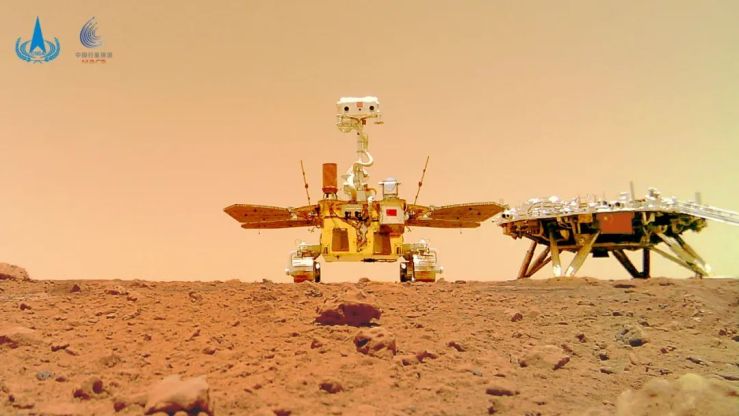
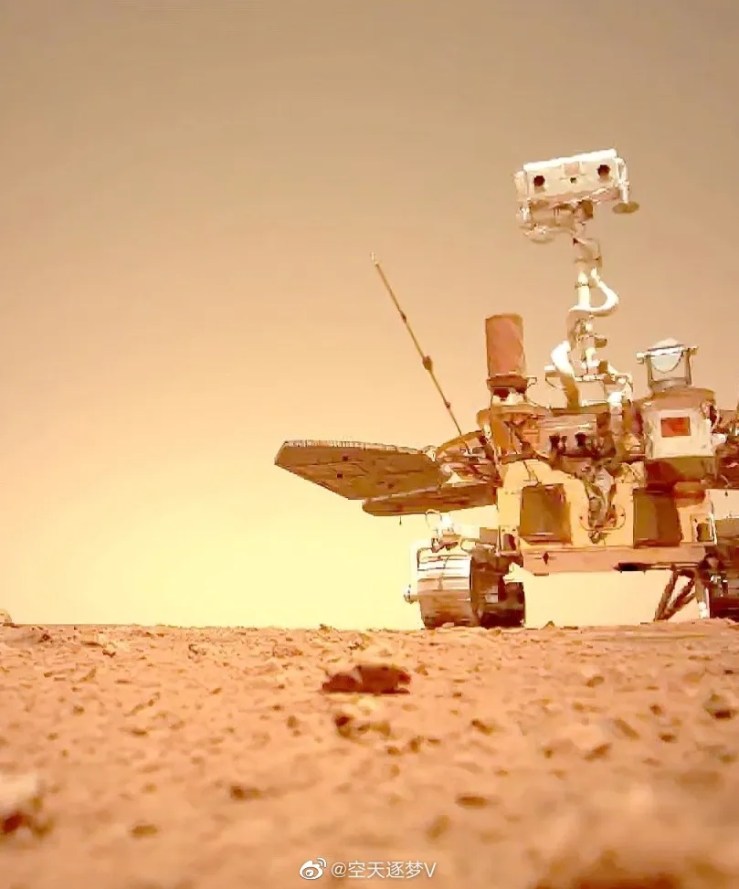
At 0:00 on December 16th 2021 Thursday, Hong Kong SAR- Beijing time, the international authoritative scientific magazine “Nature” published the top ten figures of 2021, and Zhang Rongqiao, the chief designer of my country’s first Mars exploration mission, was selected. On May 15, 2021, China’s Mars rover “Tianwen One” successfully landed on the pre-selected landing zone on the surface of Mars. China became the second country in the world to successfully land on Mars and deploy a Mars rover. After the “Zhurong” Mars rover sent back telemetry signals, the flight control center in Beijing lit up a festive red screen, and the engineer excitedly shouted “Hello, Mars!” Zhang Rongqiao took off his glasses silently at this time, tears in his eyes.
The character of the year in “Nature” describes Zhang Rongqiao as “Mars explorer”. Mars is a space nightmare for many countries. So far, the overall success rate is only about 50%, and the success rate for landing missions is only a little over 40%. China’s first Mars exploration mission completed the three major goals of Mars orbiting, landing and patrolling. It is even more difficult and risky. Behind the steadily accomplishing the three goals is the effort to “grind a sword in ten years.” “In order to win today’s first battle, we started planning 10 years ago. We have worked hard for 6 years, held at the launch site for 110 days, and held at the Beijing Aerospace Flight Control Center for 202 days. The first victory was to orbit Mars. After that, I held on for another 93 days to this day. What is the purpose? It is for today’s final victory!” Zhang Rongqiao said excitedly at the flight control center on May 15th.
At a press conference held by the National Space Administration in Beijing on June 12, Zhang Rongqiao said, “Achieving a circumnavigation in one step means that the development is more difficult. To put it more plainly, the possibility of failure increases. For our developers, we can bear it. Zhang Rongqiao said. Fortunately, there is the correct leadership of the Party Central Committee, and there are government organizations at all levels, especially the powerful organization of the National Space Administration, including the Aerospace Science and Technology Corporation, the Chinese Academy of Sciences, and the launch site and measurement and control The competent departments have vigorously coordinated, and the fire detection research and development personnel have worked hard and overcome difficulties. “To put it more bluntly, it is the fire-detector’s vigor. We succeeded today. Looking back, the choice of this technical route is very correct.” Zhang Rongqiao said that overall it is more cost-effective, especially in terms of technology. It can achieve leapfrog development and make my country enter the world’s advanced ranks in the field of planetary exploration in a relatively short period of time. “Therefore, we said that the first Mars exploration mission was based on China’s national conditions and embarked on a path of aerospace development with Chinese characteristics.”
In the future, China will implement deep space exploration missions such as Mars sampling and return missions, near-Earth asteroid sampling and return and main belt comet orbiting missions, Jupiter system orbiting and planetary crossing missions. “Looking up at the stars and keeping your feet on the ground” are two words that Zhang Rongqiao likes very much. He said: “This is precisely what society needs for each of us, and it is a way for us to settle down in society. We need to stand on the present and look to the future.” Zhang Rongqiao Said: “Our knowledge and understanding of the universe is still very superficial. We should see that the world beyond the cradle is infinitely vast. Innovation never ends.”
The Top Ten People of the Year in Nature are records of important scientific developments and events this year, as well as some of the key figures and their colleagues. The top ten figures were selected by the editors of Nature and gathered individuals who influenced some of the most important scientific events in 2021.