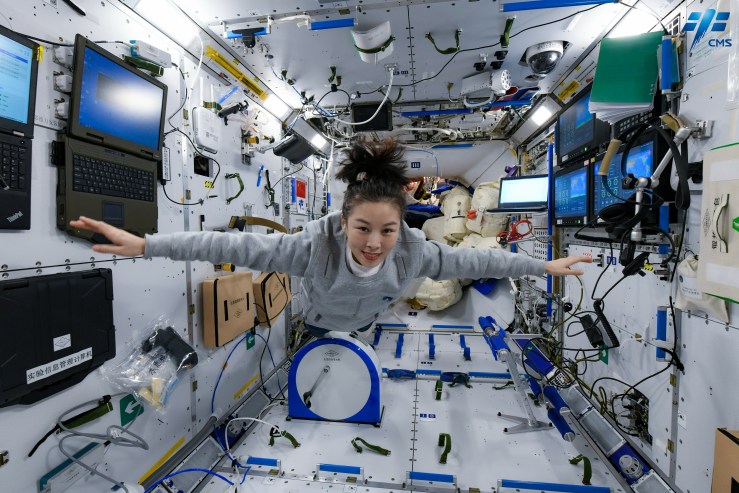
中国空间站 On currently on December 2021, the Belt and Road InitiativeCNSA –China National Space Administration CSS China Space Station in which on a three to six months setting up a new home of the first three Shenzhou 13 in which spending up to on for the further construction and verifications of the systems of the CSS –China Space Station 2021 launch calendar in which currently the three Takionauts current Shenzhou 13 …… Preparations for the six months of extension of the China Space Station In which the currently it remains awaiting for the crew of setting up home in conducting fun scientifically onboard中国空间站.. China Space station …..
On this week after the Tiangong Classroom lesson from space orbiting from Space Teacher Wang Yaping this week of 15th December 2021 Shenzhou 13 Commander翟志剛 Zhai Zhigang does the house hold chores of cleaning in which he vacuums the ventilation system vents grids and cleans the China Space Station Complex . showing a great example teaching of a good humble gentleman ….
Previously On 9th December 2021, the crew of the Shenzhou 13 conducting a Space Teaching from Space orbiting around the planet Earth towards the Students of China – People’s Republic of China on a live streaming broadcast on a multiple various media Platform in covering the Mainland, also two of its SAR- Special Administrative region of Hong Kong SAR and Macau SAR at 1540 Hours Hong Kong SAR –Beijing time The Chinese Space Station conducts space teaching. The China Central Radio and Television Station will conduct live broadcasts throughout the whole process.
八年前的今天,嫦娥三号成功落月!Today, 8 years ago, Chang’e-3 successfully landed on the moon!
As of Month of December 2021, The CNSA –China National Space AdministrationCLEP- China Lunar Exploration Program Belt and Road Initiative Lunar Mission……Chang’e-4with Yutu One the Lunar rover Today in 15th December on 14th December 2013 in which is on eight years ago 2013 the CNSA CLEP China National Space Administration – China Luna Exploration Program Chang’e-3 probe successfully landed on the moon China- People’s Republic of China becomes the third country in the world A country capable of independently implementing a soft landing on the moon on Sinus Iridium Nearby Mare Imbrium ….
8 years ago Chang’e-3 makes the five-star red flag China’s Flag debut on the moon on that day Review looking through back in time eight years ago on The historical moment of the successful landing of Chang’e-3 Lunar Lander.. landing on the The landing site of China’s first Moon lander Chang’e-3 has been named “Guang Han Gong(广寒宫) (Guang: widely, extensively; Han: cold, freezing;Gong: Palace) ” or “Moon Palace” by the International Astronomical Union (IAU), China’s State Administration of Science, Technology and Industry for National Defense (SASTIND). Three nearby impact craters were given the names Zi Wei, Tian Shi and Tai Wei, three constellations in traditional Chinese astrology
On December 14, 2013, China’s first unmanned moon landing probe, Chang’e-3, successfully landed on the moon. The setting moon starts at an altitude of 15 kilometers. During the 11-minute setting of the moon, Chang’e-3 relied on autonomous control to go through six stages: main deceleration, rapid adjustment, approach, hovering, obstacle avoidance, and slow descent. 1.7 kilometers per second gradually reduced to 0. At an altitude of 100 meters from the lunar surface, the probe stopped temporarily and used sensors to observe the landing area to avoid obstacles and select a landing site. After walking the last few meters in free fall, the four landing legs that steadily “stand” on the surface of the moon touched the moon, indicating that Chang’e-3 landed perfectly in the Hongwan area of the moon.
The landing site of Chang’e-3 has good communications and sunshine conditions in the Hongwan area of the moon, and the terrain is relatively flat. No human probe has ever visited before. This area, later named “Guanghan Palace” by the International Astronomical Union, is not only the landing site of Chang’e-3, but also a new starting point for China’s lunar exploration.
While achieving a soft landing on the moon, Chang’e-3 also shoulders the mission of breaking through key technologies such as automatic patrol surveys, deep space measurement and control communications, and moon night survival. The Chang’e-3 lunar probe consisting of the lander and the “Yutu” lunar rover has a total weight of nearly 3.8 tons. In the following time, the “Yutu” left the lander and began scientific exploration, and the lander conducted in-situ detection at the landing site.
Chang’e-3 did not live up to high expectations. It saw the earth on the moon for the first time, obtained images of the earth’s plasma layer for the first time, and completed the first geological profile of the moon and the first celestial body survey. With the successful completion of the mission of Chang’e-3, China’s three-step strategy of “orbiting, landing, and returning” for China’s lunar exploration project has progressed smoothly, and has begun to fully enter a new stage of unmanned automatic sampling and return.
On the 14th December Tuesday 2021 in CNSA _China National Space Administration -China – People’s Republic of China At 0009 morning hours Hong Kong –Beijing Time on an. China successfully launched Satellites using the Chang Zheng Long March 3B Yiyao 82 carrier rocket at the Xichang Satellite Launch Center Sichuan Province….. Successfully launches Tianlian 2 02 satellite According to the latest news of the Aerospace Science and Technology Group…..
The Chang Zheng Long March 3B carrier rocket ignited into the sky at Xichang Satellite Launch Center, successfully flying Tianlian 2 02 satellite It was sent to the predetermined orbit and the launch mission was a complete success. This is the first step in the Long March series of rocket launches from 400 to 500 launches schedule this launch is the 401st launch of the Long March series of carrier rocket …. .
Tianlian-2 02 was developed by the Fifth Academy of China Aerospace Science and Technology Corporation. It is my country’s second-generation geosynchronous orbit data relay satellite. It is mainly used to provide data relay for manned spacecraft such as spacecraft, space laboratories, and space stations. And measurement and control services, provide data relay and measurement and control services for medium and low orbit resource satellites, and provide measurement and control support for spacecraft launches in which number of relay satellites in orbit in China has increased to 7, and the line-up of “relay satellite clusters” has been upgraded again. The robustness, reliability, and flexible service capabilities of the system have been further improved.
Tianlian-2 02 is the first equipped satellite of China’s second-generation data relay satellite system. This launch is also the 401st launch of the Long March series of carrier rockets. The satellite was successfully launched It marks that China has taken an important step towards a new generation of relay satellite system networking, and will further enhance China’s space-based measurement and control and data relay capabilities.
Tianlian-2 02 was developed by the General Department of Communications and Navigation Satellites of the Fifth Academy of Aerospace Science and Technology Group. It will provide users with measurement, control and data for manned spacecraft, remote sensing meteorology and other low- and mid-orbit satellites, launch vehicles and other non-spacecraft users. Following the service. The satellite is developed by using the Dongfanghong-4 satellite public platform. Compared with the Tianlian-2 launching satellite, the satellite fully inherits the technology status of the launching satellite, and its ability to serve multiple users is enhanced to meet the simultaneous access needs of more users; at the same time; The satellite can work in different orbital positions and has strong orbital adaptability, which improves the maneuverability and flexibility of the satellite in orbit; the localization rate of the satellite’s single-machine is significantly increased, and the development cycle is greatly shortened, which verifies the Tianlian-2 satellite The ability to develop rapidly provides support for the subsequent second-generation relay multi-satellite rapid on-orbit networking, and accelerates the pace of my country’s space-based measurement and control and transmission network construction- Fifth Academy of Aerospace Engineering…
Images and visual are from Weibo and their Respectives..
酒泉衛星發射中心On 10th December 2021 Friday 0811Hong Kong SAR – Beijing Time morning, CNSA –China National Space AdministrationJiuquan Satellite Launch Center – Inner Mongolia – China – People’s Republic of China successfully Launched the International Iconic Chang Zheng 4B – Long March 4B successfully deploying the Shijian6 Group five Environmental Satellites in which achieved 400th launches of the international Icon Chang Zheng – Long March series Carrier Rocket..
The Shijian6 group five environmental Satellites is provisionments of The satellite is mainly used to carry out space environment detection and new technology test verification, The satellites will be used for space environmental exploration and new technologies. Test verification. The rockets and satellites for this mission were all developed by the Eighth Academy of China Aerospace Science and Technology Corporation. Be used for space exploration and new technology tests. This launch is the 84th launch of the Chang Zheng – Long March 4 series of carrier rockets, the 148th launch of the Long March series of carrier rockets developed by the Eighth Academy of Sciences,
Images and visuals are from Weibo also their respectives.
中国空间站 On currently on December 2021, the Belt and Road InitiativeCNSA –China National Space Administration CSS China Space Station in which on a three to six months setting up a new home of the first three Shenzhou 13 in which spending up to on for the further construction and verifications of the systems of the CSS –China Space Station 2021 launch calendar in which currently the three Takionauts current Shenzhou 13 …… Preparations for the six months of extension of the China Space Station In which the currently it remains awaiting for the crew of setting up home in conducting fun scientifically onboard中国空间站.. China Space station …..
On 9th December 2021, the crew of the Shenzhou 13 will be conducting a Space Teaching from Space orbiting around the planet Earth towards the Students of China – People’s Republic of China on a live streaming broadcast on a multiple various media Platform in covering the Mainland, also two of its SAR- Special Administrative region of Hong Kong SAR and Macau SAR at 1540 Hours Hong Kong SAR –Beijing time The Chinese Space Station conducts space teaching. The China Central Radio and Television Station will conduct live broadcasts throughout the whole process.
The first lesson of “Tiangong Classroom”] The China Manned Space Engineering Office will officially broadcast the first lesson of “Tiangong Classroom”. The first lesson of “Tiangong Class” will officially start on December 9. The Shenzhou 13 crew Takionauts Zhai Zhigang, Wang Yaping, and Ye Guangfu will give space lectures at the Chinese Space Station. From 12 noon on December 9th, the China Manned Space Engineering Office will broadcast live on Weibo uninterruptedly, witnessing the first launch of the Chinese Space Station in the whole process
This space teaching activity will be conducted in a space-to-earth interactive manner, with ground-based main classrooms set up in the China Science and Technology Museum, and ground-based sub-classes in Nanning, Guangxi, Wenchuan, Hong Kong, and Macau. At that time, 3 astronauts will introduce and display the work and life scenes of the China Space Station in orbit, demonstrate cytology experiments, object motion, liquid surface tension and other phenomena in a microgravity environment (the teaching project is attached), and conduct real-time communication with the ground class to spread the load. Human and space knowledge has stimulated the interest of young people in science.
Chinese astronauts sincerely invite young people to try to carry out related experiments on the ground simultaneously, to perceive the mysteries of the universe from the difference between heaven and earth, and experience the joy of exploration.
Attached ┃Introduction to the content of the first space teaching experiment of the China Space Station
1 Astronauts working and living scenes in orbit 2 Space cytology research experiment demonstration 3 Space turning 4 Loss of buoyancy experiment 5 Water film tension experiment 6 Water polo optics experiment 7 Effervescent film experiment 8 Interaction between heaven and earth AC
What kind of experience is it like to live on the space station? What are the interesting things that happen under weightlessness? The live broadcast of “Tiangong Classroom” is about to begin! Bring your questions quickly, scan the code to enter 空间网课直播 , let’s “rise posture” together!
Looking forward to it! 翟志刚王亚平叶光富直播 See the earth from space and appreciate the vastness of stars; unpack the space meal package and experience life in space; walk into many universities and middle schools across the country to see the N ways to open aerospace science courses; more aerospace science courses Authoritative experts in the field and science and technology experts are guest studios, and space Q&A blind boxes and fun experiments take turns. Move the small bench quickly
Before the class starts, plan a key point first.
During the course, we will have a high probability of seeing the words “BACC” and “Sky Chain” in the upper right corner of the screen. BACC is the English abbreviation of Beijing Aerospace Flight Control Center, and its full name is Beijing Aerospace Control Center. “Skylink” refers to the skylink relay satellite.
A “relay satellite” in the traditional sense is a communication satellite that forwards ground station tracking, measurement and control information to mid- and low-orbit spacecraft, and forwards the spacecraft to send back ground information. In short: the relay satellite is the data transfer station between the ground station and the satellite.
So the problem is that besides Skylink, which relay satellites do you know in our country? Source: Our Space