CNSA #ChinaNationalSpaceAdministration #國家航天局 |#BRI  #July2023 | #火星 # 天問 #天问一号#TianwenOne #MarsMission #Tianwen1 probe  #祝融号 #ZhuRong stunning Martian landscape new stunning photography during the year 2022  before Hibernation  #AGallery

天问一号飞運騎遊達达3亿CNSA – China National Space Administration – ESA – European Space agency Belt and road initiative mars mission…first Mars exploration mission, Tianwen- Martian Probe OneAs of September 15, 2022, the Tianwen-1 orbiter has been in orbit for more than 780 days, and the rover has travelled a total of 1,921 meters, completed the established scientific exploration tasks, and obtained 1,480 GB of original scientific exploration data. The scientific research team has obtained rich scientific results through the research on the first-hand scientific data obtained independently by my country. Through a comprehensive study of typical landforms such as concave cones, barrier craters, and trenches distributed in the landing area, the important connection between the formation of the above-mentioned landforms and water activities has been revealed.

朱融号  Zhurong Mars Rover The photos taken by the Mars rover before hibernation for one month (April 22), maybe this is the posthumous work…..The mosaic pictures of other scenes taken by Zhurong are all 50% of the original picture, and they were taken on January 29, March 3, March 14 and April 12, 2022.

It is worth mentioning that Figure 4 is the last batch of pictures from the navigation terrain camera of the Zhurong Mars rover currently released, and it may also be the last batch of photos from the Zhurong rover that we can see in the days to come Original..

Data source: The fourth batch of scientific exploration data of Tianwen-1 released by China Planetary Exploration Engineering Ground

On February 17, 2022, the Zhu Rong discovered an interesting-looking bunker (Figure 1). The ground around it is full of gravel, and most of it is sand here. On February 19th, the Zhurong sailed close to it to investigate it. Figure 2 is a collage of photos of the bunker taken on the side.


Source of original data: The fourth batch of scientific exploration data of Tianwen-1 released by China Planetary Exploration Engineering Ground Application System on July 3, 2023​​​​….

A selfie taken by the Zhu Rong rover on January 12, 2022, showing the back cover of the lander on the distant horizon.

Source of original data: The fourth batch of scientific exploration data of Tianwen-1 released by China Planetary Exploration Engineering Ground Application System on July 3, 2023​​​​….

Four images of the surface of Mars acquired by the Tianwen-1 orbiter’s medium-resolution camera between January and February 2022. Do these four pictures look familiar to you? A little hint: the main scenery in the four photos are Peacock Mountain (Pavonis Mons), Arsia Mountain (Arsia Mons), Matt crater (Marth crater) on the Arabian Highlands (Arabia Terra) and Mount Elysium ( Elysium Mons).

That’s right, this is the documentary “Hello! Original images of the four photos of Mars in the opening credits of each episode of Mars. With the advancement of the Mars global image mapping work in 2022, the medium-resolution camera imaging area gradually moves southward to the middle and low latitudes. We have seen more and more shocking Mars photos, and we will slowly share them with you.

Original data source: The fourth batch of scientific exploration data of Tianwen-1 released by the China Planetary Exploration Engineering Ground Application System on July 3…

Tharsis Tholus, taken by the medium-resolution camera of Tianwen-1 on January 26, 2022, is a small shield volcano at 90.69° west longitude and 13.25° north latitude on Mars. Source of original data: The fourth batch of scientific exploration data of Tianwen-1 released by China Planetary Exploration Engineering Ground Application System on July 3, 2023

Tractus Catena, long and narrow in the Arcadia region of the northern hemisphere A group of pits located between the Alba Mountains and the Asklaw Mountains, with a total length of nearly 900 kilometers.
This picture is made by mosaicing 21 orbiter medium-resolution camera (MoRIC) images, taken from February to March 2022-detection cycle 845,998, and processed using OpenCV, SKImage, and Lr. [CAS/GRAS, CNSA/PEC; export production

Noctis Labyrinthus (Noctis Labyrinthus), taken by the medium-resolution camera of the Tianwen-1 orbiter on February 21, 2022, is a complex canyon in the western section of the Grand Canyon Mariners on the surface of Mars, shaped like a maze. In fact, the Latin name Labyrinthus of this type of landform means “maze at night”, and the Chinese translation of some places is directly called “maze”. Data source: The fourth batch

of scientific exploration data of Tianwen-1, the ground application system of China Planetary Exploration Engineering

The Tianwen-1 medium-resolution camera took the wind-eroded landform on the surface of Mars at 65.4° east longitude and 5.1° north latitude on February 17, 2022 (40% original resolution). Each impact crater bears traces of wind erosion, as if meteors flew over the surface of Mars. The reason for this landform is the accumulation of wind and sand formed under the action of the prevailing wind direction. The fourth batch of scientific exploration data of Tianwen-1 released by China Planetary Exploration Engineering Ground Application System on July 3, 2023.

Images and visuals are from their respectives  CNSA China National Space AdministrationCLEP China Lunar Exploration Program.

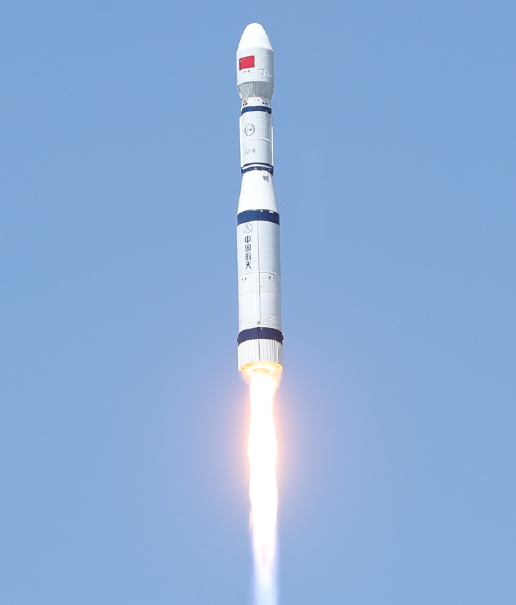
#CNSA #ChinaNationalSpaceAdministration #国家航天局 |#BRI #July2023 | #CASC #ChinaAcademyOfSpaceTechnology #长征六号#ChangZheng6C #LongMarch6C China’s first space “carpooling” rocket auction soon……

长征六号On the 13th July 2023 it is the first Auction of China, People’s Republic of China’s First Carpooling on the CNSA –China National Space Administration Chang Zheng – Long March 6 Carrier Rocket and international Icon Launch Vehicle Piggbacking Opportunities also auction activity.. “carpooling” rocket auction will start at 3:00 pm on July 13. The rocket participating in this auction is the Long March 6 developed by the CASC – China Academy of Space Technology- Eighth Academy of Aerospace Science and Technology Group C carrier rocket is expected to be launched by the end of this year of 2023, and the starting price is 80,000 yuan per kilogram. ​​​

Long March 6 carrier rocket (English: Long March 6, abbreviation: CZ-6) is a new generation of non-toxic and non-polluting small liquid carrier rocket developed by the Shanghai Academy of Aerospace Technology of the People’s Republic of China ( the Eighth Research Institute of China Aerospace Science and Technology Corporation ) .

The Chang Zheng Long March 6C 43 meters tall three-stage rocket with a carrying capacity of 500 kilograms in a sun-synchronous orbit at an altitude of 700 kilometers . The rocket has the advantages of low cost, high reliability, strong adaptability, and good safety. Many new technologies are applied for the first time in China, and the development is very difficult . The Long March-6 launch vehicle was officially approved by the state in the year  2009,

Design Principle’s

LOW COST-  Cost reduction is an important condition for improving the competitiveness of launch vehicles in the domestic and foreign satellite launch markets. The key to the development of small launch vehicles is to reduce costs. On the one hand, make full use of the basic technology of the new generation of launch vehicles to reduce the cost of development. During the design process, the idea of ​​low-cost design should always be implemented, and the system configuration should be simplified as much as possible while ensuring reliability; launch operations should be simplified to reduce launch costs. Using kerosene/liquid oxygen engine, the light fuel cost saves millions of yuan compared with before.

High reliability is the lifeblood of a rocket. Follow the reliability design principle of “simple is reliable”, and strive for simplicity in stand-alone or system design; through strict quality assurance system and quality management system, control product design and production quality. The design reliability is 95%. After further optimization, the reliability of the first flight has been increased to 98%, which is 1% higher than that of the most secure Long March 2 F-type.

Adaptable- To meet the diverse needs of users, it can not only adapt to the launch of small satellites in various orbits, but also launch double or multiple satellites; it can adapt to new launch sites or launch at existing launch sites. During its maiden flight, the Long March-6 completed 20 satellites in one rocket, setting a new record for Chinese satellite launches.

Short cycle -The technology of the basic type of new-generation carrier rocket is fully applied, the development cycle is short, the launch method is simplified, the launch cycle is shortened, and the requirements for rapid launch are met. The launch preparation time for the first flight only takes one week

Images and visuals are from their Respectives CMS China Manned SpaceCNSA-China National Space Administration

#CNSA #ChinaNationalSpaceAdministration #国家航天局 |#BRI #June2023 | #天宫#Tiangong #ChinaSpaceStation #CMS #ChinaMannedSpace #神舟十六号 #Shenzhou16 – #Mengtian Module Capsule Space Radiation Biological Exposure Experimental Device successfully launched…

On the 30th  May 2023 clear 0931 Hours Morning Hong Kong SAR- Beijing time , the Belt and Road Initiative CNSA –China National Space Administration  from Jiuquan Satellite Launch Center – Inner Mongolia –China – People’s Republic of China deployment of  the Chang Zheng –   The Chang Zheng – Long March 2F Yao 16 –Shenzhou 16  carrier rocket.. On which Takionauts Jing Haipeng, Zhu Yangzhu, and Gui Haichao took to the predetermined orbit. The first manned flight mission in the application and development stage was a complete success. The three astronauts will stay in the space station and “join up” with the crew of Shenzhou 15 to carry out on-orbit handover “face-to-face” meeting in which brings the total crew of six with a handover ceremony  from Shenzhou 15 towards 16..

[Space Station Mengtian Capsule Space Radiation Biological Exposure Experimental Device successfully launched]
On the June 9-10, 2023 Beijing time, through the overall organization and coordination of space applications, with the support of the Takionaut system, China space station system, Beijing Flight Control Center and related systems, The space radiation biology exposure experiment device in the Mengtian experimental cabin of the space station (hereinafter referred to as the space radiation biology device) was grabbed by the robotic arm and left the cargo airlock.

Starting work! 空间Tiangong radiation device out of the cabin of the Mengtian module Shenzhou 16’s “doctoral crew” entered the space station for about two weeks, and quickly carried out a lot of work such as sorting out materials and loading out of the cabin. Come and take a look at three highly educated Takionauts working on the space radiation biology device out of the cabin in orbit, and quickly entered the working state!

The space radiation biology device is the first out-of-cabin load of the Mengtian Capsule. It is used to carry out research on the biological effects of environmental elements such as space particle radiation on sample materials. It can meet the timeliness, temperature, etc. Requirements to provide life support for scientific experiments on biological samples….

Images and visuals are from their Respectives CMS China Manned SpaceCNSA-China National Space Administration

#CNSA #ChinaNationalSpaceAdministration #国家航天局 | #BRI #June2023|#太原卫星发射中心  #TaiyuanSatelliteLaunchCenter  – International Iconic #ChangZheng2D #LongMarch2D  #CarrierRocket in launch readiness to deploy #Gaofen #Jilin  series  41 Satellites into orbit..

At  15th June 2023 , China- People’s Republic of China- CNSA –China National Space Administration   Successfully launched  the New Next Generation Long March – Chang Zheng2D carrier rocket at the Taiyuan Satellite Launch Center Shanxi Province..  Is set to launch 41- forty one Satellites in which the Chang Zheng – Long March 2D Carrier Rocket is in preparing readiness to launch in which dates back to On May 22, a total of 41 satellites set off in the Changchun Aerospace Information Industry Park, among them, “Jilin No. 1” Gaofen 03D19-26 satellites, Gaofen 06A series satellites, platform 02A01-02 The 36 satellites including Si-1 are the “Jilin-1” satellites.

The Chang Zheng -Long March 2D “One Carrier Rocket  41 Satellites” will be launched on the next day on expected on 16th June 2023 …. The latest batch of Jilin-1 satellites launched in the form of “One Carrier Rocket  41 Satellites” involves 3 large software systems and 4 satellite models, 41 satellites, and 50 sets of antenna equipment.

At present, the launch of “One Carrier Rocket 41 Satellites” has officially entered the countdown! It is planned to be launched from the Taiyuan Satellite Launch Center in the near future. This will create the record for the largest number of satellites launched in a single spaceflight in China..

[The countdown to launch has entered! Uncover how “one Carrier Rocket  41 satellites ” is achieved?

How did “41 satellites  with one Carrier Rocket” come true this time? What’s the point? Li Feng, director of the satellite operation and management technology research office of Chang Guang Satellite Technology Co., Ltd., gave the answer in an exclusive interview with China Jilin Net!


“The launch of ‘One Carrier Rocket  41 Satellites’ poses a huge challenge to the transportation and management system. In the past, a maximum of 16 satellites were launched at one time, but this time the number has reached nearly three times that of the maximum one, and it involves multiple satellite models. For measurement and control , data transmission resources, software system development, and personnel requirements are all higher. In order to do a good job in the operation and management of 41 satellites, the colleagues in the Satellite Operation and Management Technology Research Office started the preparation work at the end of last year, and the internal and external coordination of the company , docking, and recently successfully completed the system development and the joint test of the three-wheel operation and management system, involving 3 large software systems, 4 satellite models, 41 satellites, and 50 sets of antenna equipment, and confirmed the functions, performance and interfaces of each system Matching situation. The 41 satellites launched this time include 8 Jilin-1 Gaofen 03D satellites and 30 Gaofen 06A series satellites. Among them, the weight of the Gaofen 06A single satellite has been successfully reduced to 20kg, and its performance indicators are still very advanced.


Li Feng said, “During the satellite-rocket separation stage, the 41 satellites were separated seven times successively. The separation time of each group of satellites lasted for three to five seconds. . This launch has put forward higher requirements for both satellites and rockets, including separation timing and control of satellite force and torque, so as to ensure that each satellite can enter the predetermined orbit smoothly and safely. “


After the 41 satellites launched this time (including 36 “Jilin-1” satellite constellation networking remote sensing satellites) are in orbit, they will form a network with the 72 “Jilin-1” satellites in orbit. So far, “Jilin-1” “The number of satellites in orbit has increased to 108, marking that the “Jilin-1” satellite constellation network project has successfully achieved the phased goal of “Hundred Stars Flying into the Sky”

Images and visuals are from their Respectives CMS China Manned SpaceCNSA-China National Space Administration

CNSA #ChinaNationalSpaceAdministration #國家航天局 |#BRI  #June2023 | #火星 # 天問 #天问一号#TianwenOne #MarsMission #Tianwen1 probe  #祝融号 stunning Martian landscape new stunning Mars Orbitally  Selected photography during the year #December2021 #AGallery   ——-

 天问一号飞運騎遊達达3亿CNSA – China National Space Administration – ESA – European Space agency Belt and road initiative mars mission…first Mars exploration mission, Tianwen- Martian Probe One As of September 15, 2022, the Tianwen-1 orbiter has been in orbit for more than 780 days, and the rover has travelled a total of 1,921 meters, completed the established scientific exploration tasks, and obtained 1,480 GB of original scientific exploration data. The scientific research team has obtained rich scientific results through the research on the first-hand scientific data obtained independently by my country. Through a comprehensive study of typical landforms such as concave cones, barrier craters, and trenches distributed in the landing area, the important connection between the formation of the above-mentioned landforms and water activities has been revealed.

Currently as to date of the Zhurong Mars Rover is currently at sleep safe mode due to the Martian Sandstorms….. the location of Zhurong taken by the Tianwen-1 orbiter after it hibernated in Zhurong last year. The rut marks left by Zhurong after traveling 1921 meters are clearly visible….. The local dust on Mars captured by the Tianwen-1 orbiter is very layered. This photo was taken by the medium-resolution camera of the Tianwen-1 orbiter on January 6, 2022, and Zhurong went into a dormant state more than three months after this time point. 

On the week of 6th June 2023 there have been new images release of the CNSA –CLEP Mars The Lunar and Planetary Data Publishing System released a new batch of Tianwen-1 data today, including a large number of Martian surface photos taken by the obiter’s medium-resolution camera! The total number is estimated to be hundreds to thousands!  But here are some stunning incredible randomly selected a few pictures is beautiful in which has been process during the Month of December 2021 at the time when before the Martian Sandstorm!

Some of the images taken by the Zhurong rover in December 2021 come from the latest data released by the China Planetary Exploration Engineering Ground Application System.


The famous Olympus Mons (Olympus Mons), a giant shield volcano on the northwest side of Mars Tharsis (Tharsis). This image is stitched together from 6 MoRIC images selected from the December 2021-detection cycle 00734 data released today, and processed using OpenCV, SKImage, and Lr. [CAS/GRAS, CNSA/PEC; export production

Selected from the December 2021 data set of the medium-resolution camera of the Tianwen-1 orbiter, source: China Planetary Exploration Engineering Ground Application System​​​​….

On August 15, 2021, the “Zhurong” rover successfully completed the 90 Martian scientific exploration missions, and continued to carry out extended exploration missions. It has traveled 1,921.5 meters on the surface of Mars. Affected by the severe winter cold and dusty weather in the landing area, the rover will enter the winter dormancy mode on May 18, 2022 as designed. Around December 2022, the “Zhurong” landing area will enter the early spring season. will resume normal work.

The orbiter has circled Mars 1,344 times, achieving global coverage and is currently in normal condition. In the follow-up, it will continue to carry out global remote sensing detection, and choose an opportunity to carry out expansion technology experiments to carry out preliminary technical verification for related tasks.

After nearly two years of flight and exploration for the Tianwen-1 mission, the 13 scientific payloads deployed by the rover and orbiter have obtained a total of about 1040GB of raw scientific data. After receiving and processing on the ground, the standard scientific data products formed are submitted to the rover on a monthly basis. A team of scientists has conducted analysis and interpretation, and relevant scientific results have been published in well-known academic journals at home and abroad. These scientific data will be open to scientists around the world at an appropriate time. Scientists around the world are welcome to actively apply for research and jointly promote the cause of human exploration of the universe.

At present, the Tianwen-1 orbiter continues to carry out scientific exploration in the orbit of the remote sensing mission, continues to accumulate first-hand scientific data, and makes China’s contribution to mankind’s in-depth understanding of Mars.
 ​​​​

Images and visuals are from CNSA China National Space AdministrationCLEP China Lunar Exploration Program.