深蓝航天 Deep Blue Limited – Deep Blue Aerospace One of sixty Chinese private space Carrier Rocket Companies in China-People’s Republic of China… As many of sixty plus Private Rocket Deep Blue Aerospace Co., Ltd. was established in 2017. The company is mainly a high-tech aerospace enterprise that focuses on the direction of liquid recovery and reusable launch vehicles and provides users with commercial launch services. Deep Blue Aerospace Co., Ltd. is headquartered in Nantong City, Jiangsu Province. At the same time, the company has rocket general and liquid engine R&D centers in Yizhuang, Beijing and Xi’an, Shaanxi, respectively, and a rocket power system test base in Tongchuan, Shaanxi…..
The Thunder-R1 engine is the latest reusable liquid oxygen kerosene rocket engine developed by Deep Blue Aerospace. It will be used in the first sub-stage of Deep Blue Aerospace’s first orbit-level recoverable launch vehicle “Nebulas 1” in a parallel manner. It will carry out technical iterations and upgrades in the future to rapidly improve the thrust performance of the engine to the order of 35-40 tons.
The “Nebula 1” carrier rocket has a take-off thrust of more than 130 tons, a low-Earth orbit carrying capacity of about 2 tons, and has a design goal of 50 reuses in the long run. It is planned to have the ability to launch into orbit by the end of 2023
On May 6, 2022, the “Nebula-M” test rocket independently developed by DeepBlue Aerospace completed a 1-kilometer vertical take-off and landing flight test. It has climbed to a new height and is a solid step closer to the successful realization of orbit and recovery
On 9th July 2022 Recently, Deep Blue Aerospace’s 20-ton “Thunder-R1” reusable engine (Thunder Reusable 1) successfully completed the first round of ignition test. The same engine was used in this test, and a total of 5 ignition tests were carried out. The cumulative ignition working time reached 138 seconds, and the longest single working time reached 90 seconds; the engine worked smoothly, and the startup and shutdown were normal in each test run. It marks the complete success of the first-round test run of the Thunder-R1 engine……
Deep Blue Aerospace’s third-hand “Nebula-M” rocket completes the flight recovery mission On May 6, 2022, the “Nebula-M” No. 1 test rocket independently developed by DeepBlue Aerospace completed a 1-kilometer vertical take-off and landing (VTVL) flight test, and the rocket moved laterally during the process of climbing and falling. , and finally landed to a point less than 0.5 meters from the “bull’s eye” position of the landing site, and the “Nebula-M” test arrow was successfully recovered.
On 15th May 2022 Hong Kong SAR – Beijing time at Jiuquan Satellite Launch Center- Inner Mongolia-China – People’s Republic of China, Interstellar Glory Hyperbola-2 verification rocket successfully completed the joint training mission of the whole eco system Onwardly that month of May 15th , 2022, Beijing Interstellar Glory Space Technology Co., Ltd. (hereinafter referred to as “Interstellar Glory”) successfully completed the double The full-process joint training of liquid oxygen and liquid nitrogen for the Curve 2 verification rocket marks a critical step for Interstellar Glory to the successful development of a reusable launch vehicle.
With the help and support of leaders at all levels of the Jiuquan Satellite Launch Center, the Hyperbola-2 verification rocket test team organized and carried out refueling preparations, power-up tests, liquid oxygen and liquid nitrogen refueling, pre-cooling drills, emergency Works such as venting drills, simulated launch, and recovery processing have been completed, and the full-process operation exercise of refueling, launching, and landing recovery of the Hyperbola-2 verification rocket has been completed. Coordination, work adaptability of related products on the rocket and the ground in low temperature environment, the matching of the function of the filling gas supply system with the rocket, the correctness and integrity of the technical documents and operating procedures used in the test, and the completion of the refueling process. The evaluation of various working hours in the process of note, launch, and landing recovery has accumulated valuable test data and laid a solid foundation for the vertical take-off and landing (VTVL) flight test of a dual-low temperature reusable rocket.
“Hyperbolic 2 Reusable Small Liquid Launch Vehicle” is the main product with international competitiveness independently developed by Interstellar Glory. Hyperbola No. 2 is a two-stage small liquid launch vehicle with a maximum diameter of 3.35 meters. The first and second stages are equipped with the “Focus No. 1” 15-ton reusable variable-thrust liquid oxygen methane engine independently developed by Interstellar Glory; The take-off mass of the Hyperbola-2 carrier rocket is 90 tons, and the carrying capacity of the 500-kilometer SSO orbit is 1.5 tons (no recovery in the first stage) / 1 ton (recovery in the first stage… )
Hyperbola II: Reusable small liquid launch vehicle, adopts a two-stage series configuration, the first and second stages adopt 15-ton reusable liquid oxygen methane liquid rocket engine Focus No. 1 (JD-1), one of which 9 units are installed and 1 unit is installed in the second level. The diameter of the first-class rocket body is 3.35 meters, and the diameter of the second-class rocket body is 2.25 meters. The total length of the rocket is about 28 meters, the take-off weight is about 90 tons, the maximum carrying capacity of low-Earth orbit is 1.9 tons, and the carrying capacity of 500km SSO orbit is 1.1 tons (non-recovery)/0.7 tons (first-stage recovery). The first stage of the rocket has a vertical landing recovery function, which can be reused more than 30 times.
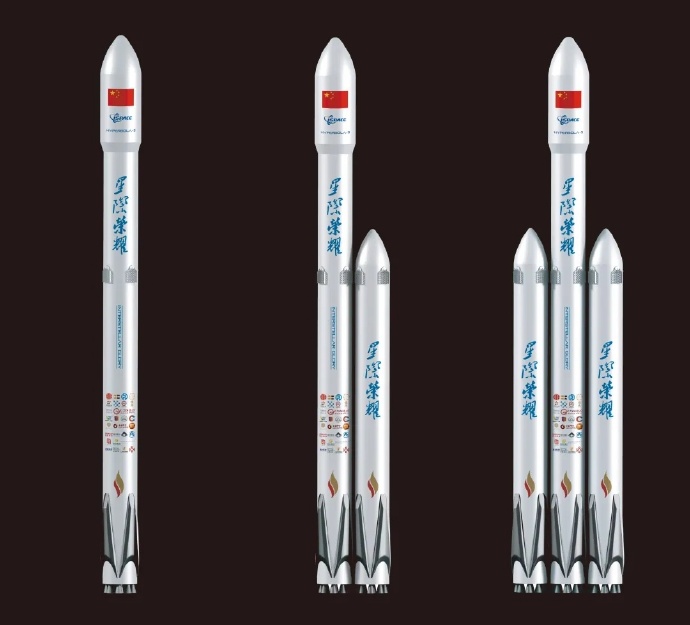
Hyperbolic III series liquid launch vehicle: medium and large reusable liquid launch vehicle, including SQX-3 basic type, SQX-3A (two-core stage parallel connection), SQX-3B (three-core stage parallel connection) three configurations, carrying Capability can meet the needs of a variety of load tasks. In addition to meeting large-scale satellite networking, medium and large-scale satellite launch tasks, it also has the capabilities of space station cargo transportation and deep space exploration also for Space Plane for crew transportation
Images-visuals are from Weibo and their respectives..
深蓝航天 Deep Blue Limited – Deep Blue Aerospace One of sixty Chinese private space Carrier Rocket Companies in China-People’s Republic of China… As many of sixty plus Private Rocket Deep Blue Aerospace Co., Ltd. was established in 2017. The company is mainly a high-tech aerospace enterprise that focuses on the direction of liquid recovery and reusable launch vehicles and provides users with commercial launch services. Deep Blue Aerospace Co., Ltd. is headquartered in Nantong City, Jiangsu Province. At the same time, the company has rocket general and liquid engine R&D centers in Yizhuang, Beijing and Xi’an, Shaanxi, respectively, and a rocket power system test base in Tongchuan, Shaanxi…..
On May 6, 2022, the “Nebula-M” test rocket independently developed by DeepBlue Aerospace completed a 1-kilometer vertical take-off and landing flight test. It has climbed to a new height and is a solid step closer to the successful realization of orbit and recovery
Deep Blue Aerospace’s third-hand “Nebula-M” rocket completes the flight recovery mission On May 6, 2022, the “Nebula-M” No. 1 test rocket independently developed by DeepBlue Aerospace completed a 1-kilometer vertical take-off and landing (VTVL) flight test, and the rocket moved laterally during the process of climbing and falling. , and finally landed to a point less than 0.5 meters from the “bull’s eye” position of the landing site, and the “Nebula-M” test arrow was successfully recovered.
The arrow body used in this Kilometer-level test is still the “Nebula-M” No. 1 test arrow, which has performed 3 flight missions and 7 ground static ignitions, truly realizing the recyclability and reuse of liquid launch vehicles ; its The equipped “Thunder-5” engine is the first needle-bolt-type liquid oxygen kerosene engine to be manufactured using 3D printing technology in China. The completion of this mission announced that Deep Blue Aerospace has climbed to a new height in the history of China’s reusable and reusable rockets, and has taken a solid step towards the successful realization of orbit and recovery.
Pictured: “Nebula-M” kilometer-level VTVL vertical recovery flight test
From July to October 2021, the “Nebula-M” test rocket has successively completed the 10-meter and 100-meter VTVL vertical recovery flight tests, achieving two zero breakthroughs in domestic liquid oxygen and kerosene rockets. In May 2022, the same rocket once again refreshed a new test height. Deep Blue Aerospace has become the fastest Chinese commercial aerospace company in the world outside the United States to develop and recycle rockets.
Pictured: “Nebula-M” kilometer-level VTVL vertical recovery flight test
This kilometer-level VTVL vertical recovery flight test marks that Deep Blue Aerospace achieved the same level of test results achieved in 2012-2013 with 8 launch tests in more than a year in only 10 months and 3 launch tests. Deep Blue Aerospace has become the second company in the world to complete all low-altitude engineering tests for vertical recovery and reuse of liquid oxygen and kerosene rockets (the first being SpaceX in the United States).
Kilometer -level VTVL vertical recovery flight test broke many domestic records…
The “Nebula-M” kilometer-level VTVL vertical recovery flight test has four technical highlights:
Significant reduction in flight test costs
Under the premise of realizing the vertical recovery of the full arrow, the cost of re-flying the mission is only about 1% of the cost of the production and manufacturing of the arrow body, including the replacement of some wear and tear parts, the test and maintenance cost of the whole arrow, and the propellant cost;
Longer working time for a single ignition
Compared with the 100-meter-level test, the kilometer-level VTVL vertical recovery flight test has greatly improved the working time of a single ignition of the engine, which is closer to the working time of a single-stage engine of an orbiting rocket. Different from the state of the ground test, this time the stability of the large-scale thrust change and long-range work of the engine is assessed in the real flight environment, which has more authenticity and practical significance in engineering development;
Application of Lateral Guidance Algorithm
In this kilometer-level test, during the vertical takeoff-vertical landing flight process, a lateral guidance algorithm was added, the coordinates of the target point were pre-booked, and the computer on the rocket carried out calculation and planning, issued lateral guidance commands, and guided the rocket to the target coordinates. Transverse, carry out the verification of the rocket’s off-site return and recovery technology, and carry out preliminary technical verification for the off-site return and reuse of the rockets entering orbit, and intercontinental travel, etc.;
Breakthroughs in multiple coefficients of the kilometer-level VTVL vertical recovery flight test
In this kilometer-level VTVL vertical recovery flight test, the flight speed reached 0.2Ma and the flight altitude reached 1 km. This is the vertical recovery flight test with the highest flight altitude, fastest flight speed and longest flight time in China.
Through this flight test, the aerodynamic problems of the rocket body in the vertical recovery process of the rocket, as well as the long-term mechanical heat and vibration environment adaptability, the engine’s long-term and large-scale thrust change ability, and the reusable arrow are further verified. Key core technologies such as body structure and landing buffer device, lateral guidance and attitude control capabilities have laid a solid foundation for the subsequent 10-kilometer-level vertical recovery and orbit-level recovery.
Huo Liang, CEO of Deep Blue
The success of Deep Blue Aerospace’s “Nebula-M” rocket kilometer-level VTVL vertical recovery flight test also announced that the low-altitude recovery stage has come to a successful end, and the “Nebula-M” 1 test rocket has successfully completed its historical mission. In the next stage, Deep Blue Aerospace will use the same full-scale test rocket as the orbiting rocket to continue the high-altitude recovery test stage (similar to the recovery test carried out by SpaceX’s second stage using the full-scale prototype “Falcon 9 R”), It will make rapid breakthroughs towards the height of 10km and 100km, and finally realize the controllable recovery and reuse of the first sub-stage of the orbiting rocket.
Pictured: “Nebula-M” kilometer-level VTVL vertical recovery flight test
In 2021, the Permanent Mission of China to the United Nations (Vienna) submitted a note verbale to the Secretary-General of the United Nations and released information that the satellites launched by the US Starlink plan had approached the Chinese space station twice, and this behavior had a negative impact on the life and health of the astronauts built by the Chinese space station. threaten. For safety reasons, the Chinese space station complex has implemented two “emergency collision avoidance” measures against the relevant US satellites. However, the key to these problems is that the number of satellite launches planned by Starlink far exceeds that of China. As of March 2022, Starlink plans to launch more than 2,000 satellites, and the only way to achieve such a large number of satellite launches is to reduce the launch cost of rockets and increase the frequency of launches to be realized.
Low-cost recyclable rockets have become the only way to develop future launch vehicles. With rapid overhaul, relaunch, successful recovery, and rapid iteration, SpaceX’s Falcon 9 ranks among the world’s rocket echelons. Up to now, SpaceX’s flight data: 95 rocket reuse flights, 118 rocket landings, and the take-off stage of a single carrier rocket can be reused up to 12 times.
On April 16, 2022 From the construction of space infrastructure to the completion and opening of the Beidou global satellite navigation system, from the successful conclusion of the “three-step” lunar exploration project to the “Tianwen-1” crossing the Earth-Moon system to start the Mars exploration journey… Countless brilliant achievements are in It continues to prove that China is making progress towards becoming a “space power”.
As a commercial aerospace enterprise, Deep Blue Aerospace actively responded to the country’s strategic deployment of the aerospace industry, anchored the goal of rocket recycling and reuse, and never wavered or changed the direction of research and development.
On 24th April 2022, China- People’s Republic of China- CNSA –China National Space Administration throughout the China- People’s Republic of China in which on that Day it’s China National Space Day in which it is the sixth China National Space Day in which there’s promotional events across the whole nation.. in which this week there’s promotional release themes on the previously hard working campaigns in space collaboratively in which features many successfully accomplishments in between various sectors among with governmentally to commercially industrial innovative designs of space ..
Long March 9 is a Chinese super-heavy carrier rocket concept that is currently under development. It is the ninth iteration of the Chang Zheng Long March Series Carrier rocket family, named for the Chinese Red Army’s 1934–35 Long March campaign during the Chinese Civil War against the illegal KMT Republic of China government…. During the Space Day of China or中国天文日China Space Day 2022 celebrating there was massive celebrationally events across the China- People’s Republic of China. The newly advancement of the Chang Zheng – Long March Nine Ultra Heavy Carrier Rocket has undergone many design generationally evolutions in the final approach that is with a cluster of ten more engines in which the new design arrangement configuration which is thicker durable taller with that the Chang Zheng – Long March Nine Ultra Heavy Carrier Rocket can be Reusable- reused..
The Chang Zheng Long March 9 Ultra Heavy Carrier- Reusable Rocket has a new polished rod configuration, with a thickness of 11 meters and a height of 111 meters or more, adding 10 new engines….Long Lehao is the chief designer and general consultant of the launch vehicle series of the China Academy of Launch Vehicle Technology, an academician of the Chinese Academy of Engineering, and the deputy chief designer of the lunar exploration project. On March 23, my country’s seventh “China Space Day”, Academician Long Lehao and a number of authoritative figures in the aerospace field were invited to the School of Astronautics of Beijing Institute of Technology. At the first report meeting, Academician Long Lehao gave a lecture on aerospace knowledge and communicated with teachers and students. During this period, he announced the latest design plan of the Long March 9, which quickly attracted widespread attention.
Many friends know that Academician Long announced a new configuration plan of the Chang Zheng Long March 9 when he visited the University of Hong Kong just last year. It is often called “21 version of Chang Zheng Long March 9 (2021 version)” on the Internet. The new version released this year is basically the same. Yu overthrew last year’s version, so what about this 22nd version (2022 version) Long March 9? Let’s take a look first.
The picture above is the PPT picture of the evolution of the configuration of the Long March 9 rocket announced by Academician Long Lehao during his visit to the University of Hong Kong in 2021. The far right is the 2021 version of the Long March 9.
The picture above shows the latest version of the Long March No. 9 PPT screen released by Academician Long Lehao at Beijing Institute of Technology on April 23 this year.
According to the composition and data of the 22nd version of Chang Zheng Long March 9, which appeared in Academician Long’s PPT presentation, this latest version of the Long March 9 continues the 21st version of the bare rod without booster configuration, but it is thicker and longer than the 21st version. Now, the core stage of the latter has a diameter of 10.6 meters, while the diameter of the 22 Chang Zheng Long March 9 has reached 11 meters, and both the first and second stage rockets are 11 meters in diameter, which is larger than the Saturn V used by the United States to land on the moon. (The diameter of the first stage is 10.1 meters) and it is nearly 1 meter thicker, which is also thicker than NASA’s SLS super-heavy rocket (the first stage of the rocket core stage is 8.4 meters in diameter) and Musk’s starship (9 meters in diameter). If it is successfully developed, it can be called the thickest rocket in history.
The picture above shows the size comparison of the three Long March 9 rockets and my country’s “Hainan” amphibious assault ship. The third from the left is the 2021 version of the Long March 9.
In terms of the diameter of the rocket, this is actually at least the third time that the Chang Zheng Long March 9 plan has become thicker. The design plan of the Long March 9 launched in 2011 has a diameter of 9.5 meters (another 4 boosters). It is 10.6 meters, and this year it has become 11 meters. It can be said that it is getting thicker and thicker.
However, the configuration of this rocket is not only thick, but also magical. When the second-stage rocket transitions to the third-stage rocket, it suddenly shrinks to a diameter of 7.5 meters, but when it reaches the fairing, it suddenly thickens to a diameter of 10 meters. The shape of the third stage to the fairing is like a waist gourd, which is very strange.
The height of the 22nd version of Chang Zheng Long March 9 has also changed, and it has become taller! The total length has reached 111 meters, which is comparable to the height of a 37-story building, 0.4 meters higher than Saturn 5, and 13 meters higher than NASA’s SLS rocket (98 meters in height for the manned version). It is 103 meters, and the height of the 2021 version of Chang Zheng Long March 9 is 108 meters, and now it has increased by 3 meters, and the height is constantly being refreshed.
The far right side of the picture above is the 2021 version of the Long March 9. It can be seen that it is much larger than the 2011 version of the three different configurations of the Long March 9 on the right. The new version of the Long March 9 released this year is larger than the 2021 version, it is conceivable How amazing its physique should be.
Not only is it thicker and longer (or taller), it also has more rocket launches. In the key equipment components, the biggest change in the new configuration of the Long March 9 is its engine. The 2011 version of the Long March 9 design plan is equipped with four YF-130 liquid oxygen kerosene engines for the core stage rocket (a single thrust of about 480 tons) ,), each of the 4 boosters is equipped with 2 YF-130 liquid oxygen kerosene engines, so that the total thrust of the first-stage rocket can reach about 5,800 tons; The core three-stage rocket is equipped with four 25-ton YF-79 hydrogen-oxygen engines.
In the 2021 version of the Chang Zheng Long March 9plan, 4 boosters were abandoned, and the bottom of the core-level polished rod rocket was replaced with 16 YF135 liquid oxygen kerosene engines (a single thrust of about 370 tons). This design is similar to the original version. The thrust is the same, but the boosterless configuration becomes simpler, the aerodynamic efficiency is better, the weight is also reduced by 15 tons, and the launch efficiency is also improved.
The engines of the 2021 version of Chang Zheng Long March 9 second- and third-stage rockets have also been replaced. The core two-stage rocket has been replaced by 2 YF-90 hydrogen-oxygen engines with a thrust of 220 tons to four 120HO hydrogen-oxygen engines with a thrust of 120 tons. The ratio increased by 40 tons, and the core three-stage rocket was replaced by a 120HO hydrogen-oxygen engine from four 25-ton YF-79 hydrogen-oxygen engines, and the thrust was increased by 20 tons.
After such an improvement, the take-off weight of the rocket has been reduced by dozens of tons, and the carrying capacity and carrying efficiency have also been improved. The capacity of the low-Earth orbit has increased from 140 tons in the 2011 version of the Chang Zheng Long March 9 plan to 150 tons, the capacity of the Earth-Moon transfer orbit has increased from 50 tons to 53 tons, and the capacity of the ground-fire transfer orbit has reached between 45 and 50 tons. Load factor and load efficiency.
But the most eye-catching change in the 2022 version of the Long March No. 9 plan is the engine. First, the number of engines has increased, and 26 200-ton liquid oxygen methane engines are used, and there is no model for this engine, so it should not be a project. The thrust of such a first-stage rocket is 5,200 tons, which is lower than the previous two versions, about 700 tons, but the carrying capacity has not been reduced. The transfer rail carrying capacity is 50 tons.
As for why a liquid oxygen methane engine is used, it is because methane has many advantages over kerosene and liquid hydrogen. First, the storage temperature of methane and liquid oxygen is not much different. Methane is minus 161 ℃, and liquid oxygen is At minus 183°C, set up a refrigeration device to separate two spaces, and set them at different temperatures to store them together. However, the storage temperature of liquid hydrogen is minus 253°C, which is quite different, while kerosene can be stored at room temperature. Therefore, in terms of refrigeration, it is more troublesome to place liquid oxygen together with kerosene or liquid hydrogen. If the insulation is not done well, liquid hydrogen will freeze liquid oxygen to solidify, and liquid oxygen will freeze kerosene to solidification. , it is necessary to add a lot of necessary things or equipment, which increases the weight of the rocket and reduces the launch efficiency ratio.
Nowadays, liquid hydrogen and liquid oxygen engines are considered ideal, but in fact the density of liquid hydrogen is very low. The liquid hydrogen storage tank in the rocket is at least 5 times larger than the liquid oxygen storage tank. The huge storage tank also increases the weight of the rocket. The methane storage tank is similar in size to the liquid oxygen storage tank, so considering all aspects of data and characteristics, the liquid oxygen methane rocket is the best choice.
Moreover, this liquid oxygen methane engine is also the best choice for building a recyclable and reusable rocket. This is also the “Raptor” liquid oxygen methane engine that Musk must use to build the starship (the original thrust is 180 tons, and the upgraded version has a thrust of 250 tons) The reason for this, and the new version of the Long March 9 PPT picture released by Academician Long, the first design purpose of the program is “reusable” use, so this time the main focus is also the “reusable” function of Chang Zheng Long March 9.
The picture above shows the three “Raptor” liquid oxygen methane engines used on the starship.
Perhaps it is precisely because of the configuration of the liquid oxygen methane rocket and the various advantages of this engine that Academician Long Lehao updated last year’s design with the 2022 version of the Long March 9 plan announced this year. This liquid oxygen methane rocket is also a giant The most ideal choice for rockets, it can even be recycled and reused in the future, and if the design is in place, the thrust-to-weight ratio of this engine will be very ideal, which also allows the volume of the engine to be made very small, so the lower end of the first stage rocket can be used. Install a number of liquid oxygen methane engines.
The number of engines of our rocket is not fixed. There are 29 to 32 Raptor engines under the first stage of Musk’s starship, and a maximum of 37 engines can be installed, but its diameter is only 9 meters. If we can develop If there is a liquid oxygen methane engine with the same thrust-to-weight ratio as the “Raptor”, then the number of engines that can be installed under the first level of the 2022 Long March 9 is not only 26, so the 26 engines mentioned by Academician Long are likely to be the minimum basic The version, if it is opened, can even put 50 “Raptor” equivalent engines under the super rocket with a diameter of 11 meters, and the thrust can reach 10,000 tons. If it can achieve 1/3 of the thrust upgrade like the Raptor, the total thrust can even reach With a total thrust of 13,000 tons, the carrying capacity can be greatly increased by 1 to 3 times.
Of course, this is only an idea at present. my country’s Long March 9 super-heavy rocket was approved last year. The manufacturing plan is basically the 2011 version of Chang 9. The various components used have also been rolled off the assembly line. It is estimated that in the next few years The assembly will be completed one after another, and the first flight will take place before 2029 at the latest. It will be a major power in my country’s aerospace field in the new era.
The picture above shows the interstage ring of the Long March 9, which is under development, and has already begun to be manufactured.
The above picture shows the actual scale simulation of the Long March 5 rocket (small left) and the 2011 version of the Long March 9 rocket (large right).
But this does not mean that the new version of the Long March 9 will not be manufactured. What Long Lao proposed is an improved optimization plan. It is not only the digestion, absorption and re-innovation of the world’s advanced aerospace technology, but also represents the future development direction of my country’s aerospace industry. The two Chang 9 versions proposed by Long Lao in the past two years are both bare-rod and non-boosted configurations, indicating that this configuration of the Long March 9 giant rocket will become a new development direction, and maybe there will be better configurations in the future. , but at present, the 22nd version of Chang Zheng Long March 9 is the most advantageous configuration scheme…..
References:
“Guangming.com” article on April 24 “Aerospace lights up dreams, BIT launches “Space Moon” activity”
“The Paper” June 24, 2021 article “The Diary of Space Entering Hong Kong, the University of Hong Kong welcomes the 83-year-old Academician Long Lehao, and changes to the scene of chasing stars in seconds “
Images and visuals are from their respectives. 科技前沿技术信息 | 科普博览
In which iSpace- Interstellar Glory in which it is the first Chinese Private Space Company to do so successfully commercially first out from sixty known private space companies in China People’s Republic of China… Founded in Beijing 2016 located in Beijing Economic and Technological Development Zone or known for short as E-Town in Capital of China – People’s Republic of China …
Currently Visually on 25th November 2021 Showcasing it’s Reusable Carrier Rockets also it Reusable ecosystem Hyperbola One: A small solid carrier rocket, with a four-stage solid configuration, with a total length of 24 meters, a diameter of 1.4 meters, a take-off mass of 42 tons, and a 500-kilometer sun-synchronous orbit. Less than 300 kg, 700 km sun-synchronous orbit carrying capacity is not less than 230 kg.
Hyperbola II: Reusable small liquid launch vehicle, adopts a two-stage series configuration, the first and second stages adopt 15-ton reusable liquid oxygen methane liquid rocket engine Focus No. 1 (JD-1), one of which 9 units are installed and 1 unit is installed in the second level. The diameter of the first-class rocket body is 3.35 meters, and the diameter of the second-class rocket body is 2.25 meters. The total length of the rocket is about 28 meters, the take-off weight is about 90 tons, the maximum carrying capacity of low-Earth orbit is 1.9 tons, and the carrying capacity of 500km SSO orbit is 1.1 tons (non-recovery)/0.7 tons (first-stage recovery). The first stage of the rocket has a vertical landing recovery function, which can be reused more than 30 times.
Hyperbolic III series liquid launch vehicle: medium and large reusable liquid launch vehicle, including SQX-3 basic type, SQX-3A (two-core stage parallel connection), SQX-3B (three-core stage parallel connection) three configurations, carrying Capability can meet the needs of a variety of load tasks. In addition to meeting large-scale satellite networking, medium and large-scale satellite launch tasks, it also has the capabilities of space station cargo transportation and deep space exploration also for Space Plane for crew transportation
Images-visuals are from Weibo and their respectives..