深蓝航天 Deep Blue Limited – Deep Blue Aerospace One of sixty Chinese private space Carrier Rocket Companies in China-People’s Republic of China… As many of sixty plus Private Rocket Deep Blue Aerospace Co., Ltd. was established in 2017. The company is mainly a high-tech aerospace enterprise that focuses on the direction of liquid recovery and reusable launch vehicles and provides users with commercial launch services. Deep Blue Aerospace Co., Ltd. is headquartered in Nantong City, Jiangsu Province. At the same time, the company has rocket general and liquid engine R&D centers in Yizhuang, Beijing and Xi’an, Shaanxi, respectively, and a rocket power system test base in Tongchuan, Shaanxi…..
On October 13 Wednesday 2021, the Deep Blue Aerospace “Nebula-M” test arrow 1 completed the 100-meter vertical take-off and landing (VTVL) flight test at the Tongchuan Test Base in Shaanxi Province, achieving all test assessment targets and the test mission was a complete success.
This test is a VTVL flight test completed by the same launch rocket in a short period of time after Deep Blue Aerospace completed the 10-meter VTVL flight test at the end of July, creating the first 100-meter liquid oxygen kerosene rocket recovery and reuse flight record in China. It demonstrates Deep Blue Aerospace’s responsiveness and organizational capabilities for rapid maintenance of the rocket body and rapid organization of re-flight. At the same time, it has accumulated valuable data and engineering experience for continuing to organize high-altitude and orbital-level vertical recovery tests.
Testing of the Reusable Carrier Rocket completed the 100-meter vertical take-off and landing (VTVL) at the Tongchuan Test Base in Shaanxi Province , The flight test reached all the test assessment targets, and the test mission was a complete success. This test is a VTVL flight test completed by the same launch rocket in a short period of time after Deep Blue Aerospace completed the 10-meter VTVL flight test at the end of July, creating the first 100-meter liquid oxygen kerosene rocket recovery and reuse flight record in China. It demonstrates Deep Blue Aerospace’s responsiveness and organizational capabilities for rapid maintenance of the rocket body and rapid organization of re-flight. At the same time, it has accumulated valuable data and engineering experience for continuing to organize high-altitude and orbital-level vertical recovery tests. Video source: Deep Blue Aerospace
Images and visuals are from Weibo also their Respectives
Currently in Zhuhai City is China International Aviation & Aerospace Exhibition -Air show China in which is currently running in between 28th September to 3rd October 2021 Zhuhai City –Guangdong province Greater Bay Area of China- People’s Republic of China…. In which iSpace – Interstellar Glory Main exhibits at this Zhuhai Air Show …..
Showcasting it’s Reusable Carrier Rockets also it Reusable ecosystem Hyperbola One: A small solid carrier rocket, with a four-stage solid configuration, with a total length of 24 meters, a diameter of 1.4 meters, a take-off mass of 42 tons, and a 500-kilometer sun-synchronous orbit. Less than 300 kg, 700 km sun-synchronous orbit carrying capacity is not less than 230 kg.
Hyperbola II: Reusable small liquid launch vehicle, adopts a two-stage series configuration, the first and second stages adopt 15-ton reusable liquid oxygen methane liquid rocket engine Focus No. 1 (JD-1), one of which 9 units are installed and 1 unit is installed in the second level. The diameter of the first-class rocket body is 3.35 meters, and the diameter of the second-class rocket body is 2.25 meters. The total length of the rocket is about 28 meters, the take-off weight is about 90 tons, the maximum carrying capacity of low-Earth orbit is 1.9 tons, and the carrying capacity of 500km SSO orbit is 1.1 tons (non-recovery)/0.7 tons (first-stage recovery). The first stage of the rocket has a vertical landing recovery function, which can be reused more than 30 times.
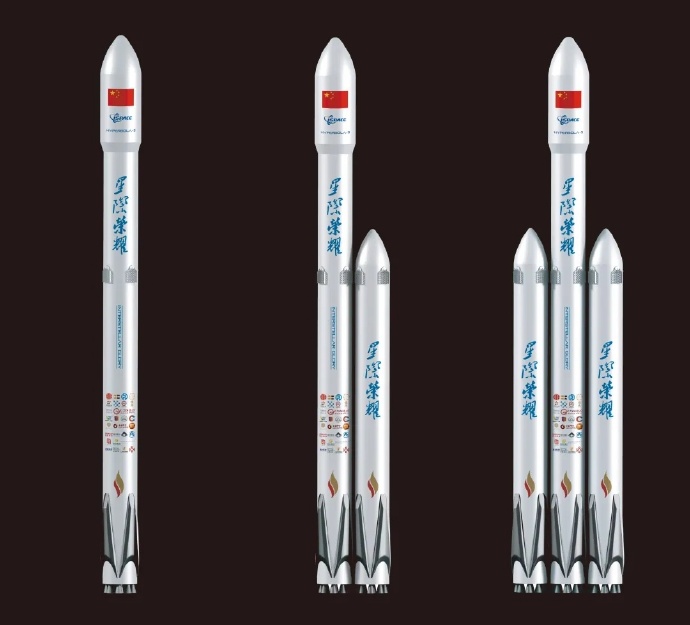
Hyperbolic III series liquid launch vehicle: medium and large reusable liquid launch vehicle, including SQX-3 basic type, SQX-3A (two-core stage parallel connection), SQX-3B (three-core stage parallel connection) three configurations, carrying Capability can meet the needs of a variety of load tasks. In addition to meeting large-scale satellite networking, medium and large-scale satellite launch tasks, it also has the capabilities of space station cargo transportation and deep space exploration…
Images-visuals are from Weibo and their respectives..
At this Zhuhai Air Show 2021 at Zhuhai City –Guangdong province Greater Bay Area of China- People’s Republic of China in which is set to take place at the end of 28th September to 3rd October 2021…. In which CNSA China National Space Administration in which one of its department The Rocket Academy will present 23 achievements. The exhibits cover three major sectors: aerospace, defense, and aerospace technology applications, covering physical objects, models, demonstrations, etc., to show the world the Rocket Academy’s presence in a multi-angle, Omni-directional and three-dimensional manner. New achievements in the aerospace field have played an important role in promoting national defense construction and the national economy.
In the aerospace section, you can see rocket products participating in major national engineering missions such as my country’s manned spaceflight, Mars exploration, and lunar exploration projects. There are also missions for my country’s future manned lunar exploration and deep space exploration to meet the needs of my country’s future space transportation. New technology products needed for system development.
In addition to the well-known Chang Zheng – Long March Carrier rocket products such as Long March 5, Long March 5B, Long March 7 and Long March 7A, the new generation of carrier rocket family also includes Long March 11 rockets, heavy launch vehicles, and a new generation of manned launch vehicles. The “Jielong” series of solid carrier rockets for the commercial aerospace market will also appear collectively. Also during the Zhuhai Air show 2021 there will be new friends of the Rocket family and new rocket configurations to meet with you of the First Academy of Aerospace…..
[Family Map of China’s New Generation of Long March Series Launch Vehicles] Since the early 10s of this century, my country has successively started to use a new generation of Long March series of launch vehicle families.
In terms of power selection, the new generation of Long March rockets generally use new non-toxic and harmless fuels such as liquid hydrogen, liquid oxygen, and liquid oxygen kerosene to replace the original highly toxic fuel of dinitrogen tetroxide/unsymmetrical dimethylhydrazine. In addition, the Long March 11 small launch vehicle using solid power has also been added to fill the gap in the demand for rapid response and global launch. The new generation of Long March 6A also fills the gap in the current Long March series of launch vehicles without solid boosters, becoming my country’s first solid-liquid hybrid power medium-sized launch vehicle, laying the foundation for larger-scale solid-liquid hybrid power applications in the future .
In terms of design configuration, the new generation of Long March rocket family adopts a modular and universal design concept. In theory, it can achieve full coverage of different trajectories and different capacities through the arrangement and combination of different take-off stages, upper stages, and boosters. For example, the first level of Long March No. 7 A is exactly the same as Long March No. 7. On the basis of shortening the second stage, Changqijia adds the hydrogen-oxygen second stage of the Long March 8 as the third stage power to achieve a higher orbital capacity coverage. The first stage of the Long March 8 is based on the first stage of the Long March 7 with two boosters. Such design ideas will also help reduce rocket manufacturing and launch costs in future larger-scale launch missions.
In terms of reusability, the Long March 6X and Long March 8R rockets in the new-generation carrier rocket family have clearly recyclable and reusable capabilities. At present, the progress of Chang 6 X is not clear, and Chang 8 R is expected to carry out key technology verification within this year. In addition, the new generation of manned launch vehicle (921 rocket) also reserves recoverable capacity, which is expected to be added to the existing configuration. The 2021 version of the Chang 9 configuration is also one step further in the direction of recyclability, and the possibility of reserving recyclable capacity is not ruled out. The overall configuration and design style approaching the starship may also include the ultimate goal of achieving 100% recovery of the entire arrow (under the second configuration).
In any case, as the new generation of Long March rocket family matures, they will gradually replace and eliminate contemporary workers who use highly toxic fuels. Cleaner fuels, safer landing control, lower usage costs and higher carrying capacity have determined that they will frequently appear in our vision in the next few decades. The launch vehicle determines how big the stage of spaceflight is. Including the International Lunar Scientific Research Station, manned landing on the moon, manned landing on fire, planetary exploration, and marginal solar system probes, almost all of my country’s important space engineering projects in the coming decades will rely on a new generation of Long March rocket family. With the help of the new generation of Long March carrier rockets, the Chinese people’s exploration of space will surely go farther and more steadily!
Images and visuals are from Weibo also their respectives.
凌空天行, Lingkong Tianxing Beijing Lingkong Tianxing Technology Co., Ltd. Located Primary Office T3, Han’s Plaza, No. 2 Ronghua South Road, Yizhuang Economic and Technological Development Zone, Beijing the Capital of China – People’s Republic of China…. It’s is a domestic technology enterprise engaged in the research and development and application of commercial hypersonic flight products. It is understood that Lingkong Tianxing has passed the preliminary demonstration, and it is clear from the technical verification platform to suborbital space tourism aircraft …global superb The technical route development plan of the sonic aircraft has achieved a number of key technological breakthroughs. Also its Space Transportation designs and manufactures space transport systems intended to reduce space exploration costs. It specializes in developing reusable commercial space transport vehicles, aiming to reduce commercial launch costs associated with re-entry and carrier recycling.. it is also among sixty Plus Chinese Private Carrier Rocket Launcher providers companies in the making to Commercialisation….
Currently on the Month of September 2021, On September 12th 2021 Sunday’s Sub Orbital ….. Lingkong Tianxing completed the “Tianxing I” Yaoba suborbital mission this morning At 8:45 am Hong Kong SAR- Beijing Time on September 12, 2021, Lingkong Tianxing successfully completed the “Tianxing I” rocket Yao-8 flight test mission. This mission is the third flight test of the “Tian Xing I” rocket and the fourth flight test of the “Tian Xing” series of rockets…… This mission is for the Carrier Rocket Tianxing I . The third flight test, it is “sky ” series of rockets 4th flight test.
Previously Before on 31st August 2021 Tuesday, Lingkong Tianxing successfully completed the “Tianxing II” rocket Yaosi flight test mission…..!….. This mission is the first flight test of the “Skywalk II” rocket and the third flight test of the “Skywalk” series of rockets
Images and visual are from Weibo and from their respectives
In which iSpace- Interstellar Glory in which it is the first Chinese Private Space Company to do so successfully commercially first out from sixty known private space companies in China People’s Republic of China… Founded in Beijing 2016 located in Beijing Economic and Technological Development Zone or known for short as E-Town in Capital of China – People’s Republic of China …
During the month of 3rd September 2021 iSpace- Interstellar Glory Technology currently Developing the Ecosystem with the Reusable Carrier Rocket Hyperbola II completes the ground deployment test of the landing device…星间耀空间科技completed the ground deployment verification test for the reusable launch vehicle landing device of the Hyperbola II (code-named “SQX-2”). The test was a complete success. This is also the first time that the launch vehicle landing device has been tested in China- People’s Republic of China.
This test simulated the aerodynamic drag during flight, verified the unlocking, deployment and locking functions of the landing gear, and obtained a large amount of test data. In the future, Interstellar Glory will also carry out multiple experiments under extreme conditions to verify the reusability and reliability of the landing device, and lay the foundation for the vertical recovery and reuse of the Hyperbolic II launch vehicle…..
Images-visuals are from Weibo and their respectives..