深蓝航天 Deep Blue Limited – Deep Blue Aerospace One of sixty Chinese private space Carrier Rocket Companies in China-People’s Republic of China… As many of sixty plus Private Rocket Deep Blue Aerospace Co., Ltd. was established in 2017. The company is mainly a high-tech aerospace enterprise that focuses on the direction of liquid recovery and reusable launch vehicles and provides users with commercial launch services. Deep Blue Aerospace Co., Ltd. is headquartered in Nantong City, Jiangsu Province. At the same time, the company has rocket general and liquid engine R&D centers in Yizhuang, Beijing and Xi’an, Shaanxi, respectively, and a rocket power system test base in Tongchuan, Shaanxi…..
Improved version of the Suzaku-2 launch vehicle
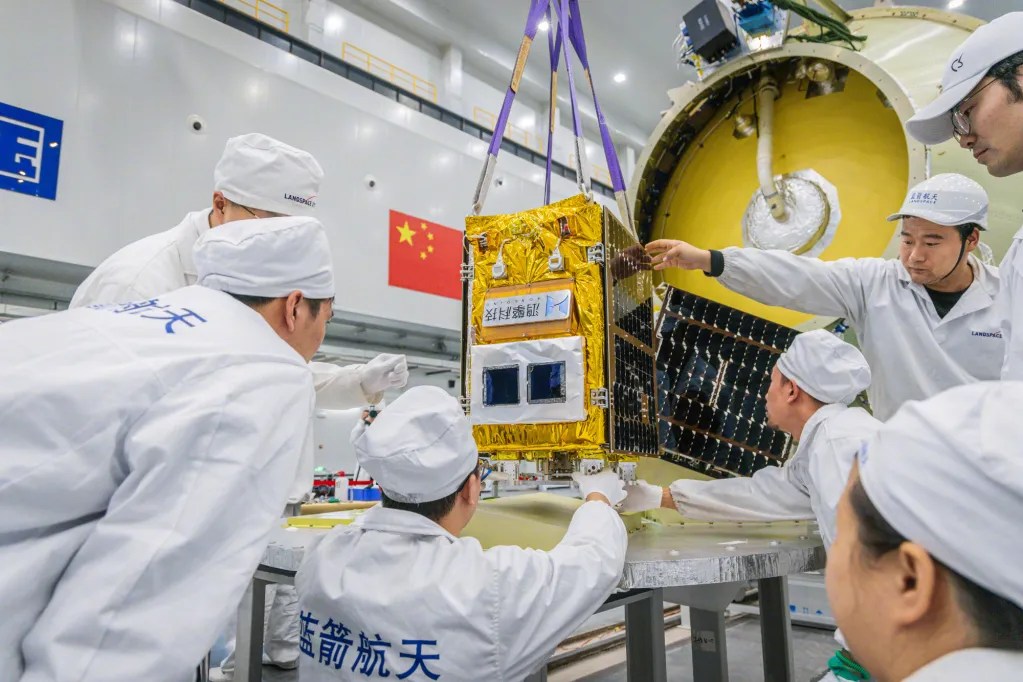
At 10:00 Beijing time on November 27, 2024, at the 96A workstation in the Dongfeng Commercial Space Innovation Test Area of the Jiuquan Satellite Launch Center, inner Mongolia, China, People’s Republic of China., the “Zhuque-2” improved (Yao-1) carrier rocket carrying the Guangchuan 01 and 02 test satellites ignited and took off. About 8 minutes and 25 seconds later, the satellite and rocket separated, sending the satellite into a low-Earth orbit with a perigee of 300 kilometers, an apogee of 500 kilometers, and an inclination of 50 degrees.
Guangchuan 01 and 02 are low-orbit communication test satellites used to test and verify low-Earth orbit communication satellite constellation technology.
Optical low-orbit communication experimental satellite
The improved version of the Zhuque-2 (ZQ-2E) launch vehicle uses the basic first stage and a deeply improved second stage. The improvements of the second stage are mainly reflected in the structural system and power system. In terms of the structural system, the improved second stage adopts a single-layer common bottom tank and tunnel delivery pipe scheme, which simplifies the structure and reduces the stage height and rocket body mass.
“Tian Que-15A” (TQ-15A) vacuum liquid oxygen-methane engine test run
In terms of the power system, the second-stage main engine was replaced by the vacuum-type “Tian Que-12” (TQ-12) with the vacuum-type “Tian Que-15A” (TQ-15A) liquid oxygen-methane engine. The latter has significantly improved thrust and specific impulse and has the ability to start three times. At the same time, the second-stage “Tian Que-11” (TQ-11) swimming engine was removed and replaced by the “Yun Que 10” (YQ-10) auxiliary power system. “Yun Que 10” is used for the second-stage precise attitude adjustment, terminal speed correction, propellant sinking, orbit change, and deorbit.
Improved version of the Suzaku-2 launch vehicle
The improved version of the “Zhuque-2” (ZQ-2E) rocket is 47.3 meters high, with a first and second stage and fairing diameter of 3.35 meters, a takeoff mass of 219 tons, a takeoff thrust of 282 tons, and a 500-kilometer sun-synchronous orbit (SSO) capacity of 4 tons. Compared with the basic version of the “Zhuque-2”, the improved version has a height reduction of 2.2 meters, a takeoff mass reduction of 1 ton, a takeoff thrust increase of 14 tons, and a 500-kilometer sun-synchronous orbit capacity increase of 2.5 tons.
Improved version of the Suzaku-2 launch vehicle
The improved version of the Zhuque-2 rocket has created many firsts in China’s aerospace industry. This rocket is China’s first dual-cryogenic liquid carrier rocket that uses full supercooling and filling, the first time in China to use a dual-cryogenic single-layer common bottom tank for a liquid carrier rocket, and the first time in China that the Tianque-15A engine uses large-size, high-precision niobium alloy nozzle processing and manufacturing technology for large-scale engines. In addition, this mission is the first time that a Chinese carrier rocket has used a probability-based high-wind area flight load calculation method, a stage separation cancellation forward rocket plan, and a rocket glide stage propellant intermittent bottoming plan.
Since its maiden flight on December 14, 2022, Beijing time, the “Zhuque-2” series of rockets has carried out four launches in less than two years, achieving three consecutive victories since the basic Yao-2 mission. In the process, the “Zhuque-2” rocket became the world’s first liquid oxygen-methane rocket to achieve an orbital launch, the first to successfully launch a payload, the first to launch continuously and the first to achieve three consecutive launch victories. The improved Yao-1 of the “Zhuque-2” is the first rocket of the new batch of the “Zhuque-2” series, and since then, the series of rockets has entered a new stage of normalized commercial launches.
Improved version of the Suzaku-2 launch vehicle
This launch mission is the first launch of the Zhuque-2 carrier rocket in 2024, the 19th launch of the Jiuquan Launch Center, the 58th launch in China and the 224th launch in the world. At the same time, this launch is also the first launch of a private commercial liquid rocket in China in 2024.
At 13:40 on September 22, Jiangsu Deep Blue Aerospace Co., Ltd. carried out the first high-altitude vertical recovery flight test of Nebula-1 at the Deep Blue Aerospace Ejin Banner Spaceport in Inner Mongolia China, People’s Republic of China … The recyclable and reusable first-stage rocket body had an abnormality during the final landing phase of the flight test, and the test mission was not completely successful. According to the “Nebula-1 First High-altitude Vertical Recovery Flight Test Test Outline”, there are a total of 11 major test verification tasks. In this flight test, 10 of them were successfully completed and 1 was not completed.
China’s first high-altitude recovery flight test of a launch vehicle that can enter orbit…. At 13:00 on September 22, Jiangsu Deep Blue Aerospace Co., Ltd. carried out the first high-altitude vertical recovery flight test of Nebula-1 at the “Deep Blue Aerospace Ejin Banner Spaceport” in Inner Mongolia. An abnormality occurred in the recyclable and reusable first-stage rocket body during the final landing phase of the flight test, and the test mission was not completely successful. The core mission objectives of this test are to verify the correctness and coordination of the operation of various systems in the vertical recovery phase after Nebula-1 enters orbit, especially to verify the multi-machine to single-machine variable power operating conditions for the first time in flight, and to accumulate key data for subsequent 100-kilometer recovery flight tests and the final orbital entry + recovery test missions
The Nebula-1 rocket that carried out this flight mission is Deep Blue Aerospace’s first commercial liquid rocket that can enter orbit and be recycled and reused. It is also an important carrier for breaking through and verifying rocket vertical recovery and reuse technology. The Nebula-1 rocket has a body diameter of 3.35 meters and a first-stage height of about 21 meters. It is equipped with the Thunder-R liquid oxygen-kerosene engine, China’s first reusable liquid rocket engine developed fully independently by Deep Blue Aerospace, with more than 90% of the main structure integrally formed using high-temperature alloy 3D printing technology.
This flight test is China’s first high-altitude recovery test of a launch vehicle that can enter orbit. The core mission of the test is to verify the correctness and coordination of the various systems in the vertical recovery phase after the Xingyun-1 enters orbit, especially to verify the multi-machine to single-machine variable power condition for the first time in flight, so as to accumulate key data for the subsequent 100-kilometer recovery flight test and the final orbital entry + recovery test mission.
According to the “Xingyun-1 First High-Altitude Vertical Recovery Flight Test Outline”, the key technical points verified during this test are as follows:
The rocket took off with three engines ignited according to the predetermined procedure. After reaching the predetermined height, the engines on both sides were shut down, and the attitude was stabilized and the ascent was slowed down by relying on the thrust of a single engine. After reaching the highest point, it relied on the thrust adjustment of a single engine to descend smoothly. After moving sideways for about 200 meters, it successfully unlocked, deployed and locked the landing legs at the predetermined height above the recovery site. However, an abnormality occurred during the final landing shutdown phase, resulting in partial damage to the rocket body. The entire flight test lasted 179 seconds. Before shutdown, the error between the rocket body and the theoretical landing point was less than 0.5 meters, and the rocket body finally landed precisely at the center of the recovery site. The flight mission profile of this test was consistent with the predetermined procedure. The entire process of test preparation and implementation was within the scope of the preliminary safety control plan. After the test, post-processing was carried out in accordance with the predetermined emergency response process, and no safety issues occurred throughout the process.
After the test, a preliminary retrospective analysis of the test process data showed that during the final landing shutdown phase, the engine thrust servo followed the control command abnormally, causing the rocket body to land at a height exceeding the design range and partial damage to the rocket body. The Deep Blue Aerospace technical team will complete the mission “zeroing” as soon as possible to lay a solid foundation for the success of subsequent recovery flight tests. Based on the summary of this test and the zeroing of technical faults, Deep Blue Aerospace will perform a high-altitude vertical recovery mission again in November.
This flight test was conducted at the Ejin Banner Spaceport built by Deep Blue Aerospace. The ground equipment, refueling system, and measurement and control system of the test site were all independently developed by Deep Blue Aerospace. The test site is the first fully commercial test site in China that can meet the needs of liquid rocket launches and flight tests. It is located in the heart of the Gobi Desert, adjacent to the Badain Jaran Desert, China’s third largest desert, on the south side. The surrounding area is a vast Gobi Desert uninhabited area, which has inherent safety characteristics. The test area this time points to the uninhabited area in the desert to the south. The test is strictly carried out in accordance with the safety management requirements of rocket tests, and comprehensive risk identification, control, and emergency plans are carried out to ensure the test safety and public safety of this test.
For the first stage of the Nebula-1 orbital rocket, only less than 1/5 of the propellant was added in this test; the precise attitude control of the propellant shallow box in the high-altitude vertical recovery condition was successfully verified. This test used high-precision self-alignment technology based on a dynamic base, as well as takeoff roll-to-launch launch technology, which can meet the full-direction launch requirements without changing the vertical installation state of the rocket. In the future, it can greatly simplify the workload of different flight missions and improve adaptability. This test preliminarily verified the recovery trajectory optimization based on optimal control and the meter-level precision guidance algorithm, and conducted engineering verification for the subsequent orbital entry + recovery optimal control method.
This test is the first time in China that an open-cycle liquid oxygen-kerosene pintle engine has been used to perform a rocket high-altitude recovery test mission. The liquid oxygen-kerosene propellant combination has the characteristics of high comprehensive carrying efficiency, low product cost, safety in use and good maintainability, and is the only choice for liquid recovery rockets for commercial use; but due to the difficulty of kerosene liquid-liquid combustion, smooth thrust regulation and stable combustion have always been the difficulties of kerosene thrust regulation engines. Pintle technology, as the best engineering practice to solve the thrust regulation of kerosene engines, is one of the technical peaks of open-cycle liquid engines. The success of this test is the first time that the Lei Ting-R engine has participated in a flight test. The central engine has carried out thrust regulation throughout the 179s flight. The actual thrust regulation command range is from 110% to 58%, and the thrust regulation accuracy is better than 1%. Under flight conditions, it responds well to step commands with a maximum amplitude of 40%, and the thrust overshoot accuracy is less than 2%.
This test was the first in China to use a landing cushion mechanism (landing legs) developed specifically for orbital-stage rockets for vertical recovery testing. In order to meet the stringent weight requirements of orbital-stage rockets, the mechanism is made of a full carbon fiber structure. In the early stages, single-machine tests of the buffer, single-machine tests of the connection and locking device, a series of deployment and retraction tests of a single leg, and joint deployment and retraction tests of four legs and the rocket body were carried out. Single-machine and system tests. Based on a series of previous tests and improvements, this mechanism is the first landing cushion device product in China to enter engineering applications. At the cost of a weight of no more than 1.2t and less than 10% of the rocket’s empty weight, the first stage of the rocket can land safely and reliably with a total weight of no more than 15 tons, a speed of no more than 3m/s, and an attitude angle of no more than 5° under the condition of carrying the remaining propellant.
In the future, Deep Blue Aerospace will continue to adhere to the serious safety awareness, rigorous and pragmatic scientific attitude, and the pursuit of excellence in innovation, focusing on the fundamental purpose of providing safer, economical, reliable, and high-frequency space transportation services, and accelerate the promotion and realization of the rapid installation of China’s reusable rockets. After accumulating valuable experience this time, Deep Blue Aerospace firmly believes that in the near future, reusable rockets will soar into the sky and help China’s aerospace “increase in volume”.
深蓝航天 Deep Blue Limited – Deep Blue AerospaceLandspace One of sixty Chinese private space Carrier Rocket Companies in China-People’s Republic of China… As many of sixty plus Private Rocket Deep Blue Aerospace Co., Ltd. was established in 2017. The company is mainly a high-tech aerospace enterprise that focuses on the direction of liquid recovery and reusable launch vehicles and provides users with commercial launch services. Deep Blue Aerospace Co., Ltd. is headquartered in Nantong City, Jiangsu Province. At the same time, the company has rocket general and liquid engine R&D centers in Yizhuang, Beijing and Xi’an, Shaanxi, respectively, and a rocket power system test base in Tongchuan, Shaanxi…..
Recently on the Month of April 2024, Blue Arrow Aerospace successfully completed the engine test run assessment of the largest niobium alloy nozzle in China at the Huzhou Hot Test Center. After the test, the product structure and surface coating were intact. The engine worked for 380 seconds under rated working conditions and high working conditions. The structural reliability, thermal protection reliability, and process reliability of the niobium alloy nozzle passed the assessment! This niobium alloy nozzle has a diameter of about 1.6m and a height of about 1.3m. The size is much larger than the existing domestic products of the same type. It is equipped with the Tianque 15A (TQ-15A) vacuum liquid oxygen methane engine with the highest thrust in China.
The test run of the largest niobium alloy nozzle in China successfully welcomed the flight of the Suzaku rocket
🔷 Recently, Blue Arrow Aerospace successfully completed the engine test run assessment of the largest niobium alloy nozzle in the country at the Huzhou Thermal Test Center. After the test, the product structure and surface coating were intact. The engine worked for 380 seconds under rated working conditions and high working conditions. The structural reliability, thermal protection reliability, and process reliability of the niobium alloy nozzle passed the assessment!
🔷This niobium alloy nozzle has a diameter of about 1.6m and a height of about 1.3m. The size is much larger than the existing domestic products of the same type. It is equipped with the Tianque 15A (TQ-15A), the vacuum liquid oxygen methane engine with the highest thrust in China, with a vacuum thrust of 836kN. , vacuum specific impulse 3320m/s.
🔷The Blue Arrow aerospace engine team has begun to develop a niobium alloy nozzle with a larger area ratio. The outlet diameter will reach 2.5m, which will continue to improve the vacuum specific impulse of the rocket’s secondary main engine.
深蓝航天 Deep Blue Limited – Deep Blue Aerospace One of sixty Chinese private space Carrier Rocket Companies in China-People’s Republic of China… As many of sixty plus Private Rocket Deep Blue Aerospace Co., Ltd. was established in 2017. The company is mainly a high-tech aerospace enterprise that focuses on the direction of liquid recovery and reusable launch vehicles and provides users with commercial launch services. Deep Blue Aerospace Co., Ltd. is headquartered in Nantong City, Jiangsu Province. At the same time, the company has rocket general and liquid engine R&D centers in Yizhuang, Beijing and Xi’an, Shaanxi, respectively, and a rocket power system test base in Tongchuan, Shaanxi…..
Recently on the 5th January 2024, DeepBlue Aerospace’s “Thunder-R1” engine rocking test run was a complete success. This test run included sine wave swing, square wave position, frequency sweep and triangle wave swing tests, covering the control requirements for subsequent flight missions and verifying the engine Compatibility with servo system operation. This engine test has accumulated a large amount of data and valuable experience for the power system test. It also laid the foundation for the high-altitude VTVL recovery test of the first sub-stage of the “Nebula-1” rocket that Deep Blue Aerospace will conduct this year, as well as the first flight of the “Nebula-1” rocket. Solid foundation…..
Recently, DeepBlue Aerospace’s “Thunder-R1” engine rocking test run was a complete success. This test run included sine wave swing, square wave position, frequency sweep and triangle wave swing tests, covering the control requirements for subsequent flight missions and verifying the engine Compatibility with servo system operation.
This test run achieved the following results:
1. Feasibility of the plan
The “Thunder-R1” engine adopts a pump backswing solution, which has a small weight in the swing part, greatly reduces the power demand on the servo mechanism, and improves the response characteristics of the small engine control loop; the pump backswing technology can achieve the same swing angle. Significantly reducing the swing envelope is a key technology to achieve a parallel layout of multiple rockets in a limited space. This test run verified the feasibility of this solution;
2 Reliability of flexible links
The maximum swing angle of the engine during the test was ±7°, which verified the reliability of the high-pressure swing hose;
3. Stability of electrical system
Through multiple complete machine tests of the “Thunder-R1” engine, the working stability and reliability of the engine’s electrical system have been fully verified.
This test run fully assessed the relevant performance indicators of the engine controller, servo system, battery, measurement system, ignition system and other parts to meet the overall requirements for the delivery of the rocket. In addition, the engine servo is the most important execution link of the rocket control system, and its working performance, stability and reliability were fully assessed and verified during this engine test run. The engine servo operates according to regulations and completes unidirectional swing and omnidirectional swing of various swing angles at multiple frequency points, with a maximum swing angle of 7 degrees. The engine servo is working normally and all performance indicators meet the requirements of the rocket control system.
This engine test has accumulated a large amount of data and valuable experience for the power system test. It also laid the foundation for the high-altitude VTVL recovery test of the first sub-stage of the “Nebula-1” rocket that Deep Blue Aerospace will conduct this year, as well as the first flight of the “Nebula-1” rocket. Solid foundation.
Knowledge Posts
The “Thunder-R1” engine thrust vector control adopts a pump backswing technical solution. As the name suggests, a swingable high-pressure hose is set between the engine’s thrust chamber and the turbine pump. When the engine is performing vector control during operation, the turbine The pump is stationary and the thrust chamber is oscillated by the servo actuator. The name pump backswing engine actually comes from the perspective of the overall engine layout. This layout is based on the engine frame, and the frame and the thrust chamber are connected through a gimbal. Since only the thrust chamber swings, the swing mass and inertia are small, and the power requirements for the servo actuator are lower; since the turbopump does not swing, the engine swing profile is more compact, and the saved space provides the possibility to connect more rocket engines in parallel.
深蓝航天 Deep Blue Limited – Deep Blue Aerospace One of sixty Chinese private space Carrier Rocket Companies in China-People’s Republic of China… As many of sixty plus Private Rocket Deep Blue Aerospace Co., Ltd. was established in 2017. The company is mainly a high-tech aerospace enterprise that focuses on the direction of liquid recovery and reusable launch vehicles and provides users with commercial launch services. Deep Blue Aerospace Co., Ltd. is headquartered in Nantong City, Jiangsu Province. At the same time, the company has rocket general and liquid engine R&D centers in Yizhuang, Beijing and Xi’an, Shaanxi, respectively, and a rocket power system test base in Tongchuan, Shaanxi…..
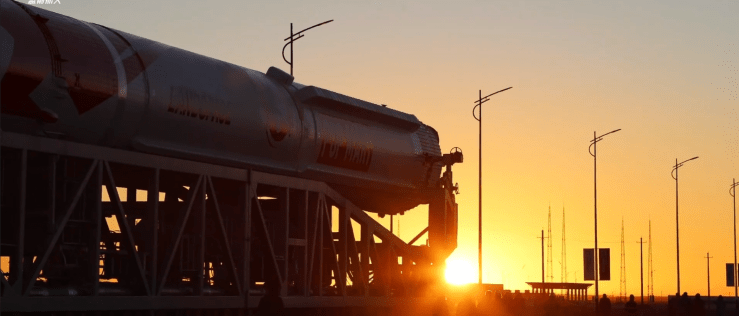
On December 1st 2023, the Blue Arrow Aerospace Zhuque Suzaku- 2 Yaosan liquid oxygen methane carrier rocket was successfully transferred to the launch area and is preparing to select an opportunity to carry out the launch mission in the near future. The launch is sponsored by PopMart ..
POP MART is a market-leading character-based entertainment company and a global champion of designer toy culture.
We have set foot in more than 23 countries and regions through our network of 350+ offline stores and 2000+ Roboshops catering to a diverse audience of cultural pioneers and art fans. Some of our best-known characters include MOLLY, The Monsters, DIMOO, Skullpanda and others – each created by one of our artist friends and regular collaborators.
Through global artist development, IP operations, designer toy culture evangelism, and strategic investments, we have built an integrated platform covering the entire designer toy value chain, allowing artists to focus solely on their craft and giving stage to talent from all over the world.
[The third rocket of Blue Arrow Aerospace Suzaku 2 has been transferred and erected and will be launched in the near future]
After the successful go-around, this launch is a key launch and is expected to officially carry commercial payloads. Therefore, it is also possible to carry out research on transportation capacity and orbit accuracy. further test.
It can be seen from the video that domestic private rockets are basically transported by road, and road transportation can easily exceed the 3.35-meter special train limit when conditions permit. It is estimated that it is more difficult for private companies to obtain special trains.
At present, the mainstream next-generation liquid launch vehicles that should be privately operated are basically aiming at a diameter of more than 4 meters, especially the 4.2-meter diameter of Interstellar, which has already passed through some launch sites.
LandSpace – Blue Arrow’s Suzaku 3 has not been officially announced, but the diameter must be more than 4 meters. I am sure that with this diameter, the entire diameter of the passage should have been passed. At present, the two are mainly Jiuquan and Wenchang. As long as they can support a diameter of more than 4 meters, this will be very advantageous for the development of my country’s rockets.
[Chinese Rockets Are Stunningly Beautiful]
Blue Arrow Aerospace has just shared photos of the Zhuque-2 Yaosan-3 rocket being tested and transferred to the launch station at the Jiuquan Satellite Launch Center.
I have to say that the desert scenery and high-tech products are really beautiful.
Blue Arrow Aerospace is a private aerospace enterprise in my country (really private, not a national team vest). Zhuque 2 is a medium-sized liquid oxygen methane rocket (fueled by natural gas), with a total length of 49.5 meters and a diameter of 3.35 meters. The design goal is to be able to carry 6 tons Objects are sent into Earth orbit.
On July 12 this year, the Zhuque-2 Yao-2 rocket was successfully launched, becoming the world’s first liquid oxygen methane rocket to enter orbit…..