#CNSA #ChinaNationalSpaceAdministration #国家航天局 |#CASC #June2023| #ChangZheng #LongMarch #CarrierRocket Hong Kong Aerospace Science and Technology Group with Zero Gravity Laboratory plans to deploy the #GoldenBauhiniaSatellite 30 #RemoteSensing #CubeSatellites #Satellites in of Year2024…

On the 16th June 2023 announcement of   Hong Kong Aerospace Science and Technology Group and Zero Gravity Laboratory has announcement of launching of 30-thirty remote sensing cube cute satellites of  Zero Weight Space plans to launch “Golden Bauhinia 7-36” remote sensing 6U cube star with “30 satellites  in one carrier rocket” early next year in the 2024 first quarter year… A few days ago, Beijing Zero Weight Space Technology Co., Ltd. signed a “30 satellites in one carrier rocket” “Project cooperation agreement. According to the agreement, the Zero Gravity Laboratory will provide Hong Kong Aerospace Science and Technology Group with a package of products and services including satellite R&D and manufacturing, assembly testing, and launch services. Launch at the end of the first quarter.

After the completion of the project, it can realize global high-frequency and high-resolution remote sensing monitoring, and provide users with high-precision data support and application services in the fields of earth observation, resource investigation, environmental protection, agriculture, and urban planning.

On previously On June 15th, 2023, the Chang Zheng- Long March 2D carrier rocket carried the Golden Bauhinia Satellite No.37 & No. 38 into space from the Taiyuan Satellite Launch Center. The satellites successfully entered their planned orbits and both are in good operating condition. This is the second launch mission of Hong Kong Aerospace Technology Group for this year.

The Golden Bauhinia Satellite No.37 & 38  are both small and high-resolution optical remote sensing satellites that use new-generation high-performance imaging technology. While effectively enhancing the weak signal detection capability and system integration, their weight and volume have been significantly reduced. They have the advantages of quick production, intelligent operation, and cost-effectiveness.

The Golden Bauhinia satellite constellation is a passive-active hybrid low-orbit high-frequency satellite constellation planned by the Hong Kong Aerospace Technology Group. The constellation combines optical remote sensing and synthetic aperture radar imaging modes to form an all-weather and all-time dynamic monitoring service system that is not affected by weather conditions such as clouds and rain. The constellation focuses on the Guangdong-Hong Kong-Macau Greater Bay Area (GBA) and is committed to providing satellite remote sensing services and overall smart city solutions for global users.


零重力实验室 Zero Gravity Laboratory Beijing Zero Weight Space Technology Co., Ltd.    In October 2016, the Zero Gravity Laboratory was established in Beijing. The laboratory is mainly engaged in the research and development of micro-nano satellites and core components. In January 2017, Beijing Zero Weight Space Technology Co., Ltd. was established in Beijing Economic and Technological Development Zone. The three core business segments of Zero Weight Space include: research and development and sales of micro-nano satellites and their core components, technical consulting and space-based data services. At present, Zero Heavy Space has more than 30 kinds of micro-nano satellite core component products in six categories with independent intellectual property rights. It has the development and production capacity to complete the micro-nano satellite on-orbit delivery within 10 months, and can provide customers with complete micro-nano satellites. Satellite overall solutions and provide customers with launch and loading services. Vision: 2025: Walking in space (2025: Space Odyssey) Slogan: Let satellites reach life Mission: We pay attention to everything you care about, as long as it is related to micro-nano satellites Goal: To become the leader of global micro-nano satellites

Hong Kong Aerospace Technology Group Limited (HKATG) is Hong Kong’s first commercial aerospace enterprise focusing on satellite network engineering and precise satellite manufacturing. Formerly known as Hentech Technologies Ltd (2003), HKATG acts as a pioneer in commercial aerospace industry and technological innovation in Hong Kong.

Located at 15/F, Data Technology Hub, 5 Chun Cheong Street, Tseung Kwan O Industrial Estate, New Territories, Hong Kong SAR, China, People’s Republic of China.

HKATG owns five technical centres and manufacturing bases, including satellite manufacturing centre, space environmental monitoring centre, satellite telemetry, tracking and control centre (TT&C), centre for satellite data and applications and precise electronic manufacturing centre.

The core business of HKATG consists of several aspects, for instance, satellite constellation engineering (Golden Bauhinia Constellation and Aurora Constellation), satellite data application, satellite design and manufacturing, satellite assembly and testing, satellite payload selection and specification, satellite TT&C service, PCBA and electronic manufacturing and launching of satellite etc.

HKATG aims for global commercial aerospace service and has strong purpose to improve the world’s aerospace industry.

Gang Hang Ke (Shenzhen) Space Technology Co., Ltd. is a wholly-owned subsidiary of HKATG. Being the major operating subsidiary of HKATG in the Mainland China, Gang Hang Ke (Shenzhen) Space Technology Co., Ltd. is mainly engaged in the aerospace technology, satellite application technology, satellite manufacturing technology, research and development of Internet of Things (IoT) application system and technical services.

Images and visuals are from their respectives

#CNSA #ChinaNationalSpaceAdministration #国家航天局 | #BRI #June2023|#太原卫星发射中心  #TaiyuanSatelliteLaunchCenter  – International Iconic #ChangZheng2D #LongMarch2D  yao 88 #CarrierRocket in launched to deploy #Gaofen #Jilin  series  41 Satellites into orbit #AGallery ..

At 1330 Hours Hong Kong SAR- Beijing Time  15th June 2023 , China- People’s Republic of China- CNSA –China National Space Administration   Successfully launched  the New Next Generation Long March – Chang Zheng2D carrier rocket at the Taiyuan Satellite Launch Center Shanxi Province..  launch 41- forty one Satellites in which the Chang Zheng – Long March 2D Carrier Rocket is in preparing readiness to launch in which dates back to On May 22, a total of 41 satellites set off in the Changchun Aerospace Information Industry Park, among them, “Jilin No. 1” Gaofen 03D19-26 satellites, Gaofen 06A series satellites, platform 02A01-02 The 36 satellites including Si-1 are the “Jilin-1” satellites.

The Chang Zheng- Long March 2 D yao 88 carrier rocket at the No. 9 station of the Taiyuan Satellite Launch Center, with the method of “one Carrier Rocket 41 satellites “, 41 optical remote sensing satellites of Jilin No. It entered the predetermined sun-synchronous orbit, and the launch mission was a complete success.

In response to the launch mission requirements of “one arrow with 41 satellites”, the Changerding rocket development team took a series of effective measures to ensure the safe and accurate orbiting of 41 satellites by rationally arranging in the limited fairing space and selecting the optimal separation scheme. .

[Chang Zheng – Long March 2D yao 88 /Jilin-1 “One Carrier Rocket 41 Satellites” adopts the satellite layout of wall-mounted*38+sidewall*3】

One arrow launches 41 satellites, setting a new record for the largest number of satellites launched in one time in my country. But to safely and smoothly send so many satellites into orbit at one time, the first thing to solve is the layout of the satellites in the fairing, not only to ensure “sit down”, but also “sit comfortably”. To this end, the development team of Eight Director Erding fully sorted out the structure and mission requirements of the satellites, fully tapped the potential, optimized the layout design, adopted the layout method of 38 satellites on the wall + 3 satellites on the side wall, and successfully found 41 satellites. Safe and comfortable location.


In order to allow 41 ” satellite passengers” to enjoy a comfortable flight experience, the model team effectively used the space in the fairing to move the “feet” of the “passengers” under the adapter, and opened up 3 “special seats” on the support cabin , Successfully let 41 satellites “board” smoothly. Although the form of the “seat” is relatively new, but a closer look shows that they are all high-quality parts that have been sent to the “passengers” before, which effectively guarantees the safety and reliability of this mission.


In addition, in order to avoid crowded collisions when “getting off the car”, the research and development team of the Eighth Academy ingeniously designed the “drop-off plan” to allow the satellites to separate in an orderly manner. The overall design team divided the 38 satellites on the cylindrical multi-satellite adapter into one group of “passengers” on each floor, a total of 6 groups; the 3 “passengers” on the lower support cabin were taken as the seventh group, and the satellites were carried out in sequence according to the group separate. In addition, this rocket is also equipped with 10 reverse thrust rockets. By turning on the reverse thrust rockets, the distance between each group of satellites is widened to ensure the safety of separation from each other

At  15th June 2023 , China- People’s Republic of China- CNSA –China National Space Administration   Successfully launched  the New Next Generation Long March – Chang Zheng2D carrier rocket at the Taiyuan Satellite Launch Center Shanxi Province..  Is set to launch 41- forty one Satellites in which the Chang Zheng – Long March 2D Carrier Rocket is in preparing readiness to launch in which dates back to On May 22, a total of 41 satellites set off in the Changchun Aerospace Information Industry Park, among them, “Jilin No. 1” Gaofen 03D19-26 satellites, Gaofen 06A series satellites, platform 02A01-02 The 36 satellites including Si-1 are the “Jilin-1” satellites.

The Chang Zheng -Long March 2D “One Carrier Rocket  41 Satellites” will be launched on the next day on expected on 16th June 2023 …. The latest batch of Jilin-1 satellites launched in the form of “One Carrier Rocket  41 Satellites” involves 3 large software systems and 4 satellite models, 41 satellites, and 50 sets of antenna equipment.

At present, the launch of “One Carrier Rocket 41 Satellites” has officially entered the countdown! It is planned to be launched from the Taiyuan Satellite Launch Center in the near future. This will create the record for the largest number of satellites launched in a single spaceflight in China

[The countdown to launch has entered! Uncover how “one Carrier Rocket  41 satellites ” is achieved?

How did “41 satellites  with one arrow” come true this time? What’s the point? Li Feng, director of the satellite operation and management technology research office of Chang Guang Satellite Technology Co., Ltd., gave the answer in an exclusive interview with China Jilin Net!


“The launch of ‘One Carrier Rocket  41 Satellites’ poses a huge challenge to the transportation and management system. In the past, a maximum of 16 satellites were launched at one time, but this time the number has reached nearly three times that of the maximum one, and it involves multiple satellite models. For measurement and control , data transmission resources, software system development, and personnel requirements are all higher. In order to do a good job in the operation and management of 41 satellites, the colleagues in the Satellite Operation and Management Technology Research Office started the preparation work at the end of last year, and the internal and external coordination of the company , docking, and recently successfully completed the system development and the joint test of the three-wheel operation and management system, involving 3 large software systems, 4 satellite models, 41 satellites, and 50 sets of antenna equipment, and confirmed the functions, performance and interfaces of each system Matching situation. The 41 satellites launched this time include 8 Jilin-1 Gaofen 03D satellites and 30 Gaofen 06A series satellites. Among them, the weight of the Gaofen 06A single satellite has been successfully reduced to 20kg, and its performance indicators are still very advanced.


Li Feng said, “During the satellite-rocket separation stage, the 41 satellites were separated seven times successively. The separation time of each group of satellites lasted for three to five seconds. . This launch has put forward higher requirements for both satellites and rockets, including separation timing and control of satellite force and torque, so as to ensure that each satellite can enter the predetermined orbit smoothly and safely. “


After the 41 satellites launched this time (including 36 “Jilin-1” satellite constellation networking remote sensing satellites) are in orbit, they will form a network with the 72 “Jilin-1” satellites in orbit. So far, “Jilin-1” “The number of satellites in orbit has increased to 108, marking that the “Jilin-1” satellite constellation network project has successfully achieved the phased goal of “Hundred Stars Flying into the Sky”

Images and visuals are from their Respectives CMS China Manned SpaceCNSA-China National Space Administration

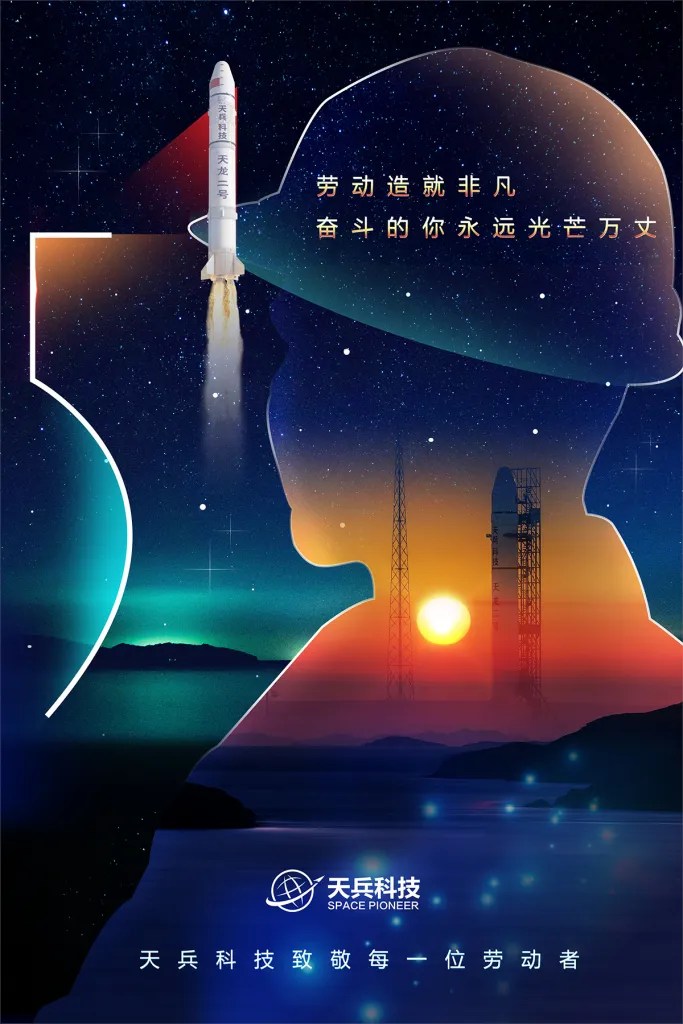
#CNSA #ChinaNationalSpaceAdministration #国家航天局 | #BRI #May2023|#MadeInChina #中國製造 #中國 |#ChineseCarrierRocketCompany Companies #五一劳动节Celebrating Saluting honouring to the workers! On #InternationalWorkersDay #LabourDay with Awesome Stunning Creative #PosterArt ….

What does International Workers Day- Labour- May Day holiday mean in China, People’s Republic of China.

The Golden Week – Labour Day in China first began in 1919. In 1949, the Chinese government officially declared Labour Day to be a national holiday. This holiday originally served as a means of honouring workers across China. In present day, Labour Day is now a fun-filled holiday meant for enjoying some time off with friends and family… in which is duration of in between 29th April to  3rd May traditionally for this year it’s last of Saturday April towards the First Wednesday of May..

During this year of Labour – May- Workers Day China, People’s Republic of China’s Domestic Tourism consumer activities rose sharply on the first day of the five-day Labour Day holiday, as residents rushed to travel and spend after three years of Covid-19 restrictions finally ended…… businesses keep running during China public holidays?…… Government offices and banks are shut, but they will usually have some staff on duty…….Some businesses will keep running during the holidays. Most large malls, tourist attractions, public transport, hotels, and restaurants will open as usual, or even stay open longer.

Today is 五一Labor Day, pay tribute to the heroic labourers, and pay tribute

Beijing Zhongke Aerospace Exploration Technology Co., Ltd. is the first domestic aerospace enterprise with mixed ownership, and it is also the target enterprise that Oriental Aerospace Port focuses on introducing. Relying on the scientific research strength and resource advantages of the Institute of Mechanics of the Chinese Academy of Sciences and the Aerospace Flight Technology Center of the Chinese Academy of Sciences, China Aerospace Science and Technology has been committed to the research and development and integration of space technology and aerospace vehicles as a platform for the transformation of major national scientific research projects, as well as the transformation and provision of technological achievements. Aerospace launch service. The Lijian-1 rocket project also adds a brand-new name card to the Oriental Space Port, which will surely promote the construction of the Oriental Space Port to take a solid step forward.

工作节 Pay tribute to you who are shining for your dreams

In which iSpace- Interstellar Glory in which it is the first Chinese Private Space Company to do so successfully commercially first out from sixty known private space companies in China People’s Republic of China…  Founded in Beijing 2016 located in Beijing Economic and Technological Development Zone or known for short as E-Town in Capital of China – People’s Republic of China

东方空间 Oreinspace Established in 2020, Dongfang Space is mainly engaged in space transportation. It is a design and manufacturing service company for launch vehicles and new aerospace vehicles. Through the research and development of the “Gravity” series of launch vehicles, the company has created serialized, diversified, and flight-based aerospace transportation products such as one-time use, recyclable reuse, and manned flight, and quickly formed low-cost, large-scale, and convenient launches. Service capability, committed to becoming the world’s most respected provider of commercial aerospace products and launch services, so that everyone can realize the dream of spaceflight.

Founded in 2015 located in Beijing ….天兵科技 – 北京天兵科技有限公司Tianbing Technology is an Aerospace propulsion system supplier and spacecraft provider One of Sixty Plus Chinese carrier Rocket companies in China, People’s Republic of China ……. Tianbing Technology is an advanced aerospace propulsion system supplier and aerospace vehicle provider. Tianbing Technology independently develops the next-generation ambient temperature green HCP liquid propellant and minimalist aerospace propulsion system. As an upgraded product of traditional chemical propulsion system, it can meet cost-effective aerospace. Advance system supporting needs. The next-generation green HCP aerospace propulsion system, first tested by Tianbing Technology, can be used in the small-vehicle main power and launch vehicle upper-level propulsion system.

Images-visuals are from Weibo and their respectives..

#MadeInChina #中國製造 #中國 |#April2023 | #北京 #Beijing#天兵科技 #TianbingTechnology #SpacePioneer #Apirl2023 |What’s to come with its Next Generation #Tianlong #ReusableCarrierRocket #CarrierRocket Series.

Founded in 2015 located in Beijing ….天兵科技 – 北京天兵科技有限公司Tianbing Technology is an Aerospace propulsion system supplier and spacecraft provider One of Sixty Plus Chinese carrier Rocket companies in China, People’s Republic of China ……. Tianbing Technology is an advanced aerospace propulsion system supplier and aerospace vehicle provider. Tianbing Technology independently develops the next-generation ambient temperature green HCP liquid propellant and minimalist aerospace propulsion system. As an upgraded product of traditional chemical propulsion system, it can meet cost-effective aerospace. Advance system supporting needs. The next-generation green HCP aerospace propulsion system, first tested by Tianbing Technology, can be used in the small-vehicle main power and launch vehicle upper-level propulsion system.

Space Pioneer Next Generation Launch Carrier Rockets are using the Reusable Carrier Rocket eco system Tianlong 3 | Dragon-3 plans to fly for the first time in 2024……. Tianbing Technology’s Tianlong-3 large liquid launch vehicle (“TL-3”) is a benchmark SpaceX Falcon 9 rocket, with a diameter of 3.8m, a take-off mass of 590t, and an SSO capacity of over 15t. It uses a high-thrust, reusable liquid rocket The engine will take the lead in realizing the domestic “60 satellites with one Carrier Rocket” group shooting capability and meet the satellite Internet’s “low cost, high reliability, and high frequency” launch requirements.

At present, the key technologies of the rocket have been researched, and the first sample product has been put into production. It is planned to complete the first flight of the rocket in early 2024, and have the commercial launch capability of more than 12 rounds per year in 2025.

In addition, Tianbing Technology’s “TL-3H” heavy-duty rocket uses a common core-level parallel bundled technical solution to make the rocket’s take-off thrust reach 2310t, and the low-earth orbit capacity can reach 68t. As a reusable heavy-duty liquid rocket, the “TL-3H” sub-stage and booster can return autonomously, which will fully meet the transportation needs of large-tonnage interstellar scenarios such as space station delivery and lunar exploration projects.


“TL-3M” is an aerospace plane designed by Tianbing Technology. With a range of 14,000km, it can carry 100 people to and from any place in the world.

天兵科技 Space Pioneer Tianbing Technology is a high-tech enterprise that takes the lead in the development of a new generation of liquid rocket engines and medium and large liquid launch vehicles in my country’s commercial aerospace field. It was born along with the wave of global commercial aerospace development. The innovative concept of “Pioneer” and the corporate mission of “promoting the fifth transportation revolution of mankind” are determined to bring faster, farther and more economical rail transportation, intercontinental transportation and interstellar transportation services into the lives of the public.

The core team of Tianbing Technology are senior experts in the industry. The company has hundreds of aerospace front-line technical backbones and management backbones. The average age of team members is 38 years old, of which 67% have senior professional titles and above, and 95% have master’s degree or above. Tianbing Technology, a talent and technical elite, is building a world-class commercial aerospace enterprise with a leading force.

Tianbing Technology will take Beijing Rocket R&D Center, Xi’an Power R&D Center, Zhengzhou Comprehensive Test Center and Zhangjiagang Intelligent Manufacturing Base as strategic starting points, and strive to form a product development strategic layout of “three machines and two arrows” and an aerospace industry with “three centers and five platforms”. The intelligent manufacturing system, the supply chain system “based on the Yangtze River Delta and radiating the whole country”, and the launch market network “based on the whole of China and facing the world”, are determined to make unique contributions to the great rejuvenation of the Chinese nation and the prosperity of the global space economy.

Images and visuals are from their respectives also天兵科技 – Tianbing Technology- Space Pioneer..

#CNSA #ChinaNationalSpaceAdministration #国家航天局 |#BRI #March2023 |  #JiuquanSatelliteLaunchCenter launched on the International Icon #ChangZheng4C  #LongMarch4C  Y49 #CarrierRocket successfully launch #Yaogan 34 #RemoteSensing Constellation  #Satellites….

On the 31st March 2023 clear 1427 Hours Hong Kong SAR- Beijing time , the Belt and Road Initiative CNSA –China National Space Administration  launching from Jiuquan Satellite Launch Center – Inner Mongolia –China – People’s Republic of China deployed launched the Chang Zheng – Long March 11 carrier rocket ….  The Chang Zheng – Long March 4C Y49 carrier rocket..

Launched The four satellites of Yaogan 34 was launched, and the satellite successfully entered the predetermined low-earth orbit (1095km×63.41º), and the launch mission was a complete success.

Remote Sensing No. 34 04 Satellite was developed by the 509 Institute of the Eighth Academy of Aerospace Science and Technology, and will form a network operation status with the already in-orbit Remote Sensing No. 34 Satellite 01, 02 and 03. It is mainly used for national land census, urban planning, land In fields such as right confirmation, road network design, crop yield estimation, disaster prevention and mitigation, etc., it meets the needs of rapid revisiting of earth observation.

The launch missions are:
◆The 14th launch of China’s spaceflight in 2023 (complete victory)
◆The 52nd launch of global spaceflight in 2023 (48 successes)
◆The 49th launch of Long March 4C (47 successes)
◆Long March 4 The 98th launch of the No. 1 rocket series (95 successes) The 185th
launch of the carrier rocket developed by the Eighth Academy of
Aerospace Science and Technology The 189th launch of the Jiuquan Satellite Launch Center (174 successes) The 470th
launch of the Long March series rockets (454 successes) Times) ◆ The
520th launch of China’s carrier rocket (487 successes)

The Chang Zheng – Long March 4C Y49 carrier rocket is equipped with space-based relay measurement and control system In order to meet the mission requirements, this rocket adopts a Φ4000mm Von Karman satellite fairing, and is equipped with a relay user terminal and an image measurement system. Compared with the traditional ground-based measurement and control method, the relay measurement and control, as a useful supplement to the ground measurement and control station, prolongs the receiving period of the rocket signal.


The 04-star R&D team of Remote Sensing 34 optimizes and adjusts the AIT process under the multi-line parallel, efficient and streamlined mode, and completes the development tasks of the whole star’s mechanical test, electrical aging, and operation and control application docking in one month, and successfully completes the four -satellites before leaving the factory. All final assembly test tasks. After entering the base, the model youth commando planned the work carefully, carried forward the tenacious style, and carried out the unloading task in the low temperature environment of minus ten degrees. Achieved a 100% unpacking pass rate of products and equipment.

Images and visuals are from their Respectives CMS China Manned SpaceCNSA-China National Space Administration