#CNSA #ChinaNationalSpaceAdministration #国家航天局 | #BRI #March2023|#太原卫星发射中心  #TaiyuanSatelliteLaunchCenter  – International Iconic #ChangZheng2D #LongMarch2D  #CarrierRocket deploying  the #Hongtu One four Satellite Constellation  #RemoteSensing #EarthSciences  #Communications  mapping #Satellite Successfully …. 

At 1850 Hours Hong Kong SAR- Beijing Time on Spring 30th  March  2023 , China- People’s Republic of China- CNSA –China National Space Administration   Successfully launched  the New Next Generation Long March – Chang Zheng2D carrier rocket at the Taiyuan Satellite Launch Center Shanxi Province.. successfully launched Hongtu-1 Group 01 satellites

Successfully launched Hongtu-1 Group 01 satellites into space using the Long March 2D carrier rocket at the Taiyuan Satellite Launch Center, and the satellites went smoothly Entering the predetermined orbit, the launch mission was a complete success. This group of satellites is mainly used to provide commercial remote sensing data services. This mission is the 469th flight of the Long March series of launch vehicles.

Hongtu No. 1 satellite group 01: the world’s first four-star wheel-type formation flight X-InSAR constellation! Hongtu-1 Group 01 consists of four satellites, consisting of a main star and three auxiliary satellites. It is the first X-band interferometric synthetic aperture radar (InSAR) ground imaging system flying in four-star formation in the world. This group of satellites is in orbit It constitutes the world’s first wheel-type satellite formation, in which the main star weighs about 320 kg, and the auxiliary star weighs about 270 kg.


As the first wheel-type satellite formation in the world, the four satellites are like wheels flying in space. The main star is located in the middle of the wheel, and the three auxiliary satellites are evenly distributed on the hub of the wheel. Inter-satellite communication links and phase synchronization links are used. When the distance between the auxiliary satellite and the main satellite is only a few hundred meters, the stability and space security of the satellite formation on-orbit configuration are guaranteed through precise orbit control. Compared with the traditional interference satellite system, the wheel formation has a relatively It has the advantages of stability, many interference baselines, and high mapping efficiency.


It is understood that this group of satellites has the ability to survey and map the non-polar regions of the world at a scale of 1:50,000, which can quickly and efficiently conduct high-precision surveying and mapping of global land; it has the ability to monitor deformation at the millimeter level, and can be used for the investigation of disasters such as land subsidence, subsidence, and landslides. It provides data support for prevention and control, and is a “sharp tool” for early identification of major geological hazards in complex areas; it has sub-meter-level high-resolution wide-format imaging capabilities, and can conduct high-quality imaging observations of the ground around the clock, and the overall technology has reached the international leading level. .

For the small-batch development of civil SAR satellites, Yinhe Aerospace has greatly improved the development efficiency through digital simulation, automated testing, and process optimization in the stages of satellite scheme design, whole-satellite integration, and launch site testing, and shortened the development time compared with conventional ones. more than 60%.

Through the batch development of four SAR satellites this time, Yinhe Aerospace has verified the company’s ability in the vertical integration of the industrial chain. The new commercial aerospace industry ecology accelerates the construction of space infrastructure.

Images and visuals are from their Respectives CMS China Manned SpaceCNSA-China National Space Administration

#CNSA #ChinaNationalSpaceAdministration #国家航天局 |#BRI  #March2023 |#西昌衛星發射中心 #XichangSatelliteLaunchCenter – Successfully launching the advance iconic #ChangZheng3B #LongMarch3B Y90  #CarrierRocket deploying advance Gaofen 13-02  #EarthSciences #RemoteSensing #EnivormentalSatellite  #Satellite The third launch within a week!

On the 17th March  2023  in  CNSA _China National Space Administration -China – People’s Republic of China At 1633 hours Hong Kong –Beijing Time China- People’s Republic of China launch the Chang Zheng – Long march 3B  Carrier Rocket launching from station form Xichang Satellite Launch Center Sichuan Province…..Deploying the Gaofen 13-02  Earth Sciences Environmental satellite….

Long March 3B successfully launched the Gaofen 13-02 satellite successfully launch the Gaofen 13-02 satellite into space, and the satellite went smoothly Entering the predetermined orbit, the launch mission was a complete success. The satellite is mainly used in the fields of land census, crop yield estimation, environmental governance, weather early warning and forecasting, and comprehensive disaster prevention and mitigation. This mission is the 468th flight of the Long March series of launch vehicles!

The 02 satellite is a high-orbit optical remote sensing satellite, which is mainly used in emergency disaster reduction, land census, ocean observation, environmental governance, meteorological observation and other fields, and can provide information services for national economic construction.

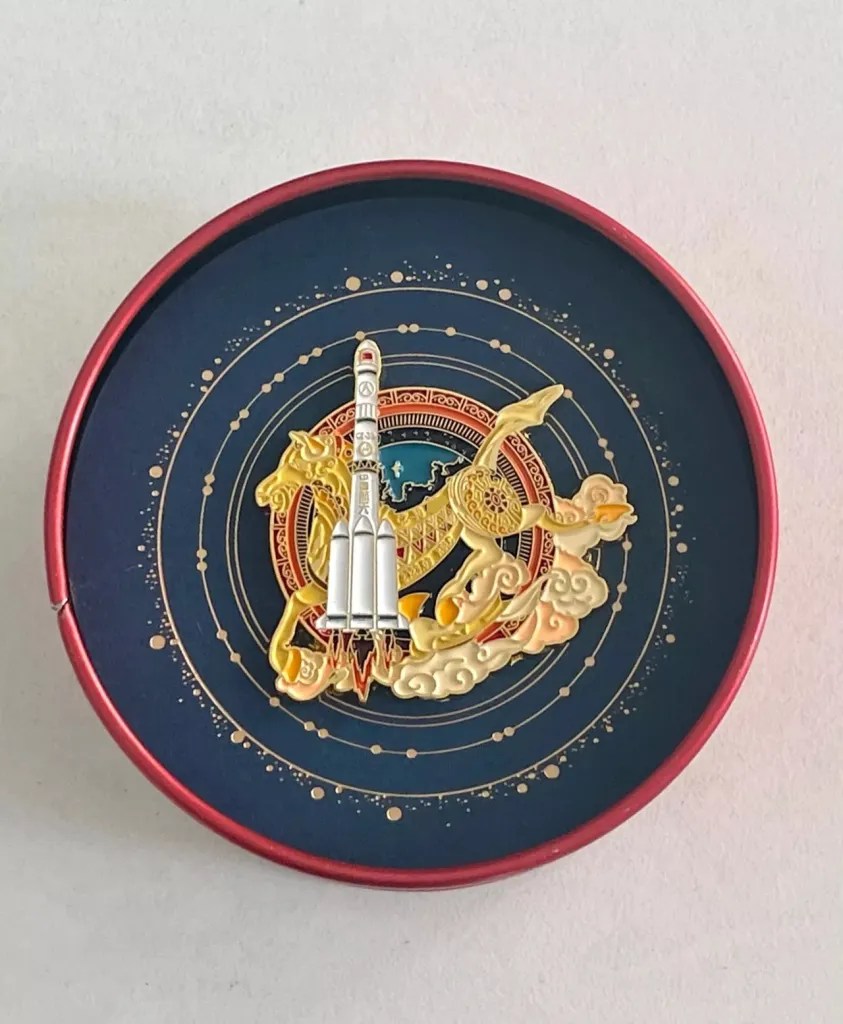
Chang Zheng – Long march 3B  Carrier Rocket yao 90 launches high score 13th No. 02 satellite mission badge: This badge is inspired by the historical allusion of a horse stepping on a flying swallow. Ma Ta Feiyan is a magical and rare treasure in the history of ancient sculpture art in my country. It is a landmark building in Xichang. As an emblem element, it implies the rapid development of China’s aerospace industry and the tenacious and indomitable spirit of astronauts.
The main body of the emblem is the Chang Zheng – Long march rocket, the earth is in the center of the picture, auspicious clouds surround the main body, and the stars mark the launch site, which means that one arrow and one star will be launched from here, and go forward bravely, just like astronauts bravely climbing the peak of science and technology, to write China’s aerospace industry The new chapter dares to overcome all difficulties and obstacles…..

Images and visuals are from their Respectives CMS China Manned SpaceCNSA-China National Space Administration

#CNSA #ChinaNationalSpaceAdministration #国家航天局 |#BRI #March2023 |  #JiuquanSatelliteLaunchCenter launched on the International Icon #长征二号丁火箭#ChangZheng2C  #LongMarch2C   #CarrierRocket successfully launch # Horus2  #RemoteSensing #Satellites for the #2023TwoSessions.. 

On the 13 March 2023 Early clear 1202 Hours Hong Kong SAR- Beijing time , the Belt and Road Initiative CNSA –China National Space Administration  launching from Jiuquan Satellite Launch Center – Inner Mongolia –China – People’s Republic of China deployed launched the Chang Zheng – Long March 2C carrier rocket ….  The Chang Zheng – Long March 2C carrier rocket of the Jiuquan Satellite Launch Center……. successfully sending the Horus 2 remote sensing satellite into the predetermined orbit , the launch mission was a complete success. This launch is the 466th launch of the Long March series of launch vehicles.

Horus 2 launch high-definition big picture! The general assembly test period and the launch area process of the Second C rocket have been shortened to 20 days and 11 days…

 Chen Shiqiang, deputy director of the eleventh room of the overall design department of the Rocket Academy, introduced that the biggest feature of this mission is stability: the rocket technology is stable and the test is stable. The launch process is stable and the test participants remain unchanged. On this basis, the development team further optimized the process and improved efficiency.
▲Based on carrying capacity and production efficiency, continue to promote refined quality control of the entire process, continue to optimize the general assembly and launch site process, shorten the rocket final assembly and test cycle to 20 days, and further shorten the launch area process to within 11 days.
▲The test rules and failure plan of the launch site have been refined and improved, and tacit knowledge has been made explicit, thereby reducing the dependence of test participants on the test experience. According to the operation test rules and plan, test participants can accurately complete the launch site. Various tasks.

[Long March 2C rocket launches Horus 2 satellite] At 12:02 on March 13, the Long March 2C carrier rocket ignited and blasted off at the Jiuquan Satellite Launch Center, successfully sending the Horus 2 remote sensing satellite into the predetermined orbit , the launch mission was a complete success. This launch is the 466th launch of the Long March series of launch vehicles.

The two sessions have come to a successful conclusion, let’s send a rocket to congratulate!
At 12:02 on March 13, the Long March 2C carrier rocket ignited and lifted off at the Jiuquan Satellite Launch Center, successfully sending the Horus 2 remote sensing satellite into the predetermined orbit, and the launch mission was a complete success. This launch is the 466th launch of the Long March series of launch vehicles

Images and visuals are from their Respectives CMS China Manned SpaceCNSA-China National Space Administration

#CNSA #ChinaNationalSpaceAdministration #国家航天局 |#BRI #February2023 |  #JiuquanSatelliteLaunchCenter launched on the International Icon #长征二号丁火箭#ChangZheng2C  #LongMarch2C  #CarrierRocket successfully launch #Horus1  #RemoteSensing #Satellites .. 

On the 24th February 2023 Early clear 1201 Hours Hong Kong SAR- Beijing time , the Belt and Road Initiative CNSA –China National Space Administration  launching from Jiuquan Satellite Launch Center – Inner Mongolia –China – People’s Republic of China deployed launched the Chang Zheng – Long March 2C carrier rocket ….  The Chang Zheng – Long March 2Ccarrier rocket erected at station 603 of the Jiuquan Satellite Launch Center, and it is expected to perform a space launch mission at noon today….

Successfully launched the Horus 1 remote sensing satellite at 12:01 Beijing time today, China, People’s Republic of China successfully launched the Horus 1 remote sensing satellite into space using the Long March 2C carrier rocket at the Jiuquan Satellite Launch Center. The satellite successfully entered the predetermined orbit, and the launch mission was a complete success. This mission is the 464th flight of the Long March series of launch vehicles!

Images and visuals are from their Respectives…

#CNSA #ChinaNationalSpaceAdministration #国家航天局 |#BRI #January2023 | #酒泉卫星发射中#JiuquanSatelliteLaunchCenter launched on the International Icon #长征二号丁火箭#ChangZheng2D  #LongMarch2D Yao 73  #CarrierRocket successfully launch #Yaogon73  #RemoteSensing and two more #Satellites .. 

On the 13th January 2023 Early clear 1500 Hours Hong Kong SAR- Beijing time , the Belt and Road Initiative CNSA –China National Space Administration  launching from Jiuquan Satellite Launch Center – Inner Mongolia –China – People’s Republic of China deployed launched the Chang Zheng – Long March 2D carrier rocket ….  The Chang Zheng – Long March 2D Yao73 carrier rocket…

The Chang Zheng – Long March 2D Yao73 carrier rocket…73 launch vehicle at station 603 of the Jiuquan Satellite Launch Center to successfully launch the Yaogan No. 37  – Remote Sensing 37 The satellite and the test No. 22 A/B satellite carried by it were launched into space, and the satellite successfully entered the predetermined orbit, and the launch mission was a complete success. The three satellites launched this time are mainly used for on-orbit verification tests of new technologies such as space environment monitoring. This mission is the 461st flight of the Long March series of launch vehicles

The Chang Zheng – Long March 2D Yao73 carrier rocket deployed the Yaogan 37 Remote Sensing Satellite is mainly used for on-orbit verification tests of new technologies such as space environment monitoring, and is developed by the Eighth Academy. Test 22 A and B stars were developed by the Eighth Academy of Sciences and the Xi’an Institute of Optics and Fine Mechanics of the Chinese Academy of Sciences respectively. Test 22 A satellites is mainly used for on-orbit verification tests of new technologies such as space environment monitoring…..

Images and visuals are from their Respectives ..