On the months of January 2022 1st January 2022 on New Years Day 天问一号飞運騎遊達达3亿CNSA – China National Space Administration – ESA – European Space agency Belt and road initiative mars mission…first Mars exploration mission, Tianwen- Martian Probe One sent back stunning images of the Half Earth Mass size of the Rustic Planet Mars in which show stunning Martian landscape with its iconic polar caps of either southern or northern .. with its timeless Stunning Mars Photography.
On the eve on 31st January 2022in which on the 1st February 2022 of the Chinese Lunar New year Spring Festival in the Year of the Tiger, the Tianwen-1 probe sent back a set of selfie videos from Mars orbit to extend New Year wishes to the people of the whole country- China – People’s Republic of China and the Chinese Communities . On the 29th of the twelfth lunar month last year (February 10, 2021), Tianwen-1 arrived on Mars and successfully implemented capture and braking. It became my country’s first artificial Mars satellite, and started a scientific exploration journey to the red planet. a lunar year.
The video is a video of the Mars group photo taken by the probe.
The video was shot by the “selfie” camera carried by the Tianwen-1 surround. The camera is installed at the end of the “selfie stick”. This selfie tool is designed to monitor and evaluate the status of key components outside the surround. In the video The orbiter’s 3000N engine, propellant storage tank, attitude control engine and other components are in good condition. The five-star red flag shining in the Mars orbit is particularly bright. During the attitude adjustment process, the angle of the sun’s illumination changes significantly. When flying over the north pole of Mars, the ice cap below was photographed. The “selfie stick” uses a special shape memory composite material, which is folded and folded before launch. After entering the orbit of Mars, the folded part is heated to a certain temperature, and the “selfie stick” gradually returns to a straight state. The “selfie stick” weighs only 0.8 kilograms and is 1.6 meters long when unfolded. The camera installed at the end can effectively complete various monitoring tasks.
As of January 31, 2022, Tianwen-1 has been in orbit for 557 days, about 325 million kilometers away from the earth, and the light travel time is about 18 minutes. The Zhurong rover has worked for 255 Martian days and travelled a total of 1524 meters. At present, the Tianwen-1 mission has returned a total of about 600GB of original scientific data, and the two devices are in good condition and operating normally
Images and visuals are from CNSA- China National Space Administration also from there respectives- CLEP –China Lunar Exploration Project..
On the months of January 2022 1st January 2022 on New Years Day 天问一号飞運騎遊達达3亿CNSA – China National Space Administration – ESA – European Space agency Belt and road initiative mars mission…first Mars exploration mission, Tianwen- Martian Probe One sent back stunning images of the Half Earth Mass size of the Rustic Planet Mars in which show stunning Martian landscape with its iconic polar caps of either southern or northern .. with its timeless Stunning Mars Photography.
This set of images includes a photo of the orbiter and Mars, a close-up of the orbiter, the North Pole ice cap of Mars, and the “Zhurong” rover shooting fire landforms, etc., showing the operating status of the orbiter, the “Zhurong” rover, and the acquired surface of Mars form.
In Figure 1, the orbiter is flying over the north pole of Mars. The orbiter body is golden, the directional antenna for high-speed data communication with the ground is silver (under the orbiter body), and the solar wing is in good condition. The white area on Mars is the “ice” sheet covering the North Pole. Unlike the ice at the two poles of the Earth, the “ice” of Mars is composed of dry ice (solid carbon dioxide) and water ice. The dark area below Mars is the Olympia Shabo of Mars, the bright circular crater in the upper left corner is named Korolev Pit, and the remaining red and dark areas are bare ground.
Partial close-up of the orbiter
In Figure 2, the solar wing on the side of the orbiter is fully deployed and the attitude is stable. An unfolded subsurface detection radar antenna is parallel to the solar wing, and the magnetometer extension rod extends to the upper left of the surround.
Mars Arctic Ice Sheet
Figure 3 shows the Martian North Pole ice cap, the bedding is clearly visible. After years of deposition and ablation, it presents a spiral landform composed of a white ice layer centered on the pole and bare ground.
Figure 4 is a mosaic of 3 images acquired by the “Zhurong” Mars rover recently using a navigation terrain camera. In the figure, we can see typical Martian topography such as ring craters and rocks. As of December 31, 2021, the Tianwen-1 orbiter has been in orbit for 526 days, and is currently about 350 million kilometers away from the Earth. The communication delay is about 19.5 minutes. 1400 meters. At present, the Tianwen No. 1 mission is carrying out detection and related tests as planned, and a total of about 560GB of raw scientific data has been returned. The two devices are in good condition and operating normally.
Images and visuals are from CNSA- China National Space Administration also from there respectives..
On the 8TH November 2021 Friday 天问一号飞運騎遊達达3亿CNSA – China National Space Administration – ESA – European Space agency Belt and road initiative mars mission…first Mars exploration mission, Tianwen- Martian Probe One …….祝融号Zhu Rong” also have been exploration Roamingly1,253 meterson the Rustic half diameter planet size Red planet Mars… During that time Tianwen-1 orbiter enters remote sensing mission orbit…
November 8, 2021, “Heaven” successfully implemented around the fifth brake near the fire, into the exact orbit remote sensing mission, the Mars Global to carry out remote sensing. In the early stage, the “Zhurong” Mars rover has successfully completed the established inspection mission objectives, and is in good condition, and continues to carry out the detection mission. Considering the global remote sensing detection of the orbiter and the relay communication requirements of the Mars rover, the engineering development team optimized the orbit design and determined a remote sensing orbit plan with a near fire point of about 265 kilometers, a far fire point of about 10,700 kilometers, and a period of about 7.08 hours. While ensuring the development of orbiting scientific exploration, it will provide more relay communication support for the Mars rover to improve the efficiency of mission development.
n the remote sensing orbit, seven scientific payloads including mid-resolution cameras, high-resolution cameras, subsurface detection radars, mineral spectrum analyzers, magnetometers, ion and neutral particle analyzers, and energy particle analyzers will be acquired Scientific data such as fire star morphology and geological structure, surface material composition and soil type distribution, atmospheric ionosphere, Martian space environment, etc., focusing on typical landforms and geological units such as craters, volcanoes, canyons, and dry river beds, and implement high-resolution detection.
Up to now, the orbiter has been in orbit for 473 days, the ground fire distance is 384 million kilometers, and the light travel time is 21 minutes and 20 seconds; the rover has worked on the surface of Mars for 174 Mars days and travelled 1,253 meters in total. The two devices are in good condition. The working condition is normal.
Today 30th July 2021 天问一号飞運騎遊達达3亿CNSA – China National Space Administration – ESA – European Space agency Belt and road initiative mars mission…first Mars exploration mission, Tianwen- Martian Probe One …….”祝融号Zhu Rong” Mars Lander – Mars rover successfully exploring more than 708 meters from its base lander camp.. Roamingly on the Rustic half diameter planet size Red planet Mars on Hong Kong SAR- Beijing Earth Friday time… In which new mileage: “Zhu Rong” Mars Rover ….Sailing in the galaxy, strolling through the glamorous confusion the first anniversary of the successful launch of Tianwen 1…
On which that Friday 30th July 2021 Earth Day “Zhurong” Mars rover began to explore more of the traverse the complex terrain.,….After the “Zhurong” rover completed its scientific survey of the second dune landform, it continued to move south and reached a complex terrain area with densely distributed rocks, impact craters and sand dunes this week.
In the follow-up, ground flight control personnel will complete the visual positioning and movement path planning of the rover based on the navigational terrain images obtained daily, and control the rover to safely traverse this complex terrain. When passing by an interested scientific detection target, the rover will use scientific payloads such as surface composition detectors and multispectral cameras to conduct detailed detections. During the journey, the surface magnetic field detector, the Martian weather measuring instrument, and the subsurface detection radar were turned on to obtain scientific data.
As of July 30, 2021, the rover has worked on the surface of Mars for 75 Martian days and travelled 708 meters in total. The orbiter has been in orbit for 372 days, the two devices are in good condition, and the working conditions of each system are normal.
[Zhu Rong: Never fear difficulties and move forward] According to the China National Space Administration, the Zhu Rong rover arrived this week in a complex terrain with densely distributed rocks, impact craters and sand dunes.
In the follow-up, ground flight control personnel will complete the visual positioning and movement path planning of the rover based on the navigational terrain images obtained daily, and control the rover to safely cross this complex terrain.
Up to now, the rover has worked on the surface of Mars for 75 Martian days and has travelled 708 meters in total. The orbiter has been in orbit for 372 days, the two devices are in good condition, and the working conditions of each system are normal.
Don’t be afraid to move forward! I wish the Zhurong a smooth journey through….!
Previously 23th July 2021 On the first anniversary of the successful launch of China – People’s Republic of China” first Mars exploration Tianwen-1 mission, the CNSA China National Space Administration’s lunar exploration and space engineering center released a collection of wonderful moments of project implementation and flight, comprehensively reviewing the magnificent journey of Tianwen-1 mission.
At 12:41:05 on July 23, 2020, the Tianwen-1 mission was successfully launched, taking the first step in China’s planetary exploration. At 19:52 on February 10, 2021, after a 202-day flight of 475 million kilometers, Tianwen-1 rendezvoused with Mars, successfully implemented the capture brake, entered an orbit around Mars, and became my country’s first man-made Mars satellite. .
At 7:18 on May 15, 2021, the Tianwen-1 probe successfully landed on the southern part of the Martian Utopia Plain. General Secretary Xi Jinping sent a congratulatory message on behalf of the Party Central Committee, the State Council and the Central Military Commission, stating that the Tianwen-1 probe landing on Mars has taken an important step in my country’s interstellar exploration journey and achieved the leap from the Earth-Moon system to the interplanetary system. For the first time, Chinese people’s footprints were left on Mars. This is another milestone in the development of my country’s aerospace industry. Han Zheng, member of the Standing Committee of the Political Bureau of the CPC Central Committee and Vice Premier of the State Council, and Liu He, member of the Political Bureau of the CPC Central Committee and Vice Premier of the State Council, witnessed the first historical moment of China’s robot landing on Mars at the Beijing Aerospace Flight Control Center and cordially expressed condolences to the participants.
At 10:40 on May 22, 2021, the “Zhu Rong” rover reached the surface of Mars, began on-orbit testing and inspections, and returned “landing site panorama”, “topography”, “Chinese imprints” and “writings”. Photographs such as Tour Group Photo. On June 11, 2021, the National Space Administration held a ceremony. Vice Premier Liu He unveiled the first batch of scientific image maps obtained on the surface of Mars, marking the complete success of my country’s first Mars exploration mission. Since the start of scientific exploration, the “Zhurong” rover has driven from the landing site to the ancient sea-land junction in the south. The driving route is as follows (produced by Beijing Aerospace Flight Control Center).
On each Martian day, the navigation terrain camera images the landforms along the way. During the journey, the subsurface radar and weather measuring instrument are turned on for detection; after the journey stops, the surface magnetic field detector is turned on for detection; on the way, rocks and rocks with high scientific detection value are encountered. For special landforms such as sand dunes, surface composition detectors, multi-spectral cameras and other payloads carry out fixed-point detection. This week, the rover drove to a sand dune on the way to patrol and explored, and took pictures of the dune landform formed by wind and wind accumulation. Several loads were turned on to detect the dunes and the surrounding environment.
As of July 23, 2021, the “Zhurong” rover has worked on the surface of Mars for 68 Martian days and travelled 585 meters in total; the first anniversary of the orbiter, the distance from the earth is about 378 million kilometers, and the one-way communication delay is about In 21 minutes, the two devices were in good condition, and the working conditions of each system were normal.
Images and visuals are from CNSA- China National Space Administration also from there respectives..
天问一号飞運騎遊達达3亿 …….As of 11th June 2021Friday CNSA – China National Space Administration – ESA – European Space agency Belt and road initiative mars mission…first Mars exploration mission, Tianwen- Martian Probe One …….”祝融号Zhu Rong” Mars Lander – Mars rover successfully sent back telemetry towards China National Space Administration released a high-resolution image of the landing area of China- People’s Republic of China’s first Mars exploration Tianwen-1 mission. The image of the Zhongtianwen-1 landing platform, the “Zhurong” rover and the surrounding area are clearly visible. Also to of the ultimate Mars Selfie of itself also it’s Mars Landing platform in releasing a high definition patches of travelling least six meters of it landing platform 天问一号-1 landing on Mars first batch of scientific images revealingly…
That Mars on Hong Kong SAR- Beijing Earth Friday time On June 11th 2021 , at the unveiling ceremony of the first batch of scientific image maps of the Tianwen-1 rover landing on Mars in Beijing, the panoramic view of the landing site, the topography of Mars, the “Chinese imprint” and the image taken by the “Zhurong” rover were announced. “Photographs with the tour” and other image maps. The release of the first batch of scientific image maps marked the complete success of my country’s first Mars exploration mission.
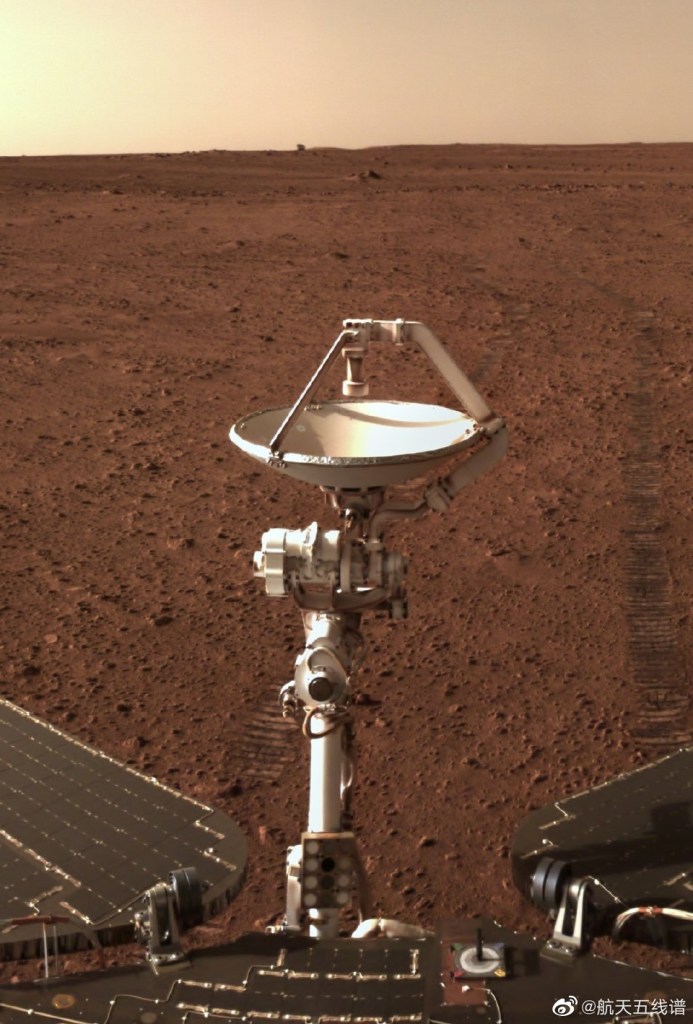
The panoramic view of the landing site is a 360-degree ring shot taken by the navigation terrain camera on the rover’s mast before the rover has left the landing platform, after correction and mosaic stitching. The image shows that the terrain near the landing site is flat, the Martian horizon can be seen in the distance, and the abundance and size of the rocks are consistent with expectations, indicating that the autonomous selection of the landing site and the implementation of hovering obstacle avoidance are effective.
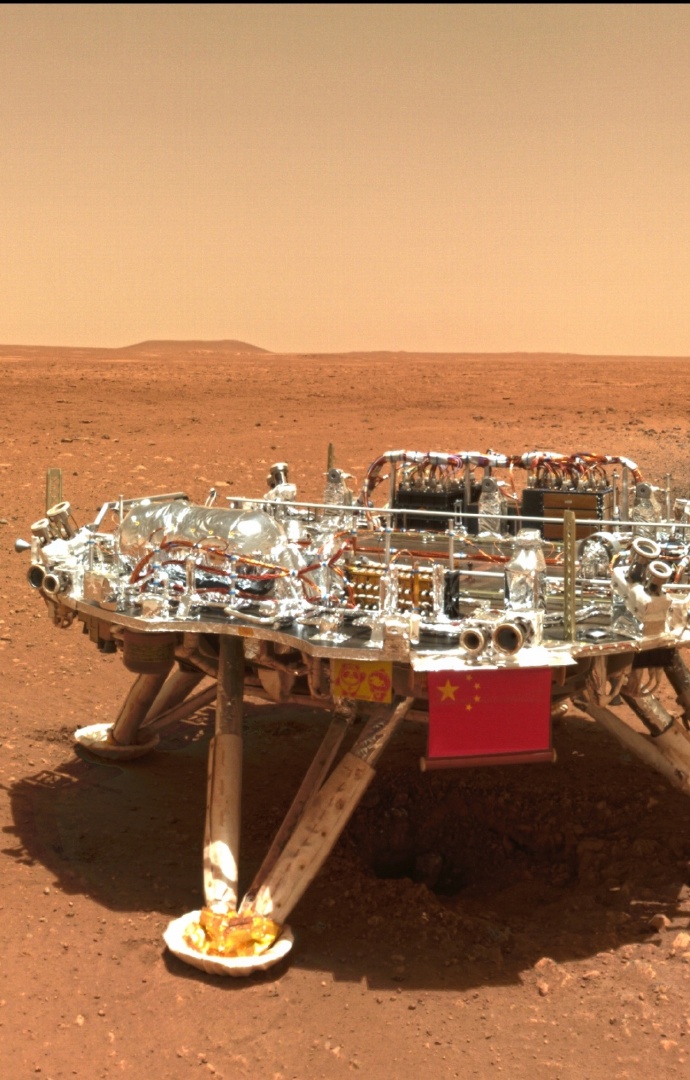
The Mars topography map is the first topography and geomorphology image map taken by the navigation terrain camera after the rover reaches the surface of Mars. The image shows that the nearby surface is relatively flat, with stones of different sizes distributed, with smooth edges, lighter colours, and semi-buried. There is an annular pit at the far end, and the edges of the annular pit are distributed with darker, angular stones. , And a few sand dunes farther away. The “Chinese Imprint” map is an image of the landing platform taken when the Mars rover travels to about 6 meters southeast of the landing platform 60° southeast. The image shows that the landing platform is shining, the national flag is bright red and square, and the surface is rich in details.
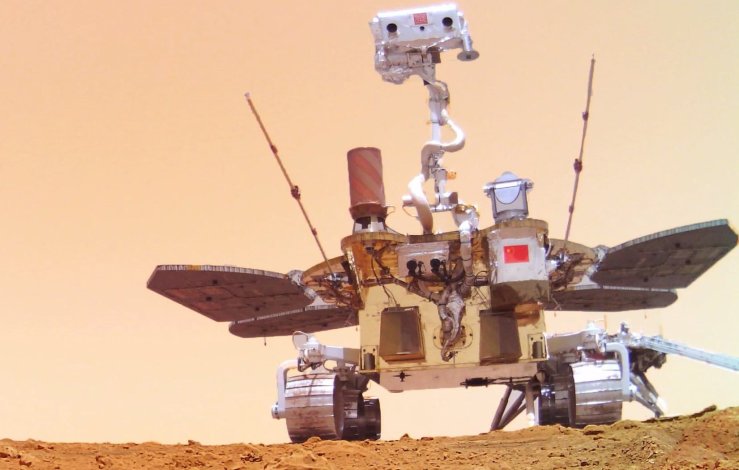
The picture of the “touring group photo” shows the rover traveling about 10 meters south of the landing platform, releasing the separate camera installed at the bottom of the vehicle, and then retreating to the vicinity of the landing platform. The separate camera took pictures of the movement of the rover and the photo of the rover and the landing platform. The image is transmitted to the rover through wireless signals, and then relayed back to the ground by the rover through the orbiter
images of the mascots of the 2022 Winter Olympics “Bingdundun” and “Xuerongrong” on the landing platform
Mars surface Photography of Zhurong with the landing platform …. The picture of the “tourist group photo” shows the rover traveling about 10 meters south of the landing platform, releasing the separate camera installed at the bottom of the vehicle, and then retreating to the vicinity of the landing platform. The separate camera took pictures of the movement of the rover and the photo of the rover and the landing platform. The image is transmitted to the rover through wireless signals, and then relayed back to the ground by the rover through the orbiter.
Chinese Imprint” image, the image of the landing platform taken by the Zhurong Mars rover driving to about 6 meters southeast of the landing platform 60° south. The image shows that the landing platform is shining, the national flag is bright red and square, and the surface is rich in details.
Images and visuals are from Weibo of CNSA – China National Space Administration – CLEP –China Lunar Exploration Program