Located in the Heart of Hong Kong central of Victoria Harbour in which locate looking at the iconic Megatroplis HongKong Island city landscape from the opposite is the Hong Kong Space Museum 香港太空館 in which located at 10 Salisbury Road, Tsim Sha Tsui, Kowloon, Hong Kong SAR, China –People’s Republic of China.. in which is one of the most international iconic buildings architecturally due to its hemispheric round dome in which is iconic known as one of Hong Kong’s local most cherish bread pastries the Pineapple Bun – Bolo Bao due to the pineapple ceramic texturing tiles of the dome structure that resembles the delicious texturing of the Pineapple Bun .. In which on In June 2014, the Hong Kong Government listed the pineapple bun as a part of Hong Kong’s intangible cultural heritage. … Despite the name, it does not traditionally contain pineapple; rather, the name refers to the look of the characteristic topping (which resembles the texture of a pineapple)……
On the 20th November 2021 Saturday – 1330 to 1530 Hong Kong SAR- Beijing Time One of leading international Iconic Planetarium Space Museums 香港太空館Hong Kong Space Museum spoken in Chinese – Cantonese –Guangdong Dialect .. live streaming in one of its Auditorium in which Hong Kong SAR Space Program thorough outs it’s Universities collaborated in China- People’s Republic of China’s first most Challenging Mars Mission in which China’s CNSA –China National Space Administration skill set far out weight NASA’s Mar Missions current and past.. . In One of Hong Kong SAR Universities, Hong Kong PloyU has contributed the Camera system of Tianwen One’s one of many Camera systems also it’s Mars lander, Zhurong Mars rover, and Mars Orbiter other elementally equiment system…. Speaker: Prof. Yung Kai-leung, BBS (Chair Professor & Associate Head, Department of Industrial and Systems Engineering, The Hong Kong Polytechnic University)
The Tianwen-1, China’s first Mars mission successfully landed on it in May, achieving another extraordinary feat in the recent Chinese Aerospace Industry. This first Mars exploration mission of China is unique that employed novel technology and engineering design and encounters exceptional challenges.
The Tianwen-1, China’s first Mars mission successfully landed on it in May, achieving another extraordinary feat in the recent Chinese Aerospace Industry. This first Mars exploration mission of China is unique that employed novel technology and engineering design and encounters exceptional challenges.
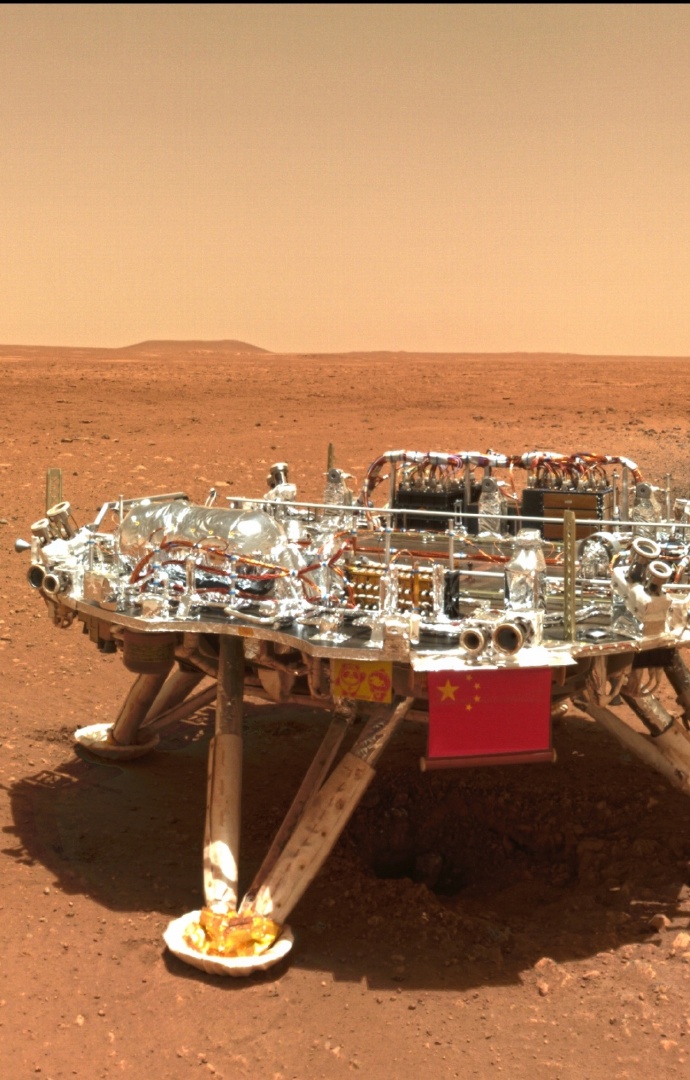
The Mars Landing Surveillance Camera (Mars Camera) is developed mainly by the research team of the Hong Kong Polytechnic University. It is a sophisticated space instrument mounting on the top surface of the lander platform of Tianwen-1, which monitors the landing status, the surrounding environment of the red planet and the operation status of the Zhu Rong rover. The Mars Camera is light in weight, yet strong and durable enough to withstand the huge impact shocks of 6,200 times Earth’s gravity. Moreover, it has to operate under low Martian temperature as well as overcome extreme temperature differences it experienced during its flight. In this lecture, Professor Yung from the Hong Kong Polytechnic University will talk about the challenges of the Mars mission and delineate the contributions of the Hong Kong research team.
On the 8TH November 2021 Friday 天问一号飞運騎遊達达3亿CNSA – China National Space Administration – ESA – European Space agency Belt and road initiative mars mission…first Mars exploration mission, Tianwen- Martian Probe One …….祝融号Zhu Rong” also have been exploration Roamingly1,253 meterson the Rustic half diameter planet size Red planet Mars… During that time Tianwen-1 orbiter enters remote sensing mission orbit…
November 8, 2021, “Heaven” successfully implemented around the fifth brake near the fire, into the exact orbit remote sensing mission, the Mars Global to carry out remote sensing. In the early stage, the “Zhurong” Mars rover has successfully completed the established inspection mission objectives, and is in good condition, and continues to carry out the detection mission. Considering the global remote sensing detection of the orbiter and the relay communication requirements of the Mars rover, the engineering development team optimized the orbit design and determined a remote sensing orbit plan with a near fire point of about 265 kilometers, a far fire point of about 10,700 kilometers, and a period of about 7.08 hours. While ensuring the development of orbiting scientific exploration, it will provide more relay communication support for the Mars rover to improve the efficiency of mission development.
n the remote sensing orbit, seven scientific payloads including mid-resolution cameras, high-resolution cameras, subsurface detection radars, mineral spectrum analyzers, magnetometers, ion and neutral particle analyzers, and energy particle analyzers will be acquired Scientific data such as fire star morphology and geological structure, surface material composition and soil type distribution, atmospheric ionosphere, Martian space environment, etc., focusing on typical landforms and geological units such as craters, volcanoes, canyons, and dry river beds, and implement high-resolution detection.
Up to now, the orbiter has been in orbit for 473 days, the ground fire distance is 384 million kilometers, and the light travel time is 21 minutes and 20 seconds; the rover has worked on the surface of Mars for 174 Mars days and travelled 1,253 meters in total. The two devices are in good condition. The working condition is normal.
On the 22nd October 2021 Friday 天问一号飞運騎遊達达3亿CNSA – China National Space Administration – ESA – European Space agency Belt and road initiative mars mission…first Mars exploration mission, Tianwen- Martian Probe One …….”祝融号Zhu Rong” previously on 30th August 2021 Mars Lander – Mars rover successfully exploring more than 1064 meters from its base lander camp.. Roamingly on the Rustic half diameter planet size Red planet Mars on Hong Kong SAR- Beijing Earth Wednesday time… In which new mileage: “Zhu Rong” Mars Rover ….Sailing in the galaxy, strolling through the glamorous rustic environment in talking it’s adventure with Tianwen 1 Martian communications probe orbiting the Red Planet… in which “Zhurong” Mars rover completes scheduled exploration mission…
In late September 2021, the Earth, Mars and the three sides to the sun almost in a straight line, a phenomenon known as Ling day. During this period, the communication between the Mars rover and the earth was disturbed by the sun’s electromagnetic radiation, which was unstable or even interrupted. During the transit period, the “Tianwen-1” orbiter and the “Zhurong” Mars rover entered autonomous operation mode and suspended scientific exploration work. In order to find out the actual impact of Riling, the engineering development team continued to carry out measurement and control link tracking tests, and for the first time obtained measured data on the interference of deep-space measurement and control communications under Riling, and accumulated first-hand data and engineering experience for subsequent tasks to deal with Riling.
The astronomical phenomenon of occultation during the solar transit provides scientists with a rare opportunity to observe the solar transit occultation. The Shanghai Astronomical Observatory, the National Space Science Center and other units, together with the European VLBI Institute, the University of Tasmania in Australia and other institutions, used Wettzell and Yebes located in Shanghai, Kunming, Urumqi, and Europe. ), Medicina, Svetloe, Zelenchukskaya, Badary, Hobart, Keith, Russia The radio telescopes in Kath, Yarra, and Hartebeesthoek in South Africa carried out the same beam day for the “Tianwen-1” orbiter and the “Mars Express” orbiter (MEX). Ling observation. A total of about 5 terabytes of data have been obtained in this observation. At present, the parties are conducting joint research. By analyzing the influence of the electromagnetic wave signals transmitted by the two detectors back to the earth through the solar wind, the fluctuations in the interplanetary electron density caused by the intrinsic turbulence of the solar wind are studied. Scientific issues such as the relationship between solar wind micro-turbulence and macro-wind speed.
A few days ago, the solar transit phenomenon has ended, and the measurement and control communication between the probe and the earth has returned to normal. Judging from the telemetry data, the “Tianwen No. 1” was in normal condition during the solar transit and passed the first solar transit safely. The orbiter will enter the remote sensing mission orbit in early November to carry out global remote sensing exploration of Mars to obtain scientific data such as Mars morphology and geological structure, surface material composition and soil type distribution, atmospheric ionosphere, and Martian space environment, while taking into account the development of the rover mission Phase of relay communication.
On the 5th October 2021天问一号飞運騎遊達达3亿CNSA – China National Space Administration – ESA – European Space agency Belt and road initiative mars mission…first Mars exploration mission, Tianwen- Martian Probe One …….”祝融号Zhu Rong” previously on 30th August 2021 Mars Lander – Mars rover successfully exploring more than 1064 meters from its base lander camp.. Roamingly on the Rustic half diameter planet size Red planet Mars on Hong Kong SAR- Beijing Earth Wednesday time… In which new mileage: “Zhu Rong” Mars Rover ….Sailing in the galaxy, strolling through the glamorous rustic environment in talking it’s adventure with Tianwen 1 Martian communications probe orbiting the Red Planet… in which “Zhurong” Mars rover completes scheduled exploration mission
In which on 5th Tuesday October 2021 Tianwen-1 probe enters the solar transit stage since late September, the earth and Mars have gradually moved to both sides of the sun and the three are almost in a straight line. The solar electromagnetic radiation interference gradually increases, and the device-to-ground communication is disturbed. Instability or even interruption, this phenomenon is called “riling”.
The “lost connection” between the probe and the ground during the solar transit is the expected normal state, and the “lost connection” is not “missing”. In order to safely pass the solar transit period, the Mars rover and the orbiter have completed the relevant state settings recently, stopped the scientific exploration work and continued to monitor the state. riling will end in mid-October, and the probe will resume communication with the ground and continue scientific exploration.
In which during China’s National Day of the People’s Republic of China was told the Marian Lander Zhurong also its Base Camp Mars Lander to go on a well earn sleep hibernation in which Tianwen No.1 probe enters the solar transit stage Beginning in late September, the Earth and Mars have gradually moved to both sides of the sun and the three are almost in a straight line. Due to the electromagnetic radiation interference of the sun has gradually increased, and the communication between the device and the ground has been disturbed, and there has been instability or even interruption. This phenomenon is called “sun.” Ling”. The “lost connection” between the probe and the ground during the solar transit is the expected normal state, and the “lost connection” is not “missing”. In order to safely pass the solar transit period, the rover and the orbiter have completed the relevant status settings recently, stopped scientific exploration work and continued to monitor the status. Ri Ling will end in mid-October; the detector will resume communication with the ground and continue to carry out scientific exploration as the Planet Mars moves out from the Occultation going behind the Sun…
On the 30th Monday August 2021天问一号飞運騎遊達达3亿CNSA – China National Space Administration – ESA – European Space agency Belt and road initiative mars mission…first Mars exploration mission, Tianwen- Martian Probe One …….”祝融号Zhu Rong” Mars Lander – Mars rover successfully exploring more than 1064 meters from its base lander camp.. Roamingly on the Rustic half diameter planet size Red planet Mars on Hong Kong SAR- Beijing Earth Wednesday time… In which new mileage: “Zhu Rong” Mars Rover ….Sailing in the galaxy, strolling through the glamorous rustic environment in talking it’s adventure with Tianwen 1 Martian communications probe orbiting the Red Planet… in which “Zhurong” Mars rover completes scheduled exploration mission
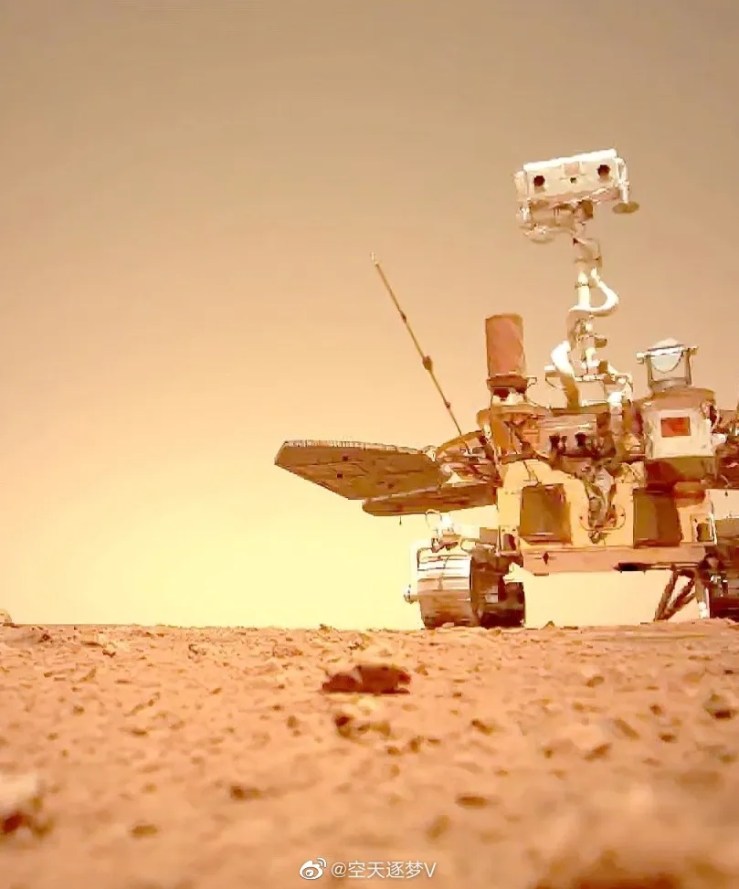
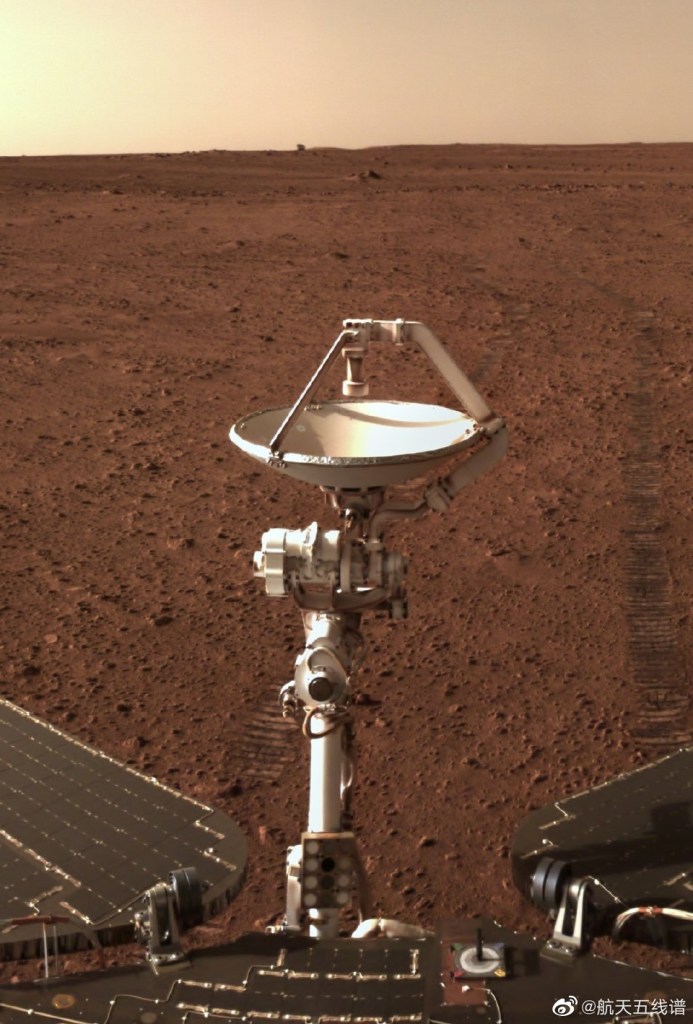
The Zhurong Mars Rover had travelled a total of 1064 meters south of the landing site. Picture 1/2 is a panoramic view of the inspection area taken by 祝融号 recently. At present, the rover is in good condition and has sufficient energy. It will continue to follow the high-efficiency detection mode of “seven-day cycle, one-day planning, daily detection”, and drive to the ancient sea-land junction in the south to obtain richer scientific exploration Data.
The orbiter has been in orbit for 403 days and is about 392 million kilometers away from the earth. On August 24, a high-resolution camera was used to image the landing area, and a 1-meter resolution image was obtained. The rover’s trajectory is clear in the image…
At present, the distance of the ground fire gradually tends to be the furthest (about 395 million kilometers). In mid-to-late September, the Earth and Mars will travel to both sides of the sun. The three are almost in a straight line, and the probe will enter the solar transit phase ….. During the transit, due to the influence of solar electromagnetic radiation interference, the device-to-ground communication is interrupted, the orbiter and the rover will switch to safe mode and stop the detection work. After the solar transit, the orbiter will select the opportunity to enter the remote sensing mission orbit to carry out global remote sensing exploration of Mars, while taking into account the relay communication of the Mars rover’s expansion mission stage
On August 30th 2021, when China- People’s Republic of China first Mars exploration Tianwen-1 mission, “Zhurong”, the rover reached the surface of Mars for more than 100 days, the National Space Administration and the People’s Bank of China held China’s first Mars exploration mission in Beijing and successfully issued gold and silver commemorative coins. The ceremony is to commemorate an important step in our successful interstellar exploration journey, leaving China’s mark on Mars for the first time, becoming the world’s first country to achieve Mars circumnavigation, landing and patrol on a single mission. Wu Yanhua, deputy director of the National Space Administration, and Mou Shangang, chairman of China Gold Coin Corporation, delivered speeches.
At the ceremony, Chen Jianxin, deputy director of the People’s Bank of China Currency and Gold and Silver Bureau, announced the release announcement. Zhang Rongqiao, chief designer of China’s first Mars exploration mission project, released information on the progress of the Mars exploration mission. The leading experts at the meeting jointly presented gold and silver commemorative coins for China’s first Mars exploration mission. Coin unveiled.
Wu Yanhua said that this year marks the 100th anniversary of the founding of the Communist Party of China and the 65th anniversary of the founding of China’s aerospace industry. At this important historical moment and at this important project node, the National Space Administration, in conjunction with the Central Bank and the Gold Coin Corporation, issued “China’s First Mars Exploration Mission Successful” The commemorative coin is an organic fusion of science and technology and culture, aerospace and art. It is conducive to engraving historical achievements, is conducive to inspiring the whole line of aerospace to take the lead, and is conducive to setting off a national upsurge of innovation and creation.
Mou Shangang said that the success of my country’s first Mars exploration mission is an important achievement of the party and the country in advancing the building of a space power and a full demonstration of China’s aerospace spirit. It is worth recording and commemorating in the form of national legal tender. The issuance of commemorative coins can play an active role in inheriting the splendid and long-standing Chinese currency culture and patriotism, striving to achieve high-quality development of the aerospace industry, and demonstrating my country’s responsibility as a major country in advancing the progress and sustainable development of human civilization. The commemorative coin is the legal tender of the People’s Republic of China and is issued by the People’s Bank of China. There are 3 coins in total, including 2 gold coins and 1 silver coin. The logos on the front are the Chinese planetary exploration logo, and the country name and year number “2021” are published, and the patterns on the back are themed on the first Mars exploration mission “Orbit, Landing, and Patrol”, and the publication “China’s First Mars Exploration Mission Success · Tianwen Yi Number” and denomination. The commemorative coin condenses the vast space in a square inch, allowing the spacecraft to rise above the gold and silver coins. It uses a design method that combines realism and freehand brushwork. It adopts classic coinage techniques such as mirror surface, sandblasting, and multi-level sandblasting. It is scientific and The combination of aesthetics has important commemorative significance and artistic value.
The commemorative coin issued this time is China’s seventh set of aerospace-themed gold and silver commemorative coins. Prior to this, the 40th anniversary of the founding of China’s aerospace, the successful first manned space flight, the first lunar exploration flight, the first space walk, and the opening of the Beidou satellite navigation system Important aerospace events such as the operation and the success of the first moon landing have issued precious metal commemorative coins, bearing in mind China’s aerospace exploration achievements in climbing the technological summit, expressing the astronauts’ scientific dreams and forge ahead attitude, and demonstrating the Chinese people’s cultural confidence and romantic feelings. As of August 30, the rover had traveled a total of 1064 meters south of the landing site. At present, the rover is in good condition and has sufficient energy. It will continue to follow the high-efficiency detection mode of “seven-day cycle, one-day planning, and daily detection”, and drive to the ancient land-sea junction in the south to obtain richer scientific exploration. data. The orbiter has been in orbit for 403 days and is about 392 million kilometers away from the earth. On August 24, a high-resolution camera was used to image the landing area, and a 1-meter resolution image was obtained. The image shows a clear track of the rover.
At present, the distance of the earth fire is gradually approaching the farthest (about 395 million kilometers). In mid-to-late September, the earth and Mars will travel to both sides of the sun, and the three will be almost in a straight line, and the probe will enter the solar transit phase. During the transit, due to the influence of solar electromagnetic radiation interference, the device-to-ground communication is interrupted, the orbiter and the rover will switch to safe mode and stop the detection work. After the solar transit, the orbiter will select the opportunity to enter the remote sensing mission orbit to carry out global remote sensing exploration of Mars, while taking into account the relay communication of the Mars rover’s expansion mission stage.
Images and visuals are from CNSA- China National Space Administration also from there respectives..