#CNSA #ChinaNationalSpaceAdministration #国家航天局 |#BeltAndRoadinitiative #December2021 | #嫦娥五号The #Moon #Change5 probe its Heroic #LunarMission from #MonsRumker #LunaExploration #Review of the first anniversary of the Chang’e 5 mission-returning home safely …..

Review of the first anniversary of the Chang’e 5 mission-returning home safely

One year ago today 24th November 2020 Now it’s the 24th November 2021 , the Chang Zheng – Long March Five Carrier Rocket Launched away  in CNSA – China National Space Administration China Wenchang spaceport launch, Change Five  Lunar probe into orbit, opened up towards China – People’s Republic of China’s first celestial bodies sample return trip from Mons Rumker on the Lunar Surface.……  

​​At 23:10 on December 3, 2020, the Chang’e-5 ascender carried a lunar sample to take off from the lunar surface. About 6 minutes later, it entered an elliptical orbit around the moon. At 2:13 on December 6, the ascender accurately reached the scheduled “handover” position 50 kilometers in front of the orbit-return assembly and about 10 kilometers above it. At 5:42, the ascender and the orbit-returning assembly completed the rendezvous and docking. At 6 o’clock, the sample packaging container was transferred from the ascender to the returner. This process of autonomous rendezvous and docking and sample transfer is like the handover process in a 100-meter relay race. It is brilliant and highly technical. Using a lunar orbital rendezvous and docking after take-off from the lunar surface, rather than a direct lunar-to-ground transfer after taking off from the lunar surface, this design is conducive to collecting and carrying more samples back to the earth, and for technical accumulation and verification for subsequent missions.

After the Chang’e-5 probe undergoes a lunar-to-earth transfer, the returner and the orbiter are separated and transferred to the return re-entry section, using a semi-ballistic jump type, that is, a “drifting” return method. After two re-entry into the atmosphere, it decelerates in Beijing. At 1:59 on December 17, 2020, the returner successfully landed in the planned area of ​​Siziwang Banner, Inner Mongolia, marking the successful completion of my country’s first extraterrestrial celestial body sampling and return mission.

At about 1 am on the 17th, the Beijing Aerospace Flight Control Center injected high-precision navigation parameters into the Chang’e-5 orbiter and returner combination through the ground measurement and control station. After that, the orbiter and the returner were normally unlocked and separated at a height of about 5,000 kilometers above the sea level of the South Atlantic Ocean, and the orbiter completed the evasive maneuver as planned. At 1:33 in the morning, the Chang’e-5 returner entered the earth’s atmosphere at a high speed close to the second cosmic speed (about 11.2 kilometers per second) at a height of about 120 kilometers above the ground, and performed the first aerodynamic deceleration. After descending to a predetermined altitude, the retractor jumps up out of the atmosphere and begins to slide down after reaching the highest point. After that, the returner enters the atmosphere again and performs a second aerodynamic deceleration. When descending to a height of about 10 kilometers above the ground, the retractor opened the parachute to complete the final deceleration and maintain a stable attitude, and then landed smoothly in the predetermined area.

During the 30-second parachute opening process, a total of 3 work phases were completed. A series of actions were completed to open the parachute with the flip cover, decelerate the deceleration parachute, pull out the main parachute by the deceleration parachute separation, open the parachute like a closed main parachute, and fully open the main parachute and descend steadily. The work of the recovery system is interlocked. Any mistake will cause the catastrophic consequences of the hard landing of the returner. All the work links cannot be controlled and adjusted from the ground. The recovery system needs to complete these accurately and reliably in such a short time. The action ensures that the returner can safely land at the predetermined location.

Before welcoming the return of Chang’e 5 at the Siziwangqi landing site, a snowfall also arrived as expected, putting a layer of “dress” on the landing site and also brought great difficulty to the search and recovery of the mission. In order to ensure this mission, the search and recovery brigade of a certain base that performed the search and recovery mission organized several rounds of search and recovery exercises under extreme weather conditions such as “extreme cold, dark night, and freezing”. In the end, the search team arrived at the landing site about half an hour after landing and successfully completed the mission. Chang’e 5 obtained a total of 1,731 grams of lunar samples, which is also in line with the characteristics of China’s lunar exploration project. It took 17 years and went through three steps of “circumnavigating, descending, and returning” to draw a blueprint for China’s lunar exploration.

Reaching the moon in nine days, sailing shining galaxy;

Dream set sail, we walk along the way!

Looking forward to the next highlight of China’s lunar exploration project!

视频制作:侯军 海报:石萌
文:刘然 戚铁磊

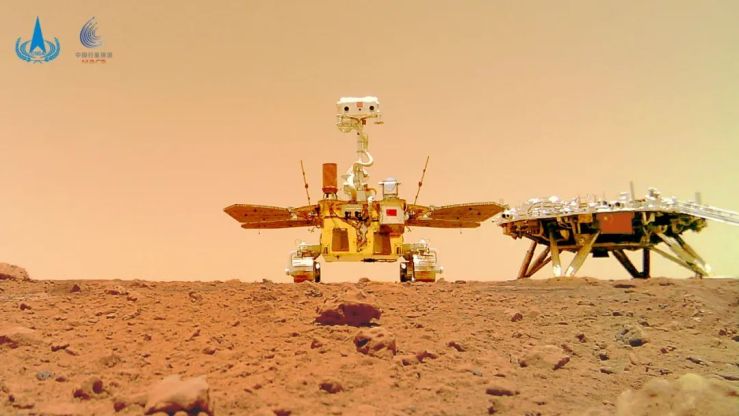
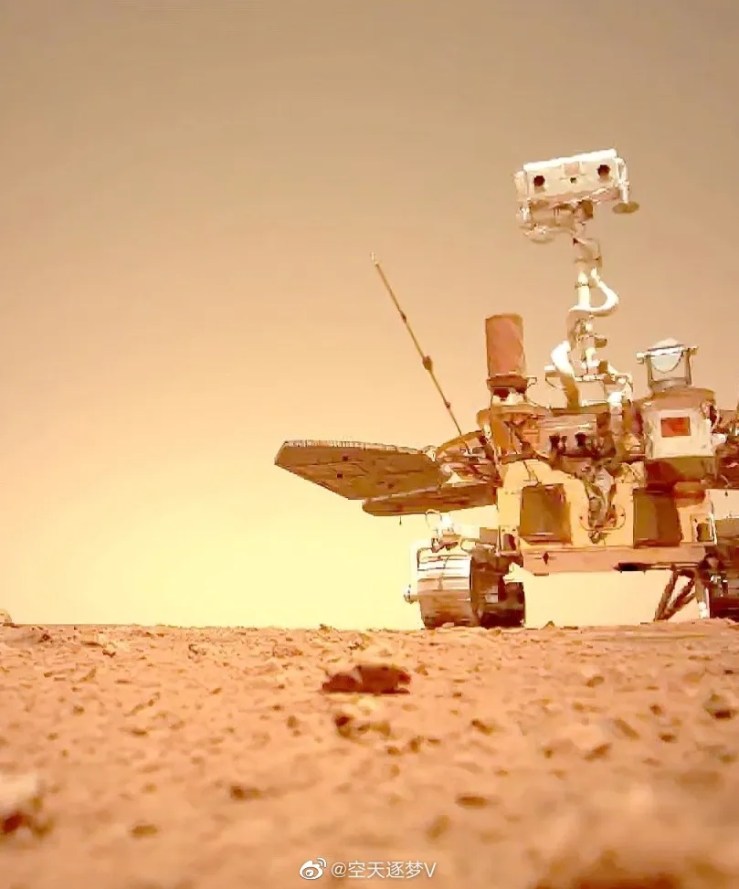
#CNSA #ChinaNationalSpaceAdministration #國家航天局 |#BeltAndRoadinitiative #December2021 |#火星 # 天問 #天问一号#TianwenOne #MarsMission #Marslander #MarsRover #Tianwen1 probe  #祝融号 #ZhuRong Tianwen1 # 張榮橋 #ZhangRongqiao, chief designer of China’s first Mars exploration mission, was selected as one of the ten greatest figures of the year in Nature….

On the months of December 2021  天问一号飞運騎遊達达3亿CNSA – China National Space Administration – ESA – European Space agency Belt and road initiative mars mission…first Mars exploration mission, Tianwen- Martian Probe One …….祝融号Zhu Rong”  Zhang Rongqiao, chief designer of China’s first Mars exploration mission, was selected as one of the ten greatest figures of the year in Nature

At 0:00 on December 16th 2021 Thursday, Hong Kong SAR- Beijing time, the international authoritative scientific magazine “Nature” published the top ten figures of 2021, and Zhang Rongqiao, the chief designer of my country’s first Mars exploration mission, was selected. On May 15, 2021, China’s Mars rover “Tianwen One” successfully landed on the pre-selected landing zone on the surface of Mars. China became the second country in the world to successfully land on Mars and deploy a Mars rover. After the “Zhurong” Mars rover sent back telemetry signals, the flight control center in Beijing lit up a festive red screen, and the engineer excitedly shouted “Hello, Mars!” Zhang Rongqiao took off his glasses silently at this time, tears in his eyes.

The character of the year in “Nature” describes Zhang Rongqiao as “Mars explorer”. Mars is a space nightmare for many countries. So far, the overall success rate is only about 50%, and the success rate for landing missions is only a little over 40%. China’s first Mars exploration mission completed the three major goals of Mars orbiting, landing and patrolling. It is even more difficult and risky. Behind the steadily accomplishing the three goals is the effort to “grind a sword in ten years.” “In order to win today’s first battle, we started planning 10 years ago. We have worked hard for 6 years, held at the launch site for 110 days, and held at the Beijing Aerospace Flight Control Center for 202 days. The first victory was to orbit Mars. After that, I held on for another 93 days to this day. What is the purpose? It is for today’s final victory!” Zhang Rongqiao said excitedly at the flight control center on May 15th.

At a press conference held by the National Space Administration in Beijing on June 12, Zhang Rongqiao said, “Achieving a circumnavigation in one step means that the development is more difficult. To put it more plainly, the possibility of failure increases. For our developers, we can bear it. Zhang Rongqiao said. Fortunately, there is the correct leadership of the Party Central Committee, and there are government organizations at all levels, especially the powerful organization of the National Space Administration, including the Aerospace Science and Technology Corporation, the Chinese Academy of Sciences, and the launch site and measurement and control The competent departments have vigorously coordinated, and the fire detection research and development personnel have worked hard and overcome difficulties. “To put it more bluntly, it is the fire-detector’s vigor. We succeeded today. Looking back, the choice of this technical route is very correct.” Zhang Rongqiao said that overall it is more cost-effective, especially in terms of technology. It can achieve leapfrog development and make my country enter the world’s advanced ranks in the field of planetary exploration in a relatively short period of time. “Therefore, we said that the first Mars exploration mission was based on China’s national conditions and embarked on a path of aerospace development with Chinese characteristics.”

In the future, China will implement deep space exploration missions such as Mars sampling and return missions, near-Earth asteroid sampling and return and main belt comet orbiting missions, Jupiter system orbiting and planetary crossing missions. “Looking up at the stars and keeping your feet on the ground” are two words that Zhang Rongqiao likes very much. He said: “This is precisely what society needs for each of us, and it is a way for us to settle down in society. We need to stand on the present and look to the future.” Zhang Rongqiao Said: “Our knowledge and understanding of the universe is still very superficial. We should see that the world beyond the cradle is infinitely vast. Innovation never ends.”

The Top Ten People of the Year in Nature are records of important scientific developments and events this year, as well as some of the key figures and their colleagues. The top ten figures were selected by the editors of Nature and gathered individuals who influenced some of the most important scientific events in 2021.

(The original website link https://www.nature.com/articles/d41586-021-03621-0)

#CNSA #ChinaNationalSpaceAdministration #国家航天局 |#BeltAndRoadinitiative #December2021| #CMS #ChinaMannedSpace the crew #Shenzhou13 #Takionauts #CSS #ChinaSpaceStation #TianheCoreModule…. #翟志剛 Commander #ZhaiZhigang Doing #HomeKeeping vacuuming Chores on the Command module..

中国空间站 On currently on December 2021, the Belt and Road Initiative CNSA –China National Space Administration  CSS China Space Station in which on a three to six months setting up a new home of the first three Shenzhou 13 in which spending up to on for the further construction and verifications of the systems of the CSS –China Space Station 2021 launch calendar in which currently the three Takionauts current Shenzhou 13 ……  Preparations for the six months of extension of the China Space Station  In which the currently it remains awaiting for the crew of setting up home in conducting fun scientifically onboard中国空间站..  China Space station …..

On this week after the Tiangong Classroom lesson from space orbiting from Space Teacher Wang Yaping this week of 15th December 2021 Shenzhou 13 Commander翟志剛  Zhai Zhigang does the house hold chores of cleaning in which he vacuums the ventilation system vents grids and cleans the China Space Station Complex . showing a great example teaching of a good  humble gentleman ….

Previously On 9th December 2021, the crew of the Shenzhou 13 conducting a Space Teaching from Space orbiting around the planet Earth towards the Students of China – People’s Republic of China on a live streaming broadcast on a multiple various media Platform in covering the Mainland, also two of its SAR- Special Administrative region of Hong Kong SAR and Macau SAR at 1540 Hours Hong Kong SAR –Beijing time The Chinese Space Station conducts space teaching. The China Central Radio and Television Station will conduct live broadcasts throughout the whole process.

Images and visuals are from their respectives.

#CNSA #ChinaNationalSpaceAdministration #国家航天局 |#BeltAndRoadinitiative #December2021 | #嫦娥五号The #Moon #Change5 probe its Heroic #LunarMission from #MonsRumker #LunaExploration #Review The third anniversary of the first anniversary of the Chang’e 5 mission series-space rods#ChangZheng5 …..

One year ago today 24th November 2020 Now it’s the 24th November 2021 , the Chang Zheng – Long March Five Carrier Rocket Launched away  in CNSA – China National Space Administration China Wenchang spaceport launch, Change Five  Lunar probe into orbit, opened up towards China – People’s Republic of China’s first celestial bodies sample return trip from Mons Rumker on the Lunar Surface.……  

​​At 23:10 on December 3, 2020, the Chang’e-5 ascender carried a lunar sample to take off from the lunar surface. About 6 minutes later, it entered an elliptical orbit around the moon. At 2:13 on December 6, the ascender accurately reached the scheduled “handover” position 50 kilometers in front of the orbit-return assembly and about 10 kilometers above it. At 5:42, the ascender and the orbit-returning assembly completed the rendezvous and docking. At 6 o’clock, the sample packaging container was transferred from the ascender to the returner. This process of autonomous rendezvous and docking and sample transfer is like the handover process in a 100-meter relay race. It is brilliant and highly technical. Using a lunar orbital rendezvous and docking after take-off from the lunar surface, rather than a direct lunar-to-ground transfer after taking off from the lunar surface, this design is conducive to collecting and carrying more samples back to the earth, and for technical accumulation and verification for subsequent missions.

Aspect 1-chase in space

Both the ascender and the orbit-back assembly fly around the moon, but the orbital heights are different. The ascender runs on the outer track at a height of 210 kilometers, and the orbit-back assembly runs on the inner track at a height of 200 kilometers. The distance on the inner track is short, the track-back assembly runs slightly faster, and the ascender on the outer track runs slower. In order to realize the “transfer bar”, the rail-back assembly needs to raise the rail in the height direction and gradually approach the ascender in the front and rear direction. When approaching a certain distance, the orbit-back assembly will autonomously control the engine to change the direction of travel and take a shortcut to catch up with the ascender. During the entire chase process, multiple anchor points are set up, and the orbit-return assembly stops to keep the relative position unchanged, conducts a state inspection, and ensures that the measurement and control conditions meet the requirements during docking.

Picture: Lunar orbital rendezvous and docking flight phase division. (Source: Xu Yang, Ma Lin, Liu Tao, etc. Chang’e 5 Lunar Orbital Rendezvous and Docking Guidance, Navigation and Control System. Science in China: Technological Sciences, 2021, 51: 788–798)

 Aspect 2-“High-precision measurement” + “Know yourself and the enemy”

During the rendezvous and docking process, it is necessary to make the orbit-return assembly and the ascender know the relative position, speed and attitude of each other. For this reason, a variety of sensors for relative measurement are configured to realize relative navigation. When the distance is 100 kilometers, the microwave radar starts to work. It not only provides the relative motion parameters of the two devices according to the traditional radar “call and answer” mode, but also upgrades to the “dialogue exchange” mode, between the orbital assembly and the ascender. Two-way transmission of remote control commands and telemetry parameters. At a distance of 20 kilometers, lidar “comes on the scene” to provide higher-precision measurement information. At about 100 meters, the optical sensor began to show its talents to achieve close distance and attitude measurement. These sensors are relayed to each other over the working distance and covered and connected, so as to ensure that there are at least two different systems of sensors available at any distance, so that the orbit-back assembly can be seen more accurately, the measurement is more precise, and the system is more reliable. 

Aspect 3-precise “handover baton” from 380,000 kilometers away

The weight of the orbit-return assembly is more than 2 tons, but the mass of the ascender is only one-sixth of its mass. If the traditional collision docking is used, it is very easy to cause the ascender to be knocked into flight. For this reason, a claw-type catching and docking mechanism is specially designed. Each pair of claws is like two arms, which are quickly closed within 1 second to form a closed space, and the passive lock handle of the ascender is firmly restrained inside. Can’t escape. It has to be accurate, and the accuracy requirement after docking is better than 0.5 mm, which is like “threading a needle” in space. The use of 3 sets of claw mechanism star-shaped circumferential layout and self-centering design realizes the automatic centering of the two aircraft after docking, and realizes the lightweight design while ensuring high-precision docking.

The design of the transfer mechanism is also very clever. In order to realize the transfer of long-stroke sample containers of more than six hundred millimeters, the designers found inspiration from the inchworm. Based on the principle of movement stroke amplification + relay transfer, they proposed a relay mechanism for imitating the inchworm. The simple circular expansion and contraction movement of the parallel link can realize the continuous movement of the object. The entire transfer process is like the movement of a caterpillar, stretching and shrinking, continuously advancing.

​​2020年12月3日23时10分,嫦娥五号上升器携带月球样品从月面点火起飞,约6分钟后,进入环月椭圆轨道。12月6日2时13分,上升器准确到达轨返组合体前方50公里、上方约10公里的预定“交班”位置。5时42分,上升器与轨返对合体完成交会对接,6时,样品封装容器从上升器转移到返回器中。这个自主交会对接和样品转移过程就好像百米接力赛中的交接棒过程,精彩纷呈,技术含量极高。采用从月面起飞后进行一次月球轨道交会对接,而不是从月面起飞后直接月地转移,这样的设计有利于采集和携带更多样品返回地球,并为后续任务进行技术积累和验证。

看点1——太空中的追逐

上升器和轨返组合体都在环月飞行,但轨道高度不同,上升器在210公里高的外道跑,轨返组合体在200公里高的内道跑。内道路程短,轨返组合体跑得稍快一些,外道的上升器则跑得要慢一点。为了实现“交接棒”,轨返组合体需要在高度方向上抬高轨道,并且在前后方向上逐渐逼近上升器。当接近到一定距离时,轨返组合体会自主控制发动机来改变行进方向,抄近道赶上上升器。整个追逐过程设置多个停泊点,轨返组合体停下来保持相对位置不变,进行状态检查,并确保对接的时候测控条件满足要求。

 看点2——“高精测量”+“知己知彼”

在交会对接过程中,需要让轨返组合体和上升器清楚彼此的相对位置、速度和姿态,为此配置了多种进行相对测量的敏感器,用来实现相对导航。在相距100公里的时候,微波雷达开始工作,既按照传统雷达的“点名答到”模式提供两器的相对运动参数,还升级到“对话交流”模式,在轨返组合体和上升器之间双向传输遥控指令和遥测参数。在相距20公里的时候,激光雷达“登场”,提供更高精度的测量信息。而到了100米左右,光学敏感器开始大显身手,实现近距离的距离和姿态测量。这些敏感器在作用距离上彼此接力又有覆盖衔接,从而确保在任意距离上至少有两种不同体制的敏感器可用,使得轨返组合体看得更准,测得更精,系统更加可靠。 

看点3——38万公里之外的精准“交接棒”

轨返组合体重达2吨多,上升器质量却只有它的六分之一,如果采用传统的碰撞式对接,极易导致上升器被撞飞。为此,专门设计了抱爪式抓捕对接机构,每对抱爪犹如两只手臂,在1秒内快速合拢形成闭合空间,将位于上升器的被动锁柄牢牢地约束在内部,再也无法逃脱。对得上还得对得准,对接后的精度要求优于0.5毫米,好比在太空“穿针引线”。采用3套抱爪机构星型周向布局、自定心设计,实现了两飞行器对接后的自动对准中心,在保证高精度对接的同时实现了轻量化设计。

转移机构的设计也很巧妙。为了实现六百多毫米的长行程样品容器转移,设计师们从尺蠖的身上找到了灵感,基于运动行程放大+接力转移的原理,提出了一种仿尺蠖大展收接力式机构,通过多级并联连杆的简单循环展收运动,就可以实现物体的连续移动。整个转移过程如同毛毛虫的运动,一伸一缩、不断前进。

作者:王琼  胡震宇 于丹 戚铁磊​​​​

Images and visuals are from Weibo and their respectives…. Of CNSA China National Space Administration … 

#CNSA #ChinaNationalSpaceAdministration #国家航天局 |#BeltAndRoadinitiative #December2021| #CMS #ChinaMannedSpace The crew of #Shenzhou12 of The International Iconic #CSS #ChinaSpaceStation #TianheCoreModule holds a #Beijing Press Conference with Stunning #EarthPhotography.

中国空间站On 17th Friday September, 2021, at Hong Kong SAR – Beijing Time  morning, the Belt and Road Initiative CNSA –China National Space Administration  CSS China Space Station in which on a three month setting up a new home of the first three Shenzhou 12 crew Takionauts –Chinese Astronauts Nie Haisheng – Liu Boming – Tang Hongbo returned home from their second home landing on safely at Dongfeng Aerospace City district in which landing at Inner Mongolia Region of China – People’s Republic of China…..  

Shenzhou 12 Commander Nie Haisheng captured Hainan Island from the space station!

On 7th December 2021 returning from physically readapting back to Earth’s Environmental condition of the Crew of Shenzhou 12 in which from the standard two weeks quarantine after a three month stay on setting up the CSS –China Space Station. In which on the afternoon the Shenzhou 12 Takionaut crew met with reporters. According to reports, their muscle strength, endurance, and exercise cardiorespiratory function reserves have been further restored. How do I practice when I come back from space? In which exercising Look at the fitness screen Treadmill, abdominal muscle wheel, plank…These items, they are all good at it… during the conference they releasing more stunning Earth  Photography of their time on the China Space Station , in which was taken through the Bedroom cabins windows portals  of the Tianhe Core Module …..

During the Conference of Shenzhou 12 astronauts have completed recuperation and restored their weight to stabilize at the pre-flight level] On the afternoon of December 7, 2021, the China Astronaut Research and Training Center held a meeting with reporters for the Shenzhou 12 astronaut crew in Beijing Aerospace City.


This is the first official meeting with the media and the public after the Shenzhou 12 crew returned.
At the meeting, Jing Haipeng, captain of the astronaut brigade, introduced the recovery situation and subsequent plans after the crew returned. According to him, the recovery period after the crew flight returns normally is divided into three phases: isolation recovery phase, recuperation recovery phase, and recovery observation phase. Up to now, the crew has completed the second phase of work. On the whole, the astronauts are emotionally stable and mentally in good condition, their weight stabilized at the pre-flight level, muscle strength, endurance, and exercise cardiopulmonary function reserves have been further restored, achieving the expected results. Next, it has been fully transferred to the recovery observation stage. After completing the mission and returning to the health assessment summary, the three astronauts will be transferred to normal training. At the meeting, the crew answered reporters’ questions about the situation of staying on the space station and after returning

Images and visuals are from Weibo also their respectives.