中国空间站 On currently on December 2021, the Belt and Road InitiativeCNSA –China National Space Administration CSS China Space Station in which on a three to six months setting up a new home of the first three Shenzhou 13 in which spending up to on for the further construction and verifications of the systems of the CSS –China Space Station 2021 launch calendar in which currently the three Takionauts current Shenzhou 13 …… Preparations for the six months of extension of the China Space Station In which the currently it remains awaiting for the crew of setting up home in conducting fun scientifically onboard中国空间站.. China Space station …..
During the week of 6th January 2022 on the previous week Celebrating on New Year’s Day 2022 is the second Space Classroom for broadcasting national wide on China- People’s Republic of China is the “New Year’s Day Beijing-Hong Kong-Macao Tiangong Dialogue” event….
The Shenzhou 13 Takionauts will spend the New Year’s Day in orbit, ushering in 2022. Wang Yaping was in charge of the check, Ye Guangfu expertly gave Zhai Zhigang a haircut, watched art gallery exhibitions on the space station in which children of China from all walks of life contributed to a selection of art gallery that was featured on the New Year’s 2022 Tiangong Dialogue, and took difficult group photos selfies in space……..What kind of new outlook do the Takionauts have in the new year in which more to come….. ?
中国空间站 On currently on 24th to 26th December 2021 Christmas eve, CNSA –China National Space Administrationin collaboration with CCTV9 China Central Radio and Television will telecast “Our Journey” is the first panoramic documentary produced by China National Space Administration and China Central Radio and Television in 4 years to show the complete course of China’s lunar exploration project in 17 years . It is a documentary. Documentary works with international vision, international expression, and international standards are excellent works that tell Chinese stories, spread space culture, and popularize space knowledge
The documentary consists of three episodes, each of 50 minutes, which truly presents the development of China’s lunar exploration project over the past 17 years, which has been through ups and downs, and left a tortuous but full history. This imprint records not only a huge and complicated super project, but also a testimony to the rapid growth of China’s aerospace industry and the common progress of the Chinese nation. The film fully and vividly interprets the spirit of lunar exploration of “chasing dreams, exploring courageously, coordinating fortifications, and win-win cooperation” , promotes the spiritual pedigree of the Chinese Communists , and conveys the spiritual power that China’s scientific and technological development and progress rely on.
Through character interviews, important development scenarios, and the combined application of various methods such as related materials, the film outlines the continuous and staggered cooperation and support between the various development units of the major systems, and demonstrates the Chinese people’s fearlessness in scientific exploration. Pursuit, as well as the admirable courage and wisdom devoted to this journey full of risks and challenges.
“Our journey” documentary will be held December 24 – the 26th in the Central Radio and Television CCTV-9 record channel 20:00 prime time heavy launch a new media center video, CCTV and other platforms will also be broadcast simultaneously.
One year ago today 24th November 2020 Now it’s the 24th November 2021 , the Chang Zheng – Long March Five Carrier Rocket Launched away in CNSA – China National Space Administration China Wenchang spaceport launch, Change Five Lunar probe into orbit, opened up towards China – People’s Republic of China’s first celestial bodies sample return trip from Mons Rumker on the Lunar Surface.……
Highlight 1: Narrow window launch The launch window is the ignition time period for the launch vehicle to meet the needs of the transfer to the moon. Due to the typhoon and strong tropical cyclone in Wenchang area, high-altitude wind, heavy rainfall, thunderstorms and other meteorological conditions are very complicated, it can be imagined. The narrower the window, the greater the risk of launching large cryogenic launch vehicles. There are many factors that determine the launch window, such as the relative position of the launch site and the target point, the safe landing zone of the rocket wreckage, the time of sunlight after the launch probe (satellite) enters orbit, the measurement and control arc, the lunar landing zone, and the lunar take-off time , Re-entry return time, etc. The more the launch constraint conditions, the narrower the launch window. In order to ensure the reliable implementation of the Chang’e-5 mission, it is necessary to solve the design difficulties of the multi-orbit moon launch scheme under the constraints of the range of launch, the safety of the landing zone, the measurement and control of the ascent section, and the rocket taxi time.
Aspect 2: During the two-stage taxiing process of the accurate low-temperature launch vehicle in the landing zone of the rocket, the quality of the propellant will decline with the passage of time, so the longer the taxiing time, the more unfavourable the startup of the low-temperature power system. For this reason, the rocket system has carried out a large number of ground tests, and the three flights of the Long March 5 have fully evaluated and verified the long sliding ability of the model. The rocket area of the Chang’e-5 mission must fly over the Philippine Islands. The booster landing area is located west of the Philippines, the fairing landing area is located east of the Philippines, and the core landing area is located in the Pacific Ocean. Multi-ballistic launching has caused significant horizontal and vertical dispersion in the sub-level wreckage landing area. Therefore, if the mission permits, the range of the shooting direction and dispersion must be minimized to optimize the safety of the landing area. The scientific research team carried out multiple rounds of optimization design for the horizontal and vertical dispersion of the multi-ballistic trajectory to the moon with variable firing direction and variable glide time. In the end, the rocket wreckage landed exactly in the intended sea area. Aspect 3: Multi-trajectory, “moving target shooting”
A key technology in the launch phase of the Chang’e-5 mission is multi-ballistic launch, that is, within 3 consecutive days, there are 5 nominal trajectories with 10 minute intervals between take-offs every day, evenly covering the 50-minute launch window. The purpose of multiple ballistics is to achieve “mobile shooting” with different take-off points and the same destination during the relative movement of the earth and the moon. As long as the launch vehicle ignites within the launch window and sends the probe into a predetermined Earth-Moon transfer orbit, the probe can fly to the near-moon point at exactly the same time, altitude, incident angle, illumination, and measurement and control conditions. Through the detailed orbit design, the outstanding performance of the launch vehicle systems, and the concerted cooperation of various departments, the Chang’e-5 probe was sent into the scheduled orbit with very high accuracy, laying a solid foundation for the subsequent flight missions.
Aspect 3: Multi-trajectory, “moving target shooting” A key technology in the launch phase of the Chang’e-5 mission is multi-ballistic launch, that is, within 3 consecutive days, there are 5 nominal trajectories with 10 minute intervals between take-offs every day, evenly covering the 50-minute launch window. The purpose of multiple ballistics is to achieve “mobile shooting” with different take-off points and the same destination during the relative movement of the earth and the moon. As long as the launch vehicle ignites within the launch window and sends the probe into a predetermined Earth-Moon transfer orbit, the probe can fly to the near-moon point at exactly the same time, altitude, incident angle, illumination, and measurement and control conditions. Through the detailed orbit design, the outstanding performance of the launch vehicle systems, and the concerted cooperation of various departments, the Chang’e-5 probe was sent into the scheduled orbit with very high accuracy, laying a solid foundation for the subsequent flight missions.
Images and visuals are from Weibo and their respectives…. Of CNSA China National Space Administration …
中国空间站 Today On 13th November 2021 in which during On 9th September, 2021, at Hong Kong SAR – Beijing Time morning, the Belt and Road InitiativeCNSA –China National Space Administration CSS China Space Station in which on a three month setting up a new home of the first three Shenzhou 12 crew Takionauts –Chinese Astronauts Nie Haisheng – Liu Boming – Tang Hongbo … in which on that Thursday Official release! The Stunning photography works taken by the Shenzhou 12 Takionauts in orbit are stunning timeless in incredible stunning photography detail through the China – The China Manned Space Engineering Office officially released the Shenzhou 12 manned mission 3 Takionauts in orbit photography shot 从空间看地球 high-definition pictures….. The Shenzhou 12 astronaut crew take you to appreciate the shocking beauty of the earth from the first perspective of the Takionauts though their time during the three months in Earth’s orbit in which last week of November 2021 all three of Shenzhou 12 crew are doing fine as their recovery into readaptivness of Earth’s environment also out from quarantine are back to work and with their families.
During that time of Shenzhou 12 crew Commander Nie Haisheng photography shot through the day and the core pillars cabin portholes Chinese section of the space station robotic arm large video.. Many have wondering where was his bedroom in which where was his Space Station porthole window of The case is solved…! It was taken by Nie Haisheng! : And it should be taken through the portholes of the large column of the core cabin. Compared with the portholes in the sleeping area, its angle of view is more suitable for space station photography! He used a special camera to shoot outside through the porthole; the effect is different from the surveillance camera in which gives a different perspectives on resolution and definition..
Looking through the large column portholes when Tianhe Robotic Arm ……Shenzhou 12 enters the Tiangong space station, there are more three portholes in the living area of the small column section of the Tianhe core cabin, and these three portholes are only facing the second and fourth quadrants. Quadrant, the viewing field is limited.
Indeed, the Tianhe core cabin is equipped with multiple panoramic outside high-definition cameras, plus the wrist binocular camera of the Tianhe robotic arm, which can achieve all-round imaging without blind spots.
However, relying solely on electronic equipment is not a fool proof option, and visual portholes have the advantage of reliability.
For example, the three portholes in the residential area can directly visually observe the outer surfaces of the Wentian experimental cabin and the Mengtian experimental cabin in the future.
In fact, in addition to the portholes in the residential area, there is also a porthole at the second quadrant of the front cone of the large column section. There is a robotic arm adapter near the porthole, and the Tianhe robotic arm is parked here.
On the one hand, the porthole can directly observe the sky and the robotic arm, and it can also visually observe the radially docked Shenzhou spacecraft. After the Tiangong space station enters the operational phase, it can also record the radial docking of the Shenzhou spacecraft in high definition from here.
Images and visuals are from Weibo also their respectives.
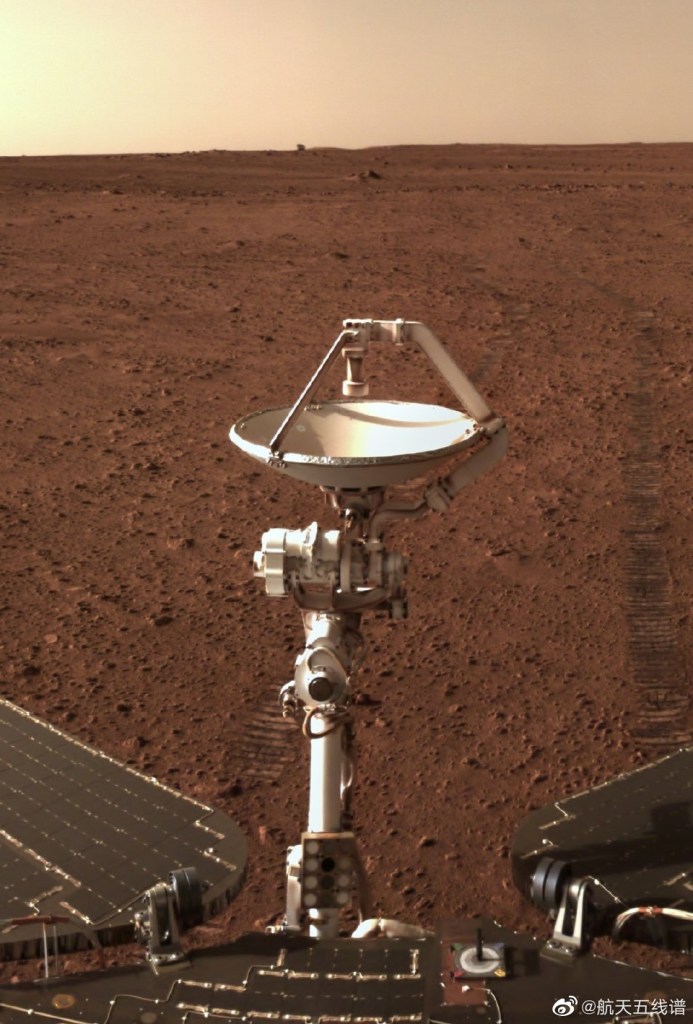
On the 8TH November 2021 Friday 天问一号飞運騎遊達达3亿CNSA – China National Space Administration – ESA – European Space agency Belt and road initiative mars mission…first Mars exploration mission, Tianwen- Martian Probe One …….祝融号Zhu Rong” also have been exploration Roamingly1,253 meterson the Rustic half diameter planet size Red planet Mars… During that time Tianwen-1 orbiter enters remote sensing mission orbit…
November 8, 2021, “Heaven” successfully implemented around the fifth brake near the fire, into the exact orbit remote sensing mission, the Mars Global to carry out remote sensing. In the early stage, the “Zhurong” Mars rover has successfully completed the established inspection mission objectives, and is in good condition, and continues to carry out the detection mission. Considering the global remote sensing detection of the orbiter and the relay communication requirements of the Mars rover, the engineering development team optimized the orbit design and determined a remote sensing orbit plan with a near fire point of about 265 kilometers, a far fire point of about 10,700 kilometers, and a period of about 7.08 hours. While ensuring the development of orbiting scientific exploration, it will provide more relay communication support for the Mars rover to improve the efficiency of mission development.
n the remote sensing orbit, seven scientific payloads including mid-resolution cameras, high-resolution cameras, subsurface detection radars, mineral spectrum analyzers, magnetometers, ion and neutral particle analyzers, and energy particle analyzers will be acquired Scientific data such as fire star morphology and geological structure, surface material composition and soil type distribution, atmospheric ionosphere, Martian space environment, etc., focusing on typical landforms and geological units such as craters, volcanoes, canyons, and dry river beds, and implement high-resolution detection.
Up to now, the orbiter has been in orbit for 473 days, the ground fire distance is 384 million kilometers, and the light travel time is 21 minutes and 20 seconds; the rover has worked on the surface of Mars for 174 Mars days and travelled 1,253 meters in total. The two devices are in good condition. The working condition is normal.