At 1250 past midday Hours Hong Kong Beijing Time on a very cloudy 10th August 2022 , China- People’s Republic of China- CNSA –China National Space Administration Successfully launched the New Next Generation Long March – Chang Zheng 6 Y10 carrier rocket at the Taiyuan Satellite Launch Center Shanxi Province ……the Chang Zheng-Long March 6 Y10 carrier rocket was ignited at the Taiyuan Satellite Launch Center, and then successfully sending the sixteen satellites to there predetermined orbits..
The Chang Zheng –Long March 6 Y10 Carrier Rocket sending the sixteen satellites, in which under the skirt of the flaring is satellite groupings including Jilin-1 Gaofen 03D09 and Yunyao 1 04-08 The satellites are mainly used in commercial remote sensing, atmospheric imaging and other fields deployment at Synchronous orbit, the launch mission was a complete successfully The sixteen satellites launched this time are provided by the aerospace science and technology group Great Wall Company as the general contractor to provide launch services, and the 16 satellites are all developed by Changguang Satellite Technology Co., Ltd. …
The Carrier Rocket Chang Zheng –Long March 6 Y10 Carrier Rocket was developed by China Aerospace Science and Technology Corporation Eighth Academy, and is a new generation of non-toxic and non-polluting liquid carrier rockets in China, People’s Republic of China.
The sixteen satellites launched this time are provided by the aerospace science and technology group Great Wall Company as the general contractor to provide launch services. The 10 Jilin-1 Gaofen-03D satellites are mainly used to obtain high-resolution optical remote sensing images, and the 6 Yunyao satellites are mainly used to image the atmosphere. This is the 432nd launch of the Long March series of launch vehicles.
Jilin also the Gaofen series constellation satellites. They are optical remote sensing technology satellites funded and developed by Changguang Satellite Technology Co., Ltd. They are mainly used to obtain high-resolution visible light push-broom images and video images. After the five satellites are networked with the in-orbit Jilin-1 satellite, they will provide users in industries such as forestry, agriculture, grassland, ocean, resources, environment, and urban construction with more abundant remote sensing data and product services.
The Gaofen series Remote Sensing Earth Sciences Satellite manufacturer is CAST – China Academy of Space Technology also in collaboration with its associate agency with CHEOS- China High Resolution Earth Observation System in which is design Built on a CAST 2000 Design Heritage Earth Sciences, in which is design for Translating Gaofen is High Resolution, also known as CHEOS- China High Resolution Earth Observation System, in which provisions in the real time observational data analysis of with high resolution multi spectra equipment imaging system in analysis for assessing environmental disaster warning, emergency response also for the protection for ecological, also providing support for infrastructure construction, transportation for various purpose of the Belt And Road initiative … one of many specifications of the Gaofen 10 Earth Sciences satellite is The high-resolution satellite is a large-scale remote sensing satellite system for the national science and technology major special arrangement of the microwave remote sensing satellite, the ground pixel resolution is up to sub-meter …
Images and visuals are from Weibo also their respectives..
On Hainan Province –China –People’s Republic of China…. in the district area of the Wenchang – Wenchang Spacecraft launch center in which the awesome team at one of many CNSA –China National Space Administration that China National Space Administration…………… On 24th July 2022
After Wentian experimental module entered orbit, the status setting was successfully completed. At 3:13 on July 25, 2022, Beijing time, it was successfully connected to the forward port of 天和 Tianhe Core Module. The entire rendezvous and docking process lasted about 13 hours. . This is the first time that two 20-ton spacecraft in my country- China- People’s Republic of China have achieved rendezvous and docking in orbit. …According to the mission plan, the Shenzhou 14 Takionaut crew will then enter the Wentian experimental module….. In which finally docked in early morning time of the 25th July 2022 in with CNSA –Beijing Aerospace City in which co-ordinated the docking maneuverers have achieved rendezvous and docking in orbit.… in which the crew of the Shenzhou 14 staying for six months in construction of the stage one of the China Space station with the additional Mengtian experimental module in which will be delivered on the October 2022 Launch Schedule calendar..
There are many experiments in the sky cabin, and space science is on a higher level…
On July 24, the high-profile Wentian experimental module was launched into space by the Long March 5B carrier rocket, and successfully rendezvoused with the space station Tianhe core module. It is understood that the Wentian experimental cabin carries 8 experimental cabinets, and its main tasks are life science and biotechnology research. What exactly are these scientific studies? Why work on the space station? Recently, a reporter from China Aerospace News visited relevant experts from the Chinese Academy of Sciences, who answered these questions.
Life Ecological Experiment Cabinet
Biomedicine welcomes opportunities
“The Wentian Experiment Module has planned and deployed more than 10 research themes in four fields, including space life science and biotechnology, microgravity fluid physics, space material science, and space application new technology experiments. Currently, more than 40 scientific projects have been established. The space station After completion, relevant scientific projects will be continuously demonstrated and implemented rollingly.” Lu Congmin, a researcher at the Space Application Center of the Chinese Academy of Sciences and deputy chief of the space application system for manned space engineering, introduced.
In order to ensure the smooth development of the above-mentioned scientific tasks and the continuous production of scientific achievements, the space application system has deployed biological ecological experimental cabinets, biotechnology experimental cabinets, scientific glove boxes and low-temperature storage cabinets, and variable gravity scientific experimental cabinets in the Wentian experimental cabin. The experimental facility is equipped with shared support equipment for application tasks inside and outside the cabin, and jointly supports the implementation of the entire mission chain of scientific projects in orbit.
Among them, the life ecology experiment cabinet uses various types of biological individuals (such as plant seeds, seedlings, plants, and small animals) as experimental samples to carry out spatial growth experiments of animals and plants such as Arabidopsis thaliana, nematodes, fruit flies, and zebrafish. Attempts to reveal the influence of microgravity on the growth, development and metabolism of individual organisms, promote human understanding of the nature of life phenomena, study the effects and mechanisms of space radiation biology and submagnetic biology, and explore the establishment of an applied controlled life ecosystem. Provide scientific basis for astronaut on-orbit radiation damage assessment and protection.
Biotechnology Experiment Cabinet
Biotechnology experiment cabinet takes tissue, cells and biochemical molecules and other different levels and types of biological samples as research objects, and carries out experiments such as cell tissue culture, space protein crystallization and analysis, protein and nucleic acid co-origin, space biomechanics, etc., to explore microgravity The law and mechanism of cell growth and differentiation in the environment may provide a theoretical basis for human health, reproduction and development; explore the impact of gravity on the origin and evolution of life; strive for high-efficiency protein/peptide drugs, nanocrystalline bone biotechnology, etc. The breakthrough discovery is expected to play an important role in guiding the research and application of tissue engineering and biomedicine.
Scientific Glove Boxes and Cryogenic Storage Cabinets
The scientific glove box provides clean and confined space and environmental control of temperature and humidity. It is equipped with a dexterous robotic arm and has the ability to operate at the cell level. The glove box provides safe and efficient support for astronauts to operate multidisciplinary experimental samples. The low-temperature storage device has three typical low-temperature storage temperature zones (minus 80 degrees Celsius, minus 20 degrees Celsius, and 4 degrees Celsius), which can meet the low-temperature storage requirements of different experimental samples.
The variable gravity scientific experiment cabinet provides 0.01~2g high-precision simulated gravity environment for scientific experiments. It adopts advanced wireless energy transmission and carrier communication technology to support the development of complex fluid physics under different gravity levels such as microgravity, simulated lunar gravity, and simulated Mars gravity. , the movement of particulate matter and other scientific research.
Variable Gravity Science Experiment Cabinet Opened
Lv Congmin introduced that energy particle detectors and plasma in-situ imaging detectors are also deployed outside the Wentian experimental cabin to obtain data on environmental elements such as protons, electrons, neutrons, heavy ions and plasma in space, so as to protect the health of astronauts , to provide guarantee support for the safe operation of the space station, and can also be used for basic research on the space environment.
Special environment hardware is available
The completed China Space Station, as a national space laboratory, will support long-term, multi-field, large-scale space science and application research. Zhang Wei, a researcher at the Space Application Center of the Chinese Academy of Sciences and director of the Application Development Center, summarized the advantages of the Chinese space station from four aspects.
First, the Chinese space station can provide long-term microgravity, radiation and other special research environments. Zhang Wei said that on the earth, life and matter are affected by gravity, and some essential laws will be covered up, and under the condition of microgravity, scientists hope to discover the essential laws of these substances. Not only that, but there are some physical effects in microgravity. “The first is that buoyant convection is greatly reduced; the second is that precipitation and stratification have basically disappeared; the third is that the pressure gradient is greatly reduced.” Zhang Wei said.
Second, the Chinese space station has astronauts involved, which is convenient for experimental operations, experimental module replacement, and maintenance.
Third, the Chinese space station can carry out round-trip transportation between the sky and the earth, and can realize the replacement of experimental modules and the return of experimental samples. After carrying out scientific experiments on life and materials in orbit, it is necessary to bring the samples back to the ground for further research.
Fourth, at the specific orbital altitude of the Chinese space station, it is convenient to conduct astronomy, earth observation and space physics research. In this regard, Zhang Wei gave an example of astronomical observation: due to atmospheric absorption and interference, gamma rays, X-rays, ultraviolet rays, and infrared rays in the universe cannot be effectively observed on the ground. device into space.
It is worth mentioning that after the construction of the Chinese space station is completed, it will operate in orbit for more than 10 years. In addition to the advanced scientific experimental cabinets that have been developed, the space station’s external exposure experimental devices and the future launch of the Sky Survey Optical Module will also bring opportunities for more scientific experiments.
中国空间站 On currently on 29th July 2022 2022, the Belt and Road Initiative CNSA –China National Space Administration on the currently developments of the latest progress of China’s Chang Zheng – LongMarch manned lunar landing carrier rockets Science and Technology Daily reporters learned from the First Academy of China Aerospace Science and Technology Corporationon July 28 2022 that the 702 Institute of the Academy recently successfully completed the multi-machine parallel static-motion joint test of my country’s new generation of manned launch vehicles. It strongly supported the smooth transition of the development of this type of rocket to the initial stage.
China- People’s Republic of China’s moon landing rocket has completed the multi-engine parallel static and dynamic test and began to manufacture, and the first flight may not be far away
China’s new generation of manned rockets has made important progress! According to news from the First Academy of China Aerospace Science and Technology Corporation published by the “Science and Technology Daily” and other media on July 28th 2022, the 702 institutes affiliated to the academy have recently successfully completed the multi-machine parallel static-motion joint test of my country’s new generation of manned launch vehicles. The first step of this type of rocket will be transferred to the initial sample development stage.
At present, my country’s only manned rocket is the Long March 2F rocket, which is especially responsible for transporting China- People’s Republic of China’s Shenzhou spacecraft and Takionauts to the sky. My country’s new generation of manned rockets is a rocket with larger and more advanced capacity. It is also the “921 rocket” that netizens have often said over the years. In fact, its real code name is “CZ-5DF”, which means Chang Zheng- Long March 5. The series of lunar rockets are exactly the rockets prepared for my country’s manned lunar landing.
According to the published data, this rocket is about 100 meters high. After successful development, it will be the highest rocket before the appearance of the Long March 9. It is about the height of a 33-story building, which should be higher than the building you live in. Well, isn’t it shocking?
And it will also be the largest rocket before the appearance of the Long March 9 carrier rocket, with a diameter of 5 meters, the same as the Long March 5, but its shape is very different from the Long March 5, because it adopts the CBC configuration, but It is not a “triple version of Chang 5”, it is not the configuration of the three core-stage rockets of the current Long March 5, because it is not composed of three core-stage rockets of the Long March 5. There are only two YF-77 liquid hydrogen-oxygen engines with a thrust of only 100 tons. The thrust of the Fat Five mainly relies on four bundled boosters. Each booster is equipped with two YF-100 engines with a thrust of 240 tons. , the thrust of the four boosters reached 960 tons, which together contributed to the 1060-ton thrust of the Long March-5 first-stage rocket.
The new generation of manned rockets with This type of rocket weighs about 2,200 tons and is a three-stage and a half configuration. The capacity of the Earth-Moon transfer orbit will not be less than 27 tons, which can meet the capacity requirements for launching China’s new generation of manned spacecraft (within 25 tons in weight). It can also meet the upward mission of large spacecraft in low-Earth orbit, because the orbital carrying capacity of low-Earth orbit will reach more than 70 tons.
Take China’s space station as an example. After the Wentian experimental module was docked, the total weight of China’s space station assembly has now reached 66 tons, and China’s new generation of manned rockets can be sent into orbit with one launch mission. Zhu Xiquan, deputy chief designer of the 702 Institute, said: The successful completion of the parallel static-dynamic joint test of my country’s new generation of manned rockets marks the first time that my country has broken through the large-load static-dynamic joint test technology of launch vehicles. The test with the largest scale, the most technical difficulty and the most complex test process has laid a solid foundation for the new generation of manned launch vehicles to adopt the parallel technology of multiple high-thrust engines.
According to the plan, this rocket will be the main launch vehicle for manned moon landing missions in China in the next 20 to 30 years, so it can also be called China’s first-generation “moon landing rocket”. It is significant, marking that China’s manned lunar landing rocket has entered a substantial manufacturing moment. After the manufacturing is completed, it will be a test flight. It was previously reported that the first flight will be completed before 2025. It can be seen that the first flight is not far away! Moreover, this type of rocket will also expand the recovery and reuse capabilities of the take-off stage in the future, that is, to create a reusable rocket like Musk’s Falcon rocket, which can also greatly reduce the launch cost.
References :”Science and Technology Daily” July 28 article “China’s new generation of manned rockets has made important progress “
中国空间站 On currently on 29th July 2022 2022, the Belt and Road Initiative CNSA –China National Space Administration on the currently developments of the latest progress of China’s Chang Zheng – LongMarch manned lunar landing carrier rockets Science and Technology Daily reporters learned from the First Academy of China Aerospace Science and Technology Corporationon July 28 2022 that the 702 Institute of the Academy recently successfully completed the multi-machine parallel static-motion joint test of my country’s new generation of manned launch vehicles. It strongly supported the smooth transition of the development of this type of rocket to the initial stage.
The key point is in picture 1 also pictured on the header. The pull rods carrying 350 tons and the thrust of 2800 tons are installed in the 8 columns. Obviously, this test is the core stage (refer to Figure 2), and the thrust of the entire rocket (including the two boosters) is to transmit from this.
This is the new ultra heavy large Chang Zheng –Long March domestically made Carrier rocket that I am most looking forward to, and it is the key model for realizing the dream of manned lunar moon landing…..
This test is an important test to verify the key technologies of multi-machine parallel connection and bottom-box force transmission of a new generation of manned launch vehicles. Wang Xiaohui, director of the 702 Institute, said that the successful completion of the test marks the first time that my country has broken through the large-load static-dynamic joint test technology. It is an important innovation in test methods and test capabilities. Solid foundation.
“This is the largest, most technically difficult, and most complicated test ever conducted in the field of mechanical testing in my country.” Zhu Xiquan, deputy chief designer of the 702 Institute, introduced that the test needs to break through the static thrust of multiple engines under actual flight conditions Combined loading with vibration load involves key test technologies such as vibration elastic boundary simulation, nearly 1,000-ton static load elastic loading, and multi-machine combined multi-dimensional vibration control and loading under large static load.
The new-generation manned launch vehicle base stage module has a diameter of 5 meters and is equipped with multiple 120-ton engines. Zhu Xiquan said that the high-thrust engine multi-machine parallel technology is the first time that my country’s launch vehicle has adopted it, which brings about the coupling effect of static and dynamic forces of complex structures and the nonlinear transmission problem under the action of combined loads. One of the key technologies to deepen research. In order to analyze and solve this problem and verify the effectiveness of the design scheme, the technical team designed and implemented the first multi-machine parallel static and dynamic joint test in my country.
Since 2019, the 702 Institute has demonstrated and determined the experimental technical plan with relevant units. According to the plan, the team successively broke through the key technologies required for the test, and this year developed a static and dynamic load consisting of 28 sets of 50-ton oil and gas support systems, multiple sets of 20-ton induction shaking tables and a set of 1,000-ton vibration elastic boundary systems. Combined loading test system…
On Hainan Province –China –People’s Republic of China…. in the district area of the Wenchang – Wenchang Spacecraft launch center in which the awesome team at one of many CNSA –China National Space Administration that China National Space Administration…………… On 23rd July 2022 The Chang Zheng- Long March 5B Yao three carrier rocket arrived at Wenchang Space Launch Site complex According to the China Manned Space Engineering Office, the Long March 5B Yao 3 carrier rocket that carried out the launch mission of the Wentian experimental module has completed all the research and development finalisation certification at the Factory also Wenchang Spacecraft Center…….
Look at the numbers of 文天Experimental Cabin – The Wentian Experimental Cabin will be launched soon Ask Tiangong Space Station- China Space Station, what is the Wentian Experimental Cabin? What are the characteristics? In these 165 seconds, let us take you close to the first experimental module of the Chinese space station with a set of numbers! Let you not only watch the fun
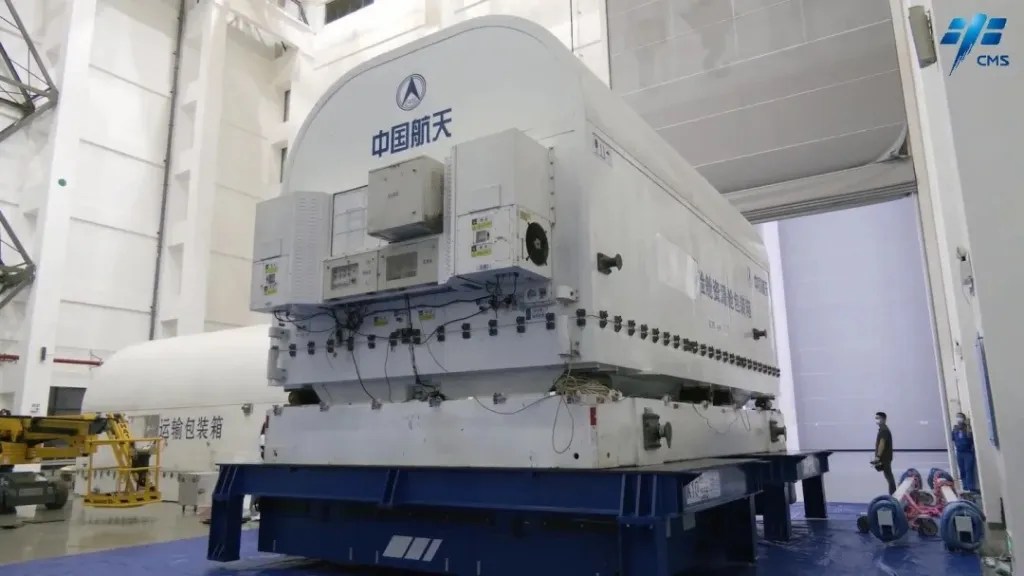
The axial length of the Wentian experimental cabin is 17.9 meters, and the maximum diameter of the cabin is 4.2 meters. After the solar wing was launched into orbit, the first deployment was about 6.5 meters, and the second deployment was about 23 meters in length. The Wentian experimental module is the largest single module in my country’s space station, with a launch mass of about 23 tons and a dry weight of 21.5 tons and a propellant of 1.5 tons. The Wentian experimental module uses a rapid rendezvous and docking method to dock the space station assembly the Tiangong –China Space Station of the small robotic arm (about 5 meters) of the Wentian experimental cabin…
The Expected Countdown towards the Launch of the Chang Zheng- Long March 5 Yao 3 Carrier Rocket in which is 28 Days in between late July 2022 until the Launch towards the China Space Station for the Wentian Experimental module in connecting Strengthen the mission and have the courage to innovate and make breakthroughs! Carefully prepare, organize, and implement carefully to ensure the complete success of the launch mission, and take practical actions to welcome the Party’s 20th National Congress of Victory….
Launch wise of the Chang Zheng –Long March 5 Yao 3 Carrier Rocket .
Location: China Wenchang Space Launch Site 101 Launch Station (WSLS LC101) Mission Rocket: Long March 5 Yiyao-3 Rocket (CZ-5B Y3) Mission Load: Space Station “Wentian” Experimental Module (WT) Launch Window: 2022 estimated launch time in late July, 2022: Afternoon of July 24, 2022 (to be determined)
Previously As of May 2022 both The experimental cabin is progressing smoothly, waiting for the launch The Wentian experimental cabin to be launched in July is ready for finally and the Mengtian experimental cabin is also making corresponding preparations.
After the construction of the China Space Station is completed, the two experimental cabins will be the main working places for Takionauts in orbit. In both experimental cabins, space science experiments and technical experiments in the sealed cabin and outside the sealed cabin can be carried out. Both cabins are equipped with The load test cabinet inside the cabin and the load installation platform outside the cabin also provide support and guarantee measures such as information, power supply and heat dissipation, and can carry out experiments in various fields such as space science, space materials, space medicine and space exploration.
The Wentian experimental module is equipped with the same Taikonauts’ living facilities as the core module, including 3 sleeping areas, 1 sanitary area, kitchen and other facilities, which can guarantee the astronauts’ life. It can also work with the core module to support the life of 6 astronauts during the rotation of the two manned spacecraft; in addition, a small robotic arm is also configured, which can be used alone or in combination with the large robotic arm of the core module. , to jointly complete the tasks of Taikonauts leaving the cabin, caring for extravehicular facilities, and patrolling. In addition, the Wentian experimental cabin is also equipped with an astronaut exit airlock. After the space station is completed, the airlock of the Wentian experimental cabin will be As the main airlock cabin for Takionauts to leave the cabin, the node cabin of the core cabin is used for other functions at this time, just as a backup; the Wentian experimental cabin also has a backup section for the core cabin to manage and control the assembly. That is to say, when the function of the core module platform fails, it can be switched to the Wentian experimental module to exercise the combined control and management functions, which can improve the reliability of the space station as a whole.
The Mengtian experimental cabin is equipped with a cargo airlock and an outboard deployment test platform. In the future, the scientific test equipment that needs to be installed outside the cabin can be transported to the space station through a cargo spacecraft, and then the load will be sent to the outside of the cabin through the cargo airlock, and the robotic arm or Takionauts will install it on the platform outside the cabin. Realize the continuous update of the extravehicular test project.