#CNSA #ChinaNationalSpaceAdministration #國家航天局 |#BeltAndRoadinitiative #May2022 | #火星 # 天問 #天问一号#TianwenOne #MarsMission #祝融号 #ZhuRong | #ChinaNationalYouthDay – a youthful woman CNSA Space engineer Boa Shuo on seizing seize the moment, working hard  aim for a goal, a dream…

On the months of 5th May 2022   天问一号飞運騎遊達达3亿CNSA – China National Space Administration – ESA – European Space agency Belt and road initiative mars mission…first Mars exploration mission, Tianwen- Martian Probe One  sent back stunning images of the Half Earth Mass size of the Rustic Planet Mars in which show stunning Martian landscape with its iconic polar caps of either southern or northern … With its timeless Stunning Mars Photography. Tianwen-1″ returned high-resolution images of the Mars inspection area The “Zhurong” rover is preparing for winter, and the orbiter continues to carry out orbital exploration…..

As of May 5, 2022, the “Tianwen-1” orbiter has been in orbit for 651 days and is 240 million kilometers away from the earth. The “Zhurong” rover has worked on the surface of Mars for 347 Martian days, with a cumulative travel of 1921 meters, the two devices have accumulated about 940GB of original scientific data, and the operation is normal.

Currently this month of 4th May 2022 it was National Youth Day on China – People’s Republic of China it’s been celebrated very year on the 4th of May, China celebrates Youth Day. The holiday is a day off for the citizens of China and it has been observed since 1949. It is a part of the May holidays, where the whole of China celebrate different occasions during 7 days of May, which is called the ‘golden week’ at one of many Observances. At Peking University, one of the top world top universities where the May Fourth Movement began, the holiday is celebrated with speeches, singing competitions, and other activities.

“Struggle is the most beautiful background of youth, and action is the most effective tempering of youth. With responsibility and responsibility, youth will shine.”

Youth is just as good as youth Actually Beijing understands that it is a young team of CNSA China National Space Administration Bao Shuo, 29, is a dispatcher of the Beijing Space Flight Control Center. “. She said that youth is for struggle; we must seize the moment, aim for a goal, a dream, and then work hard for it. Contribute to the country, regardless of age or gender; all  Space Scientist Space Engineers ,Takionauts to whom are working hard for their aerospace dreams. Today, we walk with her and share the story of her and her team’s dream of spaceflight and writing youth with struggle….

On 4 May, 1919, student protests in Beijing erupted in the wake of the signing of the Treaty of Versailles, which ended World War I. The treaty, among other things, granted Japan control of Chinese territory in the Shandong Peninsula that Germany had held before the war. This enraged many Chinese who felt they had been betrayed.

Some of the students were arrested at first, but when protests spread and intensified, the Chinese government released the arrested student leaders.

The Fourth of May Movement came out of the protests. At first, it was a movement against imperialism and an attempt to reassert Chinese nationalism and culture. But it quickly diverted into a Communist ideology, and thus is seen as a beginning point to the establishment of the Communist People’s Republic of China.

In 1949, China established Youth Day as a public holiday to be observed every 4 May to remember the events of 1919 and all that followed them. There are special youth events, community service projects, and more organised all over China- People’s Republic of China

Images and visuals are from CNSA- China National Space Administration also from there respectives- CLEP –China Lunar Exploration Project..

.

#CNSA #ChinaNationalSpaceAdministration #國家航天局 |#BeltAndRoadinitiative #May2022 | #火星 # 天問 #天问一号#TianwenOne #MarsMission #Marslander #MarsRover #Tianwen1 probe  #祝融号 #ZhuRong #Tianwen1 is preparing for winter, and the orbiter continues to carry out orbital exploration….

On the months of 5th May 2022   天问一号飞運騎遊達达3亿CNSA – China National Space Administration – ESA – European Space agency Belt and road initiative mars mission…first Mars exploration mission, Tianwen- Martian Probe One  sent back stunning images of the Half Earth Mass size of the Rustic Planet Mars in which show stunning Martian landscape with its iconic polar caps of either southern or northern … With its timeless Stunning Mars Photography. Tianwen-1″ returned high-resolution images of the Mars inspection area The “Zhurong” rover is preparing for winter, and the orbiter continues to carry out orbital exploration…..

As of May 5, 2022, the “Tianwen-1” orbiter has been in orbit for 651 days and is 240 million kilometers away from the earth. The “Zhurong” rover has worked on the surface of Mars for 347 Martian days, with a cumulative travel of 1921 meters, the two devices have accumulated about 940GB of original scientific data, and the operation is normal.

During the ring fire, all seven payloads carried by the “Tianwen-1” orbiter were powered on, and continued to carry out global remote sensing exploration of Mars. Figure 1 is a 0.8 m/pixel image taken by a high-resolution camera on April 17, 2022, of the Triolle crater on Mars, showing the “seasonal slope pattern” on the crater wall. Figure 2 is a local landform image of the Martian Sailor Valley captured by a medium-resolution camera on April 1, 2022, with a resolution of about 65 meters per pixel. 

Figure 1. “Seasonal slope pattern” of the crater wall of the Triolet crater on Mars, captured by a high-resolution camera 
Fig. 2 Local landform of Martian Sailor Valley captured by medium-resolution camera

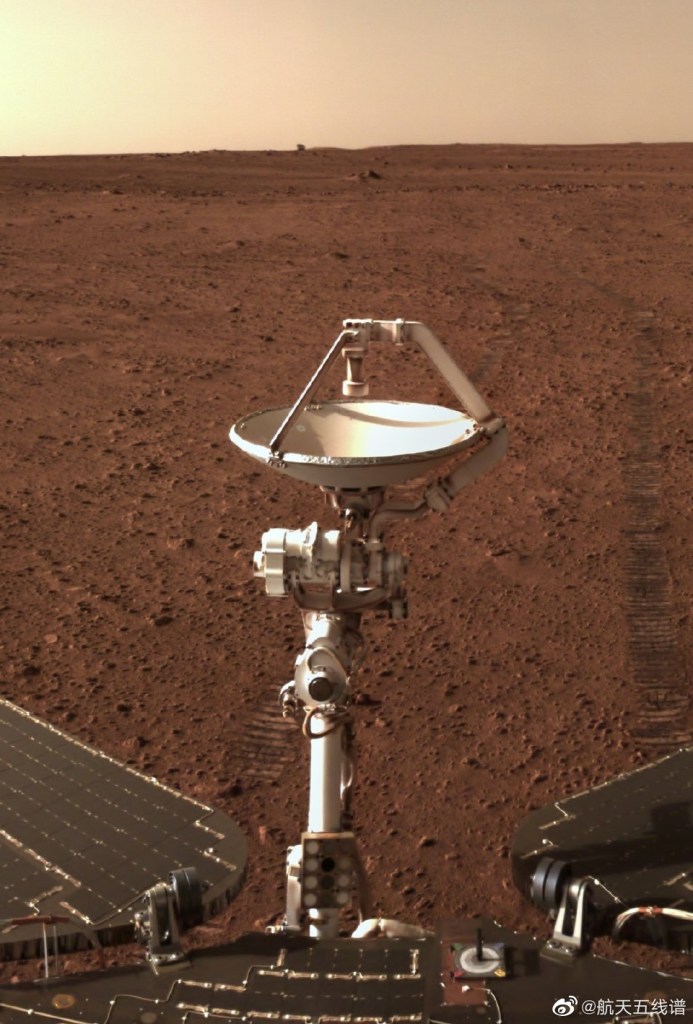
After the “Zhurong” Mars rover completed the 90-Mars day inspection mission on August 15, 2021, it will continue to carry out the expansion inspection and exploration mission. Figure 3 is an image of rocks distributed near impact craters on the Martian surface taken by the Navigation Terrain Camera on April 10, 2022 (the 323rd Martian day after landing). At present, the area where the “Zhurong” rover is located has entered winter. Similar to our earth, after entering winter, the altitude angle of solar illumination in the northern hemisphere area decreases and the duration of illumination shortens. According to the measurements, the local maximum temperature at noon on the rover has dropped to -20°C, and the ambient temperature at night is as low as -100°C. In addition, due to the presence of sand and dust weather, the light intensity is further weakened, which affects the power generation capacity of the solar wing battery array of the Mars rover. Recently, the engineering team adopted the rotation of the solar wing to adjust the light angle, reduce the daily work items and time, and achieve energy balance. 

Figure 3. Images of rocks distributed near impact craters on the Martian surface captured by the Navigation Terrain Camera

The rotation period of Mars is close to that of Earth. A Martian day is only about 40 minutes longer than that of Earth. The inclination of Mars’ rotation axis is 25.19°, which is also very close to Earth. Therefore, Mars also has day and night alternations and seasonal changes like Earth. The orbital period of Mars is about 687 days, that is, 1 Martian year is equivalent to 1.9 Earth years, which means that the average duration of each season on Mars is about twice as long as on Earth.

When the “Zhurong” first landed last year, when Mars moved to the vicinity of the aphelion, the direct sunlight point was in the northern hemisphere. At that time, the northern hemisphere had just entered summer and the southern hemisphere had entered winter. Now, nearly a year after landing on Mars, Mars is running near the perihelion, and the direct sun is in the southern hemisphere. The northern hemisphere where “Zhurong” is located is entering winter and the southern hemisphere is entering summer.

In the next two months, the direct sun point will continue to move to the south of Mars, reaching around the Tropic of Cancer around mid-to-late July, when Mars’ northern hemisphere will enter the coldest season of the year. In order to safely survive extreme weather such as Martian winter and sandstorms, the “Zhurong” rover has designed working modes such as autonomous sleep. When the energy is reduced to a certain level, it will automatically enter the sleep mode. After the environmental conditions gradually improve, it will return to normal Operating mode. 

作者:耿言 李佳威

Images and visuals are from CNSA- China National Space Administration also from there respectives- CLEP –China Lunar Exploration Project..

#CNSA #ChinaNationalSpaceAdministration #國家航天局 |#BeltAndRoadinitiative #January2022 |#火星 # 天問 #天问一号#TianwenOne #MarsMission #Marslander #MarsRover #Tianwen1 probe  #祝融号 #ZhuRong Tianwen1 #ChineseNewYear2022 #ChineseLunarNewYear Eve with  #MarsPhotography Tianwen-1 probe #SelfieStick  #UltimateMarSelfie celebrating the #YearoftheTiger  

On the months of January 2022 1st January 2022 on New Years Day  天问一号飞運騎遊達达3亿CNSA – China National Space Administration – ESA – European Space agency Belt and road initiative mars mission…first Mars exploration mission, Tianwen- Martian Probe One  sent back stunning images of the Half Earth Mass size of the Rustic Planet Mars in which show stunning Martian landscape with its iconic polar caps of either southern or northern .. with its timeless Stunning Mars Photography.

On 2022 New Year’s Day, China National Space Administration CLEP – China Lunar Exploration program  issued a set of beautiful images of the first Mars mission Heaven 1 spacecraft returned from distant Mars, report to the National People ‘Heaven One “peace, extended festival greetings .

On the eve on 31st January 2022 in which on the 1st February 2022 of the Chinese Lunar New year  Spring Festival in the Year of the Tiger, the Tianwen-1 probe sent back a set of selfie videos from Mars orbit to extend New Year wishes to the people of the whole country- China – People’s Republic of China and the Chinese Communities . On the 29th of the twelfth lunar month last year (February 10, 2021), Tianwen-1 arrived on Mars and successfully implemented capture and braking. It became my country’s first artificial Mars satellite, and started a scientific exploration journey to the red planet. a lunar year.

The video is a video of the Mars group photo taken by the probe.

The video was shot by the “selfie” camera carried by the Tianwen-1 surround. The camera is installed at the end of the “selfie stick”. This selfie tool is designed to monitor and evaluate the status of key components outside the surround. In the video The orbiter’s 3000N engine, propellant storage tank, attitude control engine and other components are in good condition. The five-star red flag shining in the Mars orbit is particularly bright. During the attitude adjustment process, the angle of the sun’s illumination changes significantly. When flying over the north pole of Mars, the ice cap below was photographed.
The “selfie stick” uses a special shape memory composite material, which is folded and folded before launch. After entering the orbit of Mars, the folded part is heated to a certain temperature, and the “selfie stick” gradually returns to a straight state. The “selfie stick” weighs only 0.8 kilograms and is 1.6 meters long when unfolded. The camera installed at the end can effectively complete various monitoring tasks.

As of January 31, 2022, Tianwen-1 has been in orbit for 557 days, about 325 million kilometers away from the earth, and the light travel time is about 18 minutes. The Zhurong rover has worked for 255 Martian days and travelled a total of 1524 meters. At present, the Tianwen-1 mission has returned a total of about 600GB of original scientific data, and the two devices are in good condition and operating normally

Images and visuals are from CNSA- China National Space Administration also from there respectives- CLEP –China Lunar Exploration Project..

#CNSA #ChinaNationalSpaceAdministration #國家航天局 |#BeltAndRoadinitiative #November2021 |#火星 # 天問 #天问一号#TianwenOne #MarsMission #Marslander #MarsRover #Tianwen1 probe  #祝融号 #ZhuRong Tianwen No.1 probe orbiter enters remote sensing mission orbit on the #RedPlanet #Mars#天问一号探测器进入日凌阶段…

On the  8TH November 2021 Friday 天问一号飞運騎遊達达3亿CNSA – China National Space Administration – ESA – European Space agency Belt and road initiative mars mission…first Mars exploration mission, Tianwen- Martian Probe One …….祝融号Zhu Rong”  also have been exploration Roamingly1,253 meterson the Rustic half diameter planet size Red planet Mars… During that time Tianwen-1 orbiter enters remote sensing mission orbit…


November 8, 2021, “Heaven” successfully implemented around the fifth brake near the fire, into the exact orbit remote sensing mission, the Mars Global to carry out remote sensing. In the early stage, the “Zhurong” Mars rover has successfully completed the established inspection mission objectives, and is in good condition, and continues to carry out the detection mission. Considering the global remote sensing detection of the orbiter and the relay communication requirements of the Mars rover, the engineering development team optimized the orbit design and determined a remote sensing orbit plan with a near fire point of about 265 kilometers, a far fire point of about 10,700 kilometers, and a period of about 7.08 hours. While ensuring the development of orbiting scientific exploration, it will provide more relay communication support for the Mars rover to improve the efficiency of mission development.

n the remote sensing orbit, seven scientific payloads including mid-resolution cameras, high-resolution cameras, subsurface detection radars, mineral spectrum analyzers, magnetometers, ion and neutral particle analyzers, and energy particle analyzers will be acquired Scientific data such as fire star morphology and geological structure, surface material composition and soil type distribution, atmospheric ionosphere, Martian space environment, etc., focusing on typical landforms and geological units such as craters, volcanoes, canyons, and dry river beds, and implement high-resolution detection.

Up to now, the orbiter has been in orbit for 473 days, the ground fire distance is 384 million kilometers, and the light travel time is 21 minutes and 20 seconds; the rover has worked on the surface of Mars for 174 Mars days and travelled 1,253 meters in total. The two devices are in good condition. The working condition is normal. 

​2021年11月8日,“天问一号”环绕器成功实施第五次近火制动,准确进入遥感使命轨道,开展火星全球遥感探测。前期,“祝融号”火星车已圆满完成既定巡视探测任务目标,各项状态良好,继续开展探测任务。综合考虑环绕器全球遥感探测和火星车中继通信需求,工程研制团队优化了轨道设计,确定了近火点约265千米、远火点约1.07万千米、周期约7.08小时的遥感轨道方案,在保证开展环绕科学探测的同时,为火星车提供更多的中继通信支持,提升任务开展的效率…


在遥感轨道,环绕器中分辨率相机、高分辨率相机、次表层探测雷达、矿物光谱分析仪、磁强计、离子与中性粒子分析仪、能量粒子分析仪等7台科学载荷,将获取火星形貌与地质构造、表面物质成分与土壤类型分布、大气电离层、火星空间环境等科学数据,重点关注陨石坑、火山、峡谷、干涸河床等典型地貌和地质单元,实施高分辨率探测。

截至目前,环绕器在轨运行473天,地火距离3.84亿千米,光行时21分20秒;火星车在火星表面工作174个火星日,累计行驶1253米,两器状态良好,各系统工况正常。  


Images and visuals are from CNSA- China National Space Administration also from there respectives..

Author: Geng Yan Chen Gang

#CNSA #ChinaNationalSpaceAdministration #國家航天局 |#BeltAndRoadinitiative #October2021 |#火星 # 天問 #天问一号#TianwenOne #MarsMission #Marslander #MarsRover #Tianwen1 probe  #祝融号 #ZhuRong Tianwen No.1 probe enters the solar transit stage on the #RedPlanet #Mars# Occultation behind the Sun天问一号探测器进入日凌阶段…

On the  5th October 2021天问一号飞運騎遊達达3亿CNSA – China National Space Administration – ESA – European Space agency Belt and road initiative mars mission…first Mars exploration mission, Tianwen- Martian Probe One …….”祝融号Zhu Rong”  previously on 30th August 2021 Mars Lander – Mars rover successfully exploring more than 1064 meters from its base lander camp.. Roamingly on the Rustic half diameter planet size Red planet Mars on Hong Kong SAR- Beijing Earth Wednesday time…  In which new mileage: “Zhu Rong” Mars Rover ….Sailing in the galaxy, strolling through the glamorous rustic environment in talking it’s adventure with Tianwen 1 Martian communications probe orbiting the Red Planet… in which “Zhurong” Mars rover completes scheduled exploration mission

In which on 5th Tuesday October 2021 Tianwen-1 probe enters the solar transit stage since late September, the earth and Mars have gradually moved to both sides of the sun and the three are almost in a straight line. The solar electromagnetic radiation interference gradually increases, and the device-to-ground communication is disturbed. Instability or even interruption, this phenomenon is called “riling”.


The “lost connection” between the probe and the ground during the solar transit is the expected normal state, and the “lost connection” is not “missing”. In order to safely pass the solar transit period, the Mars rover and the orbiter have completed the relevant state settings recently, stopped the scientific exploration work and continued to monitor the state. riling will end in mid-October, and the probe will resume communication with the ground and continue scientific exploration. 

In which during China’s National Day of the People’s Republic of China  was told the Marian Lander Zhurong also its Base Camp Mars Lander to go on a well earn sleep hibernation  in which  Tianwen No.1 probe enters the solar transit stage Beginning in late September, the Earth and Mars have gradually moved to both sides of the sun and the three are almost in a straight line. Due to  the electromagnetic radiation interference of the sun has gradually increased, and the communication between the device and the ground has been disturbed, and there has been instability or even interruption. This phenomenon is called “sun.” Ling”. The “lost connection” between the probe and the ground during the solar transit is the expected normal state, and the “lost connection” is not “missing”. In order to safely pass the solar transit period, the rover and the orbiter have completed the relevant status settings recently, stopped scientific exploration work and continued to monitor the status. Ri Ling will end in mid-October; the detector will resume communication with the ground and continue to carry out scientific exploration as the Planet Mars moves out from the Occultation going behind the Sun…

​​​天问一号探测器进入日凌阶段

9月下旬开始,地球、火星逐渐运行至太阳的两侧且三者近乎处于一条直线上,太阳电磁辐射干扰逐渐增强,器地通信受到干扰,出现不稳定甚至中断,这种现象称作“日凌”。

日凌期间探测器与地面“失联”是预期的正常状态,“失联”不是“失踪”。为安全度过日凌期,日前火星车和环绕器先后完成相关状态设置,停止科学探测工作并持续进行状态监视。

日凌将于10月中旬结束,探测器将恢复与地面的通信,继续开展科学探测。

Images and visuals are from CNSA- China National Space Administration also from there respectives..